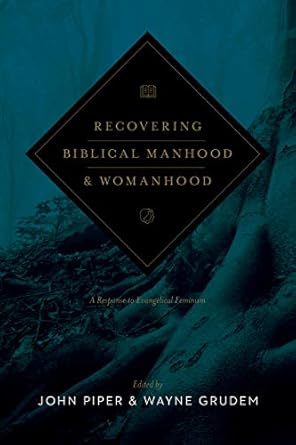
John Piper and Wayne Grudem, ed. Recovering Biblical Manhood and Womanhood: A Response to Evangelical Feminism
One of the most hotly debated matters in the church concerns the roles of men and women. The battle lines have been drawn and neither side appears willing to concede ground. In 1991, John Piper and Wayne Grudem edited a large volume entitled, Recovering Biblical Manhood & Womanhood: A Response to Evangelical Feminism. The book received the 1993 Christiantiy Today book of the year. That award carries a degree of irony with it since the heralded magazine founded by Billy Graham in 1956. Graham’s vision was to establish a magazine that would be “a flag to follow for believers who did not feel at home in progressive mainline congregations or in reactionary fundamentalist settings.” Fast-forward almost 70 years. The conservative“flag” is waving no longer at CT.
In 2021, Crossway Books published a revised edition of Recovering Biblical Manhood and Womanhood that includes some minor changes. None of the changes detract from the book’s original purpose, which is to respond graciously and forcefully to evangelical feminism, a movement that is growing at a breakneck pace. It is no small understatement to suggest that this book is needed more than ever.
The book is comprised of six sections:
Section 1: Vision and Overview
Section one of the most general in nature but includes some of the post powerful material in the book. Drs. John Piper and Wayne Grudem joins forces to present a vision of biblical complementarity and offer a helpful list of questions and answers. The authors clearly lay out the case for complementarianism. Piper in particular establishes the necessary trajectory at the outset:
At the heart of mature masculinity is a sense of benevolent responsibility to lead, provide for and protect women in ways appropriate to man’s differing relationships.
At the heart of mature femininity is a freeing disposition to affirm, receive and nurture strength and leadership from worthy men in ways appropriate to a woman’s differing relationships.
Section 2: Exegetical and Theological Studies
Section two explores the essence of the controversy as seasoned theologians tackle thorny questions that pertain to the role of men and women. No stone is left unturned in this section. Each chapter is well-written and helps build the case for complementarianism.
Section 3: Studies From Related Disciplines
Section three focuses on matters that pertain to church history, biology, sociology, and legal matters. While pertinent to the subject matter, this section was the least helpful for me, personally.
Section 4: Applications and Implications
Section four addresses matters of practical importance, such as:
- The family and the church
- Principles to use in establishing women in ministry
- Fathers
- Femininity
Section 5: Conclusion
John Piper and Wayne Grudem pen the closing chapter that ends on a high and hopeful note but at the same time responds to egalitarian arguments.
In a subsequent book, Wayne Grudem argues that evangelical feminism “has become the new path by which evangelicals are being drawn into theological liberalism.” (Evangelical Feminism, 15). Grudem’s contention, while unpopular among feminists and liberals alike, is on target and reaffirms the importance of Recovering Biblical Manhood & Womanhood.
The church owes a debt of gratitude to John Piper and Wayne Grudem for assembling such a stellar team of scholars to tackle one of the most important topics of our times.
I received this book free from the publisher. I was not required to write a positive review.
 Veritas et Lux