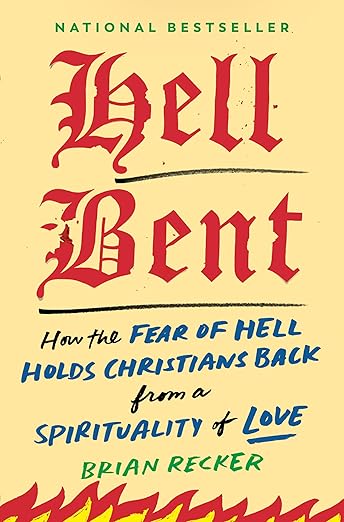
Brian Recker, Hell Bent: How the Fear of Hell Holds Christians Back from a Spirituality of Love (New York: Tarcher, 2025), 254 pp.
It is refreshing to open a book by an author who is vulnerable and authentic, one who shares everyday struggles with life. Brian Recker’s book, Hell Bent: How the Fear of Hell Holds Christians Back from a Spirituality of Love is indeed vulnerable and transparent. He shares how he gave up a career as a pastor, a decision that cost him a network of friends and a life he anticipated would last for decades. He describes a marriage that crumbled and a transition to life as a single father. Mr. Recker’s authentic approach to writing is refreshing and rare. But tragically, he does not write in a way that is faithful to the Scripture.
The author’s primary concern is to convince readers that hell, as conceived of for hundreds of years of church history and by evangelical Christians, is a myth. Unlike contemporary annihilationists, who believe in hell but reject conscious eternal torment, Mr. Recker repudiates the notion of hell altogether. Recker writes, “Hell — with the fear it inspires, the exclusivity it demands, the judgment it promotes, and the punitive God it portrays — corrupts Christian spirituality.” Questioning and rethinking the doctrine of hell led the author down his own path of deconstruction, which, in his words, is “the term used by a growing movement of people who have begun to investigate the premises of their faith with new eyes.” Recker makes his goal clear at the outset: “I deeply hope that Christians – and everyone else – reject the doctrine of hell.”
But readers will get more than they bargained for in Hell Bent. Brian Recker not only abandons the doctrine of hell (including conscious eternal torment), he also rejects the doctrine of original sin, the inerrancy of Scripture, and penal substitutionary atonement. Additionally, he rejects the gospel as it is presented in Scripture and opts for a social justice model and, not surprisingly, embraces universalism, the idea that all people will be reconciled to God, in the final analysis. To make matters worse, the author affirms the LGBTQ movement, promotes liberation theology (commending authors like James Cone and Margus Borg) and progressive Christianity (commending authors like Richard Rohr and Paul Tillich). Instead of seeing sinners who need to be reconciled to God and redeemed by the blood of Christ, he promotes what he calls, healthy spirituality, defined as “getting in touch with your divine self.” “Whatever makes me feel connected to myself, to God, and to others,” writes Recker, “this is spiritual for me.”
Hell Bent presents another gospel. In the words of the author, “The gospel – the good news – is that you are already fully loved and accepted … Salvation is just a way of describing the moment we come to know and believe that we are already loved, that we have always been loved.” Recker writes, “Hell makes it very hard to believe in our belovedness. The terrifying consequences of our supposed innate wickedness do not leave room for the possibility that God may actually rejoice over us, exactly as we are … God is not going to damn you, especially not for being the way God created you.”
While the author rejects the historical and biblical teaching concerning hell, he posits a cavalier view of hell, which is essentially the hell we create for ourselves. Recker writes, “Hell is real, but it’s not a place. Hell is a metaphor, and as a metaphor, it’s as real as anything.” Commenting on Matthew 25:45-46, where Jesus warns the unrepentant of “going away into eternal punishment,” Recker argues, “Jesus is warning us that when we neglect vulnerable, marginalized people, we create hell for ourselves and for other people.” He continues, “Hell is the natural consequence of our actions, not punishment from God. God does not punish sin in the way we punish each other. Sin is its own punishment.” He approvingly cites the Franciscan priest, Richard Rohr: “We are punished not for our sins, but by our sins.”
Even though Mr. Recker repudiates some fundamental doctrines of historical Christianity, he still professes to be a Christian. He affirms, “Although I’m a Christian, I do not believe it’s essential for people to become Christians to experience healthy spirituality or be connected to God.” He continues, “Jesus invites everyone to a banquet, and the very nature of hell is refusing to join the party.” As one who rejects the doctrine of original sin, he views everyone as “clean.” He argues, “Hell is what happens when we fail to recognize our connection to each other.”
Evaluation
Hell Bent is a complete recasting and reformulation of Scripture. The author picks and chooses the doctrines he likes and abandons the doctrines that fail to meet his personal criteria. The reasons below highlight why I cannot commend this book to any serious-minded follower of Christ.
A flawed view of God
A. W. Tozer says, “What comes into our minds when we think about God is the most important thing about us.” The god in Hell Bent is only loving and never judging. He is presented as “a universal Spirit who does not have genitals.” This god excuses sin and tolerates sinful creatures. Or, in the words of the author, “The advance of the LGBTQ rights is another libertine move of the Spirit.”
Tozer adds, “Wrong ideas about God are not only the fountain from which the polluted waters of idolatry flow; they are themselves idolatrous. The idolater simply imagines things about God and acts as if they were true.”
Hell Bent is packed with wrong ideas about God; ideas that will lead the unsuspecting reader down a pathway of idolatry.
A false gospel
Hell Bent promotes a false gospel that bears no resemblance to the gospel that Jesus and the apostles preached. This is not the first time a false gospel has appeared on the scene. The apostle Paul wrote to the Galatian church, “I am astonished that you are so quickly deserting him who called you in the grace of Christ and are turning to a different gospel — not that there is another one, but there are some who trouble you and want to distort the gospel of Christ.” (Gal. 1:6-7). Paul warned the young pastor, Timothy, to beware of such erroneous theology: “Those who have believing masters must not be disrespectful on the ground that they are brothers; rather, they must serve all the better since those who benefit by their good service are believers and beloved. Teach and urge these things. If anyone teaches a different doctrine and does not agree with the sound words of our Lord Jesus Christ and the teaching that accords with godliness, he is puffed up with conceit and understands nothing. He has an unhealthy craving for controversy and for quarrels about words, which produce envy, dissension, slander, evil suspicions, and constant friction among people who are depraved in mind and deprived of the truth, imagining that godliness is a means of gain” (1 Timothy 6:2b-5).
One of the glaring errors in Hell Bent is the watering down and minimizing of Christ’s cross. The author writes, “The cross shows me what God is like: love, all the way down. A never-stopping love, for the victims and the perpetrators. This is a God who would rather suffer loss for their enemies than punish them … The good news is, God’s presence with you and love for you are not dependent on what you believe about the cross. The cross itself shows us that you couldn’t break free from God’s love if you tried.” This is a far cry from John 3:36 – “Whoever believes in the Son has eternal life; whoever does not obey the Son shall not see life, but the wrath of God remains on him.” Or as Romans 2:5-8 says, “But because of your hard and impenitent heart you are storing up wrath for yourself on the day of wrath when God’s righteous judgment will be revealed. He will render to each one according to his works: to those who by patience in well-doing seek for glory and honor and immortality, he will give eternal life; but for those who are self-seeking and do not obey the truth, but obey unrighteousness, there will be wrath and fury.”
A fatal theology
While Hell Bent advances so-called spirituality, these pages are nothing more than a left-leaning progressive theology that advances inclusivity and syncretism. Such ideals appeal to many people these days, but the words of Proverbs 16:25 remind us, “There is a way that seems right to a man, but its end is the way to death.”
A futile attempt to debunk the doctrine of eternal conscious torment
Recker maintains (as the subtitle suggests) that “the fear of hell holds Christians back from a spirituality of love.” However, he never proves his case for the abolition of hell. While valiant in his attempt, the case against hell is weak at best and fails to uphold the teaching of God’s Word concerning the final judgment of the unbelieving and the unrepentant.
SUMMARY
I write chiefly as a Christian who upholds the authority of Scripture and orthodoxy, but also as a pastor critiquing the work of a former pastor who has clearly lost his way. I urge readers to turn away from the folly in Hell Bent and find refuge in a God who is altogether holy; a God who sent his Son to live the life that sinful creatures could never live and die a death they all deserve to die. Flee to the Savior for eternal life!
The Spirit and the Bride say, “Come.” And let the one who hears say, “Come.” And let the one who is thirsty come; let the one who desires take the water of life without price. (Rev. 22:17)
 Veritas et Lux