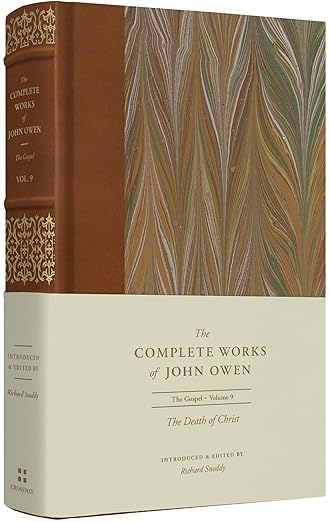
John Owen, The Death of Death, vol. 9 (Wheaton: Crossway Books, 2025), 647 pp.
Jonathan Edwards (1703 – 1758) is the greatest theologian that America ever produced. John Owen (1616 – 1683) is quite possibly the greatest theologian to walk on British soil. The large volume of written works reflects a mind riveted on the Lord Jesus Christ and a heart that was set on serving the Savior. The Death of Death, which is reprinted in Crossway Books’ repackaging of Owen’s complete works, is an apologetic tome that successfully undermines the doctrine of universal redemption (unlimited atonement), which J. I. Packer argues is “unscriptural and destructive to the gospel.” Packer’s insight is critical because large segments of the church hold to the doctrine of unlimited atonement, usually without thought or serious consideration.
Packer maintains that the contemporary church has “lost its grip on the biblical gospel.” He adds, “The new gospel conspicuously fails to produce deep reverence, deep repentance, deep humility, a spirit of worship, a concern for the church.” Of course, Packer’s concerns come four hundred years after Owen’s generation. However, his concern was John Owen’s as well. I suspect Owen would grimace at the depths to which the church has fallen. Thankfully, the Puritan divine set out to defend particular redemption in The Death of Christ.
Owen, who was a thirty-one-year-old pastor when he wrote this massive volume set out to provide a basis for the whole work of redemption that flows from the Father, through the Son, and is made effectual through the power of this Spirit. He arranged his work into three books. The first book focuses on the goal of Christ’s death, where the covenant of redemption is explained in great detail.
Book 2 provides an extensive exposition of his thesis, namely – that Christ secured the redemption of a particular group of people, his elect. The goal of that death is summarized:
Jesus Christ according to the counsel and will of his Father, did offer himself upon the cross, to the procurement of those things before recounted, and makes continual intercession: with this intent and purpose; that all the good things so procured by his death, might be actually and infallibly bestowed on, and applied to, all and every one for whom he died, according to the will and counsel of God.
Book 3 is a series of arguments that build the case for particular redemption. Citing Revelation 1:5-6, Owen writes, “For my part, I do conceive that Christ has obtained salvation for men, not upon condition if they would receive it, but so fully and perfectly that certainly they should receive it; he purchased salvation, to be bestowed on them that do believe, but withal faith that they might believe.” He not only builds the case for particular redemption; he also interacts with Arminian authors who disagree, using Scripture like a battering ram to topple all their arguments.
The Death of Death is weighty and complex. It is not for the faint of heart. Owen’s thorough exegesis and airtight arguments will challenge persuaded Arminians. Calvinists who come to the table convinced about the doctrine of particular redemption will walk away with full hearts and minds. Greater still, they will be encouraged to see Owen’s skill and sensitivity defending a much- neglected doctrine.
One helpful suggestion is to read The Death of Death with an open Bible and pen in hand. A detailed outline would greatly help readers to track Owen’s theological trajectory and keep his line of thinking crystal clear. The Death of Christ leaves no stone unturned. Any conceivable argument against particular redemption is death with by Owen, leaving readers the opportunity to determine where their doctrinal commitments will lie.
Adherents of unlimited atonement will be greatly challenged by Owen’s paraphrase of John 3:16, a text that inevitably comes up when the extent of the atonement is the topic of conversation:
God the Father so loved, had such a peculiar transcendent love, being an unchangeable purpose and act of his will concerning their salvation toward the world, miserable sinful lost men of all sorts, not only Jews but Gentiles also, which he peculiarly loved, that, intending their salvation as in the last words for the praise of his glorious grace, he gave, he prepared a way to prevent their everlasting destruction by appointing and sending his only begotten Son to be an all-sufficient Savior to all that look up unto him, that whosoever believeth in him, all believers whatsoever, and only they, should not perish, but have everlasting life, and so effectually be brought to the obtaining of these glorious things through him, which the Lord in his free love had designed for them.
The Death of Death will certainly challenge some cherished theological presuppositions. But even greater, this book will draw readers into the throne room of the triune God, where they will be drawn to bow down and worship him in all his glory!
I received this book free from the publisher. I was not required to write a positive review.
 Veritas et Lux
Amen! Thank you for this brief but helpful reminder of the significance of Owen’s magnificent defense of the Gospel of Christ’s substitutionary atonement that is both real and actual, and thus neither hypothetical nor potential.
Thanks for the kind words. Owen was legendary. May his tribe increase!