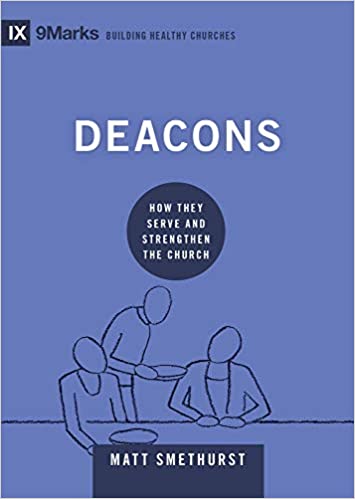
Deacons: How They Serve and Strengthen the Church – Matt Smethurst

Matt Smethurst, Deacons: How They Serve and Strengthen the Church (Wheaton: Crossway Books, 2021), 166 pp.

For several years, 9Marks has consistently produced solid resources in their Building Healthy Churches series. The newest installment, Deacons: How They Serve and Strengthen the Church by Matt Smethurst is no exception.

Smethurst’s aim is stated at the begging: “The basic thesis of this book is that deacons – rightly understood and deployed – are an irreplaceable gift to Christ’s church. They are model servants who excel in being attentive and responsive to tangible needs in the life of the church.”

The author provides the necessary context and historical background behind the office of deacon. A basic job description is offered along with the biblical qualifications. The ministry of Christ is the ultimate model of what a deacon should aim for:

And Jesus called them to him and said to them, “You know that those who are considered rulers of the Gentiles lord it over them, and their great ones exercise authority over them. But it shall not be so among you. But whoever would be great among you must be your servant, and whoever would be first among you must be slave of all. For even the Son of Man came not to be served but to serve, and to give his life as a ransom for many” (Mark 10:42–45).

Deacons: How They Serve and Strengthen the Church is short, readable, and filled with powerful stories about the impact that deacons have on a local church. Every pastor should pay careful attention to this volume along with the others in the 9Marks series.

I received this book free from the publisher. I was not required to write a positive review.

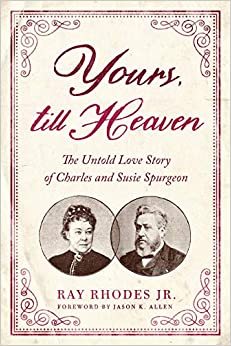
Yours, till Heaven: The Untold Love Story of Charles and Susie Spurgeon – Ray Rhodes Jr.

Ray Rhodes Jr., Yours, till Heaven: The Untold Love Story of Charles and Susie Spurgeon (Chicago: Moody Publishers, 2021), 208 pp.

Charles Haddon Spurgeon. Affectionately referred to as the “Prince of Preachers.” He is the most influential English-speaking preacher in church history. He is known around the world for his evangelistic zeal and his love for training pastors and planting churches.

Most Christians seem to know all about C.H. Spurgeon. But very few are acquainted with the love story between he and his wife, Susie. Dr. Ray Rhodes Jr. introduced Spurgeon’s wife in his outstanding book, Susie: The Life and Legacy of Susannah Spurgeon, Wife of Charles H. Spurgeon. Rhodes picks up where he left off in his latest work, Yours, till Heaven: The Untold Love Story of Charles and Susie Spurgeon.

The author sets out to show readers the “depth of Susie’s commitment to Charles and consider how her devotion to him helped to make him the man we admire.” It appears the adage is true, “Behind every good man is a godly woman.” Such is the case here.

Rhodes chronicles the Spurgeon romance, engagement, and marriage. Readers who are unfamiliar with the depth of suffering that both Charles and Susie endured throughout their lives will be humbled and encouraged to see how they navigated thirty-seven years of marriage and managed to grow through every season of adversity. The Spurgeon marriage, while not perfect, is one that should be emulated by every Christian couple.

The Spurgeon’s modeled a deep love for the gospel, the church, the Word of God, family, and of course – one another. The mutual support they showed throughout their marriage is unrivaled and inspiring. I commend this work wholeheartedly and trust that it will receive a wide readership.

I received this book free from the publisher. I was not required to write a positive review.

Biblical Apologetics: How Shall We Respond to Unbelief?

photo of three person sitting and talkingUnbelief is in the air.  Unbelief is gaining ground in postmodern culture.  Over 100 years ago, the German philosopher, Friedrich Nietzsche wrote, “I call Christianity the one great curse, the one great innermost corruption, the one great instinct of revenge, for which no means is poisonous, stealthy, subterranean, small enough – I call it the one immortal blemish of mankind.”

The bankrupt philosophy of the so-called four horsemen of atheism continues to gain in popularity.  Why?  Apparently, unbelief is in.  Unbelief is hip.  But the question that is burning a hole in the table for Christians is this: How shall we respond to unbelief?  How shall we who have a heart for lost people answer when they malign the Christian faith and mock the very foundations of historic Christianity?

The apostle Peter instructs believers to respond rightly: “But in your hearts honor Christ the Lord as holy, always being prepared to make a defense to anyone who asks you for a reason for the hope that is in you; yet do it with gentleness and respect” (1 Peter 3:15, ESV).  In other words, we must develop the mindset of an apologist (ἀπολογία).  John Frame’s definition of apologetics of helpful: Apologetics is “the discipline that teaches Christians how to give a reason for their hope … it is the application of Scripture to unbelief.”  Cornelius Van Til writes, “Apologetics is the vindication of the Christian philosophy of life against the various forms of the non-Christian philosophy of life.”  Tragically, the mandate to engage in apologetics often turns ugly.  Well-meaning Christians have turned apologetics into a nasty slug fest.  Nothing could be further from the truth.  Notice six crucial principles of biblical apologetics.

1. Apologetics involves verbal proclamation

Christians are commanded to proclaim the good news.  The Greek word, “proclaim”  (κηρύσσω) means to announce or proclaim; to preach or publish.”  St. Francis of Assisi was on to something when he quipped, “Preach the gospel and if necessary, use words.”  The point: Make sure your life matches the gospel.  However, actions alone cannot convert.  Actions must be backed up with verbal proclamation.  “So faith comes from hearing, and hearing through the word of Christ” (Romans 10:17, ESV).  Simply put, the gospel is meant to be published.  The gospel must be proclaimed.  Postmodern gurus and emergent sympathizers may be quick to downplay preaching and promote a “deeds not creeds” mentality.  Jesus disagrees: “And this gospel of the kingdom will be proclaimed throughout the whole world as a testimony to the nations, and then the end will come” (Matt. 24:14, ESV).  The first principle of apologetics involves verbal proclamation.

2. Apologetics involves bold proclamation

The New Testament apostles boldly proclaimed the truth.  Paul prayed for an extraordinary boldness (Eph. 6:19).  And Luke made it clear how bold proclamation characterized his ministry: “He lived there two whole years at his own expense, and welcomed all who came to him, proclaiming the kingdom of God and teaching about the Lord Jesus Christ with all boldness and without hindrance” (Acts 28:30-31, ESV).  We too, must boldly proclaim the Word of God without apology.  Now is the time for bold and courageous proclamation.

3. Apologetics involves logical proclamation

Peter argues that we must “always being prepared to make a defense to anyone who asks you for a reason for the hope that is in you …” (1 Peter 3:15, ESV).  “Reason” (λόγος) involves a word, an utterance or reasonable speech.  The apostle Paul was quick to reason with the thinkers that flooded the first century marketplace of ideas:

  • “And Paul went in, as was his custom, and on three Sabbath days he reasoned with them from the Scriptures” (Acts 17:2, ESV).
  • “So he reasoned in the synagogue with the Jews and the devout persons, and in the marketplace every day with those who happened to be there” (Acts 17:17, ESV).
  • “And he reasoned in the synagogue every Sabbath, and tried to persuade Jews and Greeks” (Acts 18:4, ESV).

We must be able to spell out the gospel message.  We must clearly and logically explain how a holy God created men and women in his image.  These image-bearers fell from God when they sinned which separated them from a holy God.  But God in his mercy, sent Christ – born of a virgin to live a perfect life, obey the law of God and die on the cross.  Christ satisfied  the justice of God and extinguished the wrath of God for every person who would ever believe.  On the third day, Jesus rose from the dead, conquered sin and death, opening the way to a restored relationship with God for anyone who would repent of their sin and turn to Christ alone for forgiveness.  It is our privileged responsibility to proclaim the truth of the gospel in a logically compelling way.

4. Apologetics involves hopeful proclamation

We offer a message of hope!  We offer a message that promises liberation (John 8:36).  It tells  sinners they can be forgiven; that they can be delivered from the penalty and power of sin; and one day they shall be free from the presence of sin (Luke 1:66-67; Acts 5:31; Eph. 1:7; Col. 2:13; Rom. 4:7; 1 Pet. 2:9).  Apologetics involves hopeful proclamation.

5. Apologetics involves faithful proclamation

This message of hope is for everyone.  Therefore, our task is to share this hope with people as we are given opportunity:  “And he said to them, ‘Go into all the world and proclaim the gospel to the whole creation'” (Mark 16:15, ESV).  The Great Commission involves faithful proclamation to all peoples (Rev. 5:9).

6. Apologetics involves Christ-centered proclamation

Peter makes it clear: “but in your hearts honor Christ the Lord as holy, always being prepared to make a defense to anyone who asks you for a reason for the hope that is in you; yet do it with gentleness and respect” (1 Peter 3:15, ESV).  First, we must maintain an attitude of gentleness (πραΰτης), which implies humility or an unpretentious spirit.  It involves a kind answer.  Additionally, we must be respectful (φόβος) as we engage in apologetics, a term that conveys deep admiration for another person.

Our response to unbelief is crucial.  The world is watching.  May our apologetics match the biblical model.  And may we proclaim the gospel of Jesus Christ in a winsome and compelling way.  For in the final analysis, all of God’s elect will hear and believe.

“Therefore let it be known to you that this salvation of God has been sent to the Gentiles; they will listen” (Acts 28:28).

CHARLES HODGE: The Pride of Princeton – W. Andrew Hoffecker

0875526586_bWho says reviews don’t matter?  “I could not put Hoffecker’s book down.”  Seven simple words uttered by Dr. John Frame prompted me to pick up Charles Hodge: The Pride of Princeton by  W. Andrew Hoffecker.  The author makes a solid contribution to P & R’s American Reformed Biographies Series.

I first encountered Charles Hodge in Seminary.  His piece on the decrees of God made an indelible imprint on my mind and has influenced my thinking since those early days.  Hoffecker’s work puts skin on the bones that I was confronted with in my Seminary days.  Here we find a man of courage and a man of deep conviction.   Charles Hodge was a man willing to put his neck on the line and battle for truth.  He laid the groundwork for men who would follow and continue to fight on the theological battlefield; men like B.B. Warfield and Gresham Machen.

A few highlights worth mentioning include Hodges’ faithful fight against liberalism.  Like today, the liberalism of the 19th century was popular and would influence young minds if left unchallenged.  Hodge was not content to sit by idly.  He boldly confronted the pernicious error of 19th-century liberalism (which oddly enough is seeking to permeate the church once again – primarily through many emergent sympathizers).

The second highlight is Hodges’ unwavering commitment to Reformed theology.  Call him a guardian, a defender, an apologist – or just a diehard Reformed theologian.  Hodge may have been willing to sacrifice certain negotiable doctrinal points.  But he drew the line in the sand when it came to the doctrines of grace.

Charles Hodge is a model of teaching excellence.  He is a worthy example of what it means to stand for the truth in a dark world.  Young pastors and seasoned pastors alike would do well to emulate the courage and conviction of the Pride of Princeton – Charles Hodge.

Renewing Our Commitment to Biblical Authority

man in black long sleeve shirt writing on white paper

Yesterday, we examined three important truths that emerge in Psalm 19:7. We learned that the Word of God is perfect, that it is the means of conversion and that God’s Word is reliable and trustworthy. God’s Word is the anchor that enables us to stand firm in a culture that scoffs at the notion of absolute truth.

Now notice three more principles that rise to the surface in the Scriptures. First, God’s Word brings joy to the heart. The psalmist writes, “The precepts of the LORD are right, giving joy to the heart” (Ps. 19:8). John MacArthur adds:

Because it steers us through the right course of life, God’s Word brings great joy. If you’re depressed, anxious, fearful, or doubting, learn to obey God’s counsel and share in the resulting delight . . . Focus on divine truth. Therein you will find true and lasting joy. All other sources are shallow and fleeting. While temporary joy may certainly seem possible apart from God’s Word, true and lasting joy comes only as one subjects his or her mind to the truth of God’s Word.

Second, God’s Word is eternally true: “The fear of the LORD is pure, enduring forever. The ordinances of the LORD are altogether righteous” (Ps. 19:9). Time and again, the Scriptures bear witness to this fact. “All your words are true; all your righteous laws are eternal” (Ps. 119:160). “Your righteousness is everlasting and your law is true” (Ps. 119:142). The truthfulness of God’s Word remains constant despite those who seek to downplay the meaning of language or “deconstruct” objective truth recorded in God’s Word.

Finally, the Word of God gives us a standard to live by: “My heart is set on keeping your decrees to the very end” (Ps. 119:112). The Psalmist also writes, “I have taken an oath and confirmed it, that I will follow your righteous laws” (Ps. 119:106). Indeed, God’s Word is our divine blueprint for living. And God’s standard brings freedom to anyone who will submit to almighty God. “I will always obey your law, for ever and ever. I will walk about in freedom, for I have sought out your precepts” (Ps. 119:44-45).

God has given us his Word in the form of propositional truth; truth that he intends we obey. Therefore, let us recommit ourselves to standing under the banner of God’s revealed truth and obey our great God with a glad heart. Let us refuse to compromise the high and holy standard in God’s Word. When the world tries to squeeze us into its mold, let us stand together with bold resolve and commit ourselves to be people of the Book.

Standing on the Authority of God’s Word

Standing on the Authority of God’s Word

As we embark on yet another year, the challenges before us may seem daunting. We live in a culture that relies heavily on hunches, intuitions, and feelings. The emphasis on the subjective has led many to deny biblical Christianity and reject any notion of truth. The witty British writer, G.K. Chesterton poetically described the plight of postmodern culture: “Once people stop believing in God, the problem is not that they will believe nothing; rather the problem is that they will believe anything.” 

Given the dismal postmodern attitude toward authority, where are we to turn? Perhaps more than ever, we as disciples of Jesus need a solid rock to stand on or the waves of syncretism, pluralism and false teaching may sweep us away. We must, therefore, begin and end with the Bible as the source of divine revelation from God.

The Word of God is our highest authority. Therefore, we also need to become acquainted with the supreme value of Scripture and the benefits it brings to our daily lives. Understanding the transcendent worth of God’s Word not only helps us grow more deeply in love with the Savior; it helps point our generation to the truth that can be found in Jesus Christ alone. Consider a few valuable qualities of God’s Word found in Psalm 19:7.

God’s Authoritative Word

First, the Word of God is perfect. Psalm 19:7 plainly says, “The law of the LORD is perfect.” The Hebrew word translated perfect means “complete, whole or sound.” It is in accord with what is true. So we can confidently approach God’s Word with the full assurance that the truth presented corresponds to reality. God’s Word is not a trifle or a fad. It is perfect in every way and demands our unwavering allegiance.

Psalm 19:7 secondly reveals that God’s Word is the means of conversion. “The law of the LORD is perfect, converting the soul.” In other words, apart from God’s Word, conversion is impossible. Calvin indicates that while God is revealed in general revelation, the “spectacles of faith” are needed to rightly perceive and receive God. “It is needful that another and better help be added to direct us aright to the very Creator of the universe . . . So the Scripture, gathering up the otherwise confused knowledge of God in our minds, having dispersed our dullness clearly shows us the true God.” Spurgeon adds force to the argument that God’s Word is the means of conversion: 

The great means of the conversion of sinners is the Word of God, and the more closely we keep to it in our ministry the more likely we are to be successful . . . Try men’s depraved nature with philosophy and reasoning, and it laughs at your efforts to scorn, but the Word of God soon works a transformation. 

So people everywhere must submit to God’s Word and recognize the biblical truth that salvation belongs to the Lord. 

Third, the Word of God is reliable and trustworthy. “The statutes of the LORD are trustworthy, making wise the simple” (Ps. 19:7b, NIV). “Your righteousness is everlasting and your law is true” (Ps. 119:142). “O Sovereign LORD, you are God! Your words are trustworthy, and you have promised good things to your servant” (2 Sam. 7:28). God’s Word is the anchor of truth for believers who live in a world that balks at the notion of truth. It is the firm foundation where believers may confidently rest, knowing that the sacred Scriptures will never disappoint for they are utterly reliable and trustworthy. 

When Luther stood before the Diet at Worms and was asked to repudiate his books and the “errors they contain,” he replied:

Unless I am convicted by Scripture and plain reason – I do not accept the authority of popes and councils, for they have contradicted each other – my conscience is held captive to the Word of God. I cannot and will not recant anything, for to go against conscience is neither right nor safe. God help me, Amen. 

May God grant us the rigor and courage of Luther as we hold the authoritative Word of God high in the unique culture where God has providentially placed us.

Gospel People: A Call for Evangelical Integrity – Michael Reeves

Michael Reeves, Gospel People: A Call for Evangelical Integrity (Wheaton: Crossway Books), 143 pp.

Gospel People: A Call for Evangelical Integrity is the latest work from the pen of Dr. Michael Reeves. The author issues a strong plea for Christians to live and proclaim the gospel with biblical humility.

The three components that fortify the backbone of the book include 1) Revelation from the Father, 2) Redemption by the Son, and 3) Regeneration by the Spirit. This biblical template comprises the essence of the gospel and unifies followers of Christ.

After a rigorous and illuminating discussion of the aforementioned points, the author builds momentum by calling followers of Christ to live lives grounded in humility and integrity: “It is the bearing of one refreshed by the gospel,” writes Reeves. “Captivated by the magnificence of God, such evangelicals will not be so drawn to man-centered therapeutic religion. Under the radiance of his glory, they will not want to establish their own little empires … He will loom large, making them bold to please God and not men.” Gospel integrity is the goal of every believer. Reeves paints a wonderful portrait of such a life: “They will be quick to serve, quick to bless, quick to repent, and quick to laugh at themselves, for their glory is not themselves but Christ. This is the integrity found through the lifting up of Christ in his gospel.”

Gospel People is an important book that should be devoured by Christians. The book is clear, biblical, and practical. The clarion call extended by Dr. Reeves should be heard and heeded. The result will be a renewed commitment to living as gospel people – people committed to humility, integrity, and the “faith that was once for all delivered to the saints.”

I received this book free from the publisher. I was not required to write a positive review.

Everything is Spiritual – Rob Bell

Rob Bell, Everything is Spiritual (New York: St. Martin’s Publishing Group, 2020), 310 pp.

In 2011, I reviewed Love Wins, my first book by Rob Bell. The piece prompted praise by conservatives and vicious scorn by progressive Christians and liberals. Whatever anyone thinks about Bell, one thing is for sure: the guy can write. He is a master communicator. And whenever he writes or talks, people listen.

Anyone familiar with Rob Bell knows that he is somewhat of a gadfly among evangelicals. And “gadfly” is a massive understatement. But there is something endearing about Bell. Some point to his skill. Others are impressed with his intellect. For me, I’ve always been drawn to Bell’s ability to communicate what he’s truly feeling – including insecurity, childhood pain, or unfulfilled expectations. He identifies a “generational lack of grace,” a trait that is found too often in the church. His transparency is refreshing and his candor is something that is greatly needed in our day.

While I applaud Bell’s transparency, I have expressed deep concern with some of the theological and philosophical assertions that he has proposed. His most recent book, Everything Is Spiritual is no exception. Michael Eric Dyson’s endorsement of the book provides a revealing summary:

“In Everything Is Spiritual, Rob Bell updates Teilhard de Chardin’s Catholic mysticism, makes sexier Werner Heisenberg’s quantum physics, and baptizes Jewish Kabbalah in an exciting vision of the future of human evolution. Bell challenges the notion that science and belief are at war, with his sublime fusion of Christian faith and modern evolutionary science. Bell’s book is the perfect antidote to the plague of an evangelical worldview that is captive to imperial dreams and a literalism that kills the spirit of Christianity …”

I will argue in this review that while Michael Eric Dyson truly does capture the essence of Bell’s intentions in Everything Is Spiritual, the end result is unhelpful and spiritually dangerous. Instead of illumination, readers will be left in a quagmire – with more questions than answers. And they will wander aimlessly in a spiritual wasteland, armed with an inaccurate portrait of God that leaves them hopeless without the biblical gospel.

No Final Answer

One of the common themes in Bell’s writing is ambiguity. He extinguishes certitude and exalts mystery (both of which are fundamental tenets of postmodernism). Careful readers will notice that the author is quick to pay lip service to Christian theology but swiftly degenerates into a subtle (or not so subtle man-made philosophy). The Bible warns, “For the time is coming when people will not endure sound teaching, but having itching ears they will accumulate for themselves teachers to suit their own passions, and will turn away from listening to the truth and wander off into myths” (2 Tim. 4:3-4, ESV).

Tragically, many have been deceived by Bell’s “spirit myths” over the years. For instance, in Bell’s book, What We Talk About When We Talk About God, he argues that God is “with us, for us, and ahead of us – all of us.” The notion that God is “with us,” “for us,” and “ahead of us (every single one of us) may sound good initially but falls short of the biblical model. It is true that God is “with” his people. We see this especially in the incarnation of Jesus, the One who is named Immanuel – or God with us (Matt. 1:23). Yet God is not “with” the man who has rejected the revelation of God in Christ. God is not “with” the one who rejects the Lord Jesus Christ and his gospel. “… Whoever does not obey the Son shall not see life, but the wrath of God remains on him” (John 3:36).

It is true that God is “for us” – that is to say, he is for his people. “For I am sure that neither death nor life, nor angels nor rulers, nor things present nor things to come, nor powers, nor height nor depth, nor anything else in all creation, will be able to separate us from the love of God in Christ Jesus our Lord” (Rom. 8:38–39, ESV). Yet, God is not “for” the man who repudiates the promises and purposes of God. The holy God opposes the proud (Jas. 4:6; 1 Pet. 5:5).

I referred to Paul’s warning in 2 Tim. 4:3-4 again and again as I read Everything is Spiritual. Indeed, doctrine is downplayed and orthodoxy is questioned. But not everything is ambiguous. As he did in Love Wins, Bell dogmatically casts aside the doctrine of hell: “Because some stories are better than others. Stories about a God who tortures people forever in hell shouldn’t be told. They’re terrible stories. They make people miserable. They make people want to kill themselves. Stories that insist that a few human beings are going to be okay and every other human being ever is doomed for eternity are horrible stories.”

In a magical twist, certitude suddenly reappears! Alas, the painful reality is obvious here: Anyone who bemoans doctrine is in fact, dogmatic themselves! It appears, then, that the dogmatic bark is worse than the bite.

No Final Authority

To make matters worse, no final authority is offered in Everything Is Spiritual. It is difficult to determine if Bell embraces pantheism, panentheism or some other theological construct. Whatever the case, the book makes much of God’s immanence and downplays his transcendence.

But what is missing here is a distinction between the Creator and the creature. Missing is a Creator who is sovereign over creation and rules over all. Bell’s account of God is noted in the biblical exchange with Moses who refers to himself as I AM. So far so good. But notice how Bell’s understanding of God undermines the Creator/creature distinction:

Moses wants to locate God, and what Moses gets is Everywhere. Moses wants something to wrap his mind around, and what he gets is All of it.

What an answer. Another way you could say I AM is Being Itself.

That’s past, that’s present, that’s future. All of it. Being Itself, the formless beyond any one form, animating all forms. The electricity the entire thing is plugged into. The water it’s all swimming in.

That’s every you that ever was and ever will be. All your yous.

Later, Bell refers once again to “Being Itself. I AM.” He writes, “You ground yourself in that, and you’re all of it. You root yourself in the source and Spirit beyond all these forms and categories and labels, you listen to that and follow that and you keep going.” Bell refers to this as the “collective unity of humanity,” or “the body of Christ.” He adds, “All of us humans ever, across time, all together, adding up to something. The body of Christ.”

Not only does this line of reasoning militate against the Creator/creature distinction; it misleads readers into believing that they are members of Christ’s body, when the unbelieving world is described as enemies of God and under his holy wrath.

Acts 17:22-31 reveals a Creator God who is the cosmos shaper, the kingdom shaker who lives above creation. He is the all-sufficient Ruler, Life-Giver, and Destiny Maker. And he is the righteous Judge who “commands all people everywhere to repent, because he has fixed a day on which he will judge the world in righteousness by a man whom he has appointed …” (Acts 17:30-31, ESV).

And Scripture speaks of the creature who was created by God (Gen. 2:7). The creatures (Adam and Eve) were originally free from sin but fell and as a result became sinners by nature and by choice (Gen. 3:1-7). As such, these sinful creatures have no inherent righteousness, no desire for God (Rom. 3:10-11). Subsequently, all creatures are born with a hatred in their hearts for God (Rom. 8:7-8). They are dead in sin (Eph. 2:1-3), and they are enslaved in sin; totally unable to come to Christ apart from God’s empowerment (John 6:44). These creatures are dependent upon God for everything. While they have the ability to make free choices, these choices are determined in eternity past (Acts 17:26; Prov. 19:21; 21:1). And these creatures are accountable to a righteous and sovereign Judge (Rom. 2:5-11).

As such, there is no final authority in Everything is Spiritual. Bell writes, “God is not detached from the world, up there, or above, or somewhere else, that would make God a form like everything else.” So, we are left with the strange and unbiblical blending of the Creator and the creature.

No Exclusive Path

One of the reasons that people are drawn to Bell is because he refuses to be boxed in by a religious system or creed. He is quick to jettison the traditional path and proudly promotes another route: “And then there was soul. This deeper voice within me telling me another truth, coaxing me to rethink what success even is. I had my own path, and it wasn’t this, and what you do with a path is you walk it … But walking your path, when you’re surrounded by multiple voices with strong opinions about what you should be doing, that takes tremendous spinal fortitude.”

“Spinal fortitude,” is to be commended. The problem is that Scripture points to one path – the path that Jesus describes as “narrow.” Jesus says, “Enter by the narrow gate. For the gate is wide and the way is easy that leads to destruction, and those who enter by it are many. For the gate is narrow and the way is hard that leads to life, and those who find it are few” (Matt. 7:13-14).

One of the primary arguments in Bell’s book is that “everything is spiritual.” He refers to Christ, who holds all things together: “All of it. All of us. Everybody, everywhere, in Christ.” He rightly notes how every person is created with dignity and honor and possesses “infinite worth and value.” But things take a tragic turn for the worse. For the one who pursues his own path, according to Bell, is something of a radical. In a stunning admission, Bell acknowledges: “The radical is not the person who wandered off the path into the deep weeds. The radical is the one who went back to the origins, to the roots, to how it all began. Sometimes the tribe has lost its way, sometimes the ones claiming to be orthodox, correct, pure ones have gone off the rails, sometimes it’s the mother ship that has lost its bearing, and it’s the radical who’s actually rediscovering the true path.”

Radicals like Jan Hus and Martin Luther rediscovered the true path when they embraced biblical authority and the gospel of Jesus. But Bell is not referring to these stalwarts of the faith. Rather, he is referring to those who dare to break free from the chains of orthodoxy. After all, writes Bell, “You aren’t an object, you aren’t a pawn … you possess Spirit. Personal, intimate, infinite, knowing, Spirit. You reflect the divine, present in each of us. You’re in Christ.

No exclusive path is necessary since we are “in Christ,” according to Bell. This theme emerged clearly in Love Wins as Bell undercut sovereign grace by arguing that God draws all people to himself. He writes, “ … We see that Jesus himself, again and again, demonstrates how seriously he takes his role in saving and rescuing and redeeming not just everything, but everybody.”

But Scripture stands in opposition to this theme. The Bible never declares that all people are “in Christ” as Bell supposes. Rather, each person is born in Adam and experiences death as a result (Rom. 5:12-21). Jesus never promises to rescue and redeem all people. Rather, people are assured that they will receive eternal life and forgiveness if they turn from their sin and trust the Lord Jesus Christ (John 3:15-16; 6:37, 47; 7:38; 8:12; Acts 4:12; Rom. 10:9-13, 17). When a person trusts in Christ alone for their salvation, then and only then, are they truly “in Christ.”

Bell’s “gospel” is described as “the divine announcement that you are loved and accepted exactly as you are, that everything has been taken care of, that everything you’ve been striving to earn has been yours the entire time, that you belong, in exactly this condition that you are currently in, nothing additional required or needed.” Readers are left, then, with more ambiguity. Whose “gospel” is Bell describing? And does this “gospel” tolerate sin? Does this “gospel” lay down demands? Is surrender required? Belief? Repentance? Is this “gospel” inclusive or is it exclusive? Is this “gospel light?” Or is this the “gospel” that Scripture refers to as a “different gospel” (Gal. 1:6)?

The matter of the gospel has eternal implications. The apostle Paul warns the Christians in Galatia to beware of those who “distort the gospel of Christ” (Gal. 1:7). He continues, “But even if we or an angel from heaven should preach to you a gospel contrary to the one we preached to you, let him be accursed. As we have said before, so now I say again: If anyone is preaching to you a gospel contrary to the one you received, let him be accursed” (Gal. 1:8-9, ESV).

The biblical gospel or the “good news” of God begins with God. It declares that God is sovereign and holy. It tells us that God created people for his glory (Isa. 43:7). It tells us that people are sinners by nature and by choice (Rom. 3:23; 5:12). The gospel warns us that God is just and that he has the right to punish sin and that unrepentant people will endure the wrath of God for eternity (Rom. 6:23; John 3:36). The gospel tells us about a Savior who will destroy death and rescue his creatures from the power of sin and the penalty of sin. And one day this gospel will rescue followers of Jesus from sin’s very presence.

The gospel distinguishes between the Creator and the creature. Peter Jones adds, “The Bible warns us not to worship the creation but to worship and serve only the Creator. The starting point of gospel truth is that God the Creator, in the three persons of the divine Trinity – Father, Son and Holy Spirit – is the one and only God and that all which is not God was created by him … The Christian faith maintains a separateness between God and His creation.”1 The gospel makes provision for sin, exalts the crucified and risen Savior, and reconciles sinners to a holy God.

Tragically, the biblical gospel is jettisoned in Everything is Spiritual. The gospel is reduced to a “divine announcement” of acceptance. This soft, inclusive “gospel” is a different gospel that Scripture condemns (Gal. 1:6, 9).

Summary

“Everything is spiritual.” The very idea sounds so very, well … spiritual. And people who flock to read the musings of Bell continue in a trancelike state like they’ve been doing for years. But the author makes a very revealing statement near the end of the book. He writes, “I want to help people rediscover the wonder and awe of their existence.” Yet, no final answer is given. No final authority is offered. And no exclusive path is revealed. Instead of rediscovering “the wonder and awe of their existence,” readers are left wandering in an existential fog, unaware of the Creator God who made all things for his glory; the transcendent God who sovereignly rules and reigns; the God who sent his Son to rescue sinners, redeem them, and bless them with eternal life.

Michael Eric Dyson refers to Bell’s book as “a perfect spiritual antidote to the plague of an evangelical worldview that is captive to imperial dreams and a literalism that kills the spirit of Christianity.” Nothing could be further from the truth. The message that Rob Bell presents in this book is anything but spiritual. Instead, it offers a syncretistic concoction of worldly philosophy that leads the unsuspecting on a path to divine judgment. That’s a far cry from an antidote. Poison doesn’t cure disease. Poison kills the unsuspecting.

  1. Peter Jones, Gospel Truth, Pagan Lies: Can You Tell the Difference? (Enumclaw: Winepress Publishing, 1999), 23-24.

Death By Living – N.D. Wilson

_225_350_Book.903.cover

Grasshoppers, swings, dirt, traffic jams, puppy dogs, and blue skies. N.D. Wilson appears to be captivated by everyday objects and everyday situations. He appears to be captivated by life. Living life is what his new book is meant to convey – really living life. But living also means dying.  So the author wordsmiths his way into the heart of readers by painting portraits of life and death – most of which arise from his own life and the lives of his family and extended family.

Death by Living is a plea for people to living life as God intends. In other words, to quote Red from Shawshank Redemption, “Get busy livin’ or get busy dying.” Wilson challenges readers to get busy living which of course will culminate with death: “How much of the vineyard can we burn first? How fast can we run? How deeply can we laugh?  Can we ever give more than we receive? How much gratitude can we show? How many of the least of these can we touch along the way? How many seeds will we get into the ground before we ourselves are planted?”

A theme that runs through Wilson’s work is that life is a story. Life is a story that each of us participates in. Indeed, we write our stories every day.  But the author maintains, “there is a difference between asserting that life is a story and actually living life like a story. And there is another difference between living life-like a story and living life like a good story.”  Living life like a story, therefore, is part and parcel of the Christian life.

The author helps readers see what real living looks like: “Grabbing will always fail. Giving will always succeed … Our children, our friends, and our neighbors will all be better off if we work to accumulate for their sakes … Don’t leave food uneaten, strength unspent, wine undrunk.”

Wilson urges readers to live with all their might. And while he never mentions Jonathan Edwards, I hear a strong Edwardsian influence throughout the book. Edwards himself penned 70 resolutions that reflect many of the propositions in Death by Living. One of those resolutions is to “live with all my might, while I do live” (Resolution 6). Nate Wilson argues in the same vein, which of course, is undergirded by America’s greatest intellectual: “Laugh from your gut.  Burden your moments with thankfulness. Be as empty as you can be when that clock winds down. Spend your life.  And if time is a river, may you leave a wake.”

Death by Living will elicit laughter – lots of laughter.  I found myself reading portions of Wilson’s work to my wife and she would laugh with me.  In fact, I haven’t laughed so hard in a while!  Some won’t find Wilson’s humor funny – which makes me laugh even harder!

Death by Living may prompt tears. There is a realism here that is hard to come by these days. This author speaks in candid terms.  Taking prisoners simply isn’t an option.  All the cards are on the table.  Readers are left to determine a whether the “hand they’ve been dealt” will result in joyful, Christ-saturated living or death by a thousand qualifications.  Far too many have simply thrown in the towel.  Wilson argues from an entirely different perspective as he encourages readers that “life is meant to be spent.”

One reviewer compares Wilson to John Eldredge – what is likely meant to be a compliment. Sure, whatever.  I prefer as I have done elsewhere [See my review: Notes From the Tilt-a-Whirl] to compare Wilson to Dennis Miller, G.K. Chesterton, and C.S. Lewis – no doubt a true compliment!  Death by Living is about the gospel but it never comes across in “preachy” tones.  It’s a celebration of a life lived and ended well.  It’s about a life that is lived passionately and faithfully.  Death by Living is about living with gusto; about living with passion; about living to honor Christ.  But real living also requires dying.  We are called to finish strong and die well – all to the glory of God!

I received this book free from the publisher through the BookSneeze®.com  book review bloggers program. I was not required to write a positive review. 


Steal Away Home – Matt Carter and Aaron Ivey

chMatt Carter and Aaron Ivey, Steal Away Home, Nashville: B&H Publishing Group, 2017, 294 pp. $14.60

Church history is filled with stories of courage, adventure, adversity, and persecution. From the exile of Athanasius, the martyrdom of John Rogers and William Tyndale, or Luther’s trial at Worms, these stories are well-known and we are quick to pass them along to the next generation.

Steal Away Home by Matt Carter and Aaron Ivey is a tale that will be new to many readers, however.  It was certainly new for me! The story involves two men from backgrounds that have very little in common. C.H. Spurgeon was the Prince of Preachers, a refined man with a rich theological heritage who occupied the pulpit in Victorian England. He was well-known around the world. He was a best-selling author and recognized by thousands. Thomas Johnson was a simple slave boy who was unjustly shackled in colonial America. He was known by few and treated like an animal. His slave master worked him to the bone on the Virginia tobacco fields.

Jesus Christ liberated Thomas Johnson. He freed him from the power and the penalty of sin. President Abraham Lincoln rescued Thomas Johnson from the sin of slavery. The Emancipation Proclamation, which Lincoln regarded as the crowning achievement of his presidency, liberated Thomas from his slave master. Jesus Christ liberated Thomas from the slave master of sin.

Through a series of Providential events, Thomas Johnson found himself at the front door of C.H. Spurgeon in London. After his training was complete, he and his wife made their way to Cameroon, West Africa in 1879.

PERSONAL TAKEAWAYS

Steal Away Home is a work of historical fiction. It becomes clear at the outset, however, that the authors spent many hours researching the details of this intriguing story. My hope is that a few personal takeaways will prompt many people to enter rich world of the 19th century and absorb some life-altering lessons.

1. The Humanization of C.H. Spurgeon

I have been reading Spurgeon and books about the Prince of Preachers for almost thirty years. This book brilliantly captures the essence of Spurgeon and is not afraid of revealing his warts, weaknesses, and worries. It is a breath of fresh air for anyone who is under the false notion that the famous preacher from London lived a life of ease. Spurgeon’s doubt and lifelong battle with depression is highlighted and his fears are revealed.

2. The Horror of Slavery

Most Americans recognize that slavery is a perpetual “black eye” on our nations’ history. But few understand the gravity of what these innocent African Americans endured. Carter and Ivey masterfully reveal the pitiful nature of slavery through the eyes of Thomas Johnson. Sympathetic readers will feel genuine grief as they walk with Johnson and experience the horror of his chains.

3. The Hallowed Ground of Friendship

Steal Away Home reminds readers of the importance and value of friendship. The friendship fostered by Spurgeon and Thomas is grounded in grace and nurtured by honest communication, genuine fun, rich encouragement, and biblical accountability. Like David and Jonathan, these two men are examples of friendship that glorifies God. Indeed, “A man of many companions may come to ruin, but there is a friend who sticks closer than a brother” (Prov. 18:24). Indeed, friendship is hallowed ground that too few men tread upon.

4. The Hope of the Gospel

Finally, this story shows how the gospel operates in the real world. Apart from grace, Charles Haddon Spurgeon and Thomas Johnson were dead in trespasses and sins, without hope and without God. Indeed, apart from grace, Spurgeon and Johnson were both spiritual slaves. Both men, however, were set free as they cast their hope on the Lord Jesus Christ. In the course of their very different earthly paths, they wound up on the same spiritual path, which ultimately led them both to the Celestial City!

Steal Away Home encouraged me personally and moved my soul in ways that most books only hope to do. Matt Carter and Aaron Ivey stepped up to the plate and hit the ball out of the park.  Their work will no doubt be a contender for book of the year.  I commend their work wholeheartedly!

I received this book free from the publisher. I was not required to write a positive review.