Death By Living – N.D. Wilson

_225_350_Book.903.cover

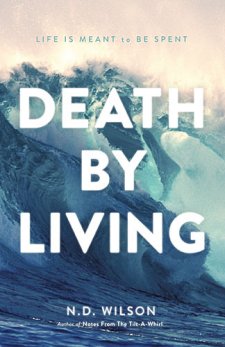
Grasshoppers, swings, dirt, traffic jams, puppy dogs, and blue skies. N.D. Wilson appears to be captivated by everyday objects and everyday situations. He appears to be captivated by life. Living life is what his new book is meant to convey – really living life. But living also means dying.  So the author wordsmiths his way into the heart of readers by painting portraits of life and death – most of which arise from his own life and the lives of his family and extended family.

Death by Living is a plea for people to living life as God intends. In other words, to quote Red from Shawshank Redemption, “Get busy livin’ or get busy dying.” Wilson challenges readers to get busy living which of course will culminate with death: “How much of the vineyard can we burn first? How fast can we run? How deeply can we laugh?  Can we ever give more than we receive? How much gratitude can we show? How many of the least of these can we touch along the way? How many seeds will we get into the ground before we ourselves are planted?”

A theme that runs through Wilson’s work is that life is a story. Life is a story that each of us participates in. Indeed, we write our stories every day.  But the author maintains, “there is a difference between asserting that life is a story and actually living life like a story. And there is another difference between living life-like a story and living life like a good story.”  Living life like a story, therefore, is part and parcel of the Christian life.

The author helps readers see what real living looks like: “Grabbing will always fail. Giving will always succeed … Our children, our friends, and our neighbors will all be better off if we work to accumulate for their sakes … Don’t leave food uneaten, strength unspent, wine undrunk.”

Wilson urges readers to live with all their might. And while he never mentions Jonathan Edwards, I hear a strong Edwardsian influence throughout the book. Edwards himself penned 70 resolutions that reflect many of the propositions in Death by Living. One of those resolutions is to “live with all my might, while I do live” (Resolution 6). Nate Wilson argues in the same vein, which of course, is undergirded by America’s greatest intellectual: “Laugh from your gut.  Burden your moments with thankfulness. Be as empty as you can be when that clock winds down. Spend your life.  And if time is a river, may you leave a wake.”

Death by Living will elicit laughter – lots of laughter.  I found myself reading portions of Wilson’s work to my wife and she would laugh with me.  In fact, I haven’t laughed so hard in a while!  Some won’t find Wilson’s humor funny – which makes me laugh even harder!

Death by Living may prompt tears. There is a realism here that is hard to come by these days. This author speaks in candid terms.  Taking prisoners simply isn’t an option.  All the cards are on the table.  Readers are left to determine a whether the “hand they’ve been dealt” will result in joyful, Christ-saturated living or death by a thousand qualifications.  Far too many have simply thrown in the towel.  Wilson argues from an entirely different perspective as he encourages readers that “life is meant to be spent.”

One reviewer compares Wilson to John Eldredge – what is likely meant to be a compliment. Sure, whatever.  I prefer as I have done elsewhere [See my review: Notes From the Tilt-a-Whirl] to compare Wilson to Dennis Miller, G.K. Chesterton, and C.S. Lewis – no doubt a true compliment!  Death by Living is about the gospel but it never comes across in “preachy” tones.  It’s a celebration of a life lived and ended well.  It’s about a life that is lived passionately and faithfully.  Death by Living is about living with gusto; about living with passion; about living to honor Christ.  But real living also requires dying.  We are called to finish strong and die well – all to the glory of God!

I received this book free from the publisher through the BookSneeze®.com  book review bloggers program. I was not required to write a positive review. 


Steal Away Home – Matt Carter and Aaron Ivey

chMatt Carter and Aaron Ivey, Steal Away Home, Nashville: B&H Publishing Group, 2017, 294 pp. $14.60

Church history is filled with stories of courage, adventure, adversity, and persecution. From the exile of Athanasius, the martyrdom of John Rogers and William Tyndale, or Luther’s trial at Worms, these stories are well-known and we are quick to pass them along to the next generation.

Steal Away Home by Matt Carter and Aaron Ivey is a tale that will be new to many readers, however.  It was certainly new for me! The story involves two men from backgrounds that have very little in common. C.H. Spurgeon was the Prince of Preachers, a refined man with a rich theological heritage who occupied the pulpit in Victorian England. He was well-known around the world. He was a best-selling author and recognized by thousands. Thomas Johnson was a simple slave boy who was unjustly shackled in colonial America. He was known by few and treated like an animal. His slave master worked him to the bone on the Virginia tobacco fields.

Jesus Christ liberated Thomas Johnson. He freed him from the power and the penalty of sin. President Abraham Lincoln rescued Thomas Johnson from the sin of slavery. The Emancipation Proclamation, which Lincoln regarded as the crowning achievement of his presidency, liberated Thomas from his slave master. Jesus Christ liberated Thomas from the slave master of sin.

Through a series of Providential events, Thomas Johnson found himself at the front door of C.H. Spurgeon in London. After his training was complete, he and his wife made their way to Cameroon, West Africa in 1879.

PERSONAL TAKEAWAYS

Steal Away Home is a work of historical fiction. It becomes clear at the outset, however, that the authors spent many hours researching the details of this intriguing story. My hope is that a few personal takeaways will prompt many people to enter rich world of the 19th century and absorb some life-altering lessons.

1. The Humanization of C.H. Spurgeon

I have been reading Spurgeon and books about the Prince of Preachers for almost thirty years. This book brilliantly captures the essence of Spurgeon and is not afraid of revealing his warts, weaknesses, and worries. It is a breath of fresh air for anyone who is under the false notion that the famous preacher from London lived a life of ease. Spurgeon’s doubt and lifelong battle with depression is highlighted and his fears are revealed.

2. The Horror of Slavery

Most Americans recognize that slavery is a perpetual “black eye” on our nations’ history. But few understand the gravity of what these innocent African Americans endured. Carter and Ivey masterfully reveal the pitiful nature of slavery through the eyes of Thomas Johnson. Sympathetic readers will feel genuine grief as they walk with Johnson and experience the horror of his chains.

3. The Hallowed Ground of Friendship

Steal Away Home reminds readers of the importance and value of friendship. The friendship fostered by Spurgeon and Thomas is grounded in grace and nurtured by honest communication, genuine fun, rich encouragement, and biblical accountability. Like David and Jonathan, these two men are examples of friendship that glorifies God. Indeed, “A man of many companions may come to ruin, but there is a friend who sticks closer than a brother” (Prov. 18:24). Indeed, friendship is hallowed ground that too few men tread upon.

4. The Hope of the Gospel

Finally, this story shows how the gospel operates in the real world. Apart from grace, Charles Haddon Spurgeon and Thomas Johnson were dead in trespasses and sins, without hope and without God. Indeed, apart from grace, Spurgeon and Johnson were both spiritual slaves. Both men, however, were set free as they cast their hope on the Lord Jesus Christ. In the course of their very different earthly paths, they wound up on the same spiritual path, which ultimately led them both to the Celestial City!

Steal Away Home encouraged me personally and moved my soul in ways that most books only hope to do. Matt Carter and Aaron Ivey stepped up to the plate and hit the ball out of the park.  Their work will no doubt be a contender for book of the year.  I commend their work wholeheartedly!

I received this book free from the publisher. I was not required to write a positive review.

The Trinity: An Introduction – Scott Swain

Scott R. Swain, The Trinity: An Introduction (Wheaton: Crossway Books, 2020), 154 pp.

The short Studies in Systematic Theology series by Crossway Books invites readers to dig deeply into the treasure chest of Scripture. Each volume sets out to accomplish five important tasks:

  1. Introduce a specific doctrine
  2. Reveal it in context
  3. Develop it biblically
  4. Demonstrate how the various threads of truth cohere
  5. Show how it practically impacts the Christian life.

The Trinity: An Introduction by Scott R. Swain is the latest volume in the series and accomplishes each of the important tasks above. In eight short chapters, the author casts the important theological vocabulary and shows readers where it may be found in Scripture.

Once the foundation is properly in place, the author unpacks some important theological realities that every reader needs to wrestle with. He focuses on the simplicity of God in a clear and understandable way. Each member of the Trinity is seen as co-equal and co-eternal and each person is fully God.

The remaining two chapters discuss the shape and the end of God’s triune work and prove to be the most valuable contributions in the book. The grand conclusion is the culmination of God’s redemptive plan:

God the Father has given a bride to God the Son, and God’s cosmic palace-temple is constructed to be their marital habitation (Rev. 19:6-10; 21:2). Within the divine King’s cosmic palace-temple, those united in marriage to Jesus Christ are welcomed into God’s household as Jesus’s redeemed siblings.

While much may be gained in Swain’s short volume, one weakness is his critique of what is commonly referred to as eternal relations of authority and submission (ERAS). The author unfairly (and unwisely) includes this understanding of the Trinity (held by notable theologians such as Wayne Grudem, Bruce Ware, and Owen Strachan) alongside the heresies of modalism and subordinationism. Incidentally, Dr. John Frame, a distinguished Reformed theologian also holds to the eternal subordination of the Son and argues persuasively that “hierarchy does not compromise the equality of nature, glory, and honor among the persons.”1 Swain seeks to undermine ERAS and fails in the end. In my mind, his argument generates more heat than light and needlessly detracts from the rest of the excellent material in the book.

Overall, however, The Trinity: An Introduction successfully carries out the stated aims in the Short Studies in Systematic Theology series. The great benefit of Dr. Swain’s treatment of the Trinity is its brevity. While the book only weighs in at 154 pages, it packs a powerful punch. The author does not short-change his readers. Rather, he offers a introduction to the Trinity that educates and leads to reverent acts of worship.

I received this book free from the publisher. I was not required to write a positive review.

  1. John M. Frame, The Doctrine of God (Phillipsburg: Presbyterian & Reformed, 2002), 721.

God, Greed, and the (Prosperity) Gospel – Costi Hinn

hinnCosti W. Hinn, God, Greed, and the (Prosperity) Gospel (Grand Rapids: Zondervan, 2019), 223 pp.

The so-called prosperity gospel has been a virtual “wrecking ball,” inflicting damage on the unsuspecting, infiltrating local churches with a diabolical message of health and wealth, and inviting the wrath of a holy God. The prosperity gospel is not another version of the gospel. It is “a different gospel,” one that not only devastates and deceives – this gospel damns.

The apostle Paul addressed the church in Galatia and confronted the false gospel of his day:

I am astonished that you are so quickly deserting him who called you in the grace of Christ and are turning to a different gospel- not that there is another one, but there are some who trouble you and want to distort the gospel of Christ. But even if we or an angel from heaven should preach to you a gospel contrary to the one we preached to you, let him be accursed.As we have said before, so now I say again: If anyone is preaching to you a gospel contrary to the one you received, let him be accursed (Gal. 1:6-9, ESV).

False gospels must be confronted, as Paul addressed the Galatians who turned to the “gospel” of the Judaizers in the first-century. Costi W. Hinn confronts the prosperity gospel in his latest book, God, Greed, and the (Prosperity) Gospel. Hinn clearly defines the poisonous effects of this pernicious movement: “The prosperity gospel is here to stay and is spanning the globe, doing damage to the true gospel of Jesus Christ. It is an evil that poses as a blessing but is truly a curse. It appears to be a loving extension of God’s goodness but is arguably the most hateful and abusive kind of false teaching plaguing the church today.”

Hinn describes how he grew up and was groomed to serve alongside his famous uncle, Benny Hinn and how God revealed the diabolical underpinnings of the prosperity gospel, which led to his repentance, conversion, and departure from the movement.

The author describes the origins of the prosperity gospel and the core elements with all of its trappings. He demonstrates from Scripture why prosperity teaching is abominable and warns readers to flee from its deadly influence. Hinn reveals ten reasons that the prosperity gospel is antithetical to Scripture:

  1. It distorts the biblical gospel.
  2. It insults God’s nature.
  3. It confuses the atonement.
  4. It demeans Jesus Christ.
  5. It twists Scripture.
  6. It is motivated by love for money.
  7. It produces false converts.
  8. It overcomplicates faith.
  9. It ruins Christianity’s witness.
  10. It abuses vulnerable people.

Thoughtful and discerning readers will take these principles to heart and be careful to guard the biblical gospel.

Costi Hinn does not shy away from controversy. But he also speaks the truth in love and his arguments are grounded in grace. God, Greed, and the (Prosperity) Gospel is sure to raise eyebrows. Hinn’s work is a labor of love that will serve the church well. And it will surely draw some people out of this false system and lead them to the truth.

I received this book free from the publisher. I was not required to write a positive review.

John Calvin: For a New Reformation

calDerek W.H. Thomas and John W. Tweeddale, Ed. John Calvin: For a New Reformation (Wheaton: Crossway, 2019), 608 pp.

Over two thousand years of church history have produced a wide assortment of Christian leaders, theologians, and churchmen.  One man who exerted an enormous amount of influence in his day was John Calvin. In recent years, theologians and pastors have revived an interest in Calvin including, A Godward Gaze: The Holy Pursuit of John Calvin, by yours truly.

The most recent and comprehensive offering is an edited volume by Derek W.H. Thomas and John W. Tweeddale. This massive volume that spans over 600 pages includes contributions from well-known scholars such as Stephen Nichols, Steven Lawson, Burk Parsons, Paul Helm and others. The afterward by R.C. Sproul is a fitting conclusion from the man who should be credited for restoring an interest in Reformed theology in the twentieth-century church. Dr. Sproul’s words are especially moving and significant, since this is his last published writing before his death in 2017.

John Calvin: For a New Reformation is arranged in two parts. Part 1 explores the life and work of John Calvin. The contributors share a wealth of biographical information on Calvin including his early years, conversion, and friendships. Especially significant is the piece by Steven Lawson that summarizes the expository preaching of Calvin.

Part 2 explores the teaching of John Calvin. The contributors weigh in on several doctrinal subjects including the providence of God, the person and work of Christ, predestination, the sacraments, perseverance of the saints, and Calvin’s approach to eschatology. Edward Donnelly’s chapter, The Christian Life stands out the most. Donnelly helps readers see the pastoral heart of Calvin, which is undergirded by four central features of the Christian life: self-denial, cross—bearing, meditation on the future life, and the present life. Donnelly shows how Calvin lived an authentic and transparent Christian life, which inspired thousands of people in the sixteenth century and continues to inspire people in our day.

Additionally, Donnelly shows readers how Calvin lived in constant fellowship with the Lord and submitted daily to his lordship. “We are God’s,” writes Calvin. This acknowledgment was the very essence of Calvin’s Christian life. Also, Calvin was committed to mortifying idolatry and serving other people.

Over the years, I have read dozens of books about the French Reformer, John Calvin. This book is among the best. Thomas and Tweeddale should be commended for assembling such a worthy team of writers who celebrate a man that continues to wield a mighty influence on individual lives and the church of Jesus Christ.

I received this book free from the publisher. I was not required to write a positive review.

Sola: How the Five Solas Are Still Reforming the Church – James K. Allen, Ed

Jason K. Allen, Sola: How the Five Solas Are Still Reforming the Church (Chicago: Moody Press, 2019), 135 pp.

The heart of what Luther and the reformers discovered during the sixteenth century can be summarized in what we know today as the five solas of the Reformation, namely, that sinners are saved by grace alone (sola gratia), through faith alone (sola fide), in Christ alone (sola Christus), on the Word alone (Sola Scriptura) for the glory of God alone (soli Deo gloria). These concise statements, what Jason Allen refers to as the “perennial touchpoint of theological and spiritual formation.” The solas, then, form an unbreakable bond on which the Reformation was built and on which the church stands.

Sola: How the Five Solas Are Still Reforming the Church, edited by Jason K. Allen is a primer on the the reformation slogans and the importance they have on the church in our generation. Each sola is carefully define, explained in its historical context, and defended biblically. Finally, each author presents the practical application that comes as a result.

These theological realities that the five solas represent not only set sixteenth century Europe on fire; they set individual hearts ablaze wherever they were proclaimed and lived out. And these unchanging truths have the power to spark new reformation and revival in our hearts today.

Sola: How the Five Solas Are Still Reforming the Church is a perfect entryway for anyone who seeks to understand why the Reformation still matters. These truths are not optional for Christ-followers. Rather, they stand at the very center of the gospel and should be boldly proclaimed.

Soli Deo Gloria!

I received this book free from the publisher. I was not required to write a positive review.

Preaching: Communicating Faith in an Age of Skepticism – Tim Keller (2015)

kellrThe two words that immediately come to mind when considering Tim Keller’s new book is this: rocket fuel.  Keller’s book is a supercharged approach to expository preaching.

Preaching: Communicating Faith in an Age of Skepticism stands alone in book market that includes several approaches to preaching.  Some books provide preachers with the nuts and bolts or the mechanics of preaching.  Others focus on the rationale for expository preaching.  Keller’s work includes both and so much more.

Readers will be drawn to a few important items that stand out in this work:

The Centrality of the Gospel

First, Keller is relentless about the necessity of gospel preaching.  He stands with C.H. Spurgeon who famously admonished preachers to “preach a text and make a beeline to the cross of Christ.”  Keller repeatedly challenges preachers to preach “Christ crucified,” to “preach Christ through every theme of the Bible.”  Wherever the preacher finds himself in the biblical text, he must alert the listener to the person of Christ and the completed work of Christ.  It is this feature that makes Keller’s work unique and should propel his work to the required reading list of every Bible College and Seminary course that pertains to preaching.

The Importance of the Heart

Second, Keller focuses on the heart in biblical preaching: 

Preaching cannot simply be accurate and sound.  It must capture the listeners’ interest and imagination; it must be compelling and penetrate to their hearts.  It is possible to merely assert and confront and feel we have been very ‘valiant for truth,’ but if you are dry or tedious, people will not repent and believe the right doctrine you present.  We must preach so that, as in the first sermon on Pentecost, hearers are ‘cut to the heart.’

Dr. Keller walks readers through a critical discussion of the heart which is “the seat of the mind, will, and emotions, all together.”  Critical to this discussion is the idea that expository preaching must move the heart to action.  Keller notes, “It is all-important, then, that preaching move the heart to stop trusting and loving other things more than God … So the goal of the sermon cannot be merely to make the truth clear and understandable to the mind, but must also be to make it gripping and real to the heart.”  Thus, Keller highlights the primacy of both the heart and the mind.  To exclude the mind in the preaching endeavor will lead to contentless preaching.  But to exclude the heart will necessarily lead to preaching which is void of application.

The standout feature of this section is Keller’s treatment of Jonathan Edwards and his approach to the heart in preaching.  Edwards refuses to pit the heart against the mind and argues for a view of preaching that integrates both.  Keller does a terrific job of expounding Edwards’s work, Religious Affections and the impact such of view has on preaching.

There is much to commend in Keller’s work on preaching.  Readers are encouraged to dive in and benefit from this godly man who has mastered the preaching task.  May the rocket fuel in Keller’s work launch many sermons into the stratosphere for the glory of God!

Other titles that will serve preachers well include The Supremacy of God in Preaching by John Piper, He is Not Silent: Preaching in a Postmodern World by Al Mohler, The Kind of Preaching God Blesses by Steven Lawson, and Preaching and Preachers by Martyn Lloyd-Jones.

I received this book free from the publisher.   I was not required to write a positive review. 

Bold Reformer: Celebrating the Gospel-Centered Convictions of Martin Luther

1632960702_b

On October 31, 1517, Martin Luther nailed the ninety-five theses to the castle door in Wittenberg. One act of courage sparked a theological firestorm in Germany that set the world ablaze in a matter of days. Spreading like wildfire, thousands were introduced to the gospel which is received by grace alone, through faith alone, in Christ alone.

Bold Reformer: Celebrating the Gospel-Centered Convictions of Martin Luther takes readers on a journey through a remarkable period of church history. It will challenge contemporary readers to learn the lessons of courage, and perseverance. It will inspire a new generation of people to follow Jesus, obey Jesus, and worship the Savior with all their heart, soul, mind, and strength. It invites a new generation of Christ-followers to recover the gospel in their generation and make their stand as a bold reformer.

Bold Reformer is born out of personal pastoral turmoil and inspired by the courage of Martin Luther.  My hope is that many pastors, Christian leaders, and Christ-followers will be encouraged as a result of reading this book; that God will propel them into the future by his grace and for his glory.

Endorsements:

“David Steele’s Bold Reformer is a book for our times! As we celebrate the 500th anniversary of the Reformation, how appropriate to look afresh at ways the bold faith and action of Martin Luther can inspire and instruct our own faith and work. Christians today need strength of character and boldness of conviction. Steele’s presentation of Luther’s life moves readers to live bold lives that adorn the gospel of grace alone, by faith alone, in Christ alone.”

Dr. Bruce A. Ware, T. Rupert and Lucille Coleman Professor of Christian Theology, Chairman of the Department of Christian Theology, The Southern Baptist Theological Seminary

“Pastoral ministry is often mingled with both blessing and despair. Many pastors experience seasons of opposition that result in discouragement and even depression. David Steele’s new work, Bold Reformer is an exploration into the gospel-centered convictions of the stalwart reformer, Martin Luther. Luther faced many pastoral hardships during his ministry, but emerged victorious because of his unwavering faith in the gospel of Jesus Christ. I encourage you to drink from the refreshing waters of this book and use the life of Luther as an example that emboldens you to stand strong in the midst of the fiery trial.”

Dr. Steven J. Lawson, President, OnePassion Ministries, Dallas, Texas

Available now on Amazon

The Eclipse of the Gospel and the School of Hard Knox

A Powerful Man

I stood in the shadow of St. Giles Cathedral in Edinburgh, Scotland. Clouds gathered overhead and people walked curiously through the front doors. Here, the famous reformer, John Knox faithfully tended the flock until his death in 1572.

Once inside this massive cathedral, I was transfixed by the sheer beauty of this place. I was overwhelmed by the architecture – the awe-inspiring flying buttresses that point worshippers to the transcendence of God. A single elevated pulpit is located in the center of the sanctuary. It stands strategically above the worshippers, which symbolically places God’s Word above sinful creatures.

John Knox brought reform to Scotland and re-energized a nation that had all but forgotten God. Knox helped awaken a nation that neglected God’s truth which led to a virtual eclipse of the gospel. Martyn Lloyd-Jones describes Knox as a man who preached “with the fire of God in his bones and in his belly!  He preached as they all preached, with fire and power, alarming sermons, convicting sermons, humbling sermons, converting sermons, and the face of Scotland was changed …” Simply put, the faithful preaching of Knox brought much needed reform to the Scottish landscape and renewed evangelical fervor to the church.

John Knox courageously raised the banner of the gospel and defended the truths of the Protestant Reformation. He was unashamed of the gospel (Rom. 1:16) and fearlessly proclaimed the Word of God. He stood boldly and with Peter and the apostles, obeyed God rather then men (Acts 5:29). Indeed, Knox is a true exemplar of faithfulness in the face of adversity.

A Personal Lesson

As I made my way out of St. Giles, my mind was filled with stories surrounding the life and ministry of John Knox. As I turned to gaze again at the rising fortress where Knox served the Lord, a thought occurred to me. It was not a new thought. Rather, it was a lesson that has moved me for many years now but in this moment, the lesson was magnified as I scanned the edifice of St. Giles. The lesson is this: church history matters.

It seems like such a simple lesson. But it is a lesson that many contemporary Christians are unfamiliar with. Even as a young Bible College student, I failed to understand the importance of church history. The buildings seemed so old and the names were so hard to pronounce. It is a sentiment that is not unique to me. I hear it all the time. I hear the cruel remarks about John Calvin and the caricatures that biased people have cooked up about Jonathan Edwards. But when we move past all the petty talk and face reality, we realize that church history truly does matter.

A Pivotal Mindset

First, Church history matters because when we forget the past, we fail to learn valuable lessons that impact our lives. George Santayana famously said, “Those who cannot remember the past are condemned to repeat it.” So Christians who minimize the importance of church history are vulnerable to the theological error that plagued the church in the past. Additionally, they repeat the sins committed by our forefathers.

For example, Arius committed a fatal theological error by teaching that Christ was the first created being. This theological controversy which erupted in 318 A.D. led to a series of heretical Arian propositions:

  1. The Son was created by the Father.
  2. The Son owed his existence to the will of the Father.
  3. The Son was not eternal, that is, there was a time when he was not.

Such teaching stood diametrically opposed to Scripture and was outside the bounds of orthodoxy. In the end, Arius rejected the full deity of the Son and the Holy Spirit.

Second, Church history matters because it strengthens our faith. Scripture instructs, “Remember your leaders, those who spoke to you the word of God. Consider the outcome of their way of life, and imitate their faith.” (Heb. 13:7, ESV) The term remember is a present imperative verb that means, “keep thinking about,” or “call to mind.”

Remembering godly leaders in church history is not optional; it is a command in sacred Scripture. The author of Hebrews does not limit the scope of these “leaders” to men like Moses, Abraham, Paul or Peter. He instructs us to remember leaders “who spoke to you the word of God.” So remembering leaders like Augustine, Calvin, Edwards, Luther, and Spurgeon is an important part of the Christian pilgrimage. We do well to follow in their paths by boldly proclaiming the truth and living faithfully before the Lord, even when our detractors heap insults on us for faithfully remembering these heroes of the faith.

Third, Church history matters because God ordained specific events that lead to the worldwide spread of his glory. Church history truly is “his story.” Whenever we discount history, we subtly stand in judgment over God and claim to know a better way. Whenever we disparage church history and subtly place ourselves in a position that was never ours to enjoy. Indeed, “Our God is in the heavens; he does all that he pleases” (Psalm 115:3, ESV).

The School of Hard Knox

John Knox was a faithful man who led a gospel-centered life, according to the grace that was given him by his Savior. His relentless preaching helped drive away the darkness and restore the light of the gospel to his land. Almost five hundred years later, St. Giles still stands but the truth has fallen on hard times. Once again, the gospel is being eclipsed by man-made philosophy and foolishness.

As Christ-followers, we must learn well the lessons that church history teaches us. When we forget the past we falter in our faith and fail to exalt the sovereign purposes of our Savior. When we forget the past, we become comfortable stumbling around in the dark and begin to glory in our ignorance.

Let us become educated in the School of Hard Knox. And may the gospel shine brightly again. “For the earth will be filled with the knowledge of the glory of the Lord as the waters cover the sea” (Habakkuk 2:14, ESV). And may we recover our love of truth and our passion for the gospel.

True Spirituality – Francis Schaeffer

Francis A. Schaeffer, True Spirituality (Wheaton: Crossway Books, 2020),

Francis Schaeffer was one of the most insightful Christian thinkers of the Twentieth century. Schaeffer’s love for truth and lost people helped galvanize a generation for the sake of the gospel.

True Spirituality, originally written in 1971 alerted readers to the importance of propositional truth and set them on a course that enabled an approach to the Christian life that is timeless. Crossway Books has reprinted this important work for a new generation of readers.

The great strength of True Spirtuality is its simple presentation of the gospel. Schaeffer shows how creatures are shackled by sin and points the way to freedom through the person and work of the Lord Jesus Christ.

One sentence sums up what Schaeffer refers to as true spirituality: “To live moment by moment through faith on the basis of the blood of Christ, in the power of the Holy Spirit, is the only really integrated way to live.”

I commend True Spirituality to first-time readers of Francis Schaefer and urge them to continue the journey by pouring over some of his other well-known works such as The God Who is There, He is There and He is Not Silent, and Death in the City.

I received this book free from the publisher. I was not required to write a positive review.