Don’t Lose Heart: Gospel Hope for the Discouraged Soul – Jason Meyer

Jason Meyer, Don’t Lose Heart: Gospel Hope for the Discouraged Soul (Grand Rapids: Baker Books, 2019), 154 pp.

Everyone faces discouragement, some more than others. More extreme examples of discouragement have many faces – chronic anxiety, fear, panic attacks, and depression are only a few manifestations of discouragement. Jason Meyer addresses the epidemic of discouragement in his book, Don’t Lose Heart: Gospel Hope for the Discouraged Soul. The author writes, “Discouragement can be defeated only when the full truth of everything that is for us confronts and conquers the half-truth of fear and despair.”

The book is filled with practical examples of dealing with discouragement and is laced with biblical ammunition for defeating this deadly foe.

Part one, How to Fight for Sight shows readers the importance of focusing on the Triune God – Father, Son, and Spirit. Meyer adds, “Vanquishing discouragement is never automatic nor easy. It is a hard-fought fight for sight.” Indeed, “we lose heart when we lose sight of all that we have in Jesus. When we lose sight of Jesus, we see only half the picture, we believe half-truths, and we are robbed of hope. But as believers, we are called to fight back.”

Part two, How to Defeat Despair provides practical help for the battle. It builds on the strong foundation that was developed in part one. “Whenever we begin to lose heart,” writes Pastor Meyer, “we should take the gospel and press it into the deep places in our hearts where discouragement loves to hide.” Specifically, the author fixes his attention on three streams of despair: past failures, present disappointments, and future fear. The gospel is applied to each arena of discouragement which leaves followers of Christ in a position of strength, not strength that they muster through their own resources, but strength from Another, namely, the Lord Jesus Christ.

In the end, Meyer reassures his readers that God has not written the final chapter. He encourages them to think and live with an eternal perspective. He urges them to cast their cares on the risen Savior who will, in the final analysis, make all things new. What a day that will be!

I received this book free from the publisher. I was not required to write a positive review.

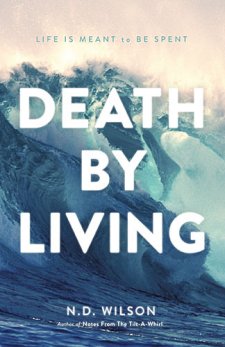
Death By Living – N.D. Wilson (2013)

_225_350_Book.903.cover

Grasshoppers, swings, dirt, traffic jams, puppy dogs, and blue skies. N.D. Wilson appears to be captivated by everyday objects and everyday situations. He appears to be captivated by life. Living life is what his new book is meant to convey – really living life. But living also means dying.  So the author wordsmiths his way into the heart of readers by painting portraits of life and death – most of which arise from his own life and the lives of his family and extended family.

Death by Living is a plea for people to living life as God intends. In other words, to quote Red from Shawshank Redemption, “Get busy livin’ or get busy dying.” Wilson challenges readers to get busy living which of course will culminate with death: “How much of the vineyard can we burn first? How fast can we run? How deeply can we laugh?  Can we ever give more than we receive? How much gratitude can we show? How many of the least of these can we touch along the way? How many seeds will we get into the ground before we ourselves are planted?”

A theme that runs through Wilson’s work is that life is a story. Life is a story that each of us participates in. Indeed, we write our stories every day.  But the author maintains, “there is a difference between asserting that life is a story and actually living life like a story. And there is another difference between living life-like a story and living life like a good story.”  Living life like a story, therefore, is part and parcel of the Christian life.

The author helps readers see what real living looks like: “Grabbing will always fail. Giving will always succeed … Our children, our friends, and our neighbors will all be better off if we work to accumulate for their sakes … Don’t leave food uneaten, strength unspent, wine undrunk.”

Wilson urges readers to live with all their might. And while he never mentions Jonathan Edwards, I hear a strong Edwardsian influence throughout the book. Edwards himself penned 70 resolutions that reflect many of the propositions in Death by Living. One of those resolutions is to “live with all my might, while I do live” (Resolution 6). Nate Wilson argues in the same vein, which of course, is undergirded by America’s greatest intellectual: “Laugh from your gut.  Burden your moments with thankfulness. Be as empty as you can be when that clock winds down. Spend your life.  And if time is a river, may you leave a wake.”

Death by Living will elicit laughter – lots of laughter.  I found myself reading portions of Wilson’s work to my wife and she would laugh with me.  In fact, I haven’t laughed so hard in a while!  Some won’t find Wilson’s humor funny – which makes me laugh even harder!

Death by Living may prompt tears. There is a realism here that is hard to come by these days. This author speaks in candid terms.  Taking prisoners simply isn’t an option.  All the cards are on the table.  Readers are left to determine a whether the “hand they’ve been dealt” will result in joyful, Christ-saturated living or death by a thousand qualifications.  Far too many have simply thrown in the towel.  Wilson argues from an entirely different perspective as he encourages readers that “life is meant to be spent.”

One reviewer compares Wilson to John Eldredge – what is likely meant to be a compliment. Sure, whatever.  I prefer as I have done elsewhere [See my review: Notes From the Tilt-a-Whirl] to compare Wilson to Dennis Miller, G.K. Chesterton, and C.S. Lewis – no doubt a true compliment!  Death by Living is about the gospel but it never comes across in “preachy” tones.  It’s a celebration of a life lived and ended well.  It’s about a life that is lived passionately and faithfully.  Death by Living is about living with gusto; about living with passion; about living to honor Christ.  But real living also requires dying.  We are called to finish strong and die well – all to the glory of God!

I received this book free from the publisher through the BookSneeze®.com  book review bloggers program. I was not required to write a positive review. 


Walking With Jesus on Campus – Stephen Kellough (2019)

Stephen Kellough, Walking With Jesus on Campus (Chicago: Moody Press, 2019), 183 pp.

One of the most invigorating seasons of life is during college. New friends, new terrain, and educational opportunities provide are the new proving grounds. But college life is also a training ground. The rigors and pressure of academics, athletics, and complex relationship pose new challenges that tend to be intimidating. Time away from open present new temptations and an array of choices that were previously unmet during high school days.

Stephen Kellough addresses these challenges in his book, Walking With Jesus on Campus. He aim is to help Christian students rearrange their spiritual priorities in order to thrive during their college days. Simply put, he sets out to help students care for their souls during college.

The foundation is securely set in Galatians 5:16 that admonishes followers of Christ to walk according to the Spirit. Such a walk is an indication that we are “making progress in the Christian life,” according to the author.

Kellough presents several challenges that students face in college that pertain to temptation, workaholism, perfectionism, and purity.

One area that is stressed is the need for a safe and godly community. “Believers,” writes Kellough, “have a common need for each other and a distinctive purpose together for the advance of Christ’s kingdom.” Authentic community, then, involves friendship, a Godward gaze, and biblical accountability. The author continues, “Our God has not created his people to function as lone rangers but are designed as relational beings. Within the body of Christ, God intends for us to live in community – depending upon each other and depending upon our Lord.”

Ultimately, students are encouraged to walk on wise steps, to walk on the path that is blazed by our Savior, the Lord Jesus Christ. Such a path is one of obedience, discipleship, devotion, service, and worship.

Walking Jesus on Campus: How to Care for Your Soul During College is a basic book that accomplishes its aim. College students are encouraged to study these pages and benefit from the pastoral wisdom of Stephen Kellough. Their souls will be encouraged and they will be prepared to flourish during an important season of life.

I received this book free from the publisher. I was not required to write a positive review.
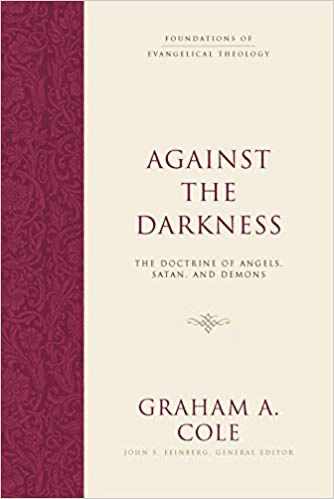
Against the Darkness: The Doctrine of Angels, Satan, and Demons – Graham A. Cole (2019)

Graham A. Cole, Against the Darkness: The Doctrine of Angels, Satan, and Demons (Wheaton: Crossway, 2019), 249.

Against the Darkness: The Doctrine of Angels, Satan, and Demons by Graham A. Cole is the most recent installment in Crossway’s Foundations of Evangelical Theology series, edited by John S. Feinberg. I have been reading these volumes since their inception and have thoroughly enjoyed the scholarship and depth that the authors share. Dr. Cole’s book is no exception.

Against the Darkness is targeted to pastors, church leaders, and lay scholars. It sets out to explore the subject of angelology in a biblical and comprehensive manner. No stone is left unturned in this volume as the author systematically unpacks the biblical doctrine of angels, demons, Satan, and spiritual warfare.

Cole is charitable with those he disagrees with and is gracious throughout this work. He is careful to avoid straw man arguments as he presents the views of scholars with whom he disagrees. His tone his noteworthy and should be emulated.

Against the Darkness is comprehensive in scope and is a very helpful book. I recommend it without reservation.

I received this book free from the publisher. I was not required to write a positive review.

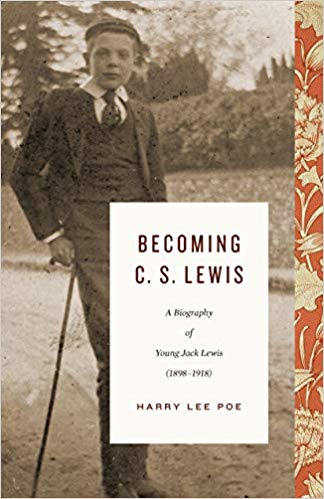
Becoming C.S. Lewis – Harry Lee Poe (2019)

Harry Lee Poe, Becoming C.S. Lewis (Wheaton: Crossway, 2019), 299 pp.

Very few people would dispute the idea that C.S. Lewis was one of the most influential Christian figures of the twentieth-century. His writings captivated the attention of young and old alike. He approach to apologetics drew the ire of atheists and bolstered believers.

While many are familiar with the writings of Lewis, fewer are acquainted with the backstory of his life. In steps Harry Lee Poe with his book, Becoming C.S. Lewis: A Biography of Young Jack Lewis (1898-1918).

Poe seeks to unpack the first two decades of Lewis’s life. The author successfully captures the relevant details of the young Lewis. Some of the details are expected; others are a surprise and will even come as a shock to most readers.

Poe has clearly done his homework on the project. He digs deeply into the early years of C.S. Lewis and sheds new light on the kinds of life experiences that shaped him to be one of the most cherished writers of our generation.

I received this book free from the publisher. I was not required to write a positive review.
25 MOST INFLUENTIAL BOOKS

Often I am asked, “What are the most influential books in your life?”  While the Bible is obviously the most influential book in my life, I offer twenty-five more that should be required reading for every Christ-follower.  Some titles do not include reviews, since I read these before my blogging days.

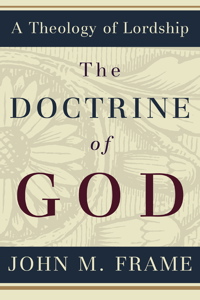
# 1 THE DOCTRINE OF GOD – John Frame

The most influential book in my life, outside of Scripture

# 2 TOTAL TRUTH – Nancy Pearcey

One of the most important books of the 21st century.

# 3  THE PLEASURES OF GOD – John Piper

This book taught me above all that God is delighted to be God.

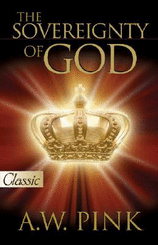
# 4  THE SOVEREIGNTY OF GOD – A.W. Pink

An absolutely foundational book that deserves to be read and re-read.

# 5  DESIRING GOD – John Piper

See my review

My introduction to Christian hedonism.

# 6 – FOUNDATIONS OF GRACE – Steven Lawson

A book that shows how the doctrines of grace show up in every book of Sacred Scripture.

# 7 A DISSERTATION CONCERNING THE END FOR WHICH GOD CREATED THE WORLD – Jonathan Edwards

See my review


# 8 INSTITUTES OF THE CHRISTIAN RELIGION – John Calvin

One of the most important Christian books of the last 500 years.

# 9 THE HOLINESS OF GOD – R.C. Sproul

See my review

A classic that will likely be in print for years to come.  A great place to begin the journey into God.

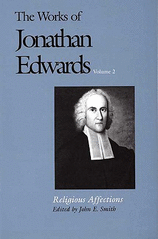
# 10 RELIGIOUS AFFECTIONS – Jonathan Edwards

See my review

As important now as it was in the 18th century.

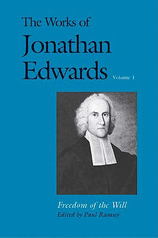
# 11 FREEDOM OF THE WILL – Jonathan Edwards

0300158408_l

No author has surpassed Edwards’s arguments.  Any discussion of free will should turn to this book.

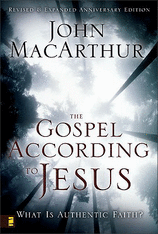
# 12 THE GOSPEL ACCORDING TO JESUS – John MacArthur

0310287294_l

One of the first serious books I read as a Bible College student.  MacArthur gets the gospel right.

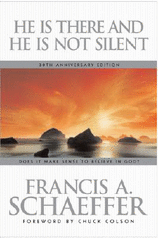
# 13 THE GOD WHO IS THERE – Francis Schaeffer

0830819479_l

Important lessons in evangelism and apologetics.  This is the book that got me interested in the discipline of apologetics.

# 14 JONATHAN EDWARDS – George Marsden

0300105967_l

My favorite biography on Jonathan Edwards.

# 15 WILLING TO BELIEVE – R.C. Sproul

0801064120_l

A great overview of the historical debate concerning free will.

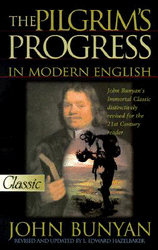
# 16 PILGRIM’S PROGRESS – John Bunyan

0882707574_l

The number 2 selling book of all time.  Spurgeon read Pilgrim’s Progress at least 100 times.

# 17 HE IS THERE AND HE IS NO SILENT – Francis Schaeffer

See my review

084231413X_l

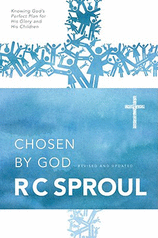
# 18 CHOSEN BY GOD – R.C. Sproul

0842313354_l

This book helped me work through the issue of predestination and election over 20 years ago.

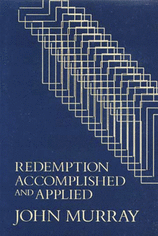
# 19  REDEMPTION ACCOMPLISHED AND APPLIED  – John Murray

0802811434_l

Terrific treatment on soteriology.

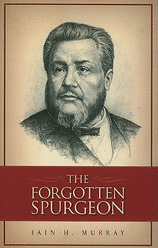
# 20 THE FORGOTTEN SPURGEON – Iain Murray

See my review

1848710119_l

Iain Murray has a special gift that introduces readers to Spurgeon.

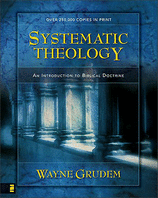
# 21 SYSTEMATIC THEOLOGY

0310286700_l

My favorite systematic theology.

# 22 HISTORICAL THEOLOGY – Gregg Allison

See my review

0310230136_l

My favorite historical theology.

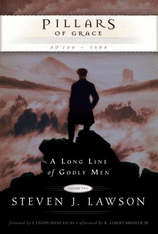
# 23 PILLARS OF GRACE – Steven Lawson

See my review

1567692117_l

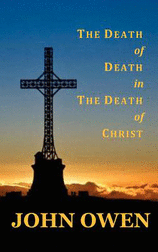
# 24 THE DEATH OF DEATH IN THE DEATH OF CHRIST – John Owen

1781393168_l

Important work on the atonement.

# 25 GEORGE WHITEFIELD – Arnold Dallimore

0851510264_lA tremendous biography that educates, inspires, and convicts.

My Favorite Reads in 2019

2019 was a fantastic year for books. My favorite reads are listed in order below:

  1. On the Road with Saint Augustine – James K.A. Smith
  2. Reenchanting Humanity: A Theology of Mankind – Owen Strachan
  3. Emblem of the Infinite King – J. Ryan Lister
  4. Competing Spectacles: Treasuring Christ in the Media Age – Tony Reinke
  5. The Doctrine on Which the Church Stands or Falls – Matthew Barrett, Ed.
  6. Why I Love the Apostle Paul – John Piper
  7. A Company of Heroes: Portraits from the Gospel’s Global Advance – Tim Keesee
  8. Grace Defined and Defended – Kevin DeYoung
  9. God, Greed, and the (Prosperity) Gospel – Costi Hinn
  10. John Calvin: For a New Reformation – Derek W.H. Thomas and John W. Tweeddale

On the Road With St. Augustine – James K.A. Smith (2019)

James K.A. Smith, On the Road With Saint Augustine: A Real-World Spirituality for Restless Hearts (Grand Rapids: Brazos Press, 2019), 240 pp.

The postmodern prophet and rock star, Bono Vox laments, “I have run, I have crawled, I have scaled these city walls, these city walls, only to be with you. But I still haven’t found what I’m looking for.” U2 isn’t the only one tapped into the inner drive and existential angst of the ages. Augustine had them beat by 1,600 years! “Oh Lord, you have created us for yourself but our hearts are restless until they find their rest in Thee.” It appears that Bono and Augustine have something in common!

James K.A. Smith is on a similar quest and is eager to share the fruit of his efforts in his most recent book, On the Road With Saint Augustine: A Real-World Spirituality for Restless Hearts. Smith’s work is an invitation to meet Augustine on the path that will lead to the culmination of his hopes, dreams, and desires.

Readers are in for a treat, especially the ones who have caricatured Augustine as a stuffy academician who puffs on a pipe, panders to the educated elite, and pontificates with an accent. Smith notes, “The Christian gospel, for Augustine, wasn’t just the answer to an intellectual question (though it was that); it was more like a shelter in a storm, a port for a wayward soul, nourishment for a prodigal who was famished, whose own heart had become, he said, ‘a famished land.’” As such, the “famished land” of many professing Christians will be laid bare. The fertile soil of Augustine will help nurture, strengthen, and revitalize travelers who dare to follow his lead.

The most endearing feature of Smith’s work is the emphasis on what he refers to as a “refugee spirituality.” Such an approach is desperately needed in our day, especially when most people seem content in the here and now and are satisfied with temporal trinkets: “Imagine a refugee spirituality,” writes Smith, “an understanding of human longing and estrangement that not only honors those experiences of not-at-homeness but also affirms the hope of finding a home, finding oneself … it’s about knowing how to make the journey, how to adopt the posture of the refugee who travels light.” Tragically, many American Christians are so burdened with temporal trinkets, they cannot even envision Augustine’s prescribed pursuit.

Smith traces the Augustinian path and focuses on several fascinating subjects that every pilgrim must wrestle with: freedom, ambition, sex, and death to name a few. On the Road With Saint Augustine: A Real-World Spirituality for Restless Hearts is a treasure map of sorts. Readers will see a totally new side of the Bishop of Hippo. Thoughtful readers will be prodded and poked. But they will also be encouraged and edified. They will be forced into a corner and challenged to weigh these heavenly realities and ultimately find their rest in God and the gospel of His Son.

Highly recommended!

Theological Retrieval for Evangelicals: Why We Need Our Past to Have a Future – Gavin Ortlund (2019)

athoelGavin Ortlund, Theological Retrieval for Evangelicals: Why We Need Our Past to Have a Future (Wheaton: Crossway, Books, 2019), 218 pp.

Interest among evangelicals in the Protestant Reformation has been on the rise for several years. With the recent quatercentenary commemoration of the Reformation, interest continues to blaze hotter than ever.

Gavin Ortlund, himself a student of the Reformation argues in his recent book, Theological Retrieval for Evangelicals: Why We Need Our Past to Have a Future that a modified approach is in order. The author observes that some evangelicals are growing restless. They yearn to understand what lies at the heart of their faith. And they lack a theological grounded that both informs and inspires.

Ortlund’s book is arranged in two parts. Part one sets forth the case for theological retrieval. Is it even possible for evangelicals to retrieve patristic and medieval theology? The author interacts with the various view of Warfield, Calvin, and Luther and argues that it is indeed possible to draw from the rich theological past. Such a retrieval, according to the author, serves like a map that serves the weary pilgrim. Various benefits of theological retrieval are proposed along with some of the pitfalls that may accompany such a pursuit.

Part two includes several case studies that reveal the various strengths of pursuing the theological retrieval that the author is proposing. The most interesting case study involves a detailed look at substitution as both satisfaction and recapitulation through the lenses of Athanasius, Irenaeus, and Anslem.

I found Theological Retrieval for Evangelicals both illuminating and informing. Ortlund’s insight and passion for church history is greatly appreciated and need in our myopic age. Too often, we are quick to throw the “theological baby” out with the bathwater. As a committed follower of Christ in the Protestant tradition, I also found parts of the book troubling. I understand the intent of the author but fear that some readers will put too much stock in Roman Catholic or Eastern Orthodox dogma and wind up on the wrong path at the end of the day. Overall, the book is worthy of careful study and consideration.

I received this book free from the publisher. I was not required to write a positive review.
John Calvin: For a New Reformation (2019)

calDerek W.H. Thomas and John W. Tweeddale, Ed. John Calvin: For a New Reformation (Wheaton: Crossway, 2019), 608 pp.

Over two thousand years of church history have produced a wide assortment of Christian leaders, theologians, and churchmen.  One man who exerted an enormous amount of influence in his day was John Calvin. In recent years, theologians and pastors have revived an interest in Calvin including, A Godward Gaze: The Holy Pursuit of John Calvin, by yours truly.

The most recent and comprehensive offering is an edited volume by Derek W.H. Thomas and John W. Tweeddale. This massive volume that spans over 600 pages includes contributions from well-known scholars such as Stephen Nichols, Steven Lawson, Burk Parsons, Paul Helm and others. The afterward by R.C. Sproul is a fitting conclusion from the man who should be credited for restoring an interest in Reformed theology in the twentieth-century church. Dr. Sproul’s words are especially moving and significant, since this is his last published writing before his death in 2017.

John Calvin: For a New Reformation is arranged in two parts. Part 1 explores the life and work of John Calvin. The contributors share a wealth of biographical information on Calvin including his early years, conversion, and friendships. Especially significant is the piece by Steven Lawson that summarizes the expository preaching of Calvin.

Part 2 explores the teaching of John Calvin. The contributors weigh in on several doctrinal subjects including the providence of God, the person and work of Christ, predestination, the sacraments, perseverance of the saints, and Calvin’s approach to eschatology. Edward Donnelly’s chapter, The Christian Life stands out the most. Donnelly helps readers see the pastoral heart of Calvin, which is undergirded by four central features of the Christian life: self-denial, cross—bearing, meditation on the future life, and the present life. Donnelly shows how Calvin lived an authentic and transparent Christian life, which inspired thousands of people in the sixteenth century and continues to inspire people in our day.

Additionally, Donnelly shows readers how Calvin lived in constant fellowship with the Lord and submitted daily to his lordship. “We are God’s,” writes Calvin. This acknowledgment was the very essence of Calvin’s Christian life. Also, Calvin was committed to mortifying idolatry and serving other people.

Over the years, I have read dozens of books about the French Reformer, John Calvin. This book is among the best. Thomas and Tweeddale should be commended for assembling such a worthy team of writers who celebrate a man that continues to wield a mighty influence on individual lives and the church of Jesus Christ.

I received this book free from the publisher. I was not required to write a positive review.