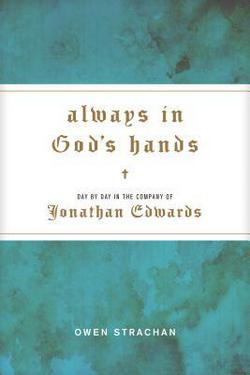
Always in God’s Hands: Day by Day in the Company of Jonathan Edwards – Owen Strachan (2018)

owenOwen Strachan, Always in God’s Hands: Day By Day in the Company of Jonathan Edwards (Carol Stream: Tyndale House Publishers, 2018), 415 pp.

I don’t usually get too excited about devotional books. They are typically too short and far too shallow. Such books gain a wide readership, which only adds fuel to my frustration. But when I learned about Dr. Owen Strachan’s new book, Always in God’s Hands: Day By Day in the Company of Jonathan Edwards, I eagerly secured a copy to review.

The book contains a short devotional for each day of the year. Readers are greeted by a short citation by America’s greatest intellectual and pastor, Jonathan Edwards. Strachan follows with an insightful devotion which is laced with Bible-centered wisdom and practical lessons that apply to the Christian life. Topics include the doctrine of the Trinity, justification, sanctification, battling temptation and worldliness, work ethic, faith, biblical authority, and many more. Each devotion concludes with a short Scripture that relates to the daily content.

Observant readers will notice several things about Strachan’s work. First, it is not short and it is not shallow. These are meaty, soul-stirring devotionals that ignite the affections and draw the attention of readers to the triune God. For instance, listen to how the author describes the promise of a Redeemer:

“It was foretold that Jesus would come as a holy warrior to face down his foe. Genesis 3:15 charts what the New Testament Gospels show us. Christ, Jonathan Edwards says, ‘went before us.’ He suffered ‘execution,’ dying to honor the justice of God, represented so vividly as a ‘sword,’ a great and terrible weapon. But the way of Christ is not a way of defeat. In dying, the Son of God crushed the serpent’s head. He rose from the dead. For believers, ‘there is no sword now,’ and eternal life awaits. The conquering hero will one day welcome us home, a liberated nation and a set-apart people.”

Second, it is a stellar introduction to the Christ-saturated worldview of Jonathan Edwards (approximately 30,000 words from the pen of Edwards are presented in this volume). Too many people unfairly caricature Edwards as a fire-breathing preacher, preoccupied with judgment and damnation. Edwards does indeed warn people to flee from the wrath to come. But this is not his only focus. The Puritan divine is fixated on the glory of God. He is consumed with the supremacy of Christ. His writing is saturated with gospel-centered joy.

Third, it provides practical help for believers at different maturity levels. This volume is certainly a great encouragement to seasoned believers. But it will also help strengthen the faith of believers who are just getting started. After completing Always in His Hands, I ordered an additional copy for my sixteen-year-old son. Inscribed in the opening pages are these words – from a father to his son:

“Jonathan Edwards life and writing have deeply shaped my views of God, the gospel, and the Christian life. No other writer outside of sacred Scripture has influenced me more. When you get to know this man, you get better acquainted with his Savior, the Lord Jesus Christ. And his Savior is our Savior!”

I’m looking forward to reading these short devotions together. Each is inspired by Jonathan Edwards but the real joy will be treasuring the Lord Jesus and finding our satisfaction in him. As John Piper says, “God is most glorified when we are most satisfied in him.”

Always in His Hands: Day By Day in the Company of Jonathan Edwards is a landmark book. It is a captivating introduction to America’s greatest thinker and invites readers to biblical spirituality that is truly unmatched. I highly recommend this work and trust that it will receive a wide reading in the evangelical world. Always in His Hands is among the best books of 2018!

I received this book free from the publisher. I was not required to write a positive review.

Holy Sexuality and the Gospel – Christopher Yuan (2018)

holyChristopher Yuan, Holy Sexuality and the Gospel (New York: Multnomah, 2018), 234 pp.

Rosaria Butterfield calls Christopher Yuan’s book, Holy Sexuality and the Gospel “the most important humanly composed book about biblical sexuality and godly living for our times.” That is quite a statement from such a respected woman. After a thorough reading, I concur that this indeed is a powerful and timely book.

Christopher Yuan is a professor at Moody Bible Institute who marks out our identity as human beings in this book. He clearly reveals that we are image bearers of God, created with a purpose for God’s glory. However, each creature has fallen short of God’s glory and has been plunged into a state of sinfulness – by nature and by choice. Yuan establishes biblical sexuality and builds upon this foundation by exploring the biblical basis for marriage and singleness.

The theme of holy sexuality is at the center of the book. Holy sexuality, which is radically contrary to the zeitgeist we’ve grown accustomed to consists of two paths: “Chastity in singleness and faithfulness in marriage.” Yuan explains, “Chastity is more than simply abstention from extramarital sex; it conveys purity and holiness. Faithfulness is more than merely maintaining chastity and avoiding illicit sex; it conveys covenantal commitment.”

Yuan maintains that the term holy sexuality is necessary since current terminology does not adequately or accurately reflect the biblical standard of sexual expression. He argues, “The purpose of this phrase is to transcend the current secular paradigm of sexual orientation that is unable to point toward God’s clear intent for sexual expression.” Holy Sexuality is meant to eliminate the confusing jargon which is usually associated with this controversial subject. Yuan adds, “Instead of deterring how we ought to live based on enduring patterns of erotic desires, God’s call for all humanity, quite simply, is holiness.”

The matter of homosexuality has been vigorously debated in recent days and has been especially elevated since the recent Supreme Court decision that legalized so-called “same-sex marriage.” Personally, I struggle with much of the literature that is either for or against “same-sex marriage.” It is hotly contested on both sides and generally produces more heat than light. But Dr. Yuan’s book takes a different path. Never once does he deviate from the biblical path to purity. He maintains the biblical boundaries of marriage between a man and a woman and sets forth a case that is both compelling and compassionate.

Christopher Yuan has written a thoughtful and compelling book. It is grounded in sacred Scripture and faithfully reflects the teaching of Scripture. Yuan’s convictions are uncompromising, yet he writes out of a deep and authentic love for people in the homosexual community. His tone is always charitable, yet he never compromises the teaching of God’s Word. Holy Sexuality and the Gospel is a much-needed corrective to the overly simplified approach that some Christian writers take. It avoids the pitfalls typically associated with this subject and leads readers to a place of faithfulness and fulfillment. Christian readers will be encouraged and challenged by Dr. Yuan’s heart. And readers who struggle with same-sex desires will be patiently instructed by a writer who writes with patience and biblical fidelity.

I received this book free from the publisher. I was not required to write a positive review.

Basics For Believers – D.A. Carson

basD.A. Carson, Basics For Believers: The Core of Christian Faith and Life (Grand Rapids: Baker, 2018), 156 pp.

D.A. Carson’s book, Basic For Believers: The Core of Christian Faith and Love is a focused overview on the book of Philippians. Carson tackles Paul’s letter to the Philippians with the care and precision that readers are accustomed to.

Dr. Carson takes five chapters to exposit Paul’s epistle, all of which are packed with gospel-centered reality and principles that encourage and equip followers of Christ. The book is basic enough for new believers to comprehend but also contains a wealth of information that seasoned believers will benefit from.

Christians are encouraged to gaze intently on the cross of Christ, emulate worthy Christian leaders and stand firm in the gospel. The principles are an accurate reflection of Paul’s letter to the Philippians, all of which are timeless and transcendent realities. I commend this work for anyone who seeks a solid treatment of Philippians and needs Christ-centered encouragement in a godless age.

I received this book free from the publisher. I was not required to write a positive review.

THE FLIP THAT FLOPPED: The Consequences of Doctrinal Compromise

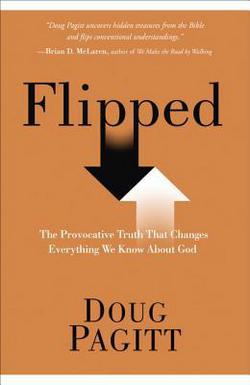
President Obama promised to “fundamentally transform the United States of America.”  He has inflipped many respects delivered on that promise with the unveiling of the Affordable Health Care Act and a host of executive orders that are, in the final analysis, out of step with American values.  But give credit where credit is due.  The transformation which the president promised has taken place.  Now, Americans wait for the painful consequences to set in.

In Doug Pagitt’s latest book, “Flipped,” the author sets out to fundamentally transform the classical view of God.   This transformation is creative and innovative.  It is intuitive and will attract the attention of many readers.

Pagitt sets forth three goals at the beginning of the book:

  1. To see that changing your mind, drawing new conclusions, and engaging new ideas all lie at the heart of Jesus’s message and life.
  2. To behold the big, beautiful story of God as you find new ways to live in it.
  3. To invite readers to a full and vibrant life in God.

The basic idea that runs through this book is what the author refers to as a “flip” – which is nothing short of revising one’s views about God, Scripture, and the Christian life in general.  Pagitt adds, “The Flip at the center of this book is one that turned me around as a pastor and a Christian writer as well as my personal life and faith.”

The Flip That Flopped

Several “flips” are addressed in this work.  But the one that keeps surfacing concerns a fundamental misunderstanding of the nature of God.  At the heart of this book is a commitment to panentheism.  This worldview, also known as process theology is a radical departure from the traditional understanding of God, yet is receiving a hearing in the emergent church and some liberal churches.  One might consider such a view a halfway house between theism and pantheism.  But make no mistake – panentheism is outside the scope of historical orthodoxy.

All is in God?

To be fair, the author never uses the word, panentheism.  Yet this panentheistic theme runs throughout the book.  Pagitt argues, “God is not a separate single subject … If God were not a separate being from all things in the cosmos, then we need not simply say God exists.  We can say that God is existence.  All is in God.”  Such language is the classic lingo of panentheism.

My initial impression: Surely this is a typo!  The author can’t possibly mean what he is saying.  But as I continued to read, my suspicions were confirmed.  “… All that exists is In God,” writes Pagitt.  He tries to justify this “flip” by appealing to the rationale from Acts 17:28 where Paul quotes Epimenides of Crete: “In him, we live and move and have our being.

In addition to promoting panentheism, the author posits the notion of universalism: “Beyond that, the power of God that was alive in Jesus is alive in us.  In short, the fullness of God is active in humanity without assistance from any religious system.”  He continues, “Instead, we can recognize that all people live, move, and exist In God.”

Evaluation

Flipped is a radical departure from the biblical understanding of God.  The notion that all people “exist In God” simply fails to match the biblical data.  Much to the contrary, we find a distinction between the Creator and the creature.  Whenever one denies such a distinction he makes a dangerous theological move with several critical implications.  What are the implications of denying the Creator-creature distinction?

  • Misreads and misinterprets Scripture.
  • Compromises God’s character.
  • Compromises biblical authority.
  • Minimizes the transcendence of God and emphasizes the immanence of God in biblically inappropriate ways.

Readers should recall how God is truly presented in Scripture.  He is never presented in a panentheistic scheme – ever!  Rather, he is presented as the absolute personal God.  This absolute God is transcendent; that is to say, he is over and above the scope of the universe.  He is distinct and independent of his creation (Isa. 57:15; Isa. 40:10).  He is preeminent  (Isa. 40:25-28; 44:6-8).  Jonathan Edwards adds, “His power is infinite, and none can resist him.  His riches are immense and inexhaustible.  His majesty is infinitely awful.”  And God carries supreme authority over all.  Nothing rivals the supreme authority of God (Job 41:10; 37:9-14).

The Triune God holds all things together.  In a few words, St. Paul demonstrates both the transcendence and the imminence of God: “For by him all things were created, in heaven and on earth, visible and invisible; whether thrones or dominions or rulers or authorities – all things were created through him and for him.  And he is before all things, and in him, all things hold together” (Col. 1:16-17, ESV).  God is sovereign (Dan. 4:34-35).  Nothing can thwart his sovereign decrees!  He is distinct from the created order (Acts 17:24-29).  And the Bible tells us that God is wholly other (Isa. 46:9).  This is a far cry from people who “exist In God.”

God is not only absolute; he is personal.  He cares for his creation.  He is intimately involved with his creation and he delights to meet the needs of his creatures.

God is the Sustainer (Col. 1:17; Heb. 1:3).  He is the Healer (2 Chron. 7:14).  He is the Protector (2 Sam. 22:2).  He is the Shepherd (Ps. 23:1-6).  He is the Forgiver (Rom. 5:1).  And Scripture demonstrates the ultimate love that God expressed on the Cross when Jesus died for sinners (Rom. 5:8).

Flipped will likely attract many readers; especially readers who are committed to theological liberalism.  The author seeks to fundamentally transform the vision of God by convincing readers that  “… All that exists is In God.”  The only problem: The view presented here is dead wrong.

A.W. Tozer understood the importance of getting God right.  He rightly noted in his best-selling book, The Knowledge of God:

The gravest question before the Church is always God Himself, and the most [awe-inspiring] fact about any man is not what he at a given time may say or do, but what he in his heart conceives God to be like … So necessary to the Church is a lofty concept of God that when that concept in any measure declines, the Church with her worship and her moral standards decline along with it.  The first step down for any church is taken when it surrenders its high opinion of God.

May followers of Christ heed Tozer’s advice.  We certainly do not need to flip our views of God.  Any deviation from the biblical vision of God will have tragic consequences in the church and the culture in which she seeks to minister.  Any flip will become a flop that ignores the clear teaching of Scripture.

I received this book free from the publisher.   I was not required to write a positive review. 


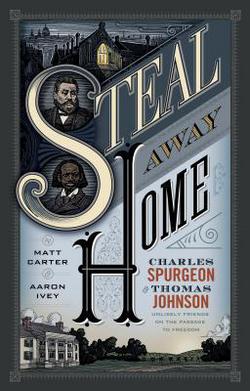
Steal Away Home – Matt Carter and Aaron Ivey (2017)

chMatt Carter and Aaron Ivey, Steal Away Home, Nashville: B&H Publishing Group, 2017, 294 pp. $14.60
Church history is filled with stories of courage, adventure, adversity, and persecution. From the exile of Athanasius, the martyrdom of John Rogers and William Tyndale, or Luther’s trial at Worms, these stories are well-known and we are quick to pass them along to the next generation.

Steal Away Home by Matt Carter and Aaron Ivey is a tale that will be new to many readers, however.  It was certainly new for me! The story involves two men from backgrounds that have very little in common. C.H. Spurgeon was the Prince of Preachers, a refined man with a rich theological heritage who occupied the pulpit in Victorian England. He was well-known around the world. He was a best-selling author and recognized by thousands. Thomas Johnson was a simple slave boy who was unjustly shackled in colonial America. He was known by few and treated like an animal. His slave master worked him to the bone on the Virginia tobacco fields.

Jesus Christ liberated Thomas Johnson. He freed him from the power and the penalty of sin. President Abraham Lincoln rescued Thomas Johnson from the sin of slavery. The Emancipation Proclamation, which Lincoln regarded as the crowning achievement of his presidency, liberated Thomas from his slave master. Jesus Christ liberated Thomas from the slave master of sin.

Through a series of Providential events, Thomas Johnson found himself at the front door of C.H. Spurgeon in London. After his training was complete, he and his wife made their way to Cameroon, West Africa in 1879.

PERSONAL TAKEAWAYS

Steal Away Home is a work of historical fiction. It becomes clear at the outset, however, that the authors spent many hours researching the details of this intriguing story. My hope is that a few personal takeaways will prompt many people to enter rich world of the 19th century and absorb some life-altering lessons.

1. The Humanization of C.H. Spurgeon

I have been reading Spurgeon and books about the Prince of Preachers for almost thirty years. This book brilliantly captures the essence of Spurgeon and is not afraid of revealing his warts, weaknesses, and worries. It is a breath of fresh air for anyone who is under the false notion that the famous preacher from London lived a life of ease. Spurgeon’s doubt and lifelong battle with depression is highlighted and his fears are revealed.

2. The Horror of Slavery

Most Americans recognize that slavery is a perpetual “black eye” on our nations’ history. But few understand the gravity of what these innocent African Americans endured. Carter and Ivey masterfully reveal the pitiful nature of slavery through the eyes of Thomas Johnson. Sympathetic readers will feel genuine grief as they walk with Johnson and experience the horror of his chains.

3. The Hallowed Ground of Friendship

Steal Away Home reminds readers of the importance and value of friendship. The friendship fostered by Spurgeon and Thomas is grounded in grace and nurtured by honest communication, genuine fun, rich encouragement, and biblical accountability. Like David and Jonathan, these two men are examples of friendship that glorifies God. Indeed, “A man of many companions may come to ruin, but there is a friend who sticks closer than a brother” (Prov. 18:24). Indeed, friendship is hallowed ground that too few men tread upon.

4. The Hope of the Gospel

Finally, this story shows how the gospel operates in the real world. Apart from grace, Charles Haddon Spurgeon and Thomas Johnson were dead in trespasses and sins, without hope and without God. Indeed, apart from grace, Spurgeon and Johnson were both spiritual slaves. Both men, however, were set free as they cast their hope on the Lord Jesus Christ. In the course of their very different earthly paths, they wound up on the same spiritual path, which ultimately led them both to the Celestial City!

Steal Away Home encouraged me personally and moved my soul in ways that most books only hope to do. Matt Carter and Aaron Ivey stepped up to the plate and hit the ball out of the park.  Their work will no doubt be a contender for book of the year.  I commend their work wholeheartedly!

I received this book free from the publisher. I was not required to write a positive review.

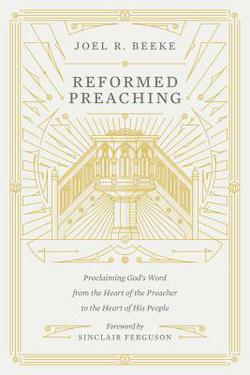
Reformed Preaching – Joel Beeke (2018)

refJoel Beeke, Reformed Preaching (Wheaton: Crossway, 2018), 475 pp.

Preaching the Word of God is at the very center of pastoral ministry. Indeed, the task of preaching God’s Word that should occupy a good portion of the pastoral week. Neglecting this critical responsibility results in weak sheep who are unable to discern the times. Minimizing or marginalizing preaching always leads to a malnourished flock.

Joel R. Beeke addresses the matter of preaching in his latest volume. Reformed Preaching: Proclaiming God’s Word from the Heart of the Preacher to the Heart of the People underscores the importance of the preaching task and inspires every expositor who is set on obeying the biblical mandate. Beeke alerts readers to his purpose early in the book:

May God graciously use this book to promote God-honoring preaching that addresses the real needs of his people – preaching that is not only biblically doctrinal, covenantal, historian-redemptive, and practical, but also biblically and warmly experiential both in its applicators and discriminatory dimensions for the building up of the universal church.

At the center of Beeke’s concern is preaching that engages the affections, a quality that is sorely absent from many Reformed pulpits. He offers a stern warning for preachers who provide good instruction but fail to nourish the flock of God! This identical concern also occupied the attention of Jonathan Edwards:

I should think myself in the way of my duty to raise the affections of my hearers as high as I possibly can, provided that they are affected with nothing but the truth … Our people don’t so much need to have their heads stored, as to have their hearts touched; and they stand in the greatest need of that sort of preaching that has the greatest tendency to do this.

Herein lies the dilemma for the preacher – engaging both the head as well as the heart. Tragically, too many Reformed preacher’s aim for the head and miss the heart altogether. Beeke’s work seeks to remedy this dreadful state of affairs. This work focuses on three areas that help accomplish the above objective.

Part One describes Reformed experiential preaching. Beeke writes, “Reformed experiential preaching uses the truth of Scripture to shine the glory of God into the depths of the soul to call people to live solely and wholly for God.” Such preaching “reaches people where they are in the trenches and gives them tactics and hope for the battle.” Beeke offers several benchmarks that help shore up the definition of Reformed expository preaching:

  • Tests genuine Christian experience by the standard of biblical truth – idealistically, realistically, and optimistically.
  • Draws lines distinguishing between believers and unbelievers.
  • Makes frequent and wise application of truth to life.
  • Balances biblical, doctrinal, experiential, and practical elements.
  • Cultivates a life of communion with our God and Savior.
  • Builds experience upon the foundation of Scripture.
  • Goes beyond contemporary superficiality into the deep wisdom of old paths.
  • Offers food to satisfy the new spiritual sense of the believer’s soul.
  • Touches the heart with the bitterness of sin and the sweetness of grace.

Experiential preaching passionately proclaims the timeless truths of Scripture without apology. Experiential preaching is deeply Reformed, that is, “it helps people to see God as the great King of grace, present and working at all times and places to carry out his wise plan of eternal love.”

Part Two illustrates Reformed experiential preaching. Fifteen chapters are packed with examples of how to preach in this fashion. The like of Calvin, Goodwin, Bunyan, Edwards, and contemporary pastors like Lloyd-Jones are presented which provide a wealth of information and inspiration. This section is historically illuminating and practical from start to finish.

Part Three addresses preaching experientially today. A host of lessons are set forth for contemporary preachers to meditate upon and immediately apply. Beeke urges preachers to be balanced in their approach: “We must speak with the tenderness of a nursing mother and the earnest love of a father, sharing with them not only the truth but opening our very souls to them.”

The author encourages preachers to be bold, even when some react with scorn to biblical dogma: “At first a sinner may dread and hate God’s sovereignty. But when convinced of his responsibility to repent and his inability to do so, God’s sovereignty becomes the sweetest of attributes, for only a sovereign Savior can help us.”

Above all, our preaching must be Christ-centered. This theme occurs again and again in this volume, leaving preachers no room to equivocate or compromise. Preachers are reminded that “it is a fact of human nature that men would rather do penance (to try to atone for sin by doing good works) than repent (to hate and forsake sin). Therefore, faithful preachers must be Christ-centered as they stand behind the pulpit.

It is exceedingly difficult to convey the depth and richness of Joel Beeke’s Reformed Preaching. This volume is educational, inspirational, and will serve preachers for many years to come. I eagerly commend this work and trust that it will be a mighty tool for many and fervently pray that the flock of God will be better nourished as a result of this marvelous book!

I received this book free from the publisher. I was not required to write a positive review.

Bold Reformer and Reformation Day

1632960702_b

The paperback version of my book, Bold Reformer: Celebrating the Gospel-Centered Convictions of Martin Luther is now available on Amazon for $11.78, but only for a limited time.  The Kindle version is also available for $2.99.

On October 31, 1517, Martin Luther nailed the ninety-five theses to the castle door in Wittenberg. One act of courage sparked a theological firestorm in Germany that set the world ablaze in a matter of days. Spreading like wildfire, thousands were introduced to the gospel which is received by grace alone, through faith alone, in Christ alone.

Bold Reformer: Celebrating the Gospel-Centered Convictions of Martin Luther takes readers on a journey through a remarkable period of church history. It will challenge contemporary readers to learn the lessons of courage, and perseverance. It will inspire a new generation of people to follow Jesus, obey Jesus, and worship the Savior with all their heart, soul, mind, and strength. It invites a new generation of Christ-followers to recover the gospel in their generation and make their stand as a bold reformer.

Bold Reformer is born out of personal pastoral turmoil and inspired by the courage of Martin Luther.  My hope is that many pastors, Christian leaders, and Christ-followers will be encouraged as a result of reading this book; that God will propel them into the future by his grace and for his glory.

Endorsements:

“David Steele’s Bold Reformer is a book for our times! As we celebrate the 500th anniversary of the Reformation, how appropriate to look afresh at ways the bold faith and action of Martin Luther can inspire and instruct our own faith and work. Christians today need strength of character and boldness of conviction. Steele’s presentation of Luther’s life moves readers to live bold lives that adorn the gospel of grace alone, by faith alone, in Christ alone.”

Dr. Bruce A. Ware, T. Rupert and Lucille Coleman Professor of Christian Theology, Chairman of the Department of Christian Theology, The Southern Baptist Theological Seminary

“Pastoral ministry is often mingled with both blessing and despair. Many pastors experience seasons of opposition that result in discouragement and even depression. David Steele’s new work, Bold Reformer is an exploration into the gospel-centered convictions of the stalwart reformer, Martin Luther. Luther faced many pastoral hardships during his ministry, but emerged victorious because of his unwavering faith in the gospel of Jesus Christ. I encourage you to drink from the refreshing waters of this book and use the life of Luther as an example that emboldens you to stand strong in the midst of the fiery trial.”

Dr. Steven J. Lawson, President, OnePassion Ministries, Dallas, Texas

The Ten Commandments – Kevin DeYoung

deyoungKevin DeYoung, The Ten Commandments (Wheaton: Crossway, 2018), 190 pp.

Ask anyone if they are familiar with the Ten Commandments and the answer will be in the affirmative. But ask that same person to recite the ten commandments by memory. The results will not be as encouraging, even among professing Christians.

Kevin DeYoung devotes his latest book, The Ten Commandments to explaining and exploring these ten imperatives. The subtitle describes the essence of the book: What They Mean, Why They Matter, and Why We Should Obey Them.

DeYoung carefully guides readers through each commandment, grounding his exposition in Scripture and applying his explanation to the real-world needs of contemporary people. Each chapter focuses on one commandment in particular and is set forth in a clear and understandable way.

I found The Ten Commandments  to be deeply encouraging and challenging. DeYoung’s writing is engaging and draws readers from different backgrounds to one conclusion: These commandments are for today. But in the final analysis, they lead us directly to the cross of Christ. Indeed, as DeYoung writes,

“We can no longer keep the Ten Commandments rightly unless we keep them in Christ, through Christ, and with a view to the all-surpassing greatness of Christ. As new creations in Christ, the law is not only our duty but also our delight. If we want to love Christ as he deserves and as he desires, we will keep his commandments.”

I received this book free from the publisher. I was not required to write a positive review.

The Legacy of Luther – R.C. Sproul and Stephen Nichols, Ed.

lutherR.C. Sproul and Stephen J. Nichols, The Legacy of Luther. Sanford: Reformation Trust Publishing, 2016, 308 pp. $15.66

On October 31, 1517, Martin Luther nailed the Ninety-Five Theses to the castle door in Wittenberg. One act of courage sparked a theological firestorm in Germany that set the world able in a matter of days. Spreading like wildfire, thousands were introduced to the gospel, which is received by grace alone, through faith alone, in Christ alone.

The Legacy of Luther celebrates the accomplishments of this godly man. Edited by R.C. Sproul and Stephen Nichols, the book surveys Luther’s life, thought, and ultimately his legacy. A wide range of pastors and theologians contribute to this volume; men like Steven J. Lawson, Michael Horton, Sinclair Ferguson, and Derek Thomas, to name a few.

The Legacy of Luther is a sweeping look at the German Reformer. The book contains basic information that will appeal to first-time students of Luther. But it is also filled with a wealth of information that will satisfy the most deeply entrenched Luther scholar.

The Legacy of Luther certainly honors a significant man who stands head and shoulders above most others in church history. But at the end of the day, the book does not exalt a man; the book exalts the gospel of grace and celebrates the accomplishments of our Savior. The neglected gospel truths which were recovered by the Reformers are proclaimed with passion in zeal in this important volume.

Readers may be interested in my recently published book, Bold Reformer: Celebrating the Gospel-Centered Convictions of Martin Luther.

WHAT WE TALK ABOUT WHEN WE TALK ABOUT GOD – Rob Bell (2013)

0062049666_lI am a disturbed man.  I am disturbed because people compromise the truth.  I am disturbed because people marginalize the truth and swerve away from biblical reality.  I am disturbed because a great communicator with a bright mind and a love for people continues down a rocky path.  On Tuesday, March 12, Rob Bell unveiled his newest book, What We Talk About When We Talk About God.  I am disturbed because one group of people uncritically accepts anything that comes off the end of Bell’s pen.  On the other hand, I am disturbed by Christians who refuse to debate civilly with the likes of Bell.   Instead, they cast stones and call names.  They protest outside at his speaking events and drop nasty one liners on Facebook.   Surely, there must be a better way!

In Bell’s previous offering,  Love Wins,  several fundamental doctrines were undermined, most notably the doctrine of hell.  Bell argued then, “If we want hell, if we want heaven, they are ours.  That’s how love works.  It can’t be forced, manipulated, or coerced.  It always leaves room for the other to decide.  God says yes, we can have what we want, because love wins.”  The author continues, “Restoration brings God glory; eternal torment doesn’t.  Reconciliation brings God glory; endless anguish doesn’t.  Renewal and return cause God’s greatness to shine through the universe; never-ending punishment doesn’t.”

The author continues the dialogue (according to emergent standards)  in What We Talk About When We Talk About God.  The writing is witty and inquisitive.  Bell has mastered the art of asking questions and has adjusted his eyes and tuned his ears in order to understand postmodern culture.

One of Bell’s central claims in the book is this: “We have a problem with God.”  He argues that many people are rethinking the nature of God.  Personally, I think that Bell is on to something here.  He is keenly aware of a shift that appears to be taking place in the minds of some people that concerns the nature of God.  Consider some of the ways that the nature of God has been recast in recent years, especially with the rise of open theism, inclusivism, and universalism.   Bell is not only aware of this “mind-shift” that has to do with the nature of God; he embraces it himself.  He compares God to the classic Oldsmobile.  This old car served many people in its day but has since been proven irrelevant.  Bell ponders what he calls the “tribal God” – “…  the one who’s always right (which means everybody else is wrong) – is increasingly perceived to be small, narrow, irrelevant, mean, and sometimes just not that intelligent.”  Bell quips, “Is God going to be left behind? Like Oldsmobiles?”

What We Talk About When We Talk About God essentially argues that the old view of God (the Oldsmobile view) is outdated and needs to be updated.  The argument revolves around three words: “With, For, and Ahead.”  Essentially, Bell argues that God is with us, for us, and ahead of us –  all of us.

With: God is with us.  He is the “energy, the glue, the force, the life, the power, and the source of all we know to be the depth, fullness, and vitality of life from the highest of highs to the lowest of lows and everything in between.”

For: God is for us.  “I believe God is for every single one of us, regardless of our beliefs or perspectives or actions or failures or mistakes or sins or opinions about whether God exists or not.”

Ahead: God is ahead of us.  “It’s as if human history were progressing along a trajectory, an arc, a continuum; and sacred history is the capturing and recording of those moments when people became aware that they were being called and drawn and pulled forward by the divine force and power and energy that gives life to everything.”

These affirmations are all very interesting and will likely receive much positive feedback.  But do they stand up to the scrutiny of Scripture?  I offer four specific critiques that go to the core of the book.

1. Being Certain About Certitude

Bell stands shoulder to shoulder with postmodern thinkers who mock the possibility of certitude.  Anyone who has studied the Enlightenment (Christian and non-Christian alike) will admit a posture of arrogance during these days.  But certitude does not necessarily entail an arrogant attitude.  Indeed, even Bell is pleading for a particular kind of knowledge that is wedded with humility.   Orthodoxy should include bold propositions and large doses of humility.

What is troubling about Bell’s discomfort with certitude is that certitude appears throughout the book.  His certitude about the world, the laws of physics, and the nature of God conflicts with the argument against certitude!

2. A Failure to Distinguish Between Law and Gospel

I am increasingly aware of and concerned with Christian thinkers who fail to distinguish between law and gospel.  What is concerning about this particular work is that neither emerge clearly.  When the author argues that “God is for every single one of us” law is essentially extinguished.  Additionally, the gospel appears to be inclusive; it is a gospel that appears to cut across all kinds of theological traditions, including traditions that fall outside the pale of orthodoxy.

3. A Failure to Distinguish Between the Creator and the Creature    

The notion that God is “with us,” “for us,” and “ahead of us leads readers away from the importance of the Creator-creature distinction.  The apostle Paul made this distinction plain in his message to the philosophers in Athens: “The God who made the world and everything in it, being the Lord of heaven and earth, does not live in temples made by man, nor is he served by human hands, as though he needed anything, since he himself gives to all mankind life and breath and everything” (Acts 17:24-25, ESV).

Acts 17:22-31 reveals a Creator God who is the cosmos shaper, the kingdom shaker who lives above creation.  He is the all-sufficient Ruler, Life Giver, and Destiny Maker.  And he is the righteous Judge who “commands all people everywhere to repent, because he has fixed a day on which he will judge the world in righteousness by a man whom he has appointed …” (Acts 17:30-31, ESV).

And Scripture speaks of the creature who was created by God (Gen. 2:7).  The creatures (Adam and Eve) were originally free from sin but fell and as a result became sinners by nature and by choice (Gen. 3:1-7).  As such, these sinful creatures have no inherent righteousness, no desire for God (Rom. 3:10-11).  Subsequently, all creatures are born with a hatred in their hearts for God (Rom. 8:7-8).  They are dead in sin (Eph. 2:1-3), and they are enslaved in sin; totally unable to come to Christ apart from God’s empowerment (John 6:44).  These creatures are dependent upon God for everything.  These creatures, while given the ability to make free choices, are determined (Acts 17:26; Prov. 19:21; 21:1).  And these creatures are accountable to a righteous and sovereign Judge (Rom. 2:5-11).

4. A Failure to Reveal the Whole Truth About God

The notion that God is “with us,” “for us,” and “ahead of us (every single one of us) may sound good initially but falls short of the biblical model.  It is true that God is with his people.  We see this especially in the incarnation of Jesus, the One who is named Immanuel – or God with us (Matt. 1:23).  Yet God is not “with” the man who  has rejected the revelation of God in Christ.  “… Whoever does not obey the Son shall not see life, but the wrath of God remains on him” (John 3:36).

It is true that God is “for us” – that is to say, he is for his people.  “For I am sure that neither death nor life, nor angels nor rulers, nor things present nor things to come, nor powers, nor height nor depth, nor anything else in all creation, will be able to separate us from the love of God in Christ Jesus our Lord” (Romans 8:38–39, ESV).  Yet God is not “for” the man who has rejected the promises and purposes of God.  He resists the proud (Jas. 4:6; 1 Pet. 5:5).

And it is true that God is “ahead of us” – he works on behalf of his people (Isa. 64:4).  Indeed, he works all things for good – but not for all.  The promise in Romans 8:28 is this: “And we know that for those who love God all things work together for good, for those who are called according to his purpose” (Romans 8:28, ESV).  And Scripture is clear on this point: God does not give sovereign grace to all people.  “For many are called, but few are chosen”” (Matthew 22:14, ESV).  The one who resists God’s authority; the one who refuses to take refuge in God will endure the wrath of almighty God (Ps. 2:12; Deut. 32:35; Rom. 1:18-24).

The model presented in What We Talk About When We Talk About God  appears to have something in common with panentheism which says that the world is “in” God.  So in the final analysis, the book appears to make much of God’s immanence and make light of his transcendence.

A.W. Tozer rightly said, “What comes into our minds when we think about God is the most important thing about us.”    Tozer continues, “Among the sins to which the human heart is prone, hardly any other is more hateful to God than idolatry, for idolatry is at bottom a libel on His character.  The idolatrous heart assumes that God is other than He is – in itself a monstrous sin – and substitutes for the true God one made after its own likeness.”  Therefore, we must beware of our propensity to fashion a god that suits our particular needs.  We must always subject our vision of God to the Scriptures and allow God’s Word to have the final say.

My plea to fellow evangelicals who disagree with Bell is to engage with biblically minded sensibility.  Name calling and ad hominem attacks must stop.  May our debates with those whom we disagree be filled with kindness, humility, meekness, and patience (Col. 3:12).  And when we talk about God, may our talk reflect the biblical vision of God that emerges in Scripture.  May we bow before his transcendent majesty.  May his holiness stop us dead in our tracks.  May we find comfort in his immanence – for he finds great delight in working for his people.  May we marvel at and worship this great God who tends “his flock like a shepherd and gathers the lambs in his arms” (Isa. 40:11).

Soli Deo Gloria!