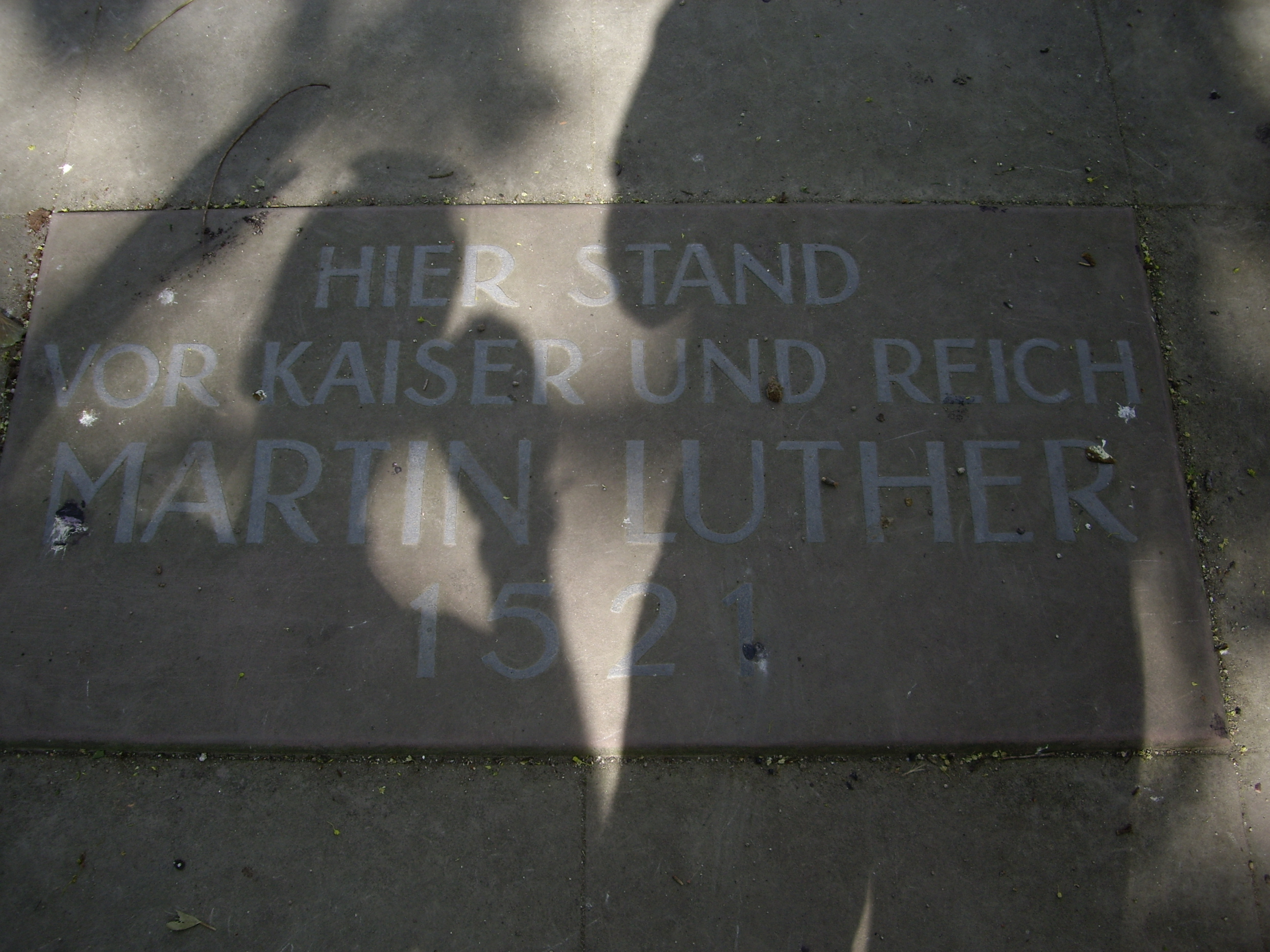
HERE I STAND

“Unless I am convinced by the testimony of the Scriptures or by clear reason (for I do not trust either in the pope or in councils alone, since it is well-known that they have often erred and contradicted themselves), I am bound by the Scriptures I have quoted and my conscience is captive to the Word of God. I cannot and will not recant anything, since it is neither safe nor right to go against conscience. May God help me. Amen.”

Martin Luther – 1521

Worms, Germany


REFORMATION DAY: THE SWANS WILL NOT BE SILENCED!

Because he proclaimed  the abuses of the Roman Catholic Church in the 15th century, John Hus was arrested and thrown into a dark hole at the opening of a sewer drain.  He endured eight months in that filthy place.  Hus was tortured and ultimately burned at the stake on July 6, 1415.  Prior to his brutal death, Hus reportedly said, “Today you are burning a goose (Hus means goose in Czech), a however, a hundred years from now, you will be able to hear a swan sing, you will not burn it, you will have to listen to him.”

Semper Reformanda!

A BLACK-AND-WHITE PROPOSAL: FAREWELL TO FUZZY THINKING

Donald Miller raises the banner for “fuzzy thinking” in a recent blog post entitled, “The Problem with Black-and-White Thinking” (re-posted on relevantmagazine.com).  His main thought: “Black-and-white, either-or thinking polarizes people and stunts progressive thought.”  Additionally, he holds that this kind of thinking stunts our “ability to find truth.”

DEFENDING THE GOOD IN MILLER’S PROPOSAL

Miller admits that there is such a thing as right and wrong.  He also admits the existence of absolute truth.  So Miller does not advocate full-fledged relativism.  For this, we can be thankful.  In fact, even though his posting is loaded with difficulties, Miller does include some helpful suggestions worth considering:

First, Miller suggests, “Disengage your ego from your ideas.”  This point is well taken because many times a particular view is so tied to one’s ego that it becomes virtually impossible to separate fact from fiction.

Second, Miller encourages, “Understand there is much you don’t understand.”  He rightly adds, “We begin to think in black-and-white when we assume we know everything.”  While he does not press the point of Christian humility (as he should – pardon the black- and white thinking), it seems to be a part of his overall argument.

Third, Miller seems to argue in essence, that charity and grace ought to be a part of conversations and even arguments.  This implied pointer ought to be a part of daily life, where conversations and arguments produce more light than heat and stimulate deeper thinking about a given subject.

DISMANTLING THE BAD IN MILLER’S PROPOSAL

Yet, there are, in my opinion, four problems that emerge; unwarranted assumptions that must be dismantled.

Black-and-White Thinking Demonizes the Opposition

Miller advances the common notion that black-and-white thinking is polarizing; a bad thing. Again, “Black-and-white, either-or thinking polarizes people and stunts progressive thought.”  He adds, “… We begin to believe whatever thought-camp we subscribe to is morally good and the other morally bad, thus demonizing a threatening position.”

But this is not necessarily the case.  One can advance a dogmatic view but do so in a humble, yet decisive way.  After gaining a hearing with the philosophers in Athens, Paul presents an argument that could be construed as black-and-white:  “The times of ignorance God overlooked, but now he commands all people everywhere to repent, because he has fixed a day on which he will judge the world in righteousness by a man whom he has appointed; and of this he has given assurance to all by raising him from the dead” (Acts 17:30, ESV).

Paul does polarize his audience.  Notice their response.  “Now then they heard of the resurrection of the dead, some mocked.  But others said, ‘We will hear you again about this'” (Acts 17:32).  The polarization that occurs is a necessary part of proclaiming the gospel message.  “For the word of the cross is folly to those who are perishing, but to us who are being saved it is the power of God” (1 Cor. 1:18, ESV).

Jesus employs a similar strategy when he confronts the Jews in John 8:  “Whoever is of God hears the words of God.  The reason why you do not hear them is that you are not of God” (v. 47, ESV).  Jesus does not demonize his hearers.  He merely tells them the truth.  Again, polarizing – but necessary.

These Jews maintained, “We are offspring of Abraham and have never been enslaved to anyone.  How is it that you can say, ‘You will become free?'” (John 8:33, ESV).  Jesus polarizes his Jewish audience when he says,”Truly, truly, I say to you, everyone who commits sin is a slave to sin” (John 8:34, ESV).  Oh, the horror of polarization!  But Jesus does not leave them without hope.  He adds, “So if the Son sets you free, you will be free indeed” (John 8:36).

I would argue that when people are polarized, this can prove to be very helpful. When a truth claim is presented, one either accepts or rejects the claim.  If one accepts the claim but disagrees, thoughtful dialogue may continue.  So instead of “stunting progressive thought” and “stunting our ability to think and find truth” as Miller claims, black-and-white thinking can actually lead to the discovery of truth.

Black-and-White Thinking Assumes Arrogance

Miller continues in his diatribe against black-and-white thinking:  “It [black-and-white thinking] allows us to feel intelligent without understanding, and once we are intelligent, we feel superior.  People who don’t agree with us are just dumb.”  Honestly, Miller’s charge may prove quite accurate at times.  It is true that black-and-white thinking may lead to arrogant behavior and a haughty spirit.  But this does not have to be the case.  One can embrace and promote a dogmatic view and do so in a spirit of gentleness and humility.  This much is demanded in the Scripture.

Scripture instructs believers to “speak the truth in love” (Eph. 4:15) and demonstrate compassion, kindness, humility, meekness, and patience with one another (Col. 3:12).  Additionally, God’s Word instructs believers to speak in a way that demonstrates gentleness and respect (1 Pet. 3:16).  Paul admonishes Timothy, “And the Lord’s servant must not be quarrelsome but kind to everyone, able to teach, patiently enduring evil, correcting his opponents with gentleness …” (2 Tim. 2:24-25a).  In other words, there is a place for admonition (which by the way requires black-and-white thinking).  But the admonition must be laced with gentleness and kindness.

For instance, Jesus says, “I am the light of the world.  Whoever follows me will not walk in darkness, but will have the light of life” (John 8:12, ESV).  What is Jesus saying here?  He graciously tells his listeners that if they reject his lordship, they will walk in darkness.  Again, he polarizes his audience but speaks the truth in love.  There is no hint of arrogance.  Indeed, this is the sinless Son of God! Jesus adds, “I told you that you would die in your sins, for unless you believe that I am he you will die in your sins” (John 8:24, ESV).

It is simply naive to automatically assume that black-and-white thinking inevitably leads to arrogance.  Christ-followers, then, must make truth claims with boldness and humility.  Recognizing the danger of pride and arrogance, they must season their words with grace and gentleness.  They must be winsome in their approach to communicating the truth.

Black-and-White Thinking Discourages Open Dialogue

This point is implied when Miller encourages people to walk away from a conversation that becomes characterized as black-and-white.  He says, “When the conversation becomes about defending one’s identity, it’s time to politely move on.”  He goes on to say that “these discussions go nowhere and don’t help me find truth.”  Miller unfairly draws a conclusion that black-and-white arguments result in “defending one’s identity.”  This is certainly a possibility – but is not inevitable.

A few years ago, Whoopi Goldberg and Joy Behar walked off their own set on The View when the conversation got heated with Bill O’Reilly.  They walked away from a black-and-white conversation as Miller encourages.  O’Reilly who was and is usually unashamedly black-and-white was construed as an uncaring and insensitive person, based on some comments he made about the 911 attacks.  Some would argue that Miller’s prediction came to pass; that O’Reilly’s strong stand was tied to his identity.   The fact is that when Goldberg and Behar made their exit, the dialogue stopped – and became even more heated and controversial.  Moreover, O’Reilly was not the only person on the set who promoted black-and-white thinking!

Black-and-White Thinking Assumes the Impossibility of Certainty

Built into the framework of Miller’s argument is at the very least, an implicit suspicion of certainty.  Since Miller admits the existence of absolute truth and since he rejects relativism, he must embrace that some truth is certain.   But where will this suspicion of certainty lead in the long run?

Some progressive-types may be tempted to hop on the postmodern bandwagon and condemn “certainty” as a worn out product of the Enlightenment (a position that is amusing because it is dripping with so much certainty!)

I am less concerned with Don Miller at this point.  He’s too smart to make absolute statements against absolute truth.  What concerns me is what some will do with his antipathy to black-and-white thinking. What concerns me deeply are those who take the next step into uncertainty because they have not examined the logic (or irrationality) of their presuppositions.  What concerns me is that full-fledged relativism is just around the corner.

John Piper sums up the essence of relativism: “No one standard of true and false, right and wrong, good and bad, or beautiful and ugly, can preempt any other standard.  No standard is valid for everyone” (Think: The Life of the Mind and the Love of God, 98).  This relativistic way of thinking is knocking on the door of the church and in some cases has already barged in.

DISTURBING ELEMENTS OF FUZZY THINKING

Fuzzy Thinking Does Not Work in the Real World

Fuzzy thinking will not fly when it comes to raising children: “Please be home by 10:00 p.m. or feel free to do whatever you want.”  Fuzzy thinking will not fly when a police officer stops you for speeding.  Fuzzy thinking doesn’t work very well at the bank.  It doesn’t work on the basketball court. And it certainly does not fare well on the operating table.  Fuzzy thinking will always lead to a bad grade in philosophy class (and every other course).  Fuzzy thinking cannot stand up to the brutal reality of absolute truth.

Fuzzy thinking didn’t work for Jesus either.  Imagine the difficulty in pointing sinners to the Father in John 14 if Jesus had employed fuzzy thinking.  He would have been forced to say, “I am one of the many ways to the Father.  Everyone gets to heaven so long as their motives are right.”  But instead, Jesus speaks in absolute, black-and-white terms: “I am the way, and the truth, and the life.  No one comes to the Father except through me” (John 14:6, ESV).  He not only makes an absolute truth claim concerning his identity; he utilizes a universal negative and makes it clear that “no one comes to the Father except through me.”

Jesus utilizes black-and-white thinking throughout his ministry.  Notice his absolute truth claims:

“Whoever believes in the Son has eternal life; whoever does not obey the Son shall not see life, but the wrath of God remains on him” (John 3:36, ESV).

“But whoever drinks of the water that I will give him will never be thirsty forever.  The water that I will give him will become in him a spring of water welling up to eternal life” (John 4:14, ESV).

“God is spirit, and those who worship him must worship in spirit and truth” (John 4:24, ESV).

“Truly, truly, I say to you, whoever hears my word and believes him who sent me has eternal life.  He does not come into judgment, but has passed from death to life” (John 5:24).

Fuzzy Thinking Does Not Work in the Pyre

If fuzzy thinking does not work in the real world, then it certainly does not work in the midst of persecution.  The martyrs of historic Christianity lived and died because of black-and-white thinking.

On his way to martyrdom, Ignatius wrote seven black-and-white letters that have proven to be very valuable documents to help our understanding of early Christianity.

When Polycarp faced execution for his Christian faith, the judge promised a quick release if Polycarp swore allegiance to the Emperor and vowed to curse Christ.  Polycarp responded, ““For eighty-six years I have served him, and he has done me no evil.  How could I curse my King, who saved me?”

When the judge threatened him with burning him alive, Polycarp simply answered that the fire that was about to be lit would only last a moment, whereas the eternal fire would never go out.  After Polycarp was tied to the post in the pyre, he looked up and prayed out loud: “Lord Sovereign God . . . I thank you that you have deemed me worthy of this moment, so that, jointly with your martyrs, I may have a share in the cup of Christ . . . For this . . . I bless and glorify you” (Justo L. Gonzalez, The Story of Christianity – Volume I, 39-48).

And consider the example of William Tyndale.  Tyndale courageously opposed anyone who quenched the work of the Spirit or despised God’s Word.   Again, Spirit enabled black-and-white thinking fueled his resolve.

One time a clergyman told Tyndale, “We are better without God’s laws than the pope’s.”  Tyndale’s black-and-white thinking prompted a decisive response: “I defy the Pope and all his laws; and if God spares my life, I will cause the boy who drives the plow in England to know more of the Scriptures than the Pope himself.”

Ignatius, Polycarp, and Tyndale held fast to the good (1 Thes. 5:21).  John MacArthur describes this imperative as “a militant, defensive, protective stance against anything that undermines the truth or does violence to it in any way.  We must hold the true securely; defend it zealously; preserve it from all threats.  To placate the enemies of truth or lower our guard is to violate this command.”

Fuzzy Thinking Minimizes the Role of Reason and Logic

Miller argues that black-and-white thinking would never make it “through the door of an undergraduate course in logic.”  Much to the contrary, the law of non-contradiction teaches us that a statement and its opposite cannot both be true at the same time and in the same sense.

Ron Nash reminds us, “The presence of contradiction is always a sign of error.  Hence, we have a right to expect a conceptual system to be logically consistent, both in its parts (its individual propositions) and in the whole.  A conceptual system is in obvious trouble if it fails to hang together logically” (Worldviews in Conflict, 55).

In other words, every worldview needs to be subjected to the law of non-contradiction.  When a contradiction emerges, the worldview must be abandoned.  Without black-and-white thinking, this worldview test passes by the wayside and discernment vanishes.

The root of this discussion concerning black-and-white thinking is tied to the formation of a worldview.   And in order for a worldview to be plausible, it must be able to be lived out in the real world.  Francis Schaeffer reminds us, “We must be able to live consistently with our theory” (The God Who is There, 121).

So in the final analysis, black-and-white thinking is not problematic.  Indeed, black-and-white thinking is not only philosophically tenable; it is an essential part of living the Christian life.  Without black-and-white thinking, it would be impossible to choose between two competing alternatives.  Without black-and-white thinking, theological and philosophical assertions would all receive equal acclaim, which is to say that truth at the end of the day is a matter of personal preference.

Whenever someone begins to back away from absolutes, reason and logic suddenly become unwelcome in the house of irrationality; a house that is destined to collapse under its own weight.  Peter Kreeft demonstrates the importance of logic: “If an argument has nothing but clear terms, true premises, and valid logic, its conclusion must be true” (Socratic Logic, 32).  Fuzzy thinking, however, tends to minimize the role of reason and logic, which at the end of the day proves not only unrealistic, but irrational.

Additionally, fuzzy thinking militates against the Law of the Excluded Middle.  James Nance and Douglas Wilson define this law: “Any statement is either true or false … it excludes the possibility of a truth value falling somewhere in the middle of truth or false” (Introductory Logic, xi).

Here’s the funny thing.  I am quite certain that Miller embraces these philosophical laws.  The problem is when he discourages black-and-white thinking, he unwittingly begins to whittle away at laws of logic which flow from the nature of God.  The downhill descent eventually leads to full-blown relativism.  Again, I am not concerned so much with Miller.  I am convinced that he would never go this route.  I am concerned, however, with those who are convinced by his arguments against black-and-white thinking.

DETERMINING A PROPOSAL REGARDING  BLACK-AND-WHITE THINKING

Donald Miller focuses on the so-called problems of black-and-white thinking.  I argue that Christian testimony and gospel witness will begin to erode to the degree that black-and-white thinking deteriorates.  Indeed, the essence of the gospel will erode to the degree we embrace fuzzy thinking.  Therefore, I submit the following proposal:

1. Black-and-White Thinking Should be Encouraged – Not Discouraged

Black-and-white thinking should be encouraged on biblical, philosophical, and practical grounds.  Sometimes, such thinking is criticized as “hair-splitting.”  Yet this black-and-white “hair-splitting” was indispensable as Athanasius challenged the arch-heretic, Arius.  This kind of thinking was a necessary part of formulating the doctrine of the Trinity and affirming the two natures of Christ; i.e. fully God and fully man.

Black-and-white thinking led to the formation of the major creeds and catechisms including the Apostles’ Creed, Nicene Creed, Chalcedonian Creed, the Heidelberg Catechism, and the Westminster Confession of Faith.

Black-and-white thinking should be encouraged.  For whenever black-and-white thinking is discouraged, the net result is theological error and irrationality.

2. Black-and-White Thinking is Essential to Christian Epistemology

Francis Schaeffer warned the church in 1968:  “We are fundamentally affected by a new way of looking at truth.  This change in the concept of the way we come to knowledge and truth is the most crucial problem facing America today” (The God Who Is There, 6).  In other words, “absolutes imply antithesis.”  The working antithesis is that God exists objectively (in antithesis) to his not existing.

The loss of antithesis (or repudiating black-and-white thinking) in American culture led to what Dr. Schaeffer coined the “line of despair” or giving up all hope of achieving a rational unified answer to knowledge and life.

So Christians must rise above the level of despair and affirm a Christ-saturated epistemology.  They recognize that truth is a unified whole.  They understand that there is no disparity between faith and reason.  In other words, faith and reason are not out of contact with each other.  They embrace what Nancy Pearcey refers to as “total truth.”

3. Black-and-White Thinking is Essential to Healthy Christian Living

Christ-followers who recognize that truth is unified understand this fundamental reality:  They know that black-and-white thinking is essential to the Christian life.  They recognize real good and real evil: “Ponder the path of your feet; then all your ways will be sure.  Do not swerve to the right or to the left; turn your foot away from evil” (Prov. 4:26-27, ESV).

Because Christians understand that “absolutes imply antithesis” they speak and live in terms of black-and-white:

“Whoever is steadfast in righteousness will live, but he who pursues evil will die.  Those of crooked heart are an abomination to the LORD, but those of blameless ways are his delight.  Be assured, an evil person will not go unpunished, but the offspring of the righteous will be delivered” (Prov. 11:19-21).

“Whoever speaks the truth gives honest evidence, but a false witness utters deceit” (Prov. 12:17).

4. There Should Be No Dichotomy Between Bold, Black-and-White Convictions and a Gracious Offering of Truth Claims

For instance, Jesus proclaims a series of woes on the Pharisees in Matthew 23.  His black-and-white thinking is actually stunning.  Yet at the end of chapter 23, we find him lamenting over Jerusalem: “O Jerusalem, Jerusalem, the city that kills the prophets and stones those who are sent to it!  How often would I have gathered your children together as a hen gathers her brood under her wings, and you would not!” (v. 37).

5. Black-and-White Truth Claims Should be Set Forth With Decisive Humility

On the one hand, Christ-followers must maintain their commitment to absolute truth claims.  They must do so vigorously and decisively.  They must boldly proclaim the truth in the marketplace of ideas.  And they must point to Christ, who is the essence of truth, apart from whom, knowledge is impossible.

On the other hand, Christ-followers must believe, proclaim, and defend black-and-white truth with Spirit-enabled humility: “But this is the one to whom I will look: he who is humble and contrite in spirit and trembles at my word” (Isa. 66:2b, ESV).  They must passionately proclaim truth “with all humility and gentleness, with patience, bearing with one another in love …” (Eph. 4:2, ESV).  And they must teach and defend the truth and embrace the framework of 2 Timothy 2:24.  “And the Lord’s servant must not be quarrelsome but kind to everyone, able to teach, patiently enduring evil, correcting his opponents with gentleness …”

SUMMARY

I hear what Don Miller is saying and I suspect that he’s concerned with Christ-followers who demonstrate less than loving behavior.  He would be right to be concerned.  Indeed, Christ is the most loving person that ever existed or will ever exist.  But Christ was also a black-and-white thinker.  The prophets were black-and-white thinkers.  The apostles were black-and-white thinkers.  And the martyrs were black-and-white thinkers.

Miller’s position could be construed to mean something like this: “We need less truth and more love and grace.”  I am quite confident that this is not his intention.  Similarly, my position could be construed to promote the following: “We need less love and more truth.”  Of course, this is not my argument either.  Rather, as Christians, we are called to both!  We are called to speak the truth – and we are called to engage in this ministry of proclamation with love, gentleness, and humility.

The funny thing is that Miller uses black-and-white thinking to argue against black-and-white thinking.  So at worst, his argument is self-refuting.  At best, perhaps there is hope for the future because, in the final analysis, Miller embraces black-and-white thinking after all!

If Miller is concerned primarily with the promotion of personal opinions, fine.  If he is concerned with soliciting dogmatic statements in gray areas that concern cultural matters like music and one’s choice of the best Italian restaurant, I have no quarrel.  But when it comes to matters of eternal significance, black-and-white thinking is essential.

We live in a world of absolutes.  And absolutes demand humble and decisive proclamation.  May Christians continue to proclaim and defend black-and-white propositional truth to the glory of Jesus Christ.  My black-and-white proposal: Farewell to fuzzy thinking!

“I know that truth stands and is mighty forever, and abides eternally, with whom there is no respect of persons.” – John Hus, Czech reformer, black-and-white thinker and martyr (1412)

Veritas et Lux!

THINK: The Life of the Mind and the Love of God – John Piper (2010)

A good friend of mine made a very important statement a number of years ago: “We need to learn  to worship God with the mind.”  Unfortunately, his statement was met with harsh criticism.  The complaint reflected an all too common anti-intellectual approach that has gripped the church for decades.  R.C. Sproul has rightly stated, “We live in what may be the most anti-intellectual period in the history of Western civilization.”

Dr. John Piper’s newest book, Think: The Life of the Mind and the Love of God is a timely response to the rampant anti-intellectualism that lurks in the evangelical mind and has found lodging in many churches.   His chief aim: “To encourage serious, faithful, humble thinking that leads to the true knowledge of God, which leads to loving him, which overflows in loving others.”  Ultimately, Piper argues that “loving God with the mind means that our thinking is wholly engaged to do all it can to awaken and express the heartfelt fullness of treasuring God above all things.”

Piper carefully forges a path between anti-intellectualism and over-intellectualism.  Both are problematic.  The path that the author encourages is bolstered by two key passages:

Think over what I say, for the Lord will give you understanding in everything (2 Tim. 2:7, ESV).

My son, if you receive my words and treasure up my commandments with you,
making your ear attentive to wisdom and inclining your heart to understanding;
yes, if you call out for insight and raise your voice for understanding,
if you seek it like silver and search for it as for hidden treasures,
then you will understand the fear of the LORD and find the knowledge of God.
For the LORD gives wisdom;  from his mouth come knowledge and understanding (Prov. 2:1-6).

The author constructs a foundation for his argument that is anchored in the Trinitarian nature of God.  He appeals to Jonathan Edwards’ insight into God’s “intra-Trinitarian” glory.  Edwards writes, “God is glorified not only by His glory being seen, but by its being rejoiced in.”  So image-bearers must glorify God with both mind and heart.  Piper repeatedly reminds readers that this is not an either-or proposition.  It is a “both-and plea” for “the mind is mainly the servant of the heart.  That is, the mind serves to know the truth that fuels the fires of the heart.”

Piper challenges Christ-followers to see the correlation between reading and thinking.  “Thinking” is described  as “working hard with our minds to figure out meaning from texts.”  He challenges readers to fire questions at a given passage.

The author shows how people come to faith via thinking.  It is a tricky but biblical sell because the unregenerate heart is stony and hard.  The unconverted heart is depraved and darkened.  And Piper reminds readers that “the corruption of our hearts is the deepest root of our irrationality.”

Nevertheless, 2 Timothy 2:7 instructs us to “think.”  So Piper beautifully demonstrates the important role of reason and the necessity of God’s role in “making the mind able to see and embrace truth.”  Again, this is not an either-or proposition.  We think – The Holy Spirit illuminates.

Chapter five continues to outline the tension by explaining  the rational Gospel and spiritual light.  Piper utilizes 2 Cor. 4:4-6 to drive home the biblical idea that we come to faith through thinking, yet the “decisive ground of saving faith is God’s gift of sight to the eyes of the heart.”

Jesus calls us to love him with our mind.  Piper explains that “our thinking should be wholly engaged to do all it can to awaken and express the heartfelt fullness of treasuring God above all things.”

Chapters seven and eight prove to be the most helpful chapters in the book.  Here Piper deals a deadly blow to the ever-popular philosophy of relativism.  He carefully defines relativism and describes the motive behind the worldview: “People don’t embrace relativism because it is philosophically satisfying.  They embrace it because it is physically and emotionally gratifying.  It provides the cover they need at key moments in their lives to do what they want without intrusion from absolutes.”

The assault on relativism continues as Piper lays bare the fundamental flaws:

  • Relativism commits treason
  • Relativism cultivates duplicity
  • Relativism often conceals doctrinal defection
  • Relativism cloaks greed with flattery
  • Relativism cloaks pride with the guise of humility
  • Relativism enslaves people
  • Relativism eventually leads to totalitarianism

The emperor’s filthy garment is systematically removed, leaving his relativistic worldview exposed and defeated.

The author encourages readers to face the uphill challenge of anti-intellectualism by thinking God’s thoughts after him and pursue knowledge as a treasure – all with the ultimate goal of loving God and loving people.  This is a work that demands serious thought but the payoff is well worth it.

Think: The Life of the Mind and the Love of God is thoughtful, biblical and balanced.  It is an invitation to a lifelong pursuit.  It is a breath of fresh air.  It cuts through the postmodern fog of uncertainty and leads the reader to a new and refreshing vista; a vista that promises fullness of joy and pleasures at God’s right hand (Ps. 16:11).

5 stars

THE UNCHANGING IMPACT OF JONATHAN EDWARDS

October 5 marks the 307th birthday of America’s premier theologian, Jonathan Edwards.  He is America’s greatest philosopher and intellectual.  Martyn Lloyd-Jones recognized this and admonishes the serious Christ-follower:

“My advice to you is this: Read Jonathan Edwards.  Stop going to so many meetings; stop craving for the various forms of entertainment which are so popular in evangelical circles at the present time.  Learn to stay at home.  Learn to read again, and do not merely read the exciting stories of certain modern people.  Go back to something solid and deep and real.  Are we losing the art of reading?  Revivals have often started as the result of people reading volumes such as these two volumes of Edwards’ works.  So read this man.  Decide to do so.  Read his sermons; read his practical treatises, and then go on to the great discourses on theological subjects.”

The legacy of Jonathan Edwards continues as his life, influence, and writings make a difference in the hearts and minds of believers all around the world.

CULTURE SHIFT: Engaging Current Issues With Timeless Truths – Al Mohler (2008)

“I am glad Al Mohler is on our team.”  I kept uttering these words to myself as read through Al Mohler’s book, Culture Shift.  Dr. Mohler consistently serves up an unrelenting diet of timeless truths that support the Christian faith in winsome and intellectually appealing ways.  Perhaps John Piper has said it best: “Albert Mohler is a steady guide, unrelentingly clear-headed.”  He has a way of sorting through the cultural muck; warning Christ-followers and admonishing them to serve as change agents in a disintegrating culture.

Culture Shift could be used as cliff notes for informing and educating Christians about the drift taking place in our society.  Mohler discusses a wide range of topics including politics, parenting, education, suffering, abortion, war, epistemology, law, and secularism.

Culture Shift is not intended to be the final answer on any of these subjects.  Rather, each topic is covered in a general way but includes riveting suggestions for penetrating post-modern culture in a caring and Christ-centered way.

4 stars

THE AEDYN CHRONICLES: Chosen Ones – Alistair McGrath (2010)

I could not resist reading The Aedyn Chronicles: Chosen Ones by Alistair McGrath.  Dr. McGrath combines his skills as a theologian with a vivid imagination to produce a tale of adventure and good versus evil.

Peter and Julia are the main characters who enter an enchanted garden, similar to the world of Narnia that was conceived in the mind of C.S. Lewis.  Peter is captivated by an Enlightenment influenced worldview while Julia is more emotive, dare I say “postmodern.”  She comments at one point, “Truth isn’t always logical.”

The two main characters enter the land of Aedyn and face the challenge of “freeing the slaves.”  They are to restore the land to the Paradise of the Lord of Hosts.  These slaves are captives to the so-called Lords of Aedyn: the Jackyl, the Leopard, and the Wolf.  The Lords of Aedyn are a wicked lot and seem to bear  a strange resemblance to the world, the flesh, and the devil.

While the primary task of Peter and Julia is to free the slaves, there is an over-arching theme that points to a Deliverer, the Lord of Hosts who will “visit and restore his people.”  One character notes, “The Lord of Hosts will visit and restore his people.  He has seen our suffering at the hands of our oppressors, and the time has come.  He has raised up a deliverer  who will break the power of the dark lords.”

The Aedyn Chronicles is a fun read.   Children over the age of eight should be able to pick up the main storyline and enjoy  the action and adventure.  However, something larger is at stake here.  McGrath seeks to introduce the Christian worldview to his readers and he does so quite skillfully.  The key themes of covenant, kingdom and Christ emerge in a subtle and powerful way.  This story unlike many popular fantasy books (use your imagination) finds righteousness reigning.  Evil is presented in vivid terms, but righteousness clearly wins the day.  Finally, I see The Aedyn Chronicles an effective means of discussing the Christian worldview with my children.

4 stars

THE WALK: Steps for New and Renewed Followers of Jesus – Stephen Smallman (2009)

When I coached tennis in college I placed a tremendous amount of stress on fundamentals.  My players were filled with chagrin when I told them to leave their racquets at home.  The reason: We would devote ourselves to fundamentals of good tennis before we ever stepped onto the court.

Understanding the fundamentals are important in any endeavor including the Christian life.    Stephen Smallman concentrates on the fundamentals of Christianity in his book, The Walk.

PART ONE: THE BASICS

In part one, Smallman generally defines a disciple as “one who is devoted to learning the ways and following the example of a teacher or master.”  However, he specifically states, “A disciple of Jesus is one who has heard the call of Jesus and has responded by repenting, believing the gospel, and following Jesus.”  He rightly describes true conversion as “faith and repentance” (or two sides of the same coin).

The author boldly promotes the notion that there is “no distinction between a disciple and a Christian.”  How often have you heard someone say, “My buddy is a Christian but he is not yet a disciple.”  Or, “My uncle has not made Jesus, lord of his life.”  Smallman repudiates these erroneous beliefs with clear, gracious language and biblical arguments.

The big story of Scripture is explained, namely, Creation, Fall, Redemption, and Consummation.  Additionally, the author includes a helpful discussion on the authority of Scripture and the importance it plays in the life of a disciple.

PART TWO: DISCIPLESHIP THROUGH THE GOSPEL

Part two includes four important components of discipleship:

  • Know the gospel itself
  • Know how you came to believe the gospel
  • Know the benefits of believing the gospel, i.e. doctrine
  • Live a life that flows from the gospel, i.e. gospel obedience

PART THREE: FOLLOWING JESUS ON HIS MISSION

The book concludes with a practical section on disciples making disciples.  The author continues to drive home the point concerning discipleship, that is, “The call to salvation is also a call to follow Jesus as his disciple … Discipleship involves a total surrender to become ‘living sacrifices’ … Following Jesus on his mission also means that his disciples are now participating in the plan of God to bring all nations into the light of the gospel.”

Justin Taylor rightly remarks, “Stephen Smallman has given us a great gift with this book.”  The book is written with new believers in mind.  It is simple without being simplistic.  It is relentless in its presentation of the gospel.  All the arguments are linked to the cross of Christ.

This book includes helpful and practical assignments at the end of each chapter.  Use The Walk with new believers and those in need of renewal.  It is sure to be a valuable discipleship tool for years to come.

4 stars

THE DEEP THINGS OF GOD: How the Trinity Changes Everything – Fred Sanders (2010)

The Deep Things of God: How the Trinity Changes Everything by Fred Sanders is not the best book I’ve read on the Trinity.  However, it is among one of the more interesting.

The title grabbed my attention as so many Christian books tend to focus on the trivial.  There is nothing trivial about Sanders’ work.  He sounds the alarm and calls evangelicals to return to their Trinitarian roots and experience the deep truths concerning God.

The author cites B.B. Warfield which serves as an effective launching point: “The religious terrain is full of the graves of good words which have died from lack of care … and these good words are still dying all around us.  There is that good word “Evangelical.”  It is certainly moribund, if not already dead.  Nobody any longer seems to know what it means.”  Sober words from a theologian who has been dead for  almost ninety years!

Sanders does not waste any time developing his thesis.  He states it early in the book: “The central argument of this book is that the doctrine of the Trinity inherently belongs to the gospel itself.”  His goal is to demonstrate that “the gospel is Trinitarian, and the Trinity is the gospel.”  And he pounds this theme at every conceivable angle for 239 pages.

The introduction rightly responds negatively to the typical anti-intellectual and reductionist tendencies among evangelicals.  Sanders writes, “When emphatic evangelicalism degenerates into reductionist evangelicalism, it is always because it has lost touch with the all-encompassing truth of its Trinitarian theology.”

One strategy the author utilizes is to call forth witnesses to testify on behalf of Trinitarian theology.  Those who testify are a diverse group: everyone from C.S. Lewis,  J.I. Packer, Francis Schaeffer, Billy Graham, Oswald Chambers, and Susannah Wesley.

Sanders introduces readers to the self-sufficiency of God in what he calls “the happy land of the Trinity.”  In other words, God, from all eternity has always been happy and complete.  There has been perfect fellowship among the members of the godhead from all eternity and there will continue to be perfect fellowship in eternity future.  The author continually returns to the main theme, namely, “The main practical reason for learning how to think well about the eternal life of the Trinity is that it is the background for the gospel.”

Sanders continues to link the doctrine of the Trinity to gospel truth: “Everything in the Christian faith should be connected, clearly and directly, to the one central thing, the gospel of salvation in Christ.”  As such, the author  does brief exposition of Ephesians 1 and borrows the insight of Henry Scougal to bolster his thesis.

Readers become familiarized with the various roles that the members of the godhead perform which ultimately ushers them into “the saving life of Christ.”  Here, Sanders leans heavily on the insight of Francis Schaeffer: “When I accept Christ as my Savior, my guilt is gone, I am indwelt by the Holy Spirit, and I am in communication with the Father and the Son, as well as the Holy Spirit – the entire Trinity.”

I can recommend The Deep Things of God to folks who have wrestled through some of the implications of the Trinitarian formulations.  For those who are unfamiliar with how the doctrine unfolded in church history and how it is developed in Scripture – this is probably not the best place to start.  I would turn first to Bruce A. Ware’s excellent work, Father, Son and Holy Spirit, Robert Letham’s, The Holy Trinity and James White’s, The Forgotten Trinity.

We would do well to remember the words of Dr. South concerning the Trinity, cited in William Shedd’s Introduction to Augustine’s De Trinitate:

  • “As he that denies this fundamental article of the Christian religion may lose his soul, so he that much strives to understand it may lose his wits.”

3.5 stars

BIBLICAL ELDERSHIP: An Urgent Call to Restore Biblical Church Leadership – Alexander Strauch (1995)

I cannot say enough about Biblical Eldership by Alexander Strauch.  The subtitle is an appropriate description of this book – An Urgent Call to Restore Biblical Church Leadership.  Helpful in so many ways, Strauch sets forth the definition of a leader, defends his position theologically and exegetically and also does a magnificent job at expositing texts that bolster his case.

In part one, Strauch lays the foundation for biblical eldership.  An elder is a shepherd, one that leads, feeds, protects the flock of God.  The shepherd elder has a heart for the people of God.  Strauch writes, “The secret to caring for the sheep is love.  A good shepherd loves sheep and loves to be with them.”

Early in the book, the author clears up any misunderstanding by defining biblical eldership: “A true biblical eldership is not a businesslike committee.  It’s a biblically qualified council of men that jointly pastors the local church.  The men who shepherd the people of God functions as a team.  That is to say, there are no lone rangers in ministry.  Plurality of leadership is the model set forth in the New Testament.  “By definition, the elder structure of government is a collective form of leadership in which each elder shares equally the position, authority, and responsibility of the office.”

Strauch clearly delineates that elders in the church must be male.  While men and women are equal in personhood, dignity, and value – God’s Word establishes different roles for men and women.  The author discusses the model of male leadership in the New Testament and carefully outlines the meaning of headship.  He rightly adds, “Ultimately the abdication of male headship is a refusal to submit to Christ’s Word and Lordship.”

Biblical elders must be qualified.  So the author carefully unpacks the biblical qualifications of an elder in 1 Timothy 3 and Titus 1.  He outlines the moral and spiritual character qualities that must be found in a prospective elder.  And he discusses the abilities of a prospective elder.

Biblical elders must be servant-minded.  The author reminds, “Elders are to be servant leaders, not rulers or dictators.”  He rightly reacts to an authoritarian mindset; one that leads in a heavy-handed way.  He cites J.I. Packer with approval: “Authoritarianism is evil, and anti-social, anti-human and ultimately anti-God (for self-deifying pride is at its heart), and I have nothing to say in its favor.”

In part two, Strauch defends biblical eldership.   He shows how the New Testament church was governed – always a plurality of leadership.  Again, “New Testament … elders are not mere representatives of the people; they are … spiritually qualified shepherds who protect, lead, and teach the people.  They provide spiritual care for the entire flock.  They are the official shepherds of the church.”

Part three is devoted to the exposition of Scripture.  Here, the author focuses on key New Testament passages, especially Acts 14:23 and 20:17-38.  This section is the “meat and potatoes” of the book.  The writing is clear and the exegesis is sound.  Numerous word studies are presented.  And the mission of the local church is expounded: “The church’s mission is to safeguard and proclaim the gospel of Christ.  Every local church is to be a gospel lighthouse, missionary agency, and gospel school … The conduct of the believing community, therefore, must speak well of the gospel and of Jesus Christ.”

Biblical Eldership is a classic in its own right.  Over the years, nothing has helped me better understand the role, mission, responsibilities, and qualifications of a biblical elder.  First published in 1995, this work will be used for years to come and will serve as a helpful “staff” for shepherds who take their work seriously.

“So I exhort the elders among you, as a fellow elder and a witness of the sufferings of Christ, as well as a partaker in the glory that is going to be revealed: shepherd the flock of God that is among you, exercising oversight, not under compulsion, but willingly, as God would have you, not for shameful gain, but eagerly, not domineering over those in your charge, but being examples to the flock” (1 Pet. 5:1-3, ESV).