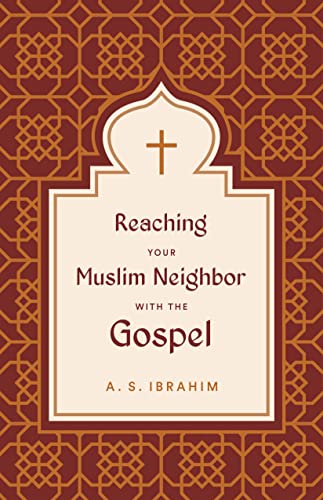
Reaching Your Muslim Neighbor With the Gospel – A.S. Ibrahim

A.S Ibrahim, Reaching Your Muslim Neighbor With the Gospel (Wheaton: Crossway Books, 2022), 176 pp.

God loves Muslims! This theme runs throughout A.S. Ibrahim’s new book, Reaching Your Muslim Neighbor With the Gospel. Dr. Ibrahim grew up in Egypt and trusted Christ at an early age. He is uniquely qualified, then, to write authoritatively about reaching Muslims for Christ.

Part 1: Understanding Muslims and Islam

In part one, the author focuses his attention on the nuts and bolts of Islam. He debunks some myths and misconceptions about Islam, which places readers in a strategic position to evangelize Muslims.

Ibrahim urges evangelists to utilize a Christ-centered strategy and avoid a confrontational approach if possible. The plea is ultimately centered around a relational approach that welcomes Muslims as friends and fellow image-bearers of God. He adds, “A sound theology always begins with this question: ‘What does the Scripture say? (Rom. 4:3). This shapes our evangelism since theology responds biblically to crucial questions related to engaging Muslims with the gospel.’”

Throughout the book, as mentioned above, Dr. Ibrahim encourages Christians to build strong relational bridges with Muslims. This dominant theme will surely bear good fruit that glorifies God as followers of Christ obey the Great Commandment by loving their Islamic neighbors. Breaking bread together, reading together, and sharing time for questions and answers are an important part of this process.

Finally, the author provides several helpful points that enable readers to understand the Islamic worldview. Readers should pay careful attention to this timely wisdom as they make inroads with their Muslim friends.

Part 2: Tools for Evangelizing Muslims

Part two provides a handful of invaluable tools for sharing the gospel with Muslims. Communications principles are set forth and the power of intercessory prayer is explored. The author also includes many dangers to avoid that focus on cultural taboos.

At the heart of the book is a passion for proclaiming Christ to Muslims. This theme emerges most vividly in chapter ten where Dr. Ibrahim urges Christians to simply read the Bible with their Muslim friends. This principle is simple, yet profound as anyone can sit down and read Scripture with a Muslim with an open mind. Reading about Jesus’s miracles and parables is emphasized with the aim of proclaiming the supremacy of Christ. Ultimately, it is the Holy Spirit who draws people to God, overcomes their resistance to the gospel, and regenerates their hearts.

Reaching Your Muslim Neighbor with the Gospel is a must-read for anyone who has a passion to share with unbelieving friends, especially Muslims. The writing is gracious, practical, and most important – biblical. Lord willing, thousands of fruitful evangelistic conversations will take place because of this timely book.

Highly recommended.

I received this book free from the publisher. I was not required to write a positive review.

The Precious Blood – Dustin Benge (2022)

Dustin Benge, The Precious Blood (West Lorne: H&E Publishing, 2022), 149 pp.

“Even before sin entered the human story, God, in his sovereign providence, provided the remedy – the blood of Christ.” So says Dustin Benge in his most recent work, The Precious Blood: The Benefits of the Atonement of Christ.

The author invites readers to discover the multi-faceted work of the cross in nine short chapters. Benge writes with the warmth of Jerry Bridges, the precision of J.I. Packer, and the passion of Martyn Lloyd-Jones. His ability to compose short chapters for lay people that focus like a laser beam on biblical truth is rare in our day.

I urge Christians to pick up a copy of The Precious Blood. Read it. Absorb it. Meditate upon it. Worship God for the wonderful reality of the gospel. And thank him for the precious blood of his Son, the Lord Jesus Christ!

One of the best books of 2022!

Luther’s Augustinian Theology of the Cross – Marco Barone

Marco Barone, Luther’s Augustinian Theology of the Cross (Eugene: Resource Publications, 2017), 145 pp.

Luther’s Augustinian Theology of the Cross by Marco Barone is an illuminating examination of the Protestant Reformer’s view of the gospel. The author seeks to show how Luther’s view coincides with Augustine and ultimately agrees with Scripture.

Barone makes good use of Luther’s Heidelberg Disputation as a means of identifying his theological convictions and concerns. The primary emphasis focuses on free will, the law of God and the works of man, the righteousness of God, and the cross work of Jesus Christ. The author boils down Luther’s view:

Man is not righteous by himself. He does not become righteous by a life of good works, or by the mere acceptance of and conformity to the moral law. Rather, man is declared righteous by a supernatural and graciously free act of God which he performs according to his eternal decree of predestination. Man’s works do not make him righteous. According to Luther’s Augustinian philosophy of the cross, true righteousness is the necessary prerequisite for producing good works.

The most essential feature of the book is understanding the distinction between the theology of the cross (Luther and Augustine) and the theology of glory. The theology of the cross that Luther maintained saw the will as bound in sin. This view holds that sinners can only achieve virtue as a result of receiving the gift of regeneration. Righteousness is “alien” to use a term coined by Luther. The sinner receives Christ’s righteousness by faith alone. And Christ’s redemptive work on the cross is mankind’s only hope for receiving eternal life, which of course is received by grace alone through faith alone.

The so-called theology of glory is diametrically opposed to Luther’s theology of the cross at every juncture. It is man-centered, focused on autonomy and self-effort, and in the end, is Pelagian to the core.

Luther’s Augustinian Theology of the Cross is a welcome addition to the growing scholarly works that examine the German Reformer’s life and theological legacy. Barone’s commitment to raising awareness of Luther’s gospel-centeredness should be celebrated. Additionally, the author should be commended for helping readers detect Pelagianism and Semi-Pelagianism, which holds millions of people captive in our culture.

I received this book free from the publisher. I was not required to write a positive review.

Fight For Your Pastor – Peter Orr

Peter Orr, Fight For Your Pastor (Wheaton: Crossway Books, 2022), 112 pp.

Pastors have a difficult job. They are asked to be top-notch scholars and theologians, counsel hurting people, lead churches with skill and godliness, feed the people of God, and protect the flock from enemies within and without. Peter Orr understands the pressure that pastors face. It was this understanding and sympathy that led him to write, Fight For Your Pastor.

Fight for Your Pastor is a call to people in the pew. It is an urgent plea to cease complaining and criticizing. It is an entreaty for the people of God to come alongside their pastor and encourage him, pray for him, and submit to his leadership.

Orr includes seven chapters that are both encouraging and convicting. Church members will do well to follow the author’s godly counsel and directives. The result will build pastors up and help ensure that the next generation of Christian leaders will be viable and spiritually strengthened for the most difficult job in the world.

The closing words of the author summarize his heart and passion:

In the end, this book sounds a call to abandon a passive, consumerist model of the church. it calls us to abandon the notion that the pastor performs the ministry which we evaluate according to how it benefits us … It is a call for us to be devoted to the work of the Lord. It is a call for us to love and support our pastor. It is a call to fight for him!

I urge Christians to pay heed to Peter Orr’s wisdom. Pick this book and absorb it. Then track down your pastor and fight for him!

I received this book free from the publisher. I was not required to write a positive review.

Workers For Your Joy – David Mathis

David Mathis, Workers For Your Joy (Wheaton: Crossway Books, 2022), 341 pp.

There is a leadership deficit in churches across the nation. A dirth of unqualified leaders fills pulpits and boardrooms that weaken the church and draw criticism from the watching world. David Mathis addresses the important matter of leadership in his book, Workers For Your Joy: The Call of Christ on Christian Leaders.

Mathis’s work is basic in some respects as he alerts his readers to the biblical qualifications for the office of elder. This basic study is a necessary one as many churches have either forgotten or are neglecting the qualifications that appear in Scripture.

The author carefully unpacks each biblical qualification and provides practical examples of how each qualification, giving elders and elders in training an inside look at God’s expectations. The writing is clear, gospel-saturated, and biblically informed. There is no hint of legalism here. Mathis clings tightly to biblical authority but he does so with a gracious tone.

Workers For Your Joy is a much-needed work in our age of pragmatism and man-centeredness. It would be a helpful book for elder training and would also be suitable for Bible College students and Seminarians.

I received this book free from the publisher. I was not required to write a positive review.

The Legacy of Luther – R.C. Sproul and Stephen Nichols, Ed.

lutherR.C. Sproul and Stephen J. Nichols, The Legacy of Luther. Sanford: Reformation Trust Publishing, 2016, 308 pp. $15.66

On October 31, 1517, Martin Luther nailed the Ninety-Five Theses to the castle door in Wittenberg. One act of courage sparked a theological firestorm in Germany that set the world able in a matter of days. Spreading like wildfire, thousands were introduced to the gospel, which is received by grace alone, through faith alone, in Christ alone.

The Legacy of Luther celebrates the accomplishments of this godly man. Edited by R.C. Sproul and Stephen Nichols, the book surveys Luther’s life, thought, and ultimately his legacy. A wide range of pastors and theologians contribute to this volume; men like Steven J. Lawson, Michael Horton, Sinclair Ferguson, and Derek Thomas, to name a few.

The Legacy of Luther is a sweeping look at the German Reformer. The book contains basic information that will appeal to first-time students of Luther. But it is also filled with a wealth of information that will satisfy the most deeply entrenched Luther scholar.

The Legacy of Luther certainly honors a significant man who stands head and shoulders above most others in church history. But at the end of the day, the book does not exalt a man; the book exalts the gospel of grace and celebrates the accomplishments of our Savior. The neglected gospel truths which were recovered by the Reformers are proclaimed with passion in zeal in this important volume.

Readers may be interested in my recently published book, Bold Reformer: Celebrating the Gospel-Centered Convictions of Martin Luther.

What is Saving Faith? – John Piper

John Piper, What is Saving Faith? (Wheaton: Crossway Books, 2022), 300 pp.

In 1986, John Piper penned Desiring God: Meditations of a Christian Hedonist. The thesis of the book is also a reflection of the author’s life, namely, “God is most glorified in us when we are most satisfied in him.” When I picked up Desiring God over thirty years ago, I never dreamed of the impact it would have on my life.

Fast-forward to 2022. John Piper’s book, What is Saving Faith? is really an extension of the arguments that were originally set forth in Desiring God. Piper writes, “God is glorified when he is trusted as true and reliable. He is more glorified when this trust is a treasuring trust – a being satisfied in God as our great reward.”

Dr. Piper is also extending the argument that John MacArthur set forth in his monumental book, The Gospel According to Jesus. Piper argues that saving faith has affectional elements that are absolutely necessary. Faith without these affectional elements is not saving faith.

The central argument that props up Piper’s thesis is receiving Christ as our supreme treasure. The author excavates dozens of Bible passages that help support this claim. In the end, he successfully defends his argument.

What is Saving Faith? is a challenging book. The arguments are tight and the logic is compelling. Sometimes the arguments seem repetitive, which may be intentional or a reflection of this reader’s poor comprehension. In any case, Dr. Piper’s newest work is deeply encouraging and educating. The God-centered themes will surely spark a new generation of faithful evangelism and a host of followers who find their satisfaction in God and the beauty of his Son in the gospel.

I received this book free from the publisher. I was not required to write a positive review.

Truth, Theology, and Perspective – Vern Poythress

Vern S. Poythress, Truth, Theology, and Perspective (Wheaton: Crossway Books, 2022), 160 pp.

Each time Dr. Vern Poythress writes a new book, he offers the church a gift that should be treasured. His keen mind and heart for God are rarities in today’s generation. His newest offering is no exception. In Truth, Theology, and Perspective, Poythress utilizes the theme of truth as a lens (or perspective) to explore the rich themes that emerge in sacred Scripture. What makes this work so unique is that the author uses truth as a primary perspective to shed light on major doctrinal themes. Dr. Poythress adds:

By using truth as a perspective, we hope to encourage readers to appreciate more deeply the biblical teaching and its inner harmony. Any one aspect of doctrine, such as the theme that God is true and that the Bible is true, is in harmony with every other aspect.

The four major themes explored in Truth, Theology, and Perspective include 1) The Doctrine of God, 2) The Doctrine of Man, 3) Redemption, and 4) Application of Redemption.

The final aim of the author emerges near the end of the book. He writes, “To know truth fully is to know God” (p. 144). In the end, Poythress accomplishes his goal which leads people on the path of truth. Indeed, “This increase in knowledge is an increase in possession of the truth and enjoyment of the truth. It goes together with a consummate increase in many other aspects of human existence in communion with God.”

I received this book free from the publisher. I was not required to write a positive review.

Sex, Race, and the Sovereignty of God – John Piper

John Piper, Sex, Race, and the Sovereignty of God (Wheaton: Crossway Books, 2022), 159 pp.

Sex, Race, and the Sovereignty of God by John Piper explores the sweet and bitter providence of God in the book of Ruth. The author lays the book out in a clear and compelling way, inviting readers to engage with God and trust his promises.

Piper’s concluding appeals are worth the price of the book and are worth noting in order:

  1. Study the Scriptures
  2. Pursue Sexual Purity
  3. Pursue Mature Manhood and Womanhood
  4. Embrace Ethnic Diversity
  5. Trust the Sovereignty of God
  6. Take the Risks of Love
  7. Live and Sing to the Glory of Christ

The principles that Dr. Piper articulates will be controversial in some minds. But careful readers will note that he is merely unpacking biblical reality and commending God’s truth for anyone with ears to hear. These principles cut against the grain of postmodern culture and help encourage a strong and robust Christian faith.

The sum of the matter concerns a great eschatological reality. In Piper’s words:

The best is yet to come. That is the unshakable truth about the life of the woman and man who follow Christ in the obedience that flows from faith. I say it to the young who are strong and hopeful, and I say it to the old, for whom the outer nature is quickly wasting away. The best is yet to come. And God is at work in the darkest of your times to get you there.

Sex, Race, and the Sovereignty of God is a deeply encouraging book. It will challenge and encourage anyone who has a heart that heeds the Word of God!

I received this book free from the publisher. I was not required to write a positive review.

Give Me Understanding That I May Live – Mark Talbot

Mark Talbot, Give Me Understanding That I May Live (Wheaton: Crossway Books, 2022), 236 pp.

Give Me Understanding That I May Live by Mark Talbot addresses the topic of suffering with the heart of a shepherd and biblical faithfulness. The author presents a well-rounded framework for understanding suffering in categories that are clear and compelling. The author observes:

Suffering prompts us to reconsider our lives now, before it is too late. It can burn the fat off our hearts, teaching us by God’s grace to delight in his ways.

Dr. Talbot has the ability to weave answers to the thorny subject of suffering through a redemptive grid that is helpful and encouraging.

I received this book free from the publisher. I was not required to write a positive review.