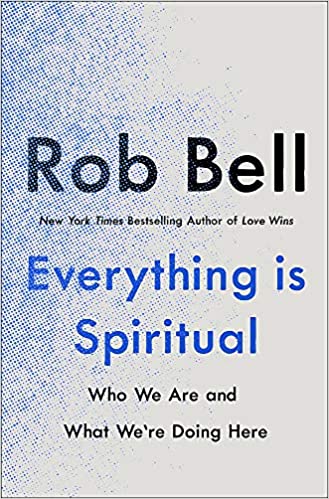
Everything is Spiritual – Rob Bell

Rob Bell, Everything is Spiritual (New York: St. Martin’s Publishing Group, 2020), 310 pp.

In 2011, I reviewed Love Wins, my first book by Rob Bell. The piece prompted praise by conservatives and vicious scorn by progressive Christians and liberals. Whatever anyone thinks about Bell, one thing is for sure: the guy can write. He is a master communicator. And whenever he writes or talks, people listen.

Anyone familiar with Rob Bell knows that he is somewhat of a gadfly among evangelicals. And “gadfly” is a massive understatement. But there is something endearing about Bell. Some point to his skill. Others are impressed with his intellect. For me, I’ve always been drawn to Bell’s ability to communicate what he’s truly feeling – including insecurity, childhood pain, or unfulfilled expectations. He identifies a “generational lack of grace,” a trait that is found too often in the church. His transparency is refreshing and his candor is something that is greatly needed in our day.

While I applaud Bell’s transparency, I have expressed deep concern with some of the theological and philosophical assertions that he has proposed. His most recent book, Everything Is Spiritual is no exception. Michael Eric Dyson’s endorsement of the book provides a revealing summary:

“In Everything Is Spiritual, Rob Bell updates Teilhard de Chardin’s Catholic mysticism, makes sexier Werner Heisenberg’s quantum physics, and baptizes Jewish Kabbalah in an exciting vision of the future of human evolution. Bell challenges the notion that science and belief are at war, with his sublime fusion of Christian faith and modern evolutionary science. Bell’s book is the perfect antidote to the plague of an evangelical worldview that is captive to imperial dreams and a literalism that kills the spirit of Christianity …”

I will argue in this review that while Michael Eric Dyson truly does capture the essence of Bell’s intentions in Everything Is Spiritual, the end result is unhelpful and spiritually dangerous. Instead of illumination, readers will be left in a quagmire – with more questions than answers. And they will wander aimlessly in a spiritual wasteland, armed with an inaccurate portrait of God that leaves them hopeless without the biblical gospel.

No Final Answer

One of the common themes in Bell’s writing is ambiguity. He extinguishes certitude and exalts mystery (both of which are fundamental tenets of postmodernism). Careful readers will notice that the author is quick to pay lip service to Christian theology but swiftly degenerates into a subtle (or not so subtle man-made philosophy). The Bible warns, “For the time is coming when people will not endure sound teaching, but having itching ears they will accumulate for themselves teachers to suit their own passions, and will turn away from listening to the truth and wander off into myths” (2 Tim. 4:3-4, ESV).

Tragically, many have been deceived by Bell’s “spirit myths” over the years. For instance, in Bell’s book, What We Talk About When We Talk About God, he argues that God is “with us, for us, and ahead of us – all of us.” The notion that God is “with us,” “for us,” and “ahead of us (every single one of us) may sound good initially but falls short of the biblical model. It is true that God is “with” his people. We see this especially in the incarnation of Jesus, the One who is named Immanuel – or God with us (Matt. 1:23). Yet God is not “with” the man who has rejected the revelation of God in Christ. God is not “with” the one who rejects the Lord Jesus Christ and his gospel. “… Whoever does not obey the Son shall not see life, but the wrath of God remains on him” (John 3:36).

It is true that God is “for us” – that is to say, he is for his people. “For I am sure that neither death nor life, nor angels nor rulers, nor things present nor things to come, nor powers, nor height nor depth, nor anything else in all creation, will be able to separate us from the love of God in Christ Jesus our Lord” (Rom. 8:38–39, ESV). Yet, God is not “for” the man who repudiates the promises and purposes of God. The holy God opposes the proud (Jas. 4:6; 1 Pet. 5:5).

I referred to Paul’s warning in 2 Tim. 4:3-4 again and again as I read Everything is Spiritual. Indeed, doctrine is downplayed and orthodoxy is questioned. But not everything is ambiguous. As he did in Love Wins, Bell dogmatically casts aside the doctrine of hell: “Because some stories are better than others. Stories about a God who tortures people forever in hell shouldn’t be told. They’re terrible stories. They make people miserable. They make people want to kill themselves. Stories that insist that a few human beings are going to be okay and every other human being ever is doomed for eternity are horrible stories.”

In a magical twist, certitude suddenly reappears! Alas, the painful reality is obvious here: Anyone who bemoans doctrine is in fact, dogmatic themselves! It appears, then, that the dogmatic bark is worse than the bite.

No Final Authority

To make matters worse, no final authority is offered in Everything Is Spiritual. It is difficult to determine if Bell embraces pantheism, panentheism or some other theological construct. Whatever the case, the book makes much of God’s immanence and downplays his transcendence.

But what is missing here is a distinction between the Creator and the creature. Missing is a Creator who is sovereign over creation and rules over all. Bell’s account of God is noted in the biblical exchange with Moses who refers to himself as I AM. So far so good. But notice how Bell’s understanding of God undermines the Creator/creature distinction:

Moses wants to locate God, and what Moses gets is Everywhere. Moses wants something to wrap his mind around, and what he gets is All of it.

What an answer. Another way you could say I AM is Being Itself.

That’s past, that’s present, that’s future. All of it. Being Itself, the formless beyond any one form, animating all forms. The electricity the entire thing is plugged into. The water it’s all swimming in.

That’s every you that ever was and ever will be. All your yous.

Later, Bell refers once again to “Being Itself. I AM.” He writes, “You ground yourself in that, and you’re all of it. You root yourself in the source and Spirit beyond all these forms and categories and labels, you listen to that and follow that and you keep going.” Bell refers to this as the “collective unity of humanity,” or “the body of Christ.” He adds, “All of us humans ever, across time, all together, adding up to something. The body of Christ.”

Not only does this line of reasoning militate against the Creator/creature distinction; it misleads readers into believing that they are members of Christ’s body, when the unbelieving world is described as enemies of God and under his holy wrath.

Acts 17:22-31 reveals a Creator God who is the cosmos shaper, the kingdom shaker who lives above creation. He is the all-sufficient Ruler, Life-Giver, and Destiny Maker. And he is the righteous Judge who “commands all people everywhere to repent, because he has fixed a day on which he will judge the world in righteousness by a man whom he has appointed …” (Acts 17:30-31, ESV).

And Scripture speaks of the creature who was created by God (Gen. 2:7). The creatures (Adam and Eve) were originally free from sin but fell and as a result became sinners by nature and by choice (Gen. 3:1-7). As such, these sinful creatures have no inherent righteousness, no desire for God (Rom. 3:10-11). Subsequently, all creatures are born with a hatred in their hearts for God (Rom. 8:7-8). They are dead in sin (Eph. 2:1-3), and they are enslaved in sin; totally unable to come to Christ apart from God’s empowerment (John 6:44). These creatures are dependent upon God for everything. While they have the ability to make free choices, these choices are determined in eternity past (Acts 17:26; Prov. 19:21; 21:1). And these creatures are accountable to a righteous and sovereign Judge (Rom. 2:5-11).

As such, there is no final authority in Everything is Spiritual. Bell writes, “God is not detached from the world, up there, or above, or somewhere else, that would make God a form like everything else.” So, we are left with the strange and unbiblical blending of the Creator and the creature.

No Exclusive Path

One of the reasons that people are drawn to Bell is because he refuses to be boxed in by a religious system or creed. He is quick to jettison the traditional path and proudly promotes another route: “And then there was soul. This deeper voice within me telling me another truth, coaxing me to rethink what success even is. I had my own path, and it wasn’t this, and what you do with a path is you walk it … But walking your path, when you’re surrounded by multiple voices with strong opinions about what you should be doing, that takes tremendous spinal fortitude.”

“Spinal fortitude,” is to be commended. The problem is that Scripture points to one path – the path that Jesus describes as “narrow.” Jesus says, “Enter by the narrow gate. For the gate is wide and the way is easy that leads to destruction, and those who enter by it are many. For the gate is narrow and the way is hard that leads to life, and those who find it are few” (Matt. 7:13-14).

One of the primary arguments in Bell’s book is that “everything is spiritual.” He refers to Christ, who holds all things together: “All of it. All of us. Everybody, everywhere, in Christ.” He rightly notes how every person is created with dignity and honor and possesses “infinite worth and value.” But things take a tragic turn for the worse. For the one who pursues his own path, according to Bell, is something of a radical. In a stunning admission, Bell acknowledges: “The radical is not the person who wandered off the path into the deep weeds. The radical is the one who went back to the origins, to the roots, to how it all began. Sometimes the tribe has lost its way, sometimes the ones claiming to be orthodox, correct, pure ones have gone off the rails, sometimes it’s the mother ship that has lost its bearing, and it’s the radical who’s actually rediscovering the true path.”

Radicals like Jan Hus and Martin Luther rediscovered the true path when they embraced biblical authority and the gospel of Jesus. But Bell is not referring to these stalwarts of the faith. Rather, he is referring to those who dare to break free from the chains of orthodoxy. After all, writes Bell, “You aren’t an object, you aren’t a pawn … you possess Spirit. Personal, intimate, infinite, knowing, Spirit. You reflect the divine, present in each of us. You’re in Christ.

No exclusive path is necessary since we are “in Christ,” according to Bell. This theme emerged clearly in Love Wins as Bell undercut sovereign grace by arguing that God draws all people to himself. He writes, “ … We see that Jesus himself, again and again, demonstrates how seriously he takes his role in saving and rescuing and redeeming not just everything, but everybody.”

But Scripture stands in opposition to this theme. The Bible never declares that all people are “in Christ” as Bell supposes. Rather, each person is born in Adam and experiences death as a result (Rom. 5:12-21). Jesus never promises to rescue and redeem all people. Rather, people are assured that they will receive eternal life and forgiveness if they turn from their sin and trust the Lord Jesus Christ (John 3:15-16; 6:37, 47; 7:38; 8:12; Acts 4:12; Rom. 10:9-13, 17). When a person trusts in Christ alone for their salvation, then and only then, are they truly “in Christ.”

Bell’s “gospel” is described as “the divine announcement that you are loved and accepted exactly as you are, that everything has been taken care of, that everything you’ve been striving to earn has been yours the entire time, that you belong, in exactly this condition that you are currently in, nothing additional required or needed.” Readers are left, then, with more ambiguity. Whose “gospel” is Bell describing? And does this “gospel” tolerate sin? Does this “gospel” lay down demands? Is surrender required? Belief? Repentance? Is this “gospel” inclusive or is it exclusive? Is this “gospel light?” Or is this the “gospel” that Scripture refers to as a “different gospel” (Gal. 1:6)?

The matter of the gospel has eternal implications. The apostle Paul warns the Christians in Galatia to beware of those who “distort the gospel of Christ” (Gal. 1:7). He continues, “But even if we or an angel from heaven should preach to you a gospel contrary to the one we preached to you, let him be accursed. As we have said before, so now I say again: If anyone is preaching to you a gospel contrary to the one you received, let him be accursed” (Gal. 1:8-9, ESV).

The biblical gospel or the “good news” of God begins with God. It declares that God is sovereign and holy. It tells us that God created people for his glory (Isa. 43:7). It tells us that people are sinners by nature and by choice (Rom. 3:23; 5:12). The gospel warns us that God is just and that he has the right to punish sin and that unrepentant people will endure the wrath of God for eternity (Rom. 6:23; John 3:36). The gospel tells us about a Savior who will destroy death and rescue his creatures from the power of sin and the penalty of sin. And one day this gospel will rescue followers of Jesus from sin’s very presence.

The gospel distinguishes between the Creator and the creature. Peter Jones adds, “The Bible warns us not to worship the creation but to worship and serve only the Creator. The starting point of gospel truth is that God the Creator, in the three persons of the divine Trinity – Father, Son and Holy Spirit – is the one and only God and that all which is not God was created by him … The Christian faith maintains a separateness between God and His creation.”1 The gospel makes provision for sin, exalts the crucified and risen Savior, and reconciles sinners to a holy God.

Tragically, the biblical gospel is jettisoned in Everything is Spiritual. The gospel is reduced to a “divine announcement” of acceptance. This soft, inclusive “gospel” is a different gospel that Scripture condemns (Gal. 1:6, 9).

Summary

“Everything is spiritual.” The very idea sounds so very, well … spiritual. And people who flock to read the musings of Bell continue in a trancelike state like they’ve been doing for years. But the author makes a very revealing statement near the end of the book. He writes, “I want to help people rediscover the wonder and awe of their existence.” Yet, no final answer is given. No final authority is offered. And no exclusive path is revealed. Instead of rediscovering “the wonder and awe of their existence,” readers are left wandering in an existential fog, unaware of the Creator God who made all things for his glory; the transcendent God who sovereignly rules and reigns; the God who sent his Son to rescue sinners, redeem them, and bless them with eternal life.

Michael Eric Dyson refers to Bell’s book as “a perfect spiritual antidote to the plague of an evangelical worldview that is captive to imperial dreams and a literalism that kills the spirit of Christianity.” Nothing could be further from the truth. The message that Rob Bell presents in this book is anything but spiritual. Instead, it offers a syncretistic concoction of worldly philosophy that leads the unsuspecting on a path to divine judgment. That’s a far cry from an antidote. Poison doesn’t cure disease. Poison kills the unsuspecting.

  1. Peter Jones, Gospel Truth, Pagan Lies: Can You Tell the Difference? (Enumclaw: Winepress Publishing, 1999), 23-24.

Worship the King!

Imagine the opportunity to visit the highest court in the land – the United States Supreme Court. You have the privilege of meeting some of the most influential men and women in our country. These judges have positions of power and authority that most can scarcely understand.

But in an ironic twist, you approach the bench wearing cut-off shorts, a tank top, and flip-flops. As you move closer, you can see Chief Justice Roberts and you utter these words: “Dude, what’s goin’ down?” And you proceed to give high-fives to the remaining justices. “Unfathomable, you think.” These men and women deserve our respect. How much more unfathomable when we enter the presence of God with a casual attitude that is marked by irreverence and indifference.

Have you ever found yourself entering God’s presence with the wrong attitude in your heart? When Moses approached the burning bush, God reinforced his authority and holiness: “Do not come ear; take your sandals off your feet, for the place on which you are standing is holy ground. And he said, ‘I am the God of your father, the God of Abraham, the God of Isaac, and the God of Jacob.’ And Moses hid his face, for he was afraid to look at God” (Exod. 3:5-6, ESV).

Uzzah approached God casually as he reached out to steady the ark of God. He knew what the law of God required. He knew that the ark was to be equipped with rings and poles (Exod. 25:12-14) and carried on the should of the priests. He knew that he was prohibited from touching the ark, lest he die (Num. 4:15). In 2 Samuel 6:7, the oxen stumbles, and Uzzah reaches his hand to steady the ark: “And the anger of the LORD was kindled against Uzzah, and God struck him down there because of his error and he died there beside the ark of God.”

We approach God in a casual way when we refer to him in flippant language like “the man upstairs.” We approach God in a casual way when we are inattentive in worship. We approach God casually, when our minds wander in worship and when we fail to honor him as we ought. And we approach God in a casual way when we discount any of his attributes or fail to embrace the biblical portrait of God.

Have you cherished notions of God that are not true? Had you subtlety stripped him of any of his attributes? Do you recoil when you hear about his sovereignty over all things? His wrath? His omnipotence?

“To devise any image of God is itself impious; because by this corruption His majesty is adulterated, and He is figured to be other than He is.”1 Calvin adds, “Therefore, to devise any image of God is itself impious; because by this corruption His majesty is adulterated, and He is figured to be other than He is.”2

What is the proper approach to the supreme Judge, the majestic God of the universe? Psalm 99:1-5 provides the proper perspective:

“The Lord reigns; let the peoples tremble! He sits enthroned upon the cherubim; let the earth quake! The Lord is great in Zion; he is exalted over all the peoples. Let them praise your great and awesome name! Holy is he! The King in his might loves justice. You have established equity; you have executed justice and righteousness in Jacob. Exalt the Lord our God; worship at his footstool! Holy is he! Moses and Aaron were among his priests, Samuel also was among those who called upon his name. They called to the Lord, and he answered them. In the pillar of the cloud he spoke to them; they kept his testimonies and the statute that he gave them. O Lord our God, you answered them; you were a forgiving God to them, but an avenger of their wrongdoings. Exalt the Lord our God, and worship at his holy mountain; for the Lord our God is holy!”

WE MUST REALIZE THE CHARACTER OF THE KING

His Kingly Authority

The first aspect of God’s kingly authority is that he reigns (Ps. 99:1). Yahweh is the covenant name of God (Exod. 3:14-15). Scripture declares Yahweh’s lordship over all things (Deut. 6:4-5). As such, he deserves our undivided love, devotion, and worship.

God acts to advance his glory so that people might know that he is the LORD. He hardens Pharaoh’s heart (Exod. 14:40. He rescues Israel (Exod. 6:7). He judges Egypt (Exod. 7:5). In each of these specific instances, we learn about God’s kingly authority. We learn that he is the LORD. Pay close attention to three important aspects of God’s reign.

Yahweh reigns sovereignly. God is completely sovereign. His sovereignty is implicit to his name. James Boice adds, “God has the right and power and wisdom to do whatever makes him happy. None of his purposes can be frustrated.”3 The psalmist proclaims, “Our God is in the heavens; he does all that he pleases.”4

Yahweh reigns over a kingdom. ”For his dominion is an everlasting dominion, and his kingdom is from generation to generation” (Dan. 4:24, ESV). George Eldon Ladd explains, “The Kingdom of God is basically the rule of God. It is God’s reign, the divine sovereignty in action … The Kingdom of God … is the realization of God’s will and the enjoyment of the accompanying blessings.”5

Yahweh’s reign is eternal. His reign is from all eternity. “The LORD reigns; he is robed in majesty; the LORD is robed; he has put on strength as his belt … Your throne is established from of old; you are from everlasting” (Ps. 93:1a-2). Psalm 47:8 says “God reigns over the nations; God sits on his holy throne.”

He reigns presently. “The LORD reigns, let the earth rejoice; let the many coastlands be glad” (Ps. 97:1, ESV).

His reign extends into the future. “The LORD will reign forever, your God, O Zion to all generations. Praise the LORD” (Ps. 146:10). John Piper observes, “Thus the declaration that God does all that he pleases is a declaration of power. This is what we mean by sovereignty – God’s power always makes way for his perfections to be expressed according to his pleasure.”6

Second, the LORD is great (Ps. 99:2). Over and over, the Scriptures testify to the greatness of God:

“You shall not be in dread of them, for the Lord your God is in your midst, a great and awesome God.” (Deuteronomy 7:21, ESV)

“For the Lord your God is God of gods and Lord of lords, the great, the mighty, and the awesome God, who is not partial and takes no bribe.” (Deuteronomy 10:17, ESV)

“For the Lord your God is God of gods and Lord of lords, the great, the mighty, and the awesome God, who is not partial and takes no bribe.” (Deuteronomy 10:17, ESV)

“God thunders wondrously with his voice; he does great things that we cannot comprehend.” (Job 37:5, ESV)

Third, the LORD is exalted over all peoples (Ps. 99:2). Jonathan Edwards observes, “The truth is, men have low thoughts of God, or else they would willingly ascribe sovereignty to him in this matter … Be still and know that he is God … You shall either know it for your good here, by submission, or to your cost hereafter.”7

Fourth, the LORD is awesome(Ps. 99:3). Edwards says, “God’s CHIEF affection consists in regard to HIMSELF, infinitely above his regard to all other things …”8 The Word of God affirms this stunning reality:

“Yet he saved them for his name’s sake, that he might make known his mighty power.” (Psalm 106:8, ESV)

““I, I am he who blots out your transgressions for my own sake, and I will not remember your sins.” (Isaiah 43:25, ESV)

“For my own sake, for my own sake, I do it, for how should my name be profaned? My glory I will not give to another.” (Isaiah 48:11, ESV)

Fifth, the LORD is holy (Ps. 99:3, 5). God is utterly set apart and holy. He is the majestic God who is pure. Spurgeon says, “In him is no flaw or fault, excess or deficiency, error or iniquity. He is wholly excellent and is therefore called holy. In his words, thoughts, acts, and revelations as well as in himself, he is perfections itself.”9

The sixth aspect of God’s kingly authority is this: The LORD is just (Ps. 99:4). The sovereign God who reigns always does so in a righteous manner. It is impossible for God to be unjust (Rom. 9:14-16). R.C. Sproul clarifies this crucial reality: “Let’s assume that all men are guilty in the sight of God. From that mass of guilty humanity, God sovereignly decides to give mercy to some of them. What do the rest get? They get justice. The saved get mercy and the unsaved get justice. Nobody gets injustice.”10

The proper approach to God is to realize the character of the King; the LORD who reigns; the LORD who is great and exalted over all peoples; the LORD who is awesome; the LORD who is holy; the LORD who is just! But we must not only realize the character of the King; we must respond correctly to him.

WE MUST RESPOND CORRECTLY TO THE KING

Three Important Responses to God’s Authority

First, we tremble before the LORD (Ps. 99:1).

We tremble because we are in the presence of royalty. We stand before the Sovereign King who reigns. Note the correlation between the character of the King and our correct response:

“The awe or ‘dread’ may indeed be so overwhelmingly great that it seems to penetrate to the very marrow, making the man’s hair bristle and his limbs quake … The ‘shudder’ reappears in a form ennobled beyond measure where the soul is held speechless, trembles inwardly to the farthest fibre of its being. It invades the mind mightily in Christian worship with the words, ‘Holy, holy, holy.’”11

Second, we praise the LORD(Ps. 99:3).

The essence of praise is giving thanks and bowing before his lordship. Praise is the appropriate response to God’s great and awesome name. Since God has a passion to spread his glory to all the earth, we too are to make his glory our end.

Third, we bow before the LORD (Ps. 99:5).

Worship involves bowing down and revering the LORD: “To worship is to quicken the conscience by the holiness of God, to feed the mind with the truth of God, to purge the imagination by the beauty of God, to open the heart to the love of God, to devote the will to the purpose of God.”12

What Does This Approach to God Look Like in our Daily Lives?

The correct response to God involves daily contrition. When we are contrite before God, we admit our propensity to drink from dirty fountains and run to God’s inexhaustible fountain. Nothing can replace humility, brokenness, and a soft heart before the living God (Isa. 66:2).

The correct response to God involves a vigorous pursuit of joy in God. This pursuit is a daily battle; a veritable fight for joy.

Finally, the correct response to God involves glorifying God no matter what the cost. The great Scottish runner, Eric Liddel said, “When I run I feel his pleasure.” How can we do any less?

Conclusion

The proper approach to God, then, is to realize the character of the King and respond correctly to the King. Jonathan Edwards reveals the importance of this Godward approach: “The truth is, men have low thoughts of God, or else they would willingly ascribe sovereignty to him in this matter … Be still and know that he is God … You shall either know it for your good here, by submission or to your cost hereafter.” As we realize that we stand in the presence of royalty, we respond correctly with a heart of reverence. Pascal says, “The infinite abyss can only be filled by an infinite and immutable object, that is to say, only by God himself.”13 As we draw near to the majesty of God, we will never be the same. So — worship the King!

  1. J.I. Packer, Knowing God (Downers Grove: Intervarsity Press, 1973), 39.
  2. John Calvin, Cited in Ibid.
  3. James Boice, The Sovereign God (Downers Grove: InterVarsity Press, 1978), 149-150.
  4. Psalm 115:3, ESV.
  5. George Eldon Ladd, The Gospel of the Kingdom (Grand Rapids: Eerdmans Publishing Company, 1959), 24.
  6. John Piper, The Pleasures of God (Portland: Multnomah Books, 1991), 52.
  7. Jonathan Edwards, The Sole Consideration, That God is God, Sufficient to Still All Objections to His Sovereignty (Edinburgh: Banner of Truth Trust, 1834), 110.
  8. Jonathan Edwards, A Dissertation Concerning the End For Which God Created the World in The Works of Jonathan Edwards (Edinburgh: Banner of Truth Trust, 1834), 108-109.
  9. Charles H. Spurgeon, The Treasury of David, 223.
  10. R.C. Sproul, Chosen By God (Wheaton: Tyndale House Publishers, 1986), 37-38.
  11. Rudolph Otto, The Idea of the Holy (London: Oxford University Press, 1950), 16.
  12. William Temple, Cited in Richard Foster, Celebration of Discipline (New York: Harper and Row, 1978), 158.
  13. Blaise Pascal, Pascal’s Pensees, trans. by W.F. Trotter (New York: E.P. Dutton, 1958), 113.

The Eternity of Hell Torments – Jonathan Edwards (1739)

Jonathan_Edwards_engravingThe doctrine of hell is under attack.  The opposition to eternal punishment is more diverse than one might expect as unbelieving philosophers and some pastors in the emergent church seek to extinguish this doctrine once and for all.

In the 18th century, people opposed hell as well.  Yet it was taught with more faithfulness and fervency than most pulpits in these days.  Jonathan Edwards’ sermon, The Eternity of Hell Torments is a fitting example of this faithfulness and fervency.

The text is Matthew 25:46 – These shall go away into everlasting punishment.  Two initial observations are advanced:

  1. The duration of the punishment on which they are here said to enter: it is called everlasting punishment.
  2. The time of their entrance on this everlasting punishment.

The doctrine as also set forth:

The misery of the wicked in hell will be absolutely eternal.

With the presuppositions and doctrine in place, Edwards moves forward by advancing four key points.

1. It is not contrary to the divine perfections to inflict on wicked men a punishment that is absolutely eternal.

Edwards argues that sin deserves such a punishment, namely, “that sin is heinous enough to deserve such a punishment, and such a punishment is no more than proportionable to the evil or demerit of sin.”

It is not contrary to God’s mercy to inflict eternal punishment on sinful men. Indeed, “It would be a great defect, and not a perfection, in the sovereign and supreme Judge of the world, to be merciful in such a sense that he could not bear to have penal justice executed.”

2. The eternal death which God threatens, is not annihilation, but an abiding sensible punishment or misery.

The Scripture never hints at the God-dishonoring doctrine of annihilation – a doctrine that surfaces in Edwards day and is even more popular now.  The argument against annihilation is clearly articulated here.

3. This misery will not only continue for a very long time, but will be absolutely without end.

Edwards utilizes several exegetical, grammatical, and biblical  arguments to point readers to the reality of eternal punishment.  “Such expressions,” says the Puritan divine, “are used to set forth the duration of the punishment of the wicked, as are never used in the scriptures of the New Testament to signify any thing but a proper eternity.”

4. Various good ends will be obtained by the eternal punishment of the wicked.

Edwards presents four good ends of eternal punishment:

  • Hereby God vindicates his injured majesty.
  • God glorifies his justice.
  • God hereby indirectly glorifies his grace on the vessels of mercy.
  • The sight of hell torments will exalt the happiness of the saints forever.

He notes, “The sight of the wonderful power, the great and dreadful majesty, and awful justice and holiness of God, manifested in the eternal punishment of ungodly men, will make them prize his favor and love vastly the more; and they will be so much the more happy in the enjoyment of it.”

Application

In typical Edwardsean fashion, the author concludes by setting forth three important points of application:

  1. Be entreated to consider attentively how great and awful a thing eternity is.
  2. Do but consider how dreadful despair will be in such torment.
  3. That you may effectually escape these dreadful and eternal torments, be entreated to flee and embrace him who came into the world for the very end of saving sinners from these torments, who has paid the whole debt due to the divine law, and exhausted eternal in temporal sufferings.

And Edwards directs the attention of every reader to Christ and his gospel:

Justice therefore never can be actually satisfied in your damnation; but it is actually satisfied in Christ.  Therefore he is accepted of the Father, and therefore all who believe are accepted and justified in him.  Therefore believe in him, come to him, commit your souls to him to be saved by him.  In him you shall be safe from the eternal torments of hell.


God the Best Portion of the Christian – Jonathan Edwards (1736)

Two hundred years after Calvin published his first edition of The jonathan-edwardsInstitutes, Jonathan Edwards preached a sermon about being content in God.  The title of the sermon was God the Best Portion of the Christian.  Edwards’s text is Psalm 73:25:

Whom have I in heaven but thee? and there is none upon earth that I desire besides thee.

The central truth is set forth at the beginning of the sermon, in deductive fashion: It is the spirit of a truly godly man, to prefer God before all other things, either in heaven or on earth.

Two propositions comprise this short sermon

1. A godly man prefers God before anything else in heaven.

Edwards presents the God-centered paradigm in this section by leading readers on the correct biblical path.  He notes, “Every godly man hath his heart in heaven; his affections are mainly set on what is to be had there.  Heaven is his chosen country and inheritance.”

The godly man sets his affection on beauty, which is to say his heart is oriented to God and the things of God.  “Now the main reason why the godly man hath his heart thus to heaven,” writes Edwards, “is because God is there; that is the palace of the Most High.  It is the place where God is gloriously present, where his love is gloriously manifested, where the godly may be with him, see him as he is, and love, serve, praise, and enjoy him perfectly.”

2. It is the temper of a godly man to prefer God before all other things on the earth.

The highest priority for the follower of Christ, according to Edwards is on the Triune God.  Three points highlight the heart of the Puritan preacher:

  1. The saint prefers that enjoyment of God, for which he hopes hereafter, to anything in the world.
  2. The saints prefer what of God may be obtained in this life before all things in the world.
  3. The saints prefer what he hath already of God before anything in this world.

Application

As usual, Edwards concludes his sermon with several points of application.  Five penetrating questions are posed:

  1. What is it which chiefly makes you desire to go to heaven when you die?
  2. If you could avoid death and might have your free choice, would you choose to live always in this world without God, rather than in his time to leave the world, in order to be with him?
  3. Do you prefer Christ to all others as the way to heaven?
  4. If you might go to heaven in what course you please, would you prefer to all others the way of a strict walk with God?
  5. Were you to spend your eternity in this world, would you choose rather to live in mean and low circumstances with the gracious presence of God, to live forever in earthly prosperity without him?

Jonathan Edwards offers perspective and godly wisdom in a sermon that directed his 18th-century hearers heavenward and continues to beckon followers of Christ to the Celestial City.

The Most High A Prayer Hearing God – Jonathan Edwards (1735)

jonathan-edwards

Psalm 65:2 is Edwards text in the winter of 1735, January 8.

O you who hears prayer, to you shall all flesh come.

Doctrine – It is the character of the Most High, that he is a God who answers prayer.

Four headings drive the sermon.

1. The Most High is a God that Hears Prayer

Though he is infinitely above all, and stands in no need of creatures; yet he is graciously pleased to take a merciful notice of poor worms in the dust.

Edwards argues that God not only accepts the supplications of all the saints; he does so willingly with favor.  He adds, “While they are praying, he gives them sweet views of his glorious grace, purity, sufficiency, and sovereignty; and enables them, with great quietness, to rest in him, to leave themselves and their prayers with him, submitting to his will, and trusting in his grace and faithfulness.”

2. He is Eminently Such a God

Edwards provides several examples of how God answers prayer:

  • In his giving such free access to him by prayer.
  • That God is eminently of this character, appears in his hearing prayer so readily.
  • That the Most High is eminently one that hears prayer, appears by his giving so liberally in answer to prayer.
  • That God is eminently of this character, appears by the greatness of the things which he hath often done in answer to prayer.
  • This truth appears, in that God is, as it were, overcome by prayer.

3. Reasons for the Doctrine

A crucial point that Edwards makes is that God answers prayer because “he is a God of infinite grace and mercy.”

  • He hath by his blood made atonement for sin; so that our guilt need not stand in the way, as a separating wall between God and us, and that our sins might not be a cloud through which our prayers cannot pass.
  • Christ, by his obedience, has purchased this privilege, viz, that the prayers of those who believe in him should be heard.
  • Christ enforces the prayers of his people, by his intercession at the right hand of God in heaven.

Application

Edwards draws out many practical applications, the chief of which alerts the saints to make good use of prayer; to be prayer warriors in this wicked age.

Seeing we have such a prayer-hearing God as we have heard, let us be much employed in the duty of prayer: let us pray with all prayer and supplication: let us live prayerful lives, continuing instant in prayer, watching thereuto with all perseverance; praying always, without ceasing, earnestly, and not fainting.

A Dozen Things God Did With Your Sin – Sam Storms

Sam Storms, A Dozen Things God Did With Your Sin (Wheaton: Crossway Books, 2022), 216 pp.

“The life, death, and resurrection of Jesus are thus to be seen as the pivotal chapter in the unfolding story of God’s redemptive purpose for humanity.” So, says Sam Storms in his recent book, A Dozen Things God Did With Your Sin. Storms masterfully unpacks the gospel in a way that is readable, compelling, and biblical.

The author’s aim is to encourage readers who struggle with embracing their identity in Christ: “It comes down to one thing and one thing only: you and I have failed to believe what God himself says he has done with our sins.” To help overcome this massive theological blunder, the author draws a crucial distinction between our eternal union with God and our experiential communion with him. The remainder of the book draws on this distinction and reminds readers that:

  • Their sins have been forgiven.
  • They are adopted by God.
  • They are ransomed from the power and penalty of sin.
  • They are in union with Christ – forever.
  • They are reconciled to God.
  • They have been delivered from the wrath of God.
  • They are seated together with Christ in heavenly places.

Storms adds, “My union with God is unchanged by my sin, but my communion with God certainly suffers … My capacity to enjoy and feel the glory of being a child of God can be undermined by unrepentant sin.”

With the proper biblical foundation in place, the author unveils twelve things that God did with our sin. Each chapter unfolds God’s activity and highlights the redemptive benefits of Christ and his gospel.

The book concludes by revealing three things God doesn’t and never will do with our sin. In the end, A Dozen Things God Did With Your Sin is an elaborate explanation of the gospel of Jesus Christ. It is a book that should be read and studied over and over again. Sam Storms should be applauded for writing such an accessible book that can be absorbed by people in the pew and passed along to the next generation!

I received this book free from the publisher. I was not required to write a positive review.

Nothing But the Truth

Scripture warns, “See to it that no one takes you captive by philosophy and empty deceit, according to human tradition, according to the elemental spirits of the world, and not according to Christ” (Col. 2:8, ESV). As followers of Christ, we need to be vigilant, constantly on guard, and discerning good from evil. One of the ways that the worldly system “takes us captive” is by marginalizing truth or eliminating it altogether. It is important to understand that the worldly system militates against the Christian view of truth. Is it any wonder, then, that the importance of truth is highlighted so much in Scripture?

David Understood the Importance of Truth

King David acknowledged that since God is truth, he expects his people to live truthful lives. He writes, “Behold, you delight in truth in the inward being, and you teach me wisdom in the secret heart” (Ps. 51:6, ESV).

The implications of David’s words are massive as we consider our inward motivations, conversations, and the way we conduct our lives. Ask yourself, “Am I a person that is committed to the truth?” “Does the love for truth undergird my life and worldview?”

Paul Spoke Often About the Truth

The apostle begins the book of Titus with these revealing words: “Paul, a servant of God and an apostle of Jesus Christ, for the sake of the faith of God’s elect and their knowledge of the truth, which accords with godliness” (Titus 1:1, ESV) . Notice the relationship between truth and godliness. Indeed, they are intimately connected. “The truth of the Gospel,” writes Warren Wiersbe, “changes a life from ungodliness.”1 As Christians, we unapologetically adhere to the truth. We must not only adhere to the truth; it must stand at the very center of our lives.

Additionally, Paul referred to the church as ” … a pillar and buttress of the truth” (1 Tim. 3:15, ESV). The church, then, is God’s appointed means of declaring the word of God to the nations. Ask yourself, “How is God using me to declare the truth to my community?” “How is God using me to declare the truth to the nations?”

Paul Warned People Who Abandon the Truth

Scripture is packed with examples of people who abandoned the truth. Paul writes, “This testimony is true. Therefore rebuke them sharply, that they may be sound in the faith, not devoting themselves to Jewish myths and the commands of people who turn away from the truth” (Titus 1:13–14, ESV). Tragically, this trend continues in our generation. Young people are turning away from the truth by the thousands. College students are manipulated and deceived by professors who peddle a worldview that opposes historic Christianity. Hearts are cold to God’s revealed truth. Ask yourself, “Am I pursuing the truth or am I fleeing from the truth?” “Do I have a sinful unbelieving heart that is turning away from the living God?” (Heb. 3:12).

Peter Pressed Home the Importance of Truth.

Peter is an interesting character to be sure. Here is a man who denied Jesus, the very embodiment of truth – three times! Yet, he was forgiven and restored and was used in a mighty way to spread a passion for the truth of God:

Having purified your souls by your obedience to the truth for a sincere brotherly love, love one another earnestly from a pure heart … (1 Peter 1:22, ESV).

Ask yourself, “Do I obey the truth?” “Am I established in the truth?”

John Had a Passion for the Truth.

The apostle John was a warm-hearted Christian thinker who had a passion for the truth. Listen to how this God-centered man expressed his love for the truth:

Little children, let us not love in word or talk but in deed and in truth (1 John 3:18, ESV).

I have no greater joy than to hear that my children are walking in the truth (3 John 4, ESV) .

Jesus Spoke Plainly About the Truth

Finally, we turn our attention to Jesus, the One who made the startling claim that he was in fact the way, the truth, and the life (John 14:6). The importance that Jesus attaches to truth cannot be denied:

Sanctify them in the truth; your word is truth (John 17:17, ESV).

… and you will know the truth, and the truth will set you free (John 8:32, ESV)

Conclusion

All spiritual growth is based on a knowledge of truth. Yet countless people, even people in the church are discarding truth and walking down paths that fail to honor and glorify God. Al Mohler warns, “Departing a Christian worldview leads to a distrust of final truth and a rejection of universal authority, which then hides the way back to the God of the Bible.”2 As followers of Jesus Christ, may we cling to the truth, proclaim the truth, and defend the truth. May we stand with the men and women throughout redemptive history who were willing to lay their lives down for the great cause of truth. May the cry of our hearts be, “nothing but the truth!”

  1. Wiersbe, W. W. (1996). The Bible exposition commentary (Vol. 2, p. 260). Wheaton, IL: Victor Books.
  2. Albert Mohler, The Gathering Storm: Secularism: Culture, and the Church (Nashville: Thomas Nelson, 2020), 11.

THE FLIP THAT FLOPPED: The Consequences of Doctrinal Compromise

flip

In Doug Pagitt’s book, Flipped, the author sets out to fundamentally transform the classical view of God.   This transformation is creative and innovative.  It is intuitive and will attract the attention of many readers.

Pagitt sets forth three goals at the beginning of the book:

  1. To see that changing your mind, drawing new conclusions, and engaging new ideas all lie at the heart of Jesus’s message and life.
  2. To behold the big, beautiful story of God as you find new ways to live in it.
  3. To invite readers to a full and vibrant life in God.

The basic idea that runs through this book is what the author refers to as a “flip” – which is nothing short of revising one’s views about God, Scripture, and the Christian life in general.  Pagitt adds, “The Flip at the center of this book is one that turned me around as a pastor and a Christian writer as well as my personal life and faith.”

The Flip That Flopped

Several “flips” are addressed in this work.  But the one that keeps surfacing concerns a fundamental misunderstanding of the nature of God.  At the heart of this book is a commitment to panentheism.  This worldview, also known as process theology is a radical departure from the traditional understanding of God, yet is receiving a hearing in the emergent church and some liberal churches.  One might consider such a view a halfway house between theism and pantheism.  But make no mistake – panentheism is outside the scope of historical orthodoxy.

All is in God?

To be fair, the author never uses the word, panentheism.  Yet this panentheistic theme runs throughout the book.  Pagitt argues, “God is not a separate single subject … If God were not a separate being from all things in the cosmos, then we need not simply say God exists.  We can say that God is existence.  All is in God.”  Such language is the classic lingo of panentheism.

My initial impression: Surely this is a typo!  The author can’t possibly mean what he is saying.  But as I continued to read, my suspicions were confirmed.  “… All that exists is In God,” writes Pagitt.  He tries to justify this “flip” by appealing to the rationale from Acts 17:28 where Paul quotes Epimenides of Crete: “In him, we live and move and have our being.

In addition to promoting panentheism, the author posits the notion of universalism: “Beyond that, the power of God that was alive in Jesus is alive in us.  In short, the fullness of God is active in humanity without assistance from any religious system.”  He continues, “Instead, we can recognize that all people live, move, and exist In God.”

Evaluation

Flipped is a radical departure from the biblical understanding of God.  The notion that all people “exist In God” simply fails to match the biblical data.  Much to the contrary, we find a distinction between the Creator and the creature.  Whenever one denies such a distinction he makes a dangerous theological move with several critical implications.  What are the implications of denying the Creator-creature distinction?

  • Misreads and misinterprets Scripture.
  • Compromises God’s character.
  • Compromises biblical authority.
  • Minimizes the transcendence of God and emphasizes the immanence of God in biblically inappropriate ways.

Readers should recall how God is truly presented in Scripture.  He is never presented in a panentheistic scheme – ever!  Rather, he is presented as the absolute personal God.  This absolute God is transcendent; that is to say, he is over and above the scope of the universe.  He is distinct and independent of his creation (Isa. 57:15; Isa. 40:10).  He is preeminent  (Isa. 40:25-28; 44:6-8).  Jonathan Edwards adds, “His power is infinite, and none can resist him.  His riches are immense and inexhaustible.  His majesty is infinitely awful.”  And God carries supreme authority over all.  Nothing rivals the supreme authority of God (Job 41:10; 37:9-14).

The Triune God holds all things together.  In a few words, St. Paul demonstrates both the transcendence and the imminence of God: “For by him all things were created, in heaven and on earth, visible and invisible; whether thrones or dominions or rulers or authorities – all things were created through him and for him.  And he is before all things, and in him, all things hold together” (Col. 1:16-17, ESV).  God is sovereign (Dan. 4:34-35).  Nothing can thwart his sovereign decrees!  He is distinct from the created order (Acts 17:24-29).  And the Bible tells us that God is wholly other (Isa. 46:9).  This is a far cry from people who “exist In God.”

God is not only absolute; he is personal.  He cares for his creation.  He is intimately involved with his creation and he delights to meet the needs of his creatures.

God is the Sustainer (Col. 1:17; Heb. 1:3).  He is the Healer (2 Chron. 7:14).  He is the Protector (2 Sam. 22:2).  He is the Shepherd (Ps. 23:1-6).  He is the Forgiver (Rom. 5:1).  And Scripture demonstrates the ultimate love that God expressed on the Cross when Jesus died for sinners (Rom. 5:8).

Flipped will likely attract many readers; especially readers who are committed to theological liberalism.  The author seeks to fundamentally transform the vision of God by convincing readers that  “… All that exists is In God.”  The only problem: The view presented here is dead wrong.

A.W. Tozer understood the importance of getting God right.  He rightly noted in his best-selling book, The Knowledge of God:

The gravest question before the Church is always God Himself, and the most [awe-inspiring] fact about any man is not what he at a given time may say or do, but what he in his heart conceives God to be like … So necessary to the Church is a lofty concept of God that when that concept in any measure declines, the Church with her worship and her moral standards decline along with it.  The first step down for any church is taken when it surrenders its high opinion of God.

May followers of Christ heed Tozer’s advice.  We certainly do not need to flip our views of God.  Any deviation from the biblical vision of God will have tragic consequences in the church and the culture in which she seeks to minister.  Any flip will become a flop that ignores the clear teaching of Scripture.

I received this book free from the publisher.   I was not required to write a positive review. 

R.C. Sproul: Defender of the Reformed Faith – Nate Pickowicz

Dr. R.C. Sproul was a theological titan, teacher, preacher, and defender of the gospel of Jesus Christ. He articulated the deep realities of the gospel in simple terms and invited anyone with ears to hear to come along for the ride. R.C. urged us to memorize Luther’s famous line that “justification is the article upon which the church stands or falls.” Nate Pickowicz captures the essence of Sproul’s life and legacy in his outstanding book, R.C. Sproul: Defender of the Reformed Faith.

Pickowicz beautifully summarizes Sproul’s life, theological commitments, and accomplishments in a short readable volume. Readers unfamiliar with R.C. Sproul will be implored to get busy reading; those who followed Sproul’s ministry will be drawn in, challenged intellectually, and moved deeply in the heart.

I urge followers of Christ to read and reflect on R.C. Sproul: Defender of the Reformed Faith.

The Safety Zone

Psalm 2:7-12

The opening verses of Psalm 2 unveil the rebels who resist the authority of God. This passage reveals the posture of rebels who are poised to dethrone God. These rebels rage against God and plot against him (v. 1). They oppose the LORD and his anointed (v. 2). These rebels make autonomy their ultimate goal (v. 3). They want to be free from God’s demands. They want to be free from God’s laws. And these recalcitrant rebels seek freedom from God’s reign and his rule.

Here’s the fascinating irony: Every rebel who searches for freedom apart from God is in bondage, and will, in the final analysis, be subjected to the almighty wrath of God. When you flee from Christ to be free from Christ you build a self-imposed prison around your life. Stated another way, when you submit to Christ’s lordship, you will rest securely in your newfound freedom.

The essential message of Psalm 2:1-5 is this: We enter the danger zone when we resist God’s rule and reign in our lives. How then, should people live before God? Psalm 2:6-12 provides an important answer. We will learn that rebels must recognize Christ’s right to rule and respond reverently to his kingly authority. Then and only then, will we find ourselves in the safety zone.

RECOGNIZE HIS RIGHT TO RULE

God possesses royal authority. He is a transcendent and majestic God who deserves our unhindered reverence and obedience. Notice several aspects of his kingly reign.

The Components of God’s Kingly Reign

First, the installation of the King (v. 6). There is a crucial distinction here between the Father and the Son: “As for me, I have set my King on Zion, on my holy hill.” Note the exalted status of his kingly reign. To set someone in a particular place suggests a unique position.

Christ is presented as his enemies’ King. C.H. Spurgeon says, “What are all the mighty men, the great, the honorable men of the earth to Jesus Christ? They are but like a little bubble in the water; for if all the nations, in comparison to God, be but as the drop in the bucket, or the dust in the balance (Isa. 40:25), how little they must be the kings of the earth!”1 Christ is presented as his saints’ King. Christ rules “over their wills, over their affections, over their judgments and understandings, and nobody hath anything to do here but Christ,” writes Spurgeon.2 Christ is presented as his Father’s King. Christ not only rules in the hearts of his people; he rules over a “providential kingdom, by which he rules the affairs of this world, and so he is the king of nations.”3

Psalm 99:1-5 emphasizes this reign. Indeed, his reign is righteous, sovereign, and omnipotent. His is a just and holy reign. This is the kind of King you would want to serve. This is the kind of King you would want to submit to. This is the kind of King you can find refuge in!

Second, we learn about the position of the King (v. 7). The Son speaks of a decree: “God’s decrees are the wise, free, and holy acts of the counsel of his will, whereby, from all eternity, he hath, for his own glory, unchangeably foreordained whatsoever comes to pass in time.”4

The decree tells of the eternal begetting of the Son. The Nicene Creed (revised in 381) confesses faith in “one Lord Jesus Christ, the only-begotten Son of God, begotten from the Father before all time, Light from Light true God from true God, begotten not created.”

John Frame helps us understand the meaning of the term, begotten:

Among human beings, begetting normally occurs in a sexual relationship. It occurs in time so that a human being who did not exist at one time comes into existence at a later time. But eternal begetting is surely neither sexual nor temporal, nor does it bring into existence someone who otherwise would not have existed, for God is a necessary being, and all three divine persons share the attribute of necessary existence.5

Third, Psalm 2:8 describes the inheritance of the King: “As of me, and I will make the nations your heritage, and the ends of the earth your possession.” The inheritance of Christ is absolutely comprehensive. There is nothing outside the scope of his sovereign control. That is, his kingly reign knows no bounds. He owns everything; he rules over everything and everyone. He is sovereign over the nations; he is sovereign over rulers; he is sovereign over our decisions; he is sovereign over our wills; he is sovereign over all. “For from him and through him and to him are all things. To him be the glory, forever. Amen” (Rom. 12:36). Abraham Kuyper rightly observes, “There is not a square inch in the whole domain of our human existence over which Christ, who is Sovereign over all, does not cry, ‘Mine!’”

Fourth, Psalm 2:9 describes the judgment of the King. The focus on verse 9 is on them. The focus is on the rebels who resist God’s rightful rule and reign in their lives. The focus is on the rebels who refuse to recognize Christ’s right to rule. John Stott describes the judgment of God as his “steady, unrelenting, unremitting, uncompromising, antagonism to evil in all its forms and manifestations.”6

Are you numbered among the rebels who refuse to recognize Christ’s right to rule and reign in your life? There comes a time when every person is faced with a reality check. Christ has been installed as the King. He has a high and holy position. Indeed, he is exalted above everything and everyone. He will judge every person who resists his rightful rule and reign. His wrath will fall on every person who refuses to recognize his sovereign rule. With the reality before us, the psalmist helps rebels understand this important principle: We must not only recognize Christ’s right to rule; we must respond reverently to his kingly authority!

RESPOND REVERENTLY TO HIS KINGLY AUTHORITY

Pay careful attention! This passage is marked off by the words, “Now, therefore” (v. 10). The psalmist urges us to “be wise.” He urges us to “be warned.” Three responses, therefore, are appropriate from those who respond reverently to his kingly authority.

Three Responses

First, serve Christ. ”Serve the LORD with fear, and rejoice with trembling” (Ps. 2:11). The Hebrew term for serve means “to work; to toil; to accomplish something.” But the word also has the flavor of worship:

““And now, Israel, what does the Lord your God require of you, but to fear the Lord your God, to walk in all his ways, to love him, to serve the Lord your God with all your heart and with all your soul,” (Deuteronomy 10:12, ESV).

“You shall walk after the Lord your God and fear him and keep his commandments and obey his voice, and you shall serve him and hold fast to him.” (Deuteronomy 13:4, ESV)

Serve the Lord with gladness! Come into his presence with singing!” (Psalm 100:2, ESV)

Serving Christ, according to Psalm 2:11 involves serving the LORD with fear. “Genuine faith is expressed in, and animated by, a reverential awe, and this is the basic meaning of the biblical idea of the fear of God. Unless there is personal awareness of the awesome and majestic sovereignty of God, it is impossible to have a meaningful faith existing in one’s heart.”7 God-centered fear is struck with the majesty of God, which expresses reverence to him. God-centered fear involves a mixture of rejoicing and trembling. When we come into his presence, we are filled with joy and Christ-exalting awe!

Second, submit to Christ. ”Kiss the Son, lest he be angry, and you perish in the way …” (v. 12a). Remember, this King as been installed. His is a lofty position. And his inheritance includes all things. Our responsibility, then, is to kiss the Son. That is, we must submit to the One who is sovereign over all things:

  • We submit to him when he calls us to love our neighbors.
  • We submit to him when he calls us to love our enemies.
  • We submit to him when he calls us to put him first – above all things.
  • We submit to him when he demands us to repudiate our idols.
  • We submit to Christ by laying down our arms, turning from our rebellion, and by turning to him in faith.
  • We kiss the Son.

The consequences are terrible and traumatic for anyone who refuses to submit to God and kiss the Son, namely, the almighty wrath of God. This is a punishment that the unrepentant will endure eternally. John writes, “Whoever believes in the Son has eternal life; whoever does not obey the Son shall not see life, but the wrath of God remains on him” (John 3:36, ESV).

Responding reverently to Christ’s authority involves serving him and submitting to him. But there is a third requirement, namely, satisfaction in Christ. The Bible speaks of the one who takes refuge in Christ. To seek refuge is to find safety. To find safety is to be satisfied and to find refuge under his wings (Ps. 36:7; Ruth 2:12). God is called a child for those who take refuge in him (2 Sam. 22:31). Over and over again, we are told in Scripture that the one who takes refuge in Christ will be blessed:

“But let all who take refuge in you rejoice; let them ever sing for joy, and spread your protection over them, that those who love your name may exult in you.” (Psalm 5:11, ESV)

“Oh, taste and see that the Lord is good! Blessed is the man who takes refuge in him!” (Psalm 34:8, ESV)

“The Lord is good, a stronghold in the day of trouble; he knows those who take refuge in him.” (Nahum 1:7, ESV)

The sum total of service, submission, and finding satisfaction in Christ boils down to this: it involves living a repentant life; one that responds reverently to his kingly authority. You show me a person who refuses to serve Christ, submit to Christ, and find satisfaction in him and I’ll show you a person who has no clue about living a repentant life. Robert Letham says, “In short, the believer is a repentant believer or he is no believer at all.”

But you show me a person who recognizes Christ’s right to rule and responds reverently to his kingly authority, I’ll show you a person who is truly blessed; a person who is living in the safety zone.

What is the proper response to Christ’s kingly authority? We are to respond reverently by serving him, submitting to him, and finding our satisfaction in him. Each response is an act of worship.

Are you responding reverently to Christ’s kingly authority? Can you say that your service to God is a reflection of how you respond to him? Do you submit to his authority? Do you humbly submit to the authority of your employer? Wives, do you humbly submit to the authority of your husband? Children, do you humbly submit to the authority of your parents? Each of these questions is a snapshot of how you respond to the kingly authority of the Lord Jesus Christ.

Conclusion

We must recognize Christ’s right to rule and respond reverently to his kingly authority. And we respond reverently to his kingly authority by serving Christ, submitting to Christ, and finding our satisfaction in Christ.

Recognizing Christ’s right to rule and responding reverently to his kingly authority is another way of saying that you are exercising faith in God. Several years ago, I served at a church that tore down a building that was packed with asbestos. We hired a firm to remove the hazardous material. Here’s what we were told: Anyone on the premises must wear a hazmat (hazardous materials) suit which is combined with a self-contained breathing apparatus.

Faith in Christ is the “hazmat suit” that shields us from the wrath of God. Don’t presume upon God’s grace. All rebels will face God’s almighty wrath. But everyone who believes in Christ and his triumphant work on the cross will know eternal life and stand secure in the safety zone!

We must recognize Christ’s right to rule and respond reverently to his kingly authority. And we respond reverently to his kingly authority by serving Christ, submitting to Christ, and finding our satisfaction in Christ. Then and only then, will we find ourselves standing in the safety zone.

Soli Deo Gloria!

  1. C.H. Spurgeon, The Treasury of David (Peabody: Hendrickson), 16.
  2. Ibid.
  3. Ibid.
  4. WLC, 12.
  5. John Frame, The Doctrine of God (Phillipsburg: Presbyterian and Reformed, 2002), 21.
  6. John Stott, The Cross of Christ (Downers Grove: InterVarsity Press, 1986), 173.
  7. Wlwell, W.A., & Beitzel, B.J. (1988). Baker Encyclopedia of the Bible (782). Grand Rapids: Baker Book House.