Dangerous Calling – Paul David Tripp

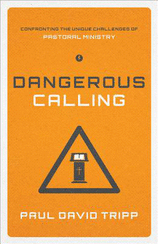
1433535823_lPaul David Tripp’s book has been titled incorrectly.  Dangerous Calling should be titled, Lessons in the Woodshed.  The author guides pastors to the woodshed again and again and again.  While this is clearly not the most glowing and winsome way to begin a book review, readers will see firsthand that the author is committed to telling pastors the truth and leading them out of the desert of sin and into the high places of victory.

Part One:

In the opening section, Tripp explores pastoral culture and expresses deep concern from the start.  His primary argument: Many pastors are headed in the wrong direction – and fast!  The author draws the reader in by using his own life and ministry as an example of one who was headed for disaster – both in his ministry and in his marriage.  Evidently, pastors around the country are in a similar situation.  Some pastors are ignoring the need for biblical community, neglecting personal worship and devotional priorities, and carry the attitude that they have “arrived.”

Part Two:

Next, Tripp uncovers a problem among pastors that appears to be somewhat of an epidemic, namely – the danger of forgetting the majesty of God: “It is that familiarity with the things of God will cause you to lose your awe.  You’ve spent so much time in Scripture that its grand redemptive narrative, with its expansive wisdom, doesn’t excite you anymore.”

Tripp reminds pastors to regain their sense of awe by cultivating humility, tenderness, passion for the gospel, confidence, discipline, and rest.  He urges pastors, “… Run now, run quickly to your Father of awesome glory.  Confess the offense of your boredom.  Plead for eyes that are open to the 360-degree, 24/7 display of glory to which you have been blind … And remind yourself to be thankful for Jesus, who offers you his grace even at those moments when that grace isn’t nearly as valuable to you as it should be.”

Part Three:

Finally, Tripp warns pastors of the danger of “arrival.”  He confronts the propensity of pastors who falsely assume that they have nothing more to learn, what he refers to as “self-glory.”  His challenge is bold and timely: “You and I must not become pastors who are all too aware of our positions.  We must not give way to protecting and polishing our power and prominence.  We must resist feeling privileged, special, or in a different category.  We must not think of ourselves as deserving or entitled.  We must not demand to be treated differently or put on some ministry pedestal.  We must not minister from above but from alongside.”  Challenges and admonition like this appear throughout the book; challenges that call pastors to be servant leaders.

 Each page is filled with sobering challenges for men who call themselves a pastor/shepherd/elder.  Indeed, there are many  “lessons in the woodshed” but the author does not leave pastors in a hopeless condition.  Rather, he applies the gospel to pastors who have been wounded in light of unconfessed sin, pride, and arrogance.   I believe that Paul David Tripp has accurately accessed the condition of pastoral ministry.  But the assessment is not the most important observation.  What stands at the center of this discussion is the gospel.  Pastors must return again and again to the gospel.  It is true that pastors must deliver the message of the gospel from the pulpit each week.  But pastors must also preach the gospel to themselves.  They must see themselves as recipients of grace; sinners in need of grace; sinners in need of forgiveness.  May God raise up a new generation of pastors who are humble, contrite, and tremble at God’s Word (Isa. 66:2b).

5 stars

Christian Ethics: An Introduction to Biblical Moral Reasoning

grudemWayne Grudem, Christian Ethics: An Introduction to Biblical Moral Reasoning (Wheaton: Crossway Books, 2018), 1212 pp.

Wayne Grudem has become a household name in evangelical circles over the years. His landmark book, Systematic Theology, is used in Bible Colleges and Seminaries around the world. I have personally taught through his excellent book at least six times. As a result, hundreds of men and women have been equipped and edified in the Christian faith.

Dr. Grudem’s newest offering, Christian Ethics: An Introduction to Biblical Moral Reasoning is a wonderful companion to Systematic Theology. The book weighs in at over 1,200 pages and will likely turn some readers away. But walking away from Grudem’s book would be like gazing at a massive treasure chest and refusing to open it for lack of time or desire. Both responses would be tantamount to foolishness.

The introduction alone is worth the price of the book as the author establishes the foundation for Christian ethics by grounding his discussion in the holy character of God and sacred Scripture. Indeed, the essence of Christian ethics is living Coram Deo, and to the glory of God.

The remainder of the book is organized around the Ten Commandments. The basic outline is as follows:

  • Protecting God’s Honor
  • Protecting Human Authority
  • Protecting Human Life
  • Protecting Life
  • Protecting Property
  • Protecting Purity of Heart

Grudem does not leave any stone unturned here. Every ethical topic imaginable is explored. Each topic, of course, is subjected to uncompromising biblical standards.

Christian Ethics is a breath of fresh air that will embolden followers of Jesus Christ and challenge them to live with God-centered resolve in a postmodern ethos that has forgotten God. It is not only a response to the zeitgeist that surrounds us; it is a rally-cry for faithful Christians to live in a way that pleases the triune God!

I received this book free from the publisher. I was not required to write a positive review.

The Aging Brain – Timothy Jennings

brainTimothy R. Jennings, The Aging Brain: Proven Steps to Prevent Dementia and Sharpen Your Mind (Grand Rapids: Baker Books, 2018), 283 pp.

The Aging Brain by Timothy R. Jennings, MD addresses the growing problem of dementia and Alzheimer’s disease. At the heart of this book is the idea that these pathological states may in some cases be avoided with a healthy lifestyle and choices. The book is arranged in four parts:

Part 1: History and Aging

The author is realistic in his assessment of aging. He understands that aging is a normal part of life and is a result of the Fall. But the effects of aging can be curtailed through a series of lifestyle changes. “The purpose of this book,” writes Dr. Jennings, “is to lead people to healthier lives, which slow the aging process and reduce the risk of dementia.”

One of the central takeaways of Part 1 is that a healthy brain requires a healthy body. So the author recommends a series of lifestyle changes including proper nutrition and regular exercise as a means of preventative care.

Part 2: Oxidative Stress and Aging

In my mind, Part 2 is the most helpful and most interesting section of The Aging Brain. Dr. Jennings discusses the three factors that lead to oxidative stress (inflammation) and aging which include obesity, sugar, and toxins (tobacco, illegal substances, and alcohol abuse). The author includes several actions steps that lead readers in a direction of health, which in the final analysis result in a healthier brain and longevity.

Part 3: Lifestyle and Aging

Part 3 includes several practical steps that lead to brain health including exercise, sleep, regular rest (sabbaticals), a healthy worldview, and stress management.

Part 4: Pathological Aging

Part 4 focuses on Alzheimer’s disease, more practical steps to help prevent dementia, and a short section that describes how to care for a loved one with dementia.

Critique

The Aging Brain is a helpful resource for anyone who seeks help in understanding the various pathological states, such as dementia. The medical and scientific discussion is readable and accessible to anyone who is willing to put in the time for study.

One of the most attractive features of The Aging Brain is the learning points that the author concludes at the close of each chapter. Also included is an action plan. Here, the author suggests practical steps for moving in a healthy direction that promotes brain health.

While much of the book is helpful, The Aging Brain does not come without weaknesses. First, the author refers in some places to God as the “higher power.” I understand his desire to reach a broad base of readers who may not be followers of Christ. However, the reference to God as a “higher power” is not only unhelpful; it proves harmful as readers may be subtly encouraged to turn to a false god.

Second, the author discourages readers from believing in a deity who is a “punishing god.” It is unclear whether he means the “punishing god” of Islam or the God of the Bible who is a God of wrath and promises to punish every unrepentant person, in the final analysis (John 3:36; 1 Thes. 1:9-10).

Third, the promotion of self-forgiveness is included which proves unhelpful and ultimately, idolatrous.

Summary

These theological disagreements are significant but should not prevent readers from benefiting from the medical wisdom that explodes from this book. Throwing out the baby with the bathwater would be a mistake. Instead, I urge readers to carefully digest the material in The Aging Brain which will involve biblical discernment and discretion.

I received this book free from the publisher. I was not required to write a positive review.

Walk On – Ben Malcolmson

ben.jpgBen Malcolmson, Walk On (New York: Waterbrook, 2018), 209 pp.

Walk On by is the inspirational tale of a young man who dared to follow his dreams onto the football field and beyond. Ben Malcolmson dreamed the impossible when he decided to play as a “walk on” during his days at the University of Southern California. Pete Carroll was the coach during those days which makes for a very interesting story.

Malcolmson not only shares the story about his athletic pursuits; he clearly describes how his relationship with Jesus Christ began and was fostered in those early days at USC.

Sports enthusiasts will appreciate Malcolmson’s heart, passion, and grit. His love for God shines clearly in these pages as he gives honor and glory to his Savior for enables his hands and guiding his feet.

I received this book free from the publisher. I was not required to write a positive review.

Hope of Nations: Standing Strong in a Post-Truth, Post-Christian World – John S. Dickerson

hopeJohn S. Dickerson, Hope of Nations: Standing Strong in a Post-Truth, Post-Christian World (Grand Rapids: Zondervan, 2018), 313 pp.

Hope of Nations: Standing Strong in a Post-Truth, Post-Christian World by John S. Dickerson addresses the rising tide of pluralism in America and offers real hope for Christians who seek to be faithful to God. The thesis of the book is stated clearly:

“In the next three decades, Post-Truth thinking will overtake Truth-Based thinking in the United States, resulting in massive societal implications for all Americans. Meanwhile, massive global conflicts of ideology will be playing out beyond the US, and eventually these globally dominant ideologies will affect a less globally dominant US, which will rank about third in global power.”

The book is arranged in three parts. Part 1 asks, “What is Happening, and Why?” The author discusses the current ideological climate and includes five forces that merit further explanation:

  1. Humans are Sinning
  2. Satan is Scheming
  3. Ideologies are Warring
  4. Western Civilization is Unraveling
  5. Christ and His People are Prevailing

Part 2 asks the question, “Where Will It Lead?” Dickerson discusses nine post-Christian trends that Christians will face:

  1. A World that is Post-Christian
  2. A World That is Post-Truth
  3. A World That is Post-Knowledge
  4. A World That is Post-Church
  5. A World That is Post-Decency
  6. A World That is Post-Human
  7. A World That is Post-Prosperity
  8. A World That is Post-Liberty
  9. A World That is Post-Peace

Part 3 asks, “How Will We Live?” This question, which was originally asked and answered by Francis Schaeffer rescued this book. In the closing pages, the author moves from diagnosis to a prescriptive mentality. Nine resolutions are presented for Christians who seek to live faithfully in a postmodern milieu. The author encourages nine “postures,” which provide hope for moving forward:

  1. We Will Remain Rooted to the Christian Scriptures
  2. We Will Train Our Young
  3. We Will Be Known for Doing Good
  4. We Will Dignify All People as Image Bearers of God
  5. We Will be Ambassadors
  6. We Will Love our Persecutors
  7. We Will Remain Calm
  8. We Will be Invincible
  9. We Will be Fearless

Each posture is developed and readers are encouraged to stand strong in a post-truth, post-Christian world.

Hope of Nations is more of a sociological study that an apologetic mandate. Quotes are endlessly highlighted throughout the book in bold font. This practice becomes tedious and annoys thoughtful readers who would just assume highlight these passages on their own. Apart from these concerns, readers will benefit from this book so long as they understand the book’s purpose. Personally, I would encourage more interaction with Scripture, which is ultimately where readers find their hope, even in a post-truth, post-Christian world.

I received this book free from the publisher. I was not required to write a positive review.

12 Faithful Men: Portraits of Courageous Endurance in Pastoral Ministry

12Collin Hansen and Jeff Robinson, Eds. 12 Faithful Men (Grand Rapids: Baker Books, 2018), 187 pp.

12 Faithful Men is a collection of portraits that capture the lives and ministries of godly men, scattered throughout church history. These men come from a variety of backgrounds and have all made significant contributions to the kingdom of God.

Collin Hansen and Jeff Robinson serve as editors of this project and enlist the help of several other pastors and scholars who paint short portraits of these faithful men. What makes this volume so valuable is that each of the twelve men has faced significant pain, suffering, or persecution in ministry. The men include the apostle Paul, John Calvin, John Bunyan, Jonathan Edwards, John Newton, Andrew Fuller, Charles Simeon, John Chavis, C.H. Spurgeon, J.C. Ryle, Janani Luwum, and Wang Ming-Dao.

Most of the faithful men featured in this book are well-known names. The portraits are painted with skill, passion, and biblical wisdom. They are short introductions that will likely prompt some readers to do a more in-depth study. A few of the faithful men in this volume are lesser known figures, most notably, Janani Luwum and Wang Ming-Dao.

Each portrait is an invitation to pursue a life and ministry, which is tethered to sacrifice and suffering. The clear message is that ministry entails suffering and that God uses adversity to mark a man and make a man. And while each portrait provides a basic glimpse of one of these twelve faithful men, the greater message is that God is exalted and glorified in each of these men.

I received this book free from the publisher. I was not required to write a positive review.

Spiritual Gifts: What They Are and Why They Matter – Thomas Schreiner (2018)

schreinerThomas R. Schreiner, Spiritual Gifts: What They Are & Why They Matter (Nashville: B&H Publishing Group, 2018), 172 pp.

The subject of spiritual gifts is an ongoing topic in the church that often times generates more heat than light. The matter of the sign gifts, in particular, is especially controversial. Continuationists set forth arguments in favor of the sign gifts. And advocates of cessationism do the same, marshaling arguments in the opposite direction. It is not unusual for the two sides to polarize, leading brothers and sisters in Christ in opposite directions.

Thomas R. Schreiner’s book, Spiritual Gifts: What They Are & Why They Matter offers a different approach, which seeks to unify continuationists and cessastionists. Alert readers will notice that Dr. Schreiner dedicates the book to three well-known continuationists: Wayne Grudem, John Piper, and Sam Storms. They are referred to as “Beloved friends and coworkers in the gospel of Christ.” So immediately, it is apparent that Schreiner has motives which are virtuous and seek to unify.

The author begins by noting the general strengths and weaknesses of the charismatic movement. This delicate task is done in a humble, tasteful manner.  After establishing the pros and cons of the charismatic movement, Schreiner launches into a discussion that concerns the spiritual gifts. He defines these gifts and offers ten foundational truths that help establish their importance.

The sign gifts are discussed in general as Schreiner presents the nature and significance of the gift of tongues in particular. Additionally, the author familiarizes readers with some erroneous arguments for cessatioinism. But the book concludes with the central argument for cessastionism. Schreiner writes, “The basis for cessationism is the claim that the church was ‘built on the foundation of the apostles and prophets’ (Eph. 2:20). This argument is developed and convincingly presented.

Whether readers agree or disagree with the presentation and conclusions of the author, all will appreciate his careful exegesis, humility, and desire to build bridges with brothers and sisters whose hearts yearn to please the Lord.

I received this book free from the publisher. I was not required to write a positive review.

A Call For Courage – Michael Anthony (2018)

callMichael Anthony, A Call For Courage (Nashville: Thomas Nelson, 2018), 219 pp.

A Call For Courage by Michael Anthony seeks to embolden and inspire readers and spur them to live courageous Christian lives. The book is specifically designed to “spark a genuine spiritual awakening” which will spill over into every arena of daily life.

Anthony sets the stage by providing relevant facts that pertain to the postmodern times we find ourselves in. He makes it clear that truth is disregarded and sometimes even discarded. The remedy involves Christian courage which withstands every assault and persecution that is unleashed by people who are hostile to biblical principles.

Courageous Humility in Action

Each chapter concludes with a point of practical application, which is entitled courageous humility in action. The very idea of courageous humility is countercultural in and of itself is the most commendable aspect of this volume. It is rare to find someone who incarnates these both courage and humility. People tend to be courageous, yet lack humility. Or they manifest the quality of humility but they battle a subtle cowardice. The author strikes the biblical balance by combining these two necessary character qualities.

One criticism is worth noting as readers are encouraged to “rediscover, re-embrace, and reteach the Declaration of Independence, the Bill of Rights, and our Constitution, along with the historical contexts in which they were forged.” I certainly understand the sentiment and personally celebrate these documents. But turning to the founding documents, in the final analysis, is not the solution to the postmodern dilemma. The solution lies in turning to the Lord Jesus Christ, turning from our sins, and living according to the Word of God.

This objection notwithstanding, A Call For Courage is a helpful book, one that will spark good discussion and instill humble courage in the hearts of God’s people.

I received this book free from the publisher. I was not required to write a positive review.

When Through Deep Waters – Rachelle Dekker

dekRachelle Dekker, When Through Deep Waters (Carol Stream: Tyndale House Publishers, 2018), 370 pp.

When Through Deep Waters is the latest book from thriller writer, Rachelle Dekker.  This gifted writer tells the tale of a young woman who tragically stares into the face of evil after the death of her young daughter. Gripped with deep spiritual and psychological sorrow, Alicen McCaffrey makes her way to the Clover Mountain Retreat Center in Deer Lodge Montana for help and healing.

Dekker does a marvelous job recounting Alicen’s pain and the guilt associated with her circumstances. In the midst of her misery, Alicen encounters strange psychological phenomena that readers must decipher on their own. Victoria is another character who emerges in the story. At first glance, she appears eager to help Alicen but not only has baggage of her own; she plans her own brand of evil, in the final analysis.

When Through the Deep Waters beautifully showcases the writing ability of Rachelle Dekker. She writes with the precision of Stephen King and the perception of C.S. Lewis. Dekker has a unique ability to paint pictures with words, tell stories with extraordinary clarity, and hauntingly draws readers into the narrative.

Dekker forces readers to wrestle with evil and spiritual warfare. But the higher purpose of her writing is to alert readers to the reality of grace, which is precisely where this review takes an unfortunate turn. The theme that reaches a crescendo in this book is self-forgiveness. When Alicen discovers grace, what she ultimately discovers is the importance of “forgiving herself.” This notion is a reoccurring theme in the evangelical world – a mantra that I hear often in personal conversations and read in many so-called Christian books.  However, “forgiving oneself” is never found in the pages of Scripture. Instead, sinners are both invited and commanded to “Believe in the Lord Jesus, and you will be saved …” (Acts 16:31, ESV).“ Sinners are never once commanded to “forgive themselves.” Rather, they are invited to come to the cross to receive forgiveness. “Blessed are those whose lawless deeds are forgiven, and whose sins are covered,“ says Romans 4:7. And Colossians 2:13 reveals that “God made alive together with him, having forgiven us all our trespasses.” Instead of “forgiving ourselves,” Scripture calls us to trust in Jesus, our Substitute (2 Cor. 5:21). He is the only One qualified to forgive us and cleanse us from unrighteousness.

When Through Deep Waters is a book I wanted to like. The storytelling is compelling. And the characters are interesting. But the underlying theology is not helpful and leads readers down a path that is not an accurate presentation of the biblical gospel.

I received this book free from the publisher. I was not required to write a positive review.

Rediscovering Humility – Christopher A. Hutchinson

huChristopher A. Hutchinson, Rediscovering Humility (Greensboro: New Growth Press, 2018), 252 pp.

For some strange reason, there are very few books that discuss the topic of humility. Rediscovering Humility: Why the Way Up Is Down by Christopher A. Hutchinson makes an appearance and offers a book that is biblical and bold.

The central thesis of the author is stated succinctly: “Humility is the chief of virtues, the best paradigm of all proper Christian thought, word, and deed – the very foundation of what it means to have a Christian worldview.”

The book is arranged in three sections, according to the Pauline matrix of “faith, hope, and love” (1 Corinthians 13:13). Each section contains a handful of chapters that unwrap the gift of humility and exalt the Lord Jesus Christ.

Rediscovering Humility is a blessing to be sure. It is a solid offering which will encourage many people in the days to come!

I received this book free from the publisher. I was not required to write a positive review.