Last Act: The Final Years and Emerging Legacy of Ronald Reagan – Craig Shirley (2015)


a reagThe legacy of President Ronald Reagan is securely established in history. Liberals can scoff and moan but the fact remains; Ronald Wilson Reagan is one of the most influential Americans of all time. Indeed, Reagan is not only one of the loved and respected presidents in American history; he is also one of the most effective.

Most books focus on the life of President Reagan and work hard to establish his presidential accomplishments. Craig Shirley’s new masterpiece, Last Act: The Final Years and Emerging Legacy of Ronald Reagan takes a different approach. Shirley sets out to help readers see Reagan in a different light and in a different context. This book serves as a lens for Americans to view President Reagan in his post-presidential days, including the days which followed his diagnosis of Alzheimer’s disease.

Last Act begins with President Reagan on his deathbed. The author highlights Reagan’s life and legacy from different perspectives – including friends, family, and foes. One of the constant themes that weave through the book is the deep and abiding love that America has for the 40th president of the United States.

We would do well to listen to the words of Reagan’s old arch nemesis, Senator Ted Kennedy who offered these fitting words, upon hearing of Reagan’s death:

“He brought a special grace to the White House and the country in everything he did. We often disagreed on specific issues, but he had an undeniably unique capacity to inspire and move the Nation. On foreign policy, he will be honored as the President who won the cold war. It was more than the fact that he was a superb communicator. Some attributed at least part of his success to the fact that he was a superb communicator. Some attributed at least part of his success to the fact that he had been an actor. But his deepest convictions were matters of heart and mind and spirit, and on them, he was no actor at all.”

Last Act: The Final Years and Emerging Legacy of Ronald Reagan bears the marks of a book which is informed by thorough research and careful study. Craig Shirley should be commended for his clear writing and respect for the 40th president of the United States. Last Act is not only a tribute to one of the most beloved leaders in American history; it is a gift to the American people.

The legacy of Ronald Wilson Reagan speaks for itself and will continue to reverberate throughout history. Antonin Scalia notes, “Ronald Reagan needs no one to sing his praises.” Justice Scalia may be on target. But the fact remains: History will not stand by in silence. The legacy of Ronald Reagan will endure for generations.

I received this book free from the publisher.   I was not required to write a positive review.

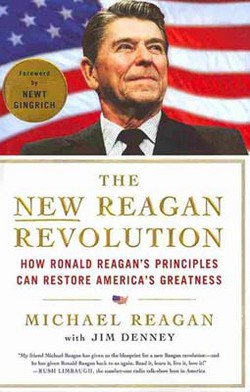
The New Reagan Revolution – Michael Reagan (2010)

Michael Reagan has captured the essence of President Reagan’s values, fiscal policy, 031264454X_band tough-minded leadership in his book, The New Reagan Revolution.  The sub-title should jolt any thinking American – “How Ronald Reagan’s Principles Can Restore America’s Greatness.”  Clearly, we have drifted far from President Reagan’s vision for America.  The city of the hill that he so loved has descended into the swamp of relativism and pragmatism that tolerates abortion on demand, celebrates homosexual marriage, and applauds big government and out-of-control spending.

The author walks readers on a path that traces Reagan from his days as a Democrat to his final days in the White House.  Readers learn that Reagan was a man of unwavering conviction.  He believed in a “banner of bold, unmistakable colors, with no pale pastel shades.”  The author adds, “Every leader who waves a banner of bold colors has plenty of critics.  If no one is criticizing you, you’re not being bold enough.  Ronald Reagan never worried about his critics.  He didn’t care what other people thought of him or said about him or wrote about him.”  Reagan’s son continues, “Pale pastel people try to straddle both sides of every issue in an attempt to get everyone to like them.  They try not to be too bold because they fear offending others or drawing criticism … Ronald Reagan knew he would never please everybody, so he staked out bold positions on the issues – then he proved he was right.”  This is the kind of leadership that brought the former Soviet Union to its knees.  This is the kind of bold leadership America needs now – bold, decisive, and unwavering in the face of adversity!

The author rightly portrays his father as the great communicator.  “Every leader,” writes the younger Reagan, “must communicate his vision in a way that persuades and inspires.”  And while Reagan truly inspired America in his two terms as president, he did not compromise his cherished values.  Nor did he play both sides for the middle in order to gain the loyalty of special interest groups.  The great communicator spoke with clarity and conviction.  He knew how to capture the heart of America.  He knew the power of the spoken word.

Additionally, the author portrays President Reagan as the great unifier.  The president once said, “We’ve got to quit talking to each other and about each other and go out and communicate to the world … We must go forth from here united, determined.”  Reagan worked to find common ground with his political opponents and even forged a friendship with his nemesis, Tip O’Neal.  America is in search of a leader who unifies like Ronald Reagan.

Finally, the author demonstrates the love that his father had for freedom.    Reagan was fond of saying, “Freedom is never more than a generation away from extinction.”  One wonders what he would say today.  One wonders what the former president would say about excessive regulation and a socialized health care system.  The author encourages readers to advance the New Reagan Revolution by “boldly standing up for the original Reagan Revolution.  Let everyone around you know the truth about Ronald Reagan, the Founding Fathers, the Declaration of Independence, and the U.S. Constitution.”

The New Reagan Revolution is a book that should be devoured by every American.  President Reagan is an inspiration for anyone who loves freedom, limited government, a strong military, and lower taxes.  The younger Ronald Reagan is on target when he says, “There will never be another Ronald Reagan.”  But we can certainly return to a day where the principles that President Reagan believed in are weaved into the fabric of American culture.

4.5 stars

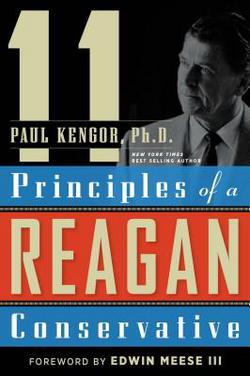
11 Principles of a Reagan Conservative – Paul Kengor (2014)

reaganRonald Reagan was a principled man.  Unlike most modern-day politicians, President Reagan governed from a set of unchangeable principles that guided his life, not to mention, his nation.

Paul Kengor presents these unshakable principles that undergirded President Ronald Reagan.  These principles of conservatism include:

1. Freedom

2. Faith

3. Family

4. Sanctity and Dignity of Human Life

5. American Exceptionalism

6. The Founders’ Wisdom and Vision

7. Lower Taxes

8. Limited Government

9. Peace Through Strength

10. Anti-Communism

11. Belief in the Individual

Kengor summarizes each principle and backs his study with a steady diet of Reagan quotes.  This is a highly readable and informative book that would be perfect for a high school student or anyone who seeks to learn more about President Ronald Wilson Reagan.

4 stars

When Character Was King: A Story of Ronald Reagan – Peggy Noonan (2001)

A number of years ago, I began devouring books about my favorite president.  When Character Was King by Peggy Noonan emerges as one of the most thoughtful and inspiring books about the former president.

Noonan paints a compelling portrait of President Reagan; a portrait that is an exceedingly human portrayal of a man who feared God, loved his country, and cherished freedom.  The author writes, “As president, Ronald Reagan believed without question that tyranny is temporary, and the hope of freedom is universal and permanent; that our nation has unique goodness, and must remain uniquely strong; that God takes the side of justice, because all our rights are His own gifts.”

Reagan opposed the godless ideology that held millions of Russians hostage from 1917 to 1991.  Lenin said in 1920, “We repudiate all morality that proceeds from supernatural ideas that are outside class conceptions. Morality is entirely subordinate to the interests of class war. Everything is moral that is necessary for the annihilation of the old exploiting social order and for uniting the proletariat.”  In contrast, Reagan knew that virtue and morality are directly related to one’s relationship with God.

A few quotes reveal the man we know as President Reagan:

“We had strayed a great distance from our Founding Fathers’ vision of America.  They regarded the central government’s responsibility as that of providing national security, protecting our democratic freedoms, and limiting the government’s intrusion in our lives – in sum, the protection of life, liberty and the pursuit of happiness.  They never envisioned vast agencies in Washington telling our farmers what to plant, our teachers what to teach, our industries what to build.”

“Don’t give up your ideals.  Don’t compromise.  Don’t turn to expediency.  And don’t for heaven’s sake, having seen the inner workings of the watch, don’t get cynical.”

“All of these things – learning to control the government, limiting the amount of money it can take from us, protecting our country through a strong defense – all of these things revolve around one word, and that word is ‘freedom.'”

President Reagan was and continues to be a breath of fresh air in an increasingly pessimistic political climate.  He was unafraid to stare evil in the face.  He courageously stood for the cause of freedom.  Indeed, he was jealous to see the flag of freedom fly in every land.  He opposed despotism, communism, and socialism.  He promoted free enterprise.  President Reagan refused to capitulate in the face of adversity.


The Rebellion of Ronald Reagan – James Mann (2009)

1400140625_bThe day was June 12, 1987.  President Ronald Reagan stood in front of the Brandenburg Gate in West Berlin and uttered these crucial and historic words: “General Secretary Gorbachev, if you seek peace, if you seek prosperity for the Soviet Union and Eastern Europe, if you seek liberalization: Come here to this gate!  Mr. Gorbachev, open this gate!  Mr. Gorbachev, Mr. Gorbachev, tear down this wall!”

James Mann’s, The Rebellion of Ronald Reagan is a fascinating and readable account of the days leading up to the end of the Cold War.  Mann clearly describes the inner workings of the Reagan administration and the resistance from liberals and conservatives alike to the president’s approach and methodology.

The Rebellion of Ronald Reagan relentlessly presents the former president’s love for freedom and his passion to eliminate totalitarianism.   I was reminded of Reagan’s love for freedom in 2005 as I stood on a bridge that spans the Moscow river.  As I gazed at the Kremlin and reflected on the new found and relative freedom the citizens of Russia enjoy, I glanced at the”Goon-inspired” graffiti that was etched onto the bridge. The words, “Heil Hitler” were mindlessly inscribed on the edge of the bridge.  The graffiti reminded me that freedom will be short-lived if liberated people grow apathetic and fail to guard their freedom.  It reminded me that fascism is still visible in the rearview mirror, not to mention the horizon.   And it reminded me that Marxism still has momentum and must be stopped at every juncture.  Liberated people everywhere would do well to seriously consider the warning of Thomas Jefferson: “When the people fear their government, there is tyranny; when the government fears the people, there is liberty.”

President Reagan was acutely aware of these concerns which helped fuel the fire of his policies and interactions with Gorbechev. The Rebellion of Ronald Reagan is a helpful reminder of events in the distant past.  While the Cold War is over, the ideology that inspired Lenin, Stalin, and Hitler is still very much alive. Ronald Reagan reminds us of the importance opposing the enemies of freedom; he reminds us to stand on the watchtower and jealously guard our freedom.  He reminds us that freedom is not free; it is a precious commodity worth dying for.  And he reminds us that freedom is never guaranteed in the future.

Reagan was aware of the protesters that gathered to voice their complaints about his appearance at the Brandenburg Gate.  His speech closes: “And I would like, before I close to say one word.  I have read, and I have been questioned since I’ve been here about certain demonstrations against my coming.  And I would like to say just one thing, and to those who demonstrate so.  I wonder if they have ever asked themselves that if they should have the kind of government they apparently seek, no one would ever be able to do what they’re doing again.  Thank you and God bless you all.”

President Reagan is no longer with us but the Reagan revolution is still alive and well; much to the chagrin of the liberal elite and secular progressives.  Big government, nationalized health care, excessive taxation, a reduction in personal liberty, and a weakened national defense was never tolerated by Reagan.  And the current progressive agenda which is aggressively promoted by the Democrats in Congress will not be tolerated by the American people.

4 stars

Lloyd-Jones on the Christian Life – Jason Meyer

jonesJason Meyer, Lloyd-Jones on the Christian Life Wheaton: Cross, 2018, 265 pp. $14.91

Dr. Martyn Lloyd-Jones could very well be the most influential preacher of the twentieth century. If there is any doubt that the Doctor carries such a weighty influence, Jason Meyer skillfully recants such a notion in his work, Lloyd-Jones on the Christian Life.

The subtitle of Meyer’s book nicely captures the central theme – “Doctrine and Life as Fuel and Fire.” The author accurately captures the essence of Lloyd-Jones’s ministry: “Doctrine should start in the head, catch fire in the heart, and create a life aflame with true obedience in the will.” This notion which once dominated the evangelical landscape is presently eclipsed by experientialism, pragmatism, and theological liberalism. Such a notion would have been unacceptable to the Doctor and in his mind would have led to a weakened church.

The ministry of Martyn Lloyd-Jones is presented in four movements as outlined below:

Part One – “The Doctor,” which includes some important biographical highlights.

Part Two – The Doctor’s Doctrine

Part Three – The Christian Life

Part Four – The Doctor’s Legacy

Lloyd-Jones on the Christian Life is a powerful portrait of a godly man who left a legacy of prayer and preaching that continues to impact pastors to this day. My hope is that God will see fit to use this helpful book to shape and sharpen the lives of the next generation of Christian leaders.

I received this book free from the publisher. I was not required to write a positive review.

GOD THE BEST PORTION OF THE CHRISTIAN – Jonathan Edwards (1736)

Two hundred years after Calvin published his first edition of The jonathan-edwardsInstitutes, Jonathan Edwards preached a sermon about being content in God.  The title of the sermon was God the Best Portion of the Christian.  Edwards’s text is Psalm 73:25:

Whom have I in heaven but thee? and there is none upon earth that I desire besides thee.

The central truth is set forth at the beginning of the sermon, in deductive fashion: It is the spirit of a truly godly man, to prefer God before all other things, either in heaven or on earth.

Two propositions comprise this short sermon

1. A godly man prefers God before anything else in heaven.

Edwards presents the God-centered paradigm in this section by leading readers on the correct biblical path.  He notes, “Every godly man hath his heart in heaven; his affections are mainly set on what is to be had there.  Heaven is his chosen country and inheritance.”

The godly man sets his affection on beauty, which is to say his heart is oriented to God and the things of God.  “Now the main reason why the godly man hath his heart thus to heaven,” writes Edwards, “is because God is there; that is the palace of the Most High.  It is the place where God is gloriously present, where his love is gloriously manifested, where the godly may be with him, see him as he is, and love, serve, praise, and enjoy him perfectly.”

2. It is the temper of a godly man to prefer God before all other things on the earth.

The highest priority for the follower of Christ, according to Edwards is on the Triune God.  Three points highlight the heart of the Puritan preacher:

  1. The saint prefers that enjoyment of God, for which he hopes hereafter, to anything in the world.
  2. The saints prefer what of God may be obtained in this life before all things in the world.
  3. The saints prefer what he hath already of God before anything in this world.

Application

As usual, Edwards concludes his sermon with several points of application.  Five penetrating questions are posed:

  1. What is it which chiefly makes you desire to go to heaven when you die?
  2. If you could avoid death and might have your free choice, would you choose to live always in this world without God, rather than in his time to leave the world, in order to be with him?
  3. Do you prefer Christ to all others as the way to heaven?
  4. If you might go to heaven in what course you please, would you prefer to all others the way of a strict walk with God?
  5. Were you to spend your eternity in this world, would you choose rather to live in mean and low circumstances with the gracious presence of God, to live forever in earthly prosperity without him?

Jonathan Edwards offers perspective and godly wisdom in a sermon that directed his 18th-century hearers heavenward and continues to beckon followers of Christ to the Celestial City.

True Grace, Distinguished From the Experience of Devils – Jonathan Edwards (1752)

Jonathan_Edwards_engravingOn September 28, 1752, Jonathan Edwards was invited to preach a sermon before the Presbyterian Synod of New York.  His son-in-law, Aaron Burr (who had recently married his daughter Esther) was the president of the College of New Jersey and undoubtedly had an influence in the invitation that Edwards received.

James 2:19 is the text that Edwards utilizes – You believe that God is one; you do that well.  Even the demons believe – and shudder!

Doctrine

Nothing in the mind of man, that is of the same nature with what the devils experience, or are the subjects of, is any sure sign of saving grace.

Edwards essentially argues this: there is no sign of grace in demons.  Three propositions drive the doctrine which he presents.

  1. The devils have no degree of holiness: and therefore, those things, which are nothing beyond what they are the subjects of, cannot be holy experiences.
  2. The devils are not only absolutely without all true holiness, but they are not so much as the subjects of any common grace.
  3. It is unreasonable to suppose, that a person’s being in any respect as the devil is, should be a certain sign, that he is very unlike, and opposite to him; and hereafter, shall not have his part with him.

Edwards includes a series of improvements or inferences which assist his hearers and instruct them in the Christian faith.

First, Nothing that damned men do, or ever will experience, can be any sure sign of grace.

Second, No degree of speculative knowledge of things of religion, is any certain sign of saving grace.

Third, For persons merely to yield to a speculative assent to the doctrines of religion as true, is no certain evidence of a state of grace.

Fourth, [Converted men] have been the subjects of very great distress and terrors of mind, through apprehensions of God’s wrath, and fears of damnation.

Fifth, It may be further inferred from the doctrine, that no work of the law on men’s hearts, in conviction of guilt, and just desert of punishment, is a sure argument, that a person has been savingly converted. 

Sixth, It is no certain sign of grace, that persons have earnest desires and longings after salvation.

Seventh, Persons who have no grace may have a great apprehension of an external glory.

Edwards demonstrates in stroke after stroke how and why the devils lack saving grace.  He applies his thesis to the hearts of men as noted above.  Once again, the Puritan divine accurately diagnoses the human condition apart from grace.  But he concludes by contrasting the graceless state of devils with the gracious state of a person who trusts Christ: “By this, above all other things, do men glorify God.   By this, above all other things, do the saints shine as lights in the world, and are blessings to mankind.”    It is here where Edwards draws his readers and those who would listen to this sermon – to the fountain of grace which never ends!


A Black-And-White Proposal: Farewell To Fuzzy Thinking

Donald Miller raises the banner for “fuzzy thinking” in a recent blog post entitled, “The Problem with Black-and-White Thinking” (re-posted on relevantmagazine.com).  His main thought: “Black-and-white, either-or thinking polarizes people and stunts progressive thought.”  Additionally, he holds that this kind of thinking stunts our “ability to find truth.”

DEFENDING THE GOOD IN MILLER’S PROPOSAL

Miller admits that there is such a thing as right and wrong.  He also admits the existence of absolute truth.  So Miller does not advocate full-fledged relativism.  For this, we can be thankful.  In fact, even though his posting is loaded with difficulties, Miller does include some helpful suggestions worth considering:

First, Miller suggests, “Disengage your ego from your ideas.”  This point is well taken because many times a particular view is so tied to one’s ego that it becomes virtually impossible to separate fact from fiction.

Second, Miller encourages, “Understand there is much you don’t understand.”  He rightly adds, “We begin to think in black-and-white when we assume we know everything.”  While he does not press the point of Christian humility (as he should – pardon the black- and white thinking), it seems to be a part of his overall argument.

Third, Miller seems to argue in essence, that charity and grace ought to be a part of conversations and even arguments.  This implied pointer ought to be a part of daily life, where conversations and arguments produce more light than heat and stimulate deeper thinking about a given subject.

DISMANTLING THE BAD IN MILLER’S PROPOSAL

There are four problems that emerge, including unwarranted assumptions that must be dismantled.

Black-and-White Thinking Demonizes the Opposition

Miller advances the common notion that black-and-white thinking is polarizing; a bad thing. Again, “Black-and-white, either-or thinking polarizes people and stunts progressive thought.”  He adds, “… We begin to believe whatever thought-camp we subscribe to is morally good and the other morally bad, thus demonizing a threatening position.”

But this is not necessarily the case.  One can advance a dogmatic view but do so in a humble, yet decisive way.  After gaining a hearing with the philosophers in Athens, Paul presents an argument that could be construed as black-and-white:  “The times of ignorance God overlooked, but now he commands all people everywhere to repent, because he has fixed a day on which he will judge the world in righteousness by a man whom he has appointed; and of this he has given assurance to all by raising him from the dead” (Acts 17:30, ESV).

Paul does polarize his audience.  Notice their response.  “Now then they heard of the resurrection of the dead, some mocked.  But others said, ‘We will hear you again about this'” (Acts 17:32).  The polarization that occurs is a necessary part of proclaiming the gospel message.  “For the word of the cross is folly to those who are perishing, but to us who are being saved it is the power of God” (1 Cor. 1:18, ESV).

Jesus employs a similar strategy when he confronts the Jews in John 8:  “Whoever is of God hears the words of God.  The reason why you do not hear them is that you are not of God” (v. 47, ESV).  Jesus does not demonize his hearers.  He merely tells them the truth.  Again, polarizing – but necessary.

These Jews maintained, “We are offspring of Abraham and have never been enslaved to anyone.  How is it that you can say, ‘You will become free?'” (John 8:33, ESV).  Jesus polarizes his Jewish audience when he says,”Truly, truly, I say to you, everyone who commits sin is a slave to sin” (John 8:34, ESV).  Oh, the horror of polarization!  But Jesus does not leave them without hope.  He adds, “So if the Son sets you free, you will be free indeed” (John 8:36).

I would argue that when people are polarized, this can prove to be very helpful. When a truth claim is presented, one either accepts or rejects the claim.  If one accepts the claim but disagrees, thoughtful dialogue may continue.  So instead of “stunting progressive thought” and “stunting our ability to think and find truth” as Miller claims, black-and-white thinking can actually lead to the discovery of truth.

Black-and-White Thinking Assumes Arrogance

Miller continues in his diatribe against black-and-white thinking:  “It [black-and-white thinking] allows us to feel intelligent without understanding, and once we are intelligent, we feel superior.  People who don’t agree with us are just dumb.”  Honestly, Miller’s charge may prove quite accurate at times.  It is true that black-and-white thinking may lead to arrogant behavior and a haughty spirit.  But this does not have to be the case.  One can embrace and promote a dogmatic view and do so in a spirit of gentleness and humility.  This much is demanded in the Scripture.

Scripture instructs believers to “speak the truth in love” (Eph. 4:15) and demonstrate compassion, kindness, humility, meekness, and patience with one another (Col. 3:12).  Additionally, God’s Word instructs believers to speak in a way that demonstrates gentleness and respect (1 Pet. 3:16).  Paul admonishes Timothy, “And the Lord’s servant must not be quarrelsome but kind to everyone, able to teach, patiently enduring evil, correcting his opponents with gentleness …” (2 Tim. 2:24-25a).  In other words, there is a place for admonition (which by the way requires black-and-white thinking).  But the admonition must be laced with gentleness and kindness.

For instance, Jesus says, “I am the light of the world.  Whoever follows me will not walk in darkness, but will have the light of life” (John 8:12, ESV).  What is Jesus saying here?  He graciously tells his listeners that if they reject his lordship, they will walk in darkness.  Again, he polarizes his audience but speaks the truth in love.  There is no hint of arrogance.  Indeed, this is the sinless Son of God! Jesus adds, “I told you that you would die in your sins, for unless you believe that I am he you will die in your sins” (John 8:24, ESV).

It is simply naive to automatically assume that black-and-white thinking inevitably leads to arrogance.  Christ-followers, then, must make truth claims with boldness and humility.  Recognizing the danger of pride and arrogance, they must season their words with grace and gentleness.  They must be winsome in their approach to communicating the truth.

Black-and-White Thinking Discourages Open Dialogue

This point is implied when Miller encourages people to walk away from a conversation that becomes characterized as black-and-white.  He says, “When the conversation becomes about defending one’s identity, it’s time to politely move on.”  He goes on to say that “these discussions go nowhere and don’t help me find truth.”  Miller unfairly draws a conclusion that black-and-white arguments result in “defending one’s identity.”  This is certainly a possibility – but is not inevitable.

A few years ago, Whoopi Goldberg and Joy Behar walked off their own set on The View when the conversation got heated with Bill O’Reilly.  They walked away from a black-and-white conversation as Miller encourages.  O’Reilly who was and is usually unashamedly black-and-white was construed as an uncaring and insensitive person, based on some comments he made about the 911 attacks.  Some would argue that Miller’s prediction came to pass; that O’Reilly’s strong stand was tied to his identity.   The fact is that when Goldberg and Behar made their exit, the dialogue stopped – and became even more heated and controversial.  Moreover, O’Reilly was not the only person on the set who promoted black-and-white thinking!

Black-and-White Thinking Assumes the Impossibility of Certainty

Built into the framework of Miller’s argument is at the very least, an implicit suspicion of certainty.  Since Miller admits the existence of absolute truth and since he rejects relativism, he must embrace that some truth is certain.   But where will this suspicion of certainty lead in the long run?

Some progressive-types may be tempted to hop on the postmodern bandwagon and condemn “certainty” as a worn out product of the Enlightenment (a position that is amusing because it is dripping with so much certainty!)

I am less concerned with Don Miller at this point.  He’s too smart to make absolute statements against absolute truth.  What concerns me is what some will do with his antipathy to black-and-white thinking. What concerns me deeply are those who take the next step into uncertainty because they have not examined the logic (or irrationality) of their presuppositions.  What concerns me is that full-fledged relativism is just around the corner.

John Piper sums up the essence of relativism: “No one standard of true and false, right and wrong, good and bad, or beautiful and ugly, can preempt any other standard.  No standard is valid for everyone” (Think: The Life of the Mind and the Love of God, 98).  This relativistic way of thinking is knocking on the door of the church and in some cases has already barged in.

DISTURBING ELEMENTS OF FUZZY THINKING

Fuzzy Thinking Does Not Work in the Real World

Fuzzy thinking will not fly when it comes to raising children: “Please be home by 10:00 p.m. or feel free to do whatever you want.”  Fuzzy thinking will not fly when a police officer stops you for speeding.  Fuzzy thinking doesn’t work very well at the bank.  It doesn’t work on the basketball court. And it certainly does not fare well on the operating table.  Fuzzy thinking will always lead to a bad grade in philosophy class (and every other course).  Fuzzy thinking cannot stand up to the brutal reality of absolute truth.

Fuzzy thinking didn’t work for Jesus either.  Imagine the difficulty in pointing sinners to the Father in John 14 if Jesus had employed fuzzy thinking.  He would have been forced to say, “I am one of the many ways to the Father.  Everyone gets to heaven so long as their motives are right.”  But instead, Jesus speaks in absolute, black-and-white terms: “I am the way, and the truth, and the life.  No one comes to the Father except through me” (John 14:6, ESV).  He not only makes an absolute truth claim concerning his identity; he utilizes a universal negative and makes it clear that “no one comes to the Father except through me.”

Jesus utilizes black-and-white thinking throughout his ministry.  Notice his absolute truth claims:

“Whoever believes in the Son has eternal life; whoever does not obey the Son shall not see life, but the wrath of God remains on him” (John 3:36, ESV).

“But whoever drinks of the water that I will give him will never be thirsty forever.  The water that I will give him will become in him a spring of water welling up to eternal life” (John 4:14, ESV).

“God is spirit, and those who worship him must worship in spirit and truth” (John 4:24, ESV).

“Truly, truly, I say to you, whoever hears my word and believes him who sent me has eternal life.  He does not come into judgment, but has passed from death to life” (John 5:24).

Fuzzy Thinking Does Not Work in the Pyre

If fuzzy thinking does not work in the real world, then it certainly does not work in the midst of persecution.  The martyrs of historic Christianity lived and died because of black-and-white thinking.

On his way to martyrdom, Ignatius wrote seven black-and-white letters that have proven to be very valuable documents to help our understanding of early Christianity.

When Polycarp faced execution for his Christian faith, the judge promised a quick release if Polycarp swore allegiance to the Emperor and vowed to curse Christ.  Polycarp responded, ““For eighty-six years I have served him, and he has done me no evil.  How could I curse my King, who saved me?”

When the judge threatened him with burning him alive, Polycarp simply answered that the fire that was about to be lit would only last a moment, whereas the eternal fire would never go out.  After Polycarp was tied to the post in the pyre, he looked up and prayed out loud: “Lord Sovereign God . . . I thank you that you have deemed me worthy of this moment, so that, jointly with your martyrs, I may have a share in the cup of Christ . . . For this . . . I bless and glorify you” (Justo L. Gonzalez, The Story of Christianity – Volume I, 39-48).

And consider the example of William Tyndale.  Tyndale courageously opposed anyone who quenched the work of the Spirit or despised God’s Word.   Again, Spirit enabled black-and-white thinking fueled his resolve.

One time a clergyman told Tyndale, “We are better without God’s laws than the pope’s.”  Tyndale’s black-and-white thinking prompted a decisive response: “I defy the Pope and all his laws; and if God spares my life, I will cause the boy who drives the plow in England to know more of the Scriptures than the Pope himself.”

Ignatius, Polycarp, and Tyndale held fast to the good (1 Thes. 5:21).  John MacArthur describes this imperative as “a militant, defensive, protective stance against anything that undermines the truth or does violence to it in any way.  We must hold the true securely; defend it zealously; preserve it from all threats.  To placate the enemies of truth or lower our guard is to violate this command.”

Fuzzy Thinking Minimizes the Role of Reason and Logic

Miller argues that black-and-white thinking would never make it “through the door of an undergraduate course in logic.”  Much to the contrary, the law of non-contradiction teaches us that a statement and its opposite cannot both be true at the same time and in the same sense.

Ron Nash reminds us, “The presence of contradiction is always a sign of error.  Hence, we have a right to expect a conceptual system to be logically consistent, both in its parts (its individual propositions) and in the whole.  A conceptual system is in obvious trouble if it fails to hang together logically” (Worldviews in Conflict, 55).

In other words, every worldview needs to be subjected to the law of non-contradiction.  When a contradiction emerges, the worldview must be abandoned.  Without black-and-white thinking, this worldview test passes by the wayside and discernment vanishes.

The root of this discussion concerning black-and-white thinking is tied to the formation of a worldview.   And in order for a worldview to be plausible, it must be able to be lived out in the real world.  Francis Schaeffer reminds us, “We must be able to live consistently with our theory” (The God Who is There, 121).

So in the final analysis, black-and-white thinking is not problematic.  Indeed, black-and-white thinking is not only philosophically tenable; it is an essential part of living the Christian life.  Without black-and-white thinking, it would be impossible to choose between two competing alternatives.  Without black-and-white thinking, theological and philosophical assertions would all receive equal acclaim, which is to say that truth at the end of the day is a matter of personal preference.

Whenever someone begins to back away from absolutes, reason and logic suddenly become unwelcome in the house of irrationality; a house that is destined to collapse under its own weight.  Peter Kreeft demonstrates the importance of logic: “If an argument has nothing but clear terms, true premises, and valid logic, its conclusion must be true” (Socratic Logic, 32).  Fuzzy thinking, however, tends to minimize the role of reason and logic, which at the end of the day proves not only unrealistic, but irrational.

Additionally, fuzzy thinking militates against the Law of the Excluded Middle.  James Nance and Douglas Wilson define this law: “Any statement is either true or false … it excludes the possibility of a truth value falling somewhere in the middle of truth or false” (Introductory Logic, xi).

Here’s the funny thing.  I am quite certain that Miller embraces these philosophical laws.  The problem is when he discourages black-and-white thinking, he unwittingly begins to whittle away at laws of logic which flow from the nature of God.  The downhill descent eventually leads to full-blown relativism.  Again, I am not concerned so much with Miller.  I am convinced that he would never go this route.  I am concerned, however, with those who are convinced by his arguments against black-and-white thinking.

DETERMINING A PROPOSAL REGARDING  BLACK-AND-WHITE THINKING

Donald Miller focuses on the so-called problems of black-and-white thinking.  I argue that Christian testimony and gospel witness will begin to erode to the degree that black-and-white thinking deteriorates.  Indeed, the essence of the gospel will erode to the degree we embrace fuzzy thinking.  Therefore, I submit the following proposal:

1. Black-and-White Thinking Should be Encouraged – Not Discouraged

Black-and-white thinking should be encouraged on biblical, philosophical, and practical grounds.  Sometimes, such thinking is criticized as “hair-splitting.”  Yet this black-and-white “hair-splitting” was indispensable as Athanasius challenged the arch-heretic, Arius.  This kind of thinking was a necessary part of formulating the doctrine of the Trinity and affirming the two natures of Christ; i.e. fully God and fully man.

Black-and-white thinking led to the formation of the major creeds and catechisms including the Apostles’ Creed, Nicene Creed, Chalcedonian Creed, the Heidelberg Catechism, and the Westminster Confession of Faith.

Black-and-white thinking should be encouraged.  For whenever black-and-white thinking is discouraged, the net result is theological error and irrationality.

2. Black-and-White Thinking is Essential to Christian Epistemology

Francis Schaeffer warned the church in 1968:  “We are fundamentally affected by a new way of looking at truth.  This change in the concept of the way we come to knowledge and truth is the most crucial problem facing America today” (The God Who Is There, 6).  In other words, “absolutes imply antithesis.”  The working antithesis is that God exists objectively (in antithesis) to his not existing.

The loss of antithesis (or repudiating black-and-white thinking) in American culture led to what Dr. Schaeffer coined the “line of despair” or giving up all hope of achieving a rational unified answer to knowledge and life.

So Christians must rise above the level of despair and affirm a Christ-saturated epistemology.  They recognize that truth is a unified whole.  They understand that there is no disparity between faith and reason.  In other words, faith and reason are not out of contact with each other.  They embrace what Nancy Pearcey refers to as “total truth.”

3. Black-and-White Thinking is Essential to Healthy Christian Living

Christ-followers who recognize that truth is unified understand this fundamental reality:  They know that black-and-white thinking is essential to the Christian life.  They recognize real good and real evil: “Ponder the path of your feet; then all your ways will be sure.  Do not swerve to the right or to the left; turn your foot away from evil” (Prov. 4:26-27, ESV).

Because Christians understand that “absolutes imply antithesis” they speak and live in terms of black-and-white:

“Whoever is steadfast in righteousness will live, but he who pursues evil will die.  Those of crooked heart are an abomination to the LORD, but those of blameless ways are his delight.  Be assured, an evil person will not go unpunished, but the offspring of the righteous will be delivered” (Prov. 11:19-21).

“Whoever speaks the truth gives honest evidence, but a false witness utters deceit” (Prov. 12:17).

4. There Should Be No Dichotomy Between Bold, Black-and-White Convictions and a Gracious Offering of Truth Claims

For instance, Jesus proclaims a series of woes on the Pharisees in Matthew 23.  His black-and-white thinking is actually stunning.  Yet at the end of chapter 23, we find him lamenting over Jerusalem: “O Jerusalem, Jerusalem, the city that kills the prophets and stones those who are sent to it!  How often would I have gathered your children together as a hen gathers her brood under her wings, and you would not!” (v. 37).

5. Black-and-White Truth Claims Should be Set Forth With Decisive Humility

On the one hand, Christ-followers must maintain their commitment to absolute truth claims.  They must do so vigorously and decisively.  They must boldly proclaim the truth in the marketplace of ideas.  And they must point to Christ, who is the essence of truth, apart from whom, knowledge is impossible.

On the other hand, Christ-followers must believe, proclaim, and defend black-and-white truth with Spirit-enabled humility: “But this is the one to whom I will look: he who is humble and contrite in spirit and trembles at my word” (Isa. 66:2b, ESV).  They must passionately proclaim truth “with all humility and gentleness, with patience, bearing with one another in love …” (Eph. 4:2, ESV).  And they must teach and defend the truth and embrace the framework of 2 Timothy 2:24.  “And the Lord’s servant must not be quarrelsome but kind to everyone, able to teach, patiently enduring evil, correcting his opponents with gentleness …”

SUMMARY

I hear what Don Miller is saying and I suspect that he’s concerned with Christ-followers who demonstrate less than loving behavior.  He would be right to be concerned.  Indeed, Christ is the most loving person that ever existed or will ever exist.  But Christ was also a black-and-white thinker.  The prophets were black-and-white thinkers.  The apostles were black-and-white thinkers.  And the martyrs were black-and-white thinkers.

Miller’s position could be construed to mean something like this: “We need less truth and more love and grace.”  I am quite confident that this is not his intention.  Similarly, my position could be construed to promote the following: “We need less love and more truth.”  Of course, this is not my argument either.  Rather, as Christians, we are called to both!  We are called to speak the truth – and we are called to engage in this ministry of proclamation with love, gentleness, and humility.

The funny thing is that Miller uses black-and-white thinking to argue against black-and-white thinking.  So at worst, his argument is self-refuting.  At best, perhaps there is hope for the future because, in the final analysis, Miller embraces black-and-white thinking after all!

If Miller is concerned primarily with the promotion of personal opinions, fine.  If he is concerned with soliciting dogmatic statements in gray areas that concern cultural matters like music and one’s choice of the best Italian restaurant, I have no quarrel.  But when it comes to matters of eternal significance, black-and-white thinking is essential.

We live in a world of absolutes.  And absolutes demand humble and decisive proclamation.  May Christians continue to proclaim and defend black-and-white propositional truth to the glory of Jesus Christ.  My black-and-white proposal: Farewell to fuzzy thinking!

“I know that truth stands and is mighty forever, and abides eternally, with whom there is no respect of persons.” – John Hus, Czech reformer, black-and-white thinker and martyr (1412)

Veritas et Lux!

Theophany: A Biblical Theology of God’s Appearing – Vern Poythress

theoVern Poythress, Theophany: A Biblical Theology of God’s Appearing Wheaton: Crossway, 2018, 463 pp. $26.79

“A theophany is a manifestation of divine presence accompanied by an extraordinary display mediating that presence.” This is the primary goal of Vern S. Poythress in his recent book, Theophany: A Biblical Theology of God’s Appearing.

Theophanies, according to the author have three primary functions: (1) They manifest God’s character and glory. (2) They remind us that God is with us. (3) They fill us with a sense of holy anticipation for the final coming and appearance of God.

“In short,” writes Poythress, “God is present everywhere and at all times in the created world that he has made.” Theophany is arranged in five sections as outlined below:

Part I: The Biblical Theme of God Appearing

Part II: The Mystery of God Appearing

Part III: A History of God Appearing in the Old Testament

Part IV: A History of God Appearing in the New Testament

Using this framework, the author guides readers on an enthralling journey that presents God from cover to cover. A threefold theme emerges throughout this book that alert readers to the promises of God, his covenants, and the presence of God. Ultimately, the appearances of God foreshadow the appearance of God in Christ, whom Poythress says is the “permanent and climactic theophany.”

I highly recommend Theophany and trust that many will be encouraged and edified as they come face-to-face with the God of the Bible.

I received this book free from the publisher. I was not required to write a positive review.