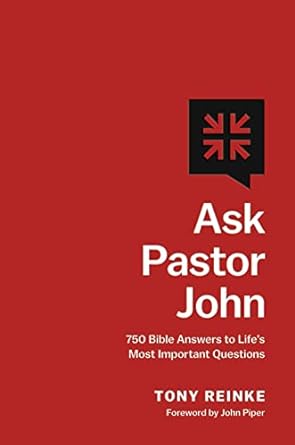
Tony Reinke, Ask Pastor John (Wheaton: Crossway Books, 2024), 499 pp.
I cannot think of a living writer who has wielded more influence in my life than Dr. John Piper. My personal journey began with Piper’s epic book, Desiring God: Meditations of a Christian Hedonist. To say the book was pivotal would be a massive understatement. Desiring God was a theological tidal wave that crashed into my life with force, authority, and passion.
After embracing Piper’s Christian Hedonism, many more books followed that only reinforced and encouraged my heart and mind. Reformed theology took hold and I’ve never been the same. The cry of Piper, “God is most glorified in us when we are most satisfied in him,” has left a permanent mark on my heart.
Almost forty years later, Tony Reinke captured Dr. Piper’s theological convictions and worldview in his book, Ask Pastor John. As the subtitle suggests, the book contains 750 Bible Answers to Life’s Most Important Questions. The book is an extension and overflow of the podcast that bears the same name, Ask Pastor John.
Readers have a front-row seat in this book as it presents topics that range from Bible reading, memorization, divorce and remarriage, spiritual warfare, suffering, technology, and hundreds of other topics. The book goes straight to the heart of John Piper. It not only sets forth his theological positions; it also reveals his heart, his joys, his struggles, his temptations, and his triumphs.
Ask Pastor John is heartfelt, transparent, and humble. Anyone familiar with John Piper will recognize that he presents his positions with authority and dogmatism. Some may react to such confidence and boldness. I am personally drawn to this kind of writing.
But the most important feature of Ask Pastor John is the deep love of Piper’s love for God, his Son the Lord Jesus Christ, the power of the Holy Spirit, the authority and sufficiency of Scripture, and the preciousness of the gospel. It is impossible to read this book and walk away unaffected. Even after reading Piper’s works for nearly forty years, I can say that my heart was even more transfixed and transformed after reading Ask Pastor John.
Thanks and gratitude go out to Tony Reinke, who curated the podcasts and gifts this wonderful book to the church. Ask Pastor John is truly a labor of love, one that countless thousands of people will cherish for years to come.
I received this book free from the publisher. I was not required to write a positive review.
Ana Ávila, Make the Most of Your Productivity (Wheaton: Crossway Books, 2024), 156 pp.
I’m a sucker for books that address personal productivity. So when the chance came to review Make the Most of Your Productivity by Ana Ávila, I jumped at the opportunity. Mrs. Ávila is a senior writer for Coalición for el Evangelio. The author brings some keen insight into the subject of productivity.
The groundwork for the book is established with a working definition of productivity:
The productive life is a life that seeks to honor God with all that you have.
Such a definition goes against the grain of conventional wisdom and is grounded first and foremost in the gospel. In other words, we don’t seek to be productive to merit favor in God’s eyes. Instead, we work hard and strive to live productive lives as an overflow of gratitude for what Christ accomplished for us on the cross. Or as Ávila writes, “God is God and does not need us, but he still delights in making us part of his plan. He uses our efforts to accomplish his purposes.”
Ávila reminds readers that productive, in the final analysis isn’t about following regimes and routines: “But being productive isn’t about finding the perfect tool to keep your schedule under control. Rather, being productive is being transformed day by day into a person who uses what they have for the glory of God and the good of others.”
Make the Most of Your Productivity contains value tools and suggestions that one would expect. But this book is a cut above since the principles are grounded in the gospel of Jesus Christ. In the end, the only thing that matters is glorifying God. This theme echoes throughout the book. For this reason, I enthusiastically commend it without reservation.
I received this book free from the publisher. I was not required to write a positive review.
Andrew M. Davis, How to Memorize Scripture for Life (Wheaton: Crossway Books, 2024), 57 pp.
There was a day in the church when Scripture memory was expected. Something happened around the turn of the century. The emphasis on Scripture memory began to decline, both among children and adults. How to Memorize Scripture for Life by Andrew M. Davis is a book that will help recover a passion for hiding the Bible in our hearts.
Davis first establishes the foundation by arguing that Scripture memorization is mandated. Citing John 15:7-8, the author says, “For me, this is the strongest passage in the Bible on the role of Scripture memorization.” He cites several passages that bolster the case for making Scripture memory a regular part of a disciple’s life.
Next, the author includes several advantages for memorizing the word of God. At the heart of the argument is sanctification. Davis writes, “The word of God must enter us through our minds – through our understanding – in order to change our hearts.”
Another advantage of Scripture memory is evangelism. The discipline of memorizing the Bible helps bless people and presents God’s word in clear and revealing ways. Having the Bible memorized is a powerful tool when defending the faith or pressing the claims of the gospel on our hearers.
Dr. Davis includes a helpful chapter that overcomes objections to memorizing Scripture. He cites several well-known objections and skillfully dismantles them all.
Much of the book is devoted to helping readers develop strategies and skills that help them memorize Bible verses. The author makes a strong case for memorizing large chunks of Scripture. More than that, he argues that memorizing entire books is well worth the effort. Readers will be fascinated to learn the various techniques that Davis includes. He is a gracious instructor who leads his readers well.
I hope this book will gain a wide hearing. More than that, I expect many people will accept the challenge of memorizing the word of God. The blessings will bear much fruit and will glorify the great God of the universe!
I received this book free from the publisher. I was not required to write a positive review.
Stephen J. Wellum, Systematic Theology: From Canon to Concept, vol. 1 (Brentwood: B&H Academic, 2024), 988 pp.
Stephen J. Wellum has contributed significantly to the thorny questions of redemptive history that help bridge the gap between Presbyterian covenant theology and Dispensational theology. Kingdom Through Covenant, co-authored with Peter J. Gentry, provides biblical answers that unlock questions that the church has posed for ages.
In his most recent work, Systematic Theology: From Canon to Concept, Dr. Wellum makes another significant contribution. Volume 1 contains four parts, including:
Introduction
The Revelation of the Triune God Who Speaks
The Biblical-Theological Framework of Scripture
From Biblical Theology to Theological Formulation
Each part contains riveting prose that turns the attention of readers to God’s redemptive work from the creation to the cross of Christ. The section of Providence is worth the price of the book!
There is only one significant disappointment; one that I will probably receive criticism for. Dr. Wellum does not embrace eternal relational authority submission Trinitarianism (ERAS). His arguments against ERAS are not compelling and only strengthen my convictions concerning ERAS. Thankfully, his critique is fair-minded and humble, which is a pleasant twist in this contentious debate.
Overall, I commend this remarkable work and trust that it will receive a wide readership.
John Owen, Apostasy from the Gospel (Wheaton: Crossway Books, 2023), 422 pp.
Crossway Books deserves a great debt of gratitude for republishing The Complete Works of John Owen, including his magisterial treatment of Hebrews. Lee Gatiss and Shawn D. Wright edited the series. The volumes are bound in beautiful hardcovers and include an attractive slipcover.
Apostasy from the Gospel (volume 14) is introduced and edited by Joel R. Beeke. The fitting introduction is basic enough for first-time readers of Owen, but will also satisfy Owen scholars. The volume under consideration includes thirteen chapters that draw hearts and minds to the Savior and also warn them of the sin of apostasy.
Owen begins his treatment with a rather comprehensive definition of apostasy and exposition of Hebrews 6:4-6. The message is clear: “And until the word in the heart be mixed and incorporated with faith, it will not advantage us (Heb. 4:2), and there is nothing hereof where there is a taste of the word only.”
The Puritan divine builds upon this framework and explains how various people are prone to apostasy. He highlights various causes of apostasy and admonishes readers to steer clear from an evil heart of unbelief.
The closing chapter contains several ways to safeguard ourselves from falling into apostasy:
Labor for a real sense of the glory of God.
Keep watch over your hearts to maintain duties and to guard against dangers.
Beware of merely resting in the outward privileges or ordinances of the church.
Beware of the influences of vices prevalent in your nation.
Avoid the errors of professing Christians who alienate others from the gospel.
Apostasy from the Gospel is a vivid reminder to remain close to the Savior and guard our hearts from sin. It is not only a warning to stand strong but contains gospel treasures throughout.
Highly recommended!
I received this book free from the publisher. I was not required to write a positive review.
Scripture affirms that men and women are equal in importance and personhood, created in the image of God, and created to reflect his glory (Gen. 1:26-27; Isa. 43:7).
Scripture affirms important distinctions of roles between men and women and establishes a biblical framework for authority, including male headship, which was instituted prior to the Fall (1 Cor. 11:7-9; Eph. 5:21-33; Col. 3:18-19; 1 Tim. 2:11-15).
While the Fall created gender confusion and distorted God’s intended design for men and women, the redemptive work of God in Christ seeks to erase the distortions that were inaugurated at the curse.
In this biblical model, husbands are called to love their wives as Christ loved the church (Eph. 5:25-30). Wives happily submit to this sacrificial love (Eph. 5:22-24). When men and women fulfill their God-ordained roles by living according to his design for husbands to love their wives and for wives to respect their husbands, they put the glory of God on display!
The Trinity provides a model for interpersonal relationships.
The Trinity helps us see equality that exists among men and women, clergy and laypeople, employers and employees, etc.
The Trinity helps us see the role distinctions between men and women.
The Trinity provides us with a framework for authority; i.e. the Son submits to the Father, and the Holy Spirit submits to the Son, etc.
The Trinity shows how to find joy in a relationship where there are clearly defined role distinctions.
As a complementarian, I affirm the responsibility of biblically qualified men to serve as elders in the household of God and to lead and shepherd the people of God (1 Tim. 2:11-15; 1 Cor. 14:34-36; 11:2-16).1 Therefore, the office of elder/pastor is reserved for men.
I deny an egalitarian framework that rejects role distinctions between men and women.2
“1 Timothy 2:8-15 imposes two restrictions on the ministry of women: they are not to teach Christian doctrine to men and they are not to exercise authority directly over men in the church.” See Douglas Moo, John Piper and Wayne Grudem, Ed. Recovering Biblical Manhood & Womanhood (Wheaton: Crossway, 1991), 180. ↩
Mark Dever alerts us to the troubling trend of egalitarianism: “… There may be no way the authority of Scripture is being undermined more quickly or more thoroughly in our day than through the hermeneutics of egalitarian readings of the Bible. And when the authority of Scripture is undermined, the gospel will not long be acknowledged.” Cited in Wayne Grudem, Evangelical Feminism: A New Path to Liberalism (Wheaton: Crossway, 2006), 19. ↩
I affirm the sovereignty of God in salvation and embrace a Calvinistic worldview where the glory and supremacy of God are the end of all things. Seven fundamental realities compel me to embrace Calvinism, what C.H. Spurgeon referred to as a “nickname for biblical Christianity.”1
Calvinism is rooted in Scripture. The sovereignty of God over all things, including the salvation of his elect is a pervasive theme in the Bible (Jonah 2:9; Isa. 46:9-10; Eph. 1:11).
Calvinism upholds the dignity of mankind and his total inability in proper tension (Gen. 1:27; 6:5; Ps. 8:5).
Calvinism upholds the sovereignty of God in all things (Ps. 115:3; Dan. 4:34-35).
Calvinism upholds the responsibility of mankind and God’s sovereign control over all things.
Calvinism upholds the joy of the Creator and the joy of the creature. This God-centered joy is captured in the popular acrostic, TULIP:
Total depravity is not just badness, but blindness to beauty and deadness to joy.
Unconditional election is how God planned, before we existed, to complete our joy in Christ.
Limited atonement is the assurance that indestructible joy in God in infallibly secured for us by the blood of Jesus.
Irresistible grace is the sovereign commitment of God to make sure we hold on to superior delights instead of the false pleasures that will ultimately destroy us.
Perseverance of the saints is the almighty work of God, to keep us through all affliction and suffering, for an inheritance of pleasures at God’s right hand forever.2
Calvinism underscores the five solas of the Reformation:
I believe that sinners are saved by God’s grace alonebecause apart from his grace we do not have the ability nor the desire to please him or earn his favor – Grace Alone (Eph. 2:1-5).
I believe that we are saved by faith in Jesus Christ alone apart from any human merit, works or ritual. Genuine faith produces Christ-glorifying fruit in the people of God for the glory of God – Faith Alone (Eph. 2:8-10).
I believe that we are saved by Christ alone, who is fully God and fully man. Christ was our substitute who died for our sins on the cross and was raised from the dead on the third day – Christ Alone (1 Cor. 15:3-4).
I believe the Bible is God’s absolute truth for all people, for all times; it is our final authority for discerning truth – Scripture Alone (2 Tim. 3:16).
I believe in the triune God who exists in three distinct Persons (Father, Son, and Spirit) who created, sustains and sovereignly rules over all things, and to whom belongs all the glory forever and ever – To the Glory of God Alone (Rom. 11:36).
7. Calvinism is God-centered. “A Calvinist is someone who has seen God in His majestic glory and has been overwhelmed.”3
The world may mock and the world may scorn. But the truth holds fast: I am a Calvinist.
I deny the notion of hyper-Calvinism which minimizes human responsibility, promotes passivity, and fails to proclaim the gospel to all peoples. ↩
John Piper, Cited in Tony Reinke, The Joy Project: The True Story of Inescapable Happiness (Minneapolis: Desiring God Ministries, 2015), 6. ↩
Ian Hamilton, What is Experiential Calvinsim (Grand Rapids: Reformation Heritage Books, 2015), Loc. 202. ↩
My wife and I recently spent five days in Edinburgh, Scotland. While there is much to commend in this very beautiful city, it did not take long to realize that God is no longer welcome for many of the inhabitants there.
On the last evening in Edinburgh, I watched a young street preacher proclaiming the gospel from a makeshift podium on Royal Mile Street, which stands in the shadow of St. Giles Cathedral. Here, the mighty John Knox wielded the mighty sword of God’s Word, which brought reformation to Scotland in the sixteenth century. Knox prayed, “Give me Scotland or I will die,” demonstrating his great love for God and his countrymen.
However, the days of the Reformation are long gone in Scotland. The scoffs of the crowd which were directed at the street preacher bore witness to that:
“Who created God?” one man shouted. “What about the holocaust?” another queried. “Who wrote the Bible?” questioned one of the street performers. “How could anyone believe in a talking serpent?” “Where did evil come from?” “What about the dinosaurs?” “What about the other religions?” And, “How could a loving God send anyone to hell?”
These emotionally charged questions were all hurled at the street preacher who merely sought to proclaim the simple message of the gospel.
I stood and prayed for the young man who heralded the truth. I asked God to soften the hearts of this angry mob. In the midst of my petition, the thought struck me, This is the same kind of crowd that Noah encountered.These are the same kinds of people who spewed their venom at Jeremiah and Jonah. And these are the kinds of people who hurled their hate against the New Testament apostles.
Nothing has changed. There is nothing new under the sun. The hearts of men are continuously evil (Gen. 6:5). “The heart is deceitful above all things, and desperately sick” (Jer. 17:9). Ever since the fall of man, sinful people continually suppress the truth (Rom. 1:18).
Every person carries a bag full of presuppositions. Atheism, evolution, immorality, homosexuality, and relativism. These are only a few of the presuppositions that I saw in the Edinburgh square. The people who embrace these worldviews are unwitting worshippers. They worship the false god of success. They worship the false god of autonomy. Or they worship the false god of another religion.
The angry mob who squared off against the preacher in Edinburgh willingly exchanged the truth of God for a lie. The Bible says unregenerate people realize that God exists; yet they refuse to acknowledge him: “For although they knew God, they did not honor God or give thanks to him, but they became futile in their thinking, and their foolish hearts were darkened” (Rom. 1:21).
And so I watched a tragic scene unfold on Royal Mile Street in Edinburgh. I watched a frenzied mob reject the truth from a “voice in the wilderness.” I gazed upon a group of worshippers who willingly turned from the God of the Bible to a god of their own making.
A few thoughts echoed in my mind and pressed against my heart as I stood on Royal Mile Street in the heart of Edinburgh:
First, the unbelieving world who preaches “tolerance” fails to be tolerant when the truth is proclaimed.Tolerance is only a virtue when it lines up with a worldview that rejects God, turns from his law, and marginalizes his Word. The “tolerance mantra” is a smokescreen, in the final analysis. Anyone who repudiates the truth claims of Scripture is tolerated. But anyone who embraces the propositional truth of God’s Word is cast aside and criticized.
Second, followers of Jesus Christ are called to faithfully proclaim the truth. Most will be unwilling to stand on a makeshift platform and herald the gospel to a hostile crowd. But how many of us could utter the claims of Christ over a cup of coffee? How many of us could share the love of Christ in the workplace? Who among us could challenge the pagan mind with the gospel truth in the marketplace of ideas? Paul understood this mandate to faithfully proclaim the truth: “How then will they call on him in whom they have not believed? And how are they to believe in him of whom they have never heard? And how are they to hear without someone preaching? And how are they to preach unless they are sent? As it is written, ‘How beautiful are the feet of those who preach the good news!'” (Rom. 10:14-15).
Third, when the truth is faithfully proclaimed, the unbelieving world will invariably become offended. The Edinburgh preacher recognized this reality when he stepped upon his makeshift platform. He realized that he would be opposed. He realized that he would be scoffed at. And he realized that the crowd would laugh. Scripture warns us that in the last days, people will not put up with sound doctrine (2 Tim. 4:3). The Bible says people will “accumulate for themselves teachers to suit their own passions, and will turn away from listening to the truth and wander off into myths” (2 Tim. 4:3-4). Tragically, we will not only find these kinds of people in the public square; we will also find them in the church.
In his book, Get Real: Sharing Your Everyday Faith Every Day, John Leonard argues that people have stopped listening to the gospel “because we want to share it in the least inconvenient, least costly way. We want to save dirty people at a distance.” Leonard has touched upon an important truth. And we can certainly do a much better job of sharing the gospel up-close. But the real reason for their resistance to the truth is a rocky, stubborn, and unbelieving, sinful heart! Our task is to faithfully share the truth and trust the Holy Spirit to soften hearts and effectually draw sinners to the Savior (John 6:44).
Finally, bold proclamation invites persecution.Indeed, all who desire to live a godly life in Christ Jesus will be persecuted” (2 Tim. 3:12). Yet Scripture reminds us, “And after you have suffered a little while, the God of all grace, who has called you to his eternal glory in Christ, will himself restore, confirm, strengthen, and establish you. To him be the dominion forever and ever. Amen.” (1 Peter 5:10–11, ESV) The promise of persecution should not hinder our passion to proclaim the truth. Rather, this reality should embolden our efforts to wield the mighty sword of truth!
Was the angry mob who ridiculed the preacher a fair representation of the feelings of the Scottish people? Were their harsh words and cackling laughs an accurate portrait of the people living in Edinburgh? Since I only met a handful of people in our brief stay, I cannot answer this question with any clarity. However, the Word of God informs us that what I saw on that cold winter afternoon is representative of the unbelieving world.
When truth is unhinged, we will face an intolerant audience. When truth is unhinged, the unbelieving world will be offended which will prompt persecution. But when the truth is unhinged, some will hear and respond. Some will be cut to the quick. Hearts will be softened. Minds will be sharpened. For the truth of God’s Word will unlock the most resistant and callous heart. Truth unhinged will transform lives as God’s Word is faithfully proclaimed.
It takes 234 pages for Tony Jones to answer the central question in his new book, Did God Kill Jesus? The author is a self-described “theological provocateur,” so the question posed in his book should not surprise anyone. The answer that emerges on page 234 is crystal clear: “No, God did not kill Jesus,” says Dr. Jones. Readers will find that the path to this answer is paved with doubt and skepticism. Frankly, it is a path fraught with theological compromise.
Tony Jones has a knack for asking questions. He has an uncanny ability to question the theological status quo and force readers to decide, even re-evaluate their cherished views. Unfortunately, some of the answers that Jones provides do not match the biblical record or pass the test of orthodoxy.
The author sets out to examine the various views of the atonement which have been offered up throughout church history. The questions he fires at these theories are fair enough:
What does the model say about God?
What does it say about Jesus?
What does the model say about the relationship between God and Jesus?
How does it make sense of violence?
What does it mean for us spiritually?
Where’s the love?
Ultimately, none of the theories fully satisfy the author. But the one he finds the most repugnant is penal substitutionary atonement. Jones argues that this view, which he labels the payment model is currently in vogue “largely because it appeals to our sense of justice and our understanding of law and penalties.” And he is not particularly bashful about how he feels about penal substitutionary atonement. In his previous book, A Better Atonement: Beyond the Depraved Doctrine of Original Sin, Jones writes, “I’m on no quest to reject the penal substitutionary theory of the atonement (PSA). (I merely intend to dethrone it).” However, what he fails to see is this: when penal substitutionary atonement is dethroned, the gospel of Jesus Christ is thrown into the ash heap and the hope of every person perishes.
In his explanation of penal substitutionary atonement, the author assures readers that “God is holy, and we are less-than-holy.” This appears to be a strange starting point since all who hold to penal substitutionary atonement embrace the biblical idea of total depravity – which is quite a leap from “less-than-holy.” However, Jones’ starting point makes perfect sense (just not biblical sense) when one discovers that he has also discarded the doctrine of original sin:
“What I’ve come to realize is that the idea of original sin is not, in fact, God Eternal Truth. It is, instead, like so many other items of faith, historically conditioned.”
To be fair Jones’ acknowledges the existence of sin. However, he rejects the “notion that human beings are depraved from birth.”
Jones caricatures the doctrine of penal substitutionary atonement by placing God the Father in an untenable position by “sending his perfect Son to Earth, then letting him – or making him – die as a substitute for the billions of human beings past and future who are incapable of paying off the debt incurred by their sin. That’s the Payment model” according to Tony Jones.
The biggest disappointment in this book is the repudiation of penal substitutionary atonement, the doctrine which contains the very core of the gospel message. As noted above, the path which leads to the ultimate question in the book is riddled with “rocks” and “weeds” and “branches” that careful readers should navigate in order to understand the position the author takes. Two of these stumbling blocks are noted below:
1. Dishonoring God
A.W. Tozer was certainly on target when he wrote, “What we think about God is the most important thing about us.” Yet what we find here is a view that has much in common with process theology. The author writes, “… We can surmise that in Jesus, God was learning.” He continues, “But on the cross, something else happened altogether, possibly something that even God did not expect.” The implication here appears to be a compromise of God’s comprehensive omniscience, a troubling turn of events to be sure.
Additionally, the author promotes what he refers to as the “weakness of God.” He adds,
Here is the guiding idea: God has forsaken power in order to give creation freedom. In other words, God’s primary posture in the world is that of weakness, not strength. This is a tough pill for many Christians to swallow – we’ve been taught to claim God’s power in our lives, to pray for power, and to trust God’s power and perfect plan for our lives …
A “tough pill” to swallow? You bet! Discerning readers would do well to keep that “pill” out of their mouths, especially when the testimony of Scripture points to a God who is completely sovereign and omnipotent over everything and everyone in the cosmos. Swallowing such a “pill” will leave readers spiritually sick.
2. Destroying the Heart of the Atonement
Jones makes it clear early in the book that he along with other liberals have “grown increasingly uncomfortable with the regnant interpretation of Jesus’ death as primarily the propitiation of a wrathful God.”
Yet, when one reduces the cross to a mere display of love and refuses to acknowledge that Jesus bore the wrath of God, the gospel is utterly stripped of its saving power. Such a move is to destroy the very heart of the atonement.
Summary
In the final analysis, the answer to the question of this book is not a simple yes or no answer. The Scripture makes it plain that both God and man killed Jesus Christ.
… let it be known to all of you and to all the people of Israel that by the name of Jesus Christ of Nazareth, whom you crucified, whom God raised from the dead—by him this man is standing before you well. (Acts 4:10, ESV)
… for truly in this city there were gathered together against your holy servant Jesus, whom you anointed, both Herod and Pontius Pilate, along with the Gentiles and the peoples of Israel, to do whatever your hand and your plan had predestined to take place. (Acts 4:27–28, ESV)
This is a book that should upset a lot of people. Frankly, I’m glad Jones wrote the book because it will rally conservatives around the truth of the gospel. This book should motivate pastors and scholars to go deeper into the reality of the gospel and prompt God-centered reverence and worship as they glory in the beauty of penal substitutionary atonement.
Evangelicals need to pay careful attention to books like this that grow more and more popular. Jones urges readers to participate in what he calls, “the smell test.” Unfortunately, something doesn’t smell right about this book.
Admittedly, Tony Jones stands in a theological stream that is more liberal-minded. One important distinction between Jones and many other liberals is that he actually affirms the bodily resurrection of Jesus. For this, we can be thankful. However, since he rejects penal substitution and as a result softens (or even eliminates) the wrath that Jesus bore on the cross, the scandal of the cross is blurred and even obscured. Indeed, as Jeffery, Ovey, and Sach have rightly written, “If we blunt the sharp edges of the cross, we dull the glittering diamond of God’s love.”
Whenever wrath is removed from the cross, something crucial is missing, which is to say, the gospel is at stake. For this reason, the view promoted here does not pass the “smell test.”
Readers are encouraged to explore the God-honoring doctrine of penal substitutionary atonement in four powerful and provocative books which include: The Warrior Savior, by Owen Strachan, The Apostolic Preaching of the Cross, by Leon Morris, Pierced For Our Transgressions, by Steve Jeffery, Michael Ovey, Andrew Sach, and It is Well: Expositions on Substitutionary Atonement, by Mark Dever and Michael Lawrence.
Lucy S.R. Austen, Elisabeth Elliot: A Life (Wheaton: Crossway Books, 2023), 611 pp.
My late Aunt, Betty Steele used to urge me to read biographies, especially missionary biographies. In a strange irony, the latest biography on my reading list is Elisabeth Elliot: A Life by Lucy S.R. Austen. The ironic twist is because of my late aunt’s acquaintance with Elizabeth Elliot when she served at HCJB in Quito, Ecuador. Elliot is known best as the wife of Jim Elliot, one of the five men slain by Auca Indians, the people group they longed to reach with the gospel of Jesus Christ. On January 8, 1956, Jim Elliot, Nate Saint, Ed McCully, Roger Youderian, and Pete Fleming were speared to death.
Nate Saint’s son, Steve Saint, retells the tale of his father’s death in his book, The End of the Spear. Lucy S.R. Austen tells another story – the story of a young woman whose husband was abruptly taken in the early years of their marriage. Austen presents readers with a comprehensive biographical look at one of the most well-known Christian women of the twentieth century.
Elisabeth Elliot: A Life is an inside look at a woman who endured gut-wrenching tragedy, yet persisted in her dream of winning lost people to Christ. Austen does not spare any details. She helps readers understand what made Elisabeth Elliot tick. She recounts the full spectrum of faith in Elliot’s life – both struggling and resilient.
One of the most fascinating aspects of Elliot’s life was her commitment to complementarianism. Austen cites from Elliot’s book, Let Me Be a Woman: “God created male and female, the male to call forth, to lead, initiate and rule, and the female to respond, follow, adapt, submit … Within the Godhead, there is both the just and legitimate authority of the Father and the willing and joyful submission of the Son.”
Elliot’s views on marriage struck the proper biblical balance: “The man and woman who recognize that they are heirs together of the grace of life move in time to the rhythm, accepting their boundaries as do the waves, yielding their self-life to the Will of life Universal … moving always toward the final fulfillment and joy – the perfect Music – which is the will of God.”
Elisabeth Elliot: A Life is a riveting look at a remarkable Christian woman. She penned twenty-eight books, spoke around the world, and left a legacy that will stand the test of time. Elliot’s life was not perfect – not even close. She, like every follower of Christ, was a sinner saved by grace. Her life is a testament to the gospel of God and will continue to shine forth for generations!
I received this book free from the publisher. I was not required to write a positive review.