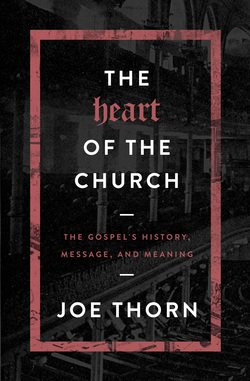
The Heart of the Church – Joe Thorn (2017)

a heartJoe Thorn, The Heart of the Church, Chicago: Moody Press, 2017, 108 pp. $11.95

The first review I read of Joe Thorn’s new book, The Heart of the Church was decisively negative. This specific reviewer awarded the book with a dreaded “two stars,” which in the land of book reviews is something akin to wandering through a barren wasteland without water. But nothing could be further from the truth. My aim, therefore, is to set the record straight and give Thorn’s work the credit it deserves.

The Heart of the Church is the first in a series of three, which were all recently released. The first book guides readers on a fascinating journey – the history of the gospel, the doctrine of the gospel, and the God of the gospel.

Part 1: The History of the Gospel

The author anchors some of the key themes of Scripture by pointing to creation, covenant, sin, and salvation. The covenants point to the great arrival of the Savior, Jesus Christ, the One who “came to take away sin, fulfill all righteousness, establish a kingdom, and conquer the devil.”

Thorn presents the gospel simply and biblically alerting readers to the great reality of the life, death, burial, resurrection, and ascension of Jesus Christ. Jesus is not only set forth as our example. Indeed, he is our substitute and righteousness as well. Thorn’s insistence on the substitutionary atonement is refreshing in the face of recent denials of this crucial doctrine. “All of this is the gospel,” argues Thorn. “It is history, and it is foundation for our doctrine.”

Part 2: The Doctrine of the Gospel

Part two is the “meat and potatoes” of this excellent book. Here, the author unfolds the crucial gospel doctrines of justification, forgiveness, faith and repentance, reconciliation, sanctification, and good works. These short chapters are basic enough for new believers but also contains substantial spiritual food for more experienced believers.

Each doctrine is explained and defended with basic biblical rationale. Readers will appreciate Thorn’s ability to articulate these weighty doctrines with great precision and profundity. While each treatment is short, there is a theological fuel here that will help feed the “spiritual fire” of growing Christians.

Part 3: The God of the Gospel

The final section builds upon the previous section and explores the important subjects of God’s justice, sovereignty, the atonement, irresistible grace, and particular redemption. Again, the author provides short explanations with strong biblical support.

Summary

The Heart of the Church is written for new believers but should be devoured by all believers. Joe Thorn has a unique gift of teaching which is warm, relational, and theologically rigorous. Pastor Thorn has a passion for the doctrines of grace that is apparent throughout the book. Readers will be deeply encouraged by Thorn’s labor – for the gospel is at the very center of this outstanding work. May this gospel continue to transform lives as people pour over this excellent work. Highly recommended!

I received this book free from the publisher. I was not required to write a positive review.

Without Warning (2017)

rosenbergJoel Rosenberg, Without Warning, Carol Stream: Tyndale House Publishers, 2017, 451 pp. $14.16

Without Warning is the third and final installment of Joel Rosenberg’s in the J.B. Collins Series. Collins, a New York Times journalist finds himself in the middle of a spine-tingling plot that involves the United States President, ISIS, and a host of other details that will keep readers awake deep into the night.

As one who reads the great thriller writers like Daniel Silva, David Baldacci, John Grisham, and the late Vince Flynn, I can say that Without Warning is on par with these authors. The characterization is through and the storyline is compelling. Rosenberg has proven himself in an elite field of experienced writers and will no doubt, continue to churn out books that not only entertain but also educate.

There is so much that good be said about Without Warning. But underneath the story lies a crucial lesson that the author clearly communicates in a winsome way:

Terrorism is an existential threat that must be dealt with bold resolve and decisiveness. Appeasement has never worked and will never work in the future. Terrorists cannot be negotiated with or paid off. Only swift and courageous military might will render terrorism impotent. The policies of the Obama administration are a testimony to the negative impact of political appeasement. Such a strategy only weakens a nation and endangers her citizens.

I commend Without Warning to a wide variety of readers and trust that many will devour Rosenberg’s top-notch writing.

I received this book free from the publisher. I was not required to write a positive review.

Unshackled: The god of WM. Paul Young

liesWM. Paul Young, Lies We Believe About God, New York: Atria Books, 2017, 273 pp. $13.48

Lies We Believe About God is the latest book from the author of The Shack, WM. Paul Young. The author originally penned The Shack at the request of his wife as a Christmas gift to his six children. First published in 2007, this book has sold over 20 million copies and was recently unveiled as a feature film.

The Shack struck a central chord in people, many of whom confess that the storyline helped them overcome personal pain and tragedy, what the author refers to as, the Great Sadness. Wes Yoder, who endorses The Shack summarizes the ideas in this story. He writes, “The Shack is a beautiful story of how God comes to find us in the midst of our sorrows, trapped by disappointments, betrayed by our own presumptions.” Eugene Peterson adds, “This book has the potential to do for our generation what John Bunyan’s Pilgrim’s Progress did for his. It’s that good.”

But many reviewers of The Shack were less sympathetic. In the minds of some, the nature of God was compromised and the boundaries of orthodoxy were broached. But since The Shack is a novel, the line between fact and fiction became blurred and the theological intentions of the author were difficult to discern.

Young’s most recent offering, Lies We Believe About God, puts to rest any speculation about his views of God and Christian theology. The truly impressive feature about Young’s most recent offering is its transparency and honesty. The author presents twenty-eight “lies we believe about God” in terms that are unmistakable. Readers will no longer be able to sweep the theological statements in Young’s previous novels under the carpet. His views concerning God are set forth in plain terms, giving readers a better understanding of what was proposed in his previous novels.

The question for discerning readers to ask is whether or not Young’s views measure up to the scrutiny of God’s Word. Three critical areas of concern surface in the book, Lies We Believe About God.

A Flawed View of God

It is a great irony that a book which sets out to challenge the so-called “lies we believe about God,” does in fact, promote views of God that fail to match the biblical record. First, Young promotes a soft view of God. Specifically, he argues that God is not in control.

Instead of accepting God’s will of decree, which is settled in eternity past, the author questions God’s sovereign control: “Does God have a wonderful plan for our lives? Does God sit and draw up a perfect will for you and me on some cosmic drafting table, a perfect plan that requires a perfect response? If God then left to react to our stupidity or deafness or blindness or inability, as we constantly violate perfection through our own presumption?”1 John, one of the characters in Young’s novel, Eve concurs: “When it comes to plans and purposes, God is not a Draftsman but an Artist, and God will not be God apart from us.”2

Instead of accepting a sovereign God who ordains everything that comes to pass, Young posits a God who reigns by love and relationship alone. “The sovereignty of God is not about deterministic control … Love and relationship trump control every time. Forced love is no love at all,”3 writes the author.

Yet, Scripture contradicts what Young would have us believe. The Bible presents a God who exercises control in creation, providence, and miracles. Proverbs 21:1 illustrates the control of God in vivid terms: “The king’s heart is a stream of water in the hand of the LORD; he turns it wherever he will.” In Ezra 6:22, the LORD “turned the heart of the king of Assyria.” In Ecclesiastes 7:13-14, God’s providential control over all things is clearly illustrated: “Consider the work of God: who can make straight what he has made crooked? In the day of prosperity be joyful, and in the day of adversity consider: God has made the one as well as the other, so that man may not find out anything that will be after him.” And Ephesians 1:11 shows us the overarching purposes of our God: “In him we have obtained an inheritance, having been predestined according to the purpose of him who works all things according to the counsel of his will.” Indeed, God exercises sovereign control over all things.

The Westminster Catechism argues, “The decrees of God are his eternal purpose, according to the counsel of his will, whereby for his own glory he hath foreordained whatsoever comes to pass.” That is, God is the sovereign king who does as he pleases (Ps. 115:3). God reigns (Ps. 99:1-5). His control knows no boundaries. God acts in order to advance his glory (Exod. 14:4). And we rest in the infinite wisdom of God’s plan, knowing that his purposes can never be thwarted (Isa. 46:9-10; Job 42:2).

Charles Hodge has a sharp disagreement with the soft view of God presented in Lies We Believe About God. Hodge writes,

“This is the end which our Lord proposed to himself. He did everything for the glory of God; and for this end, all his followers are required to live and act … If we make the good of the creature the ultimate object of all God’s works, then we subordinate God to the creature, and endless confusion and unavoidable error are the consequence. It is characteristic of the Bible that it places God first, and the good of the creation second.”4

The errors which result from promoting a God who is not fully in control, as Hodge maintains, will have serious consequences and have tragic consequences on one’s perception of God.

Second, Young presents a God who submits to people. The notion that God submits to the creature emerges in The Shack as well. The Holy Spirit figure, Sarayu, tells Mack, “We have limited ourselves out of respect for you … Relationships are never about power, and one way to avoid the will to power is to choose to limit oneself.”5 And Papa sympathetically responds to Mack who is reluctant to demonstrate emotion: “That’s okay, we’ll do things on your terms and time.”6

The Jesus of The Shack confesses to Mack, “Submission is not about authority and it is not obedience; it is all about relationships of love and respect. In fact, we are submitted to you in the same way.”7

In Young’s novel, Eve, Adonai says to Adam, “Our Love will not withhold from you the consequences of your choices. We honor and respect you, so We consent and submit to you” (emphasis mine).8 Later in the story, Adonai makes a similar remark to Lily: “Look up and into My face. I am here and will never leave you. In any dance you sometimes lead, but always both submit. So now, dear Lilly, you must choose, and I submit to you.”9

In Lies We Believe About God, the author maintains that the word control is not a part of God’s vocabulary: “God submits,” writes Young “rather than controls and joins us in the resulting mess of relationship, to participate in co-creating the possibility of life, even in the face of death.”10

Yet, we never find God submitting to the creature in Scripture. To the contrary, the creature submits to the Creator. Job learned a quick lesson when he tried to turn the tables on God. He learned the importance of submitting to God, not the other way around (Job 38-41).

John Frame helps us understand the importance of God’s authority and the proper response of the creature: “The first thing, and in one sense the only thing, we need to know about God is that he is Lord …This is a confession of lordship: that Yahweh, the Lord, is the one and only true God, and that therefore he deserves all of our love and allegiance.”11

The soft view of God who submits to the creature must be rejected as it fails to stand the test of biblical faithfulness.

A Fallacious View of Humanity

Young rightly holds that humans are created by God in the imago Dei. Since humans are created in God’s image, they have inherent worth and significance. The author should be commended for highlighting this important aspect of anthropology, which admittedly, is neglected by some Christians.

Additionally, the author believes that humans are sinners. However, sin is redefined and fails to measure up to the biblical test. “Blind, not depraved, is our condition,”12 writes Young. He continues, “Sin, then, is anything that negates or diminishes or misrepresents the truth of who you are, no matter how pretty or ugly that is.”13 Such a view find no biblical support and is a foreign concept in Christian theology.

Young acknowledges that sin involves “missing the mark.” But he adds, “The mark is not perfect moral behavior. The ‘mark’ is the Truth of your being.”14 But Young goes one step further in his redefinition of sin: “And what does the truth of your being look like? God. You are made in the image of God, and the truth of your being looks like God.”15

Now that Young has redefined sin, he is in a position to pose an additional question: Does sin separate us from God? Young argues that the notion of sinners being separated from God is a lie: “A lot of ‘my people’ will believe that the following statement is in the Bible, but it isn’t: ’You have sinned, and you are separated from God.’” 16 The biblical proof he offers is Romans 8:38-39, that is, “nothing can separate us from the love of God.” Such an explanation, however, fails to consider the context of Romans 8 which is a clear promise to the elect of God, not the entirety of the human race.

Two responses are in order. First, Young’s reformulation of sin is inadequate as the Bible clearly teaches that all people are sinners by nature and choice. John MacArthur sheds light on the real meaning of sin:

“Sin must be understood from a theocentric or God-centered standpoint. At its core, sin is a violation of the Creator-creature relationship. Man only exists because God made him, and man is in every sense obligated to serve his Creator. Sin causes man to assume the role of God and to assert autonomy for himself apart from the Creator. The most all-encompassing view of sin’s mainspring, therefore, is the demand for autonomy.”17

When sin is redefined from a man-centered viewpoint, this only strengthens the resolve of his quest for autonomy. Yet this is exactly what we find in Young’s version of sin – a Creator catering to the needs of the creature and satisfying his autonomous bent.

The Scriptures paint a portrait of sinful creatures which is undeniable and devastating: “The Lord saw that the wickedness of man was great in the earth, and that every intention of the thoughts of his heart was only evil continually.” (Gen. 6:5, ESV) Indeed, “The heart is deceitful above all things, and desperately sick; who can understand it?” (Jer. 17:9, ESV) Edwin Palmer writes, “Total depravity means that natural man is never able to do any good that is fundamentally pleasing to God, and, in fact, does evil all the time.”18 The biblical evidence for total depravity is overwhelming and conclusive (Ps. 51:5; Isa. 53:6; 64:6; Eph. 2:1-3; Rom. 3:23; 5:12).

Second, the Bible clearly teaches that sinners are separated from God. Apart from grace, sinners are without hope and are utterly cut off and separated from God. Isaiah 59:2 says, “But your iniquities have made a separation between you and your God, and your sins have hidden his face from you so that he does not hear.” In his letter to the Ephesians, Paul demonstrates that sinners are separated from Christ. He refers to them as “having no hope and without God in the world” (Eph. 2:12). Our only hope, then, is found in Christ alone who came to forgive us and reconcile us to a holy God (Eph. 2:13-22).

A Faulty View of Salvation

Two major problems can be summarized here. First, Young promotes universal reconciliation. In The Shack, Papa answers Mack’s questions concerning the efficacy of the cross. Papa says, “Honey, you asked me what Jesus accomplished on the cross; so now listen to me carefully: through his death and resurrection, I am now fully reconciled to the world.”19 Mack asks, “The whole world? You mean those who believe in you, right?”20 Papa answers resolutely, “The whole world, Mack. All I am telling you is that reconciliation is a two-way street, and I have done my part, totally, completely, finally.”21

In a stunning admission, Young says,

“The Good News is not that Jesus opened up the possibility of salvation and you have been invited to receive Jesus into your life. The Gospel is that Jesus has already included you into His life, into His relationship with God the Father, and into His anointing in the Holy Spirit … God has acted decisively and universally for all humankind.”22

If there is any question about the universalism here, the author removes any cause for doubt: “Are you suggesting that everyone is saved? That you believe in universal salvation? That is exactly what I am saying?”23 He continues, “Here’s the truth: every person who has ever been conceived was included in the death, burial, and resurrection, and ascension of Jesus. When Jesus was lifted up, God ‘dragged’ all human beings to Himself.24

The Bible paints a very different portrait. The Bible speaks of people apart from grace who are enemies of God (Col. 1:21; Rom. 5:10) and children of wrath (Eph. 2:1-3). Only the redeemed are reconciled to God.

Appealing to passages like John 12:32 is insufficient and fails to build the case for universal reconciliation. Jesus says, “And I, when I am lifted up from the earth, will draw all people to myself.” All people must either mean “all without exception” or “all without distinction.” As we compare Scripture with Scripture, clearly the later is in view.

Jesus proclaims, “Enter by the narrow gate. For the gate is wide and the way is easy that leads to destruction, and those who enter it are many. For the gate is narrow and the way is hard that leads to life, and those who find it are few” (Matt. 7:13-14). ). Jesus speaks of two trees, the healthy and the diseased. Speaking of the diseased tree, Jesus says, “Every tree that does not bear good fruit is cut down and thrown into the fire” (Matt. 7:19). Moreover, Jesus teaches about two kinds of houses, the one that is built on the rock and one that is built on the sand. “And everyone who hears these words of mine and does not do them will be like a foolish man who built his house on the sand. And the rain fell, and the floods came, and the winds blew and beat against that house, and it tell, and great was the fall of it” (Matt. 7:26-27). Indeed, every person who refuses to build his “house” on the rock and build his or her life on the promises of God; every person who rejects the Son and his work on the cross will endure an eternity of wrath (John 3:36; Rom. 2:8; 2 Thes. 1:9). “At the end of the day, there are only two ways – the way of the kingdom or the way of death.” Scripture is clear: not everyone will pursue the way of the kingdom. Universal reconciliation is a lie.

Second, Young argues that the cross was not God’s idea. The author poses the question, “Who originated the Cross?” Young’s answer is disturbing, to say the least: “If God did, then we worship a cosmic abuser, who in Divine wisdom created a means to torture human beings in the most painful and abhorrent manner … Better no god at all, than this one.”25 In a few words, the author not only repudiates the reality of God’s involvement in the cross of Christ; he casts aside penal substitutionary atonement.

The apostle Paul speaks of the power of the cross (1 Cor. 1:17-18), “making peace by the blood of his cross (Col. 1:20) and even boasts in the cross (Gal. 6:14). However, Young says, “Nothing not even the salvation of the entire cosmos, could ever justify a horrific torture device called a cross.”26

When we contrast the Bible with Young’s view, we find that the cross was God’s idea after all. Two passages in the book of Acts show the sovereignty of God in salvation and demonstrate God’s involvement in the cross from start to finish:

“this Jesus, delivered up according to the definite plan and foreknowledge of God, you crucified and killed by the hands of lawless men. God raised him up, loosing the pangs of death, because it was not possible for him to be held by it.” (Acts 2:23–24, ESV)

“for truly in this city there were gathered together against your holy servant Jesus, whom you anointed, both Herod and Pontius Pilate, along with the Gentiles and the peoples of Israel, to do whatever your hand and your plan had predestined to take place.” (Acts 4:27–28, ESV)

The faulty view of salvation which is promoted in Lies We Believe About God is deeply troubling and must be rejected by discerning Christians.

Conclusion

Paul Young has shared openly and honestly about some of the hurts in his life. Pain and suffering, while inevitable in this life are regrettable realities. The dark night of the soul will likely affect most of us. And so we sympathize with Young and his Great Sadness and pray that God will minister in deep and abiding ways. But no amount of personal tragedy or loss can excuse the propagation of false views of God.

It is a great tragedy when an author writes a book that minimizes God or misrepresents God. A.W. Tozer helps us understand the importance of understanding God rightly: “Worship is pure or base as the worshipper entertains high or low thoughts of God.”27 How we think about God matters! For “there is nothing more important than knowing God.”28 Our view concerning his essence and attributes is not a mere academic debate among theologians. Our view of God affects how we approach him and how we worship him. Tozer continues, “For this reason the gravest question before the Church is always God himself, and the most portentous fact about any man is not what he at a given time may say or do, but what he in his deep heart conceives God to be like.”29

“God does not lower his standards to accommodate us.”30 Therefore, our responsibility is to view God rightly, worship God rightly, and approach God rightly and reverently. Indeed, “What comes into our minds when we think about God is the most important thing about us.”31

The chief problem in Lies We Believe About God is an undermining of biblical authority.  It ultimately caters to the creature and encourages the autonomy that he craves. When the authority of the Bible is compromised the people of God always pay a price. It’s not too late to get unshackled.  True freedom is found in submitting to Scripture, trusting and obeying Jesus Christ who loves sinners, and worshipping God in the way that he demands!

  1. WM. Paul Young, Lies We Believe About God  (New York: Atria Books, 2017), Loc. 329.
  2. WM. Paul Young, Eve (New York: Howard Books, 2015), 181.
  3. Ibid, Loc. 347.
  4. Charles Hodge, Systematic Theology – Volume I (Grand Rapids: Eerdmans Publishing Company, reprint 1995), 536.
  5. Young, The Shack, (Newbury Park: Windblown Media, 2007)106.
  6. Ibid, 83.
  7. Ibid, 145.
  8. WM. Paul Young, Eve (New York: Howard Books, 2015), 239.
  9. Ibid, 258.
  10. Young, Lies We Believe About God, Loc. 355.
  11. John Frame, The Doctrine of God (Phillipsburg: Presbyterian and Reformed, 2002), 21-22.
  12. WM. Paul Young, Lies We Believe About God, Loc. 296.
  13. Ibid, Loc. 1645.
  14. Ibid, Loc. 1643.
  15. Ibid, Loc. 1645.
  16. Ibid, Loc. 1663.
  17. John MacArthur and Richard Mayhue, Biblical Doctrine: A Systematic Summary of Bible Truth (Wheaton: Crossway Books, 2017), 453.
  18. Edwin H. Palmer, The Five Points of Calvinism (Grand Rapids: Baker Books, 1972), 13.
  19. William P. Young, The Shack, 82.
  20. Ibid.
  21. Ibid.
  22. Young, Lies We Believe About God, Loc. 889.
  23. Ibid, Loc. 898.
  24. Ibid.
  25. Ibid, Loc. 1101.
  26. Ibid, 329.
  27. A.W. Tozer, The Knowledge of the Holy (San Francisco: HarperCollins Publishers, 1961), 1.
  28. John Frame, The Doctrine of God (Phillipsburg: Presbyterian and Reformed, 2002), 1.
  29. A.W. Tozer, The Knowledge of the Holy, 1.
  30. R.C. Sproul, The Holiness of God (Wheaton: Tyndale House Publishers, 1995), 88.
  31. Tozer, The Knowledge of the Holy, 1.

Killing the Rising Sun: How America Vanquished World War II Japan (2016)

killing

Bill O’Reilly & Martin Dugard, Killing the Rising Sun: How America Vanquished World War II Japan New York: Henry Holt and Company, 2016, 284 pp. $18.00

Bill O’Reilly and Martin Dugard continue to mesmerize their reading audience with a new title in the ever-popular “killing series.” Unlike the other killing books which focused on specific individuals, O’Reilly and Dugard focus on a critical juncture in American history, a point where indecisive leadership or a policy of appeasement would have not only changed the face of America; it would have charted a new and tragic course in the history of the world.

Killing the Rising Sun explores the roles of a handful of American icons who faced a ruthless enemy, namely, the Imperial Japanese Army. Most Americans, it seems, simply do not know this story. They certainly do not understand the vicious nature of the enemy and the threat that the empire of Japan posed and the horrible consequences of defeat. Thankfully, under the leadership of FDR and Truman, America prevailed and effectively ended a 2,500-year-old dynasty.

A few features of this book are worth noting. First, the authors tell a fascinating story which is rooted in historical reality. One of the reasons that modern-day students recoil at the prospect of studying history is that many teachers and books are just plain boring. This is where O’Reilly and Dugard shine the brightest. They have an uncanny ability of weaving in the pertinent historical detail and simultaneously keeping the attention of readers. This feature runs through the other killing books and has proven to be a mighty boon for readers who might otherwise turn away from reading about history.

Second, the authors paint clear portraits of the key players during this period of history. They show the steadfastness of FDR, the bold resolve of Truman, and the courage of General MacArthur. But they also show the evil nature of the Japanese leader, Hirohito. Here is a man who portrayed himself as a “god-man” to the Japanese people, and in the final analysis, led them to the point of no return, which resulted in a decisive and historical defeat.

Finally, the authors help readers understand the importance of freedom; the priceless reality that Americans enjoy. We live in a country where the gift of freedom is taken for granted and even scoffed at by some social progressives. Killing the Rising Sun is a stark reminder of the sacrifice, bravery, and devotion of the American soldier. While much of the attention is focused on Truman and MacArthur, the real hero is the valiant American military man. Many of these brave soldiers paid the ultimate price of death. Some of them survived and bore the pain, either physically or emotionally which is associated with war. Now each American is the beneficiary of their devoted service. May we cherish the freedom we enjoy as American citizens and pay homage to those who went before us. They killed the rising sun. The world is a better place because of them.

Truth Unhinged in Edinburgh Square

My wife and I recently spent five days in Edinburgh, Scotland. While there is much to commend in this very beautiful city, it did not take long to realize that God is no longer welcome for many of the inhabitants there.

On the last evening in Edinburgh, I watched a young street preacher proclaiming the gospel from a makeshift podium on Royal Mile Street, which stands in the shadow of St. Giles Cathedral. Here, the mighty John Knox wielded the mighty sword of God’s Word, which brought reformation to Scotland in the sixteenth century. Knox prayed, “Give me Scotland or I will die,” demonstrating his great love for God and his countrymen.

However, the days of the Reformation are long gone in Scotland. The scoffs of the crowd which were directed at the street preacher bore witness to that:

“Who created God?” one man shouted. “What about the holocaust?” another queried. “Who wrote the Bible?” questioned one of the street performers. “How could anyone believe in a talking serpent?” “Where did evil come from?” “What about the dinosaurs?” “What about the other religions?” And, “How could a loving God send anyone to hell?”

These emotionally charged questions were all hurled at the street preacher who merely sought to proclaim the simple message of the gospel.

I stood and prayed for the young man who heralded the truth. I asked God to soften the hearts of this angry mob. In the midst of my petition, the thought struck me, This is the same kind of crowd that Noah encountered. These are the same kinds of people who spewed their venom at Jeremiah and Jonah. And these are the kinds of people who hurled their hate against the New Testament apostles.

Nothing has changed. There is nothing new under the sun. The hearts of men are continuously evil (Gen. 6:5). “The heart is deceitful above all things, and desperately sick” (Jer. 17:9). Ever since the fall of man, sinful people continually suppress the truth (Rom. 1:18).

Every person carries a bag full of presuppositions. Atheism, evolution, immorality, homosexuality, and relativism. These are only a few of the presuppositions that I saw in the Edinburgh square. The people who embrace these worldviews are unwitting worshippers. They worship the false god of success. They worship the false god of autonomy. Or they worship the false god of another religion.

The angry mob who squared off against the preacher in Edinburgh willingly exchanged the truth of God for a lie. The Bible says unregenerate people realize that God exists; yet they refuse to acknowledge him: “For although they knew God, they did not honor God or give thanks to him, but they became futile in their thinking, and their foolish hearts were darkened” (Rom. 1:21).

And so I watched a tragic scene unfold on Royal Mile Street in Edinburgh. I watched a frenzied mob reject the truth from a “voice in the wilderness.” I gazed upon a group of worshippers who willingly turned from the God of the Bible to a god of their own making.

A few thoughts echoed in my mind and pressed against my heart as I stood on Royal Mile Street in the heart of Edinburgh:

First, the unbelieving world who preaches “tolerance” fails to be tolerant when the truth is proclaimed. Tolerance is only a virtue when it lines up with a worldview that rejects God, turns from his law, and marginalizes his Word. The “tolerance mantra” is a smokescreen, in the final analysis. Anyone who repudiates the truth claims of Scripture is tolerated. But anyone who embraces the propositional truth of God’s Word is cast aside and criticized.

Second, followers of Jesus Christ are called to faithfully proclaim the truth. Most will be unwilling to stand on a makeshift platform and herald the gospel to a hostile crowd. But how many of us could utter the claims of Christ over a cup of coffee? How many of us could share the love of Christ in the workplace? Who among us could challenge the pagan mind with the gospel truth in the marketplace of ideas? Paul understood this mandate to faithfully proclaim the truth: “How then will they call on him in whom they have not believed? And how are they to believe in him of whom they have never heard? And how are they to hear without someone preaching? And how are they to preach unless they are sent? As it is written, ‘How beautiful are the feet of those who preach the good news!'” (Rom. 10:14-15).

Third, when the truth is faithfully proclaimed, the unbelieving world will invariably become offended. The Edinburgh preacher recognized this reality when he stepped upon his makeshift platform. He realized that he would be opposed. He realized that he would be scoffed at. And he realized that the crowd would laugh. Scripture warns us that in the last days, people will not put up with sound doctrine (2 Tim. 4:3). The Bible says people will “accumulate for themselves teachers to suit their own passions, and will turn away from listening to the truth and wander off into myths” (2 Tim. 4:3-4). Tragically, we will not only find these kinds of people in the public square; we will also find them in the church.

In his book, Get Real: Sharing Your Everyday Faith Every Day, John Leonard argues that people have stopped listening to the gospel “because we want to share it in the least inconvenient, least costly way. We want to save dirty people at a distance.” Leonard has touched upon an important truth. And we can certainly do a much better job of sharing the gospel up-close. But the real reason for their resistance to the truth is a rocky, stubborn, and unbelieving, sinful heart! Our task is to faithfully share the truth and trust the Holy Spirit to soften hearts and effectually draw sinners to the Savior (John 6:44).

Finally, bold proclamation invites persecution. Indeed, all who desire to live a godly life in Christ Jesus will be persecuted” (2 Tim. 3:12). Yet Scripture reminds us, “And after you have suffered a little while, the God of all grace, who has called you to his eternal glory in Christ, will himself restore, confirm, strengthen, and establish you. To him be the dominion forever and ever. Amen.” (1 Peter 5:10–11, ESV) The promise of persecution should not hinder our passion to proclaim the truth. Rather, this reality should embolden our efforts to wield the mighty sword of truth!

Was the angry mob who ridiculed the preacher a fair representation of the feelings of the Scottish people? Were their harsh words and cackling laughs an accurate portrait of the people living in Edinburgh? Since I only met a handful of people in our brief stay, I cannot answer this question with any clarity. However, the Word of God informs us that what I saw on that cold winter afternoon is representative of the unbelieving world.

When truth is unhinged, we will face an intolerant audience. When truth is unhinged, the unbelieving world will be offended which will prompt persecution. But when truth is unhinged, some will hear and respond. Some will be cut to the quick. Hearts will be softened. Minds will be sharpened. For the truth of God’s Word will unlock the most resistant and callous heart. Truth unhinged will transform lives as God’s Word is faithfully proclaimed.

Meet Generation Z (2017)

zJames Emery White, Meet Generation Z: Understanding and Reaching the New Post-Christian World, Grand Rapids: Baker Books, 2017, 219 pp. $10.11

Most people are familiar with the respective generations which are generally designated as the Silent Generation (born 1928-1945), the Baby Boomers (born 1946-1964), Generation X (born 1965-1980), Older Millennials (born 1981-1989), and the Younger Millennials (born 1990-1996). But a new group of people is emerging: Meet Generation Z. Born after 1996, this fascinating people group is the first truly post-Christian tribe. And as the author ofMeet Generation Z says, they “will be the most influential religious force int he West and the heart of the missional challenge facing the Christian church.”

James Emery White is the author of Meet Generation Z: Understanding and Reaching the New Post-Christian World. The author alerts readers to the growing secularization of culture. Built within this unique secular culture lies the “squishy center,” which includes people who are shapable but bear little in the area of convictions. These people have a propensity to move in the direction of the prevailing culture winds, which creates a special challenge to Christ-followers who long to make an impact on this generation.

James Emery White writes with urgency and passion. But he also writes with a sober-minded concern. His chief concern is that the church is missing an opportunity to reach Generation Z: ”But this is about more than losing an ideological bridge. We are also losing a relational bridge – one we can walk across to reach the largest generation in American history.”

The book is divided into two parts. Part One explores the New Realityand captures the pertinent demographic data that concerns Generation Z. The author introduces readers to the nones, that is, people are have little to no religious affiliation. This growing group represents one of of every five Americans. The nones are characterized by their commitment to secularism. They have been influenced by an age pummeled by economic recession. They are linked to computers and Wi-Fi. They tend to be multi-racial and sexually fluid. That is, they offer strong support to social causes such as transgender rights and “gay marriage.” They are, for the most part, biblically illiterate, that is, they fail to understand the redemptive themes in the Bible, let alone the basic stories in the Bible. And the nones, as described above, are radically post-Christian.

Part Two explores A New Approach. The author reexamines ways of reaching Generation Z and encourages pastors and Christian workers to think outside the box. He cites Ron Dreher approvingly: “Christians must pioneer new ways to bind ourselves to Scripture, to our traditions, and to each other – not for mere survival, but so that the church can be the authentic light of Christ to a world lost in darkness.” Our task, then is to be truly Christ-centered by modeling the gospel to a lost generation.

There is a plea here for “finding our voice,” something that appears to be increasingly difficult for many evangelicals: “There is a thin line between maintaining an earned voice through which to speak to culture and compromising the very message we long to share.” Ultimately, our task is to communicate the gospel in an uncompromising way to a generation that does not understand the Bible. The problem is that many people are compromising. The author notes, “If we harden ourselves against revelation’s voice, then again, like clay, we can only crumble in response to its touch.”

Finally, there is a challenge to rethink apologetics and evangelism directed to the Generation X generation. James Emery White offers these wise words: “At the most basic level, the goal is to hold both grace and truth together. Truth without grace is just judgment. Grace without truth is license. Only authentic Christianity brings together both truth and grace … The only kind of voice that will arrest the attention of the world will be convictional in nature, clear in its message, substantive in its content, and bold in its challenge.”

Meet Generation X is a much-needed book, especially in light of the challenges we face in the days ahead. For me personally, there are some things in the book that could be discarded. But to throw out the baby with the bathwater would be a huge overstep. Much of the wisdom here is sound and biblical. I commend this book to a new generation of pastors and Christian workers who have a heart for building a bridge to the next generation, namely, Generation X.

I received this book free from the publisher. I was not required to write a positive review.

Biblical Doctrine: A Systematic Summary of Bible Truth (2017)

big-mac

John F. MacArthur and Richard Mayhue, Biblical Doctrine: A Systematic Summary of Bible Truth Wheaton: Crossway Books, 2017, 1,024 pp. $41.43

A theological tour de force. A magnum opus. A breath-taking panorama that leaves the reader in awe. These are only a few descriptions of Biblical Doctrine: A Systematic Summary of Bible Truth. by John MacArthur and Richard Mayhue.

The book is arranged as one might expect, according to the various branches of systematic theology:

  1. Prolegomena
  2. God’s Word: Bibliology
  3. God the Father: Theology Proper
  4. God the Son: Christology
  5. God the Holy Spirit: Pneumatology
  6. Man and Sin: Anthropology and Hamartiology
  7. Salvation: Soteriology
  8. Angels: Angelology
  9. The Church: Ecclesiology
  10. The Future: Eschatology

A comprehensive glossary is included which helps beginning students with cumbersome theological language. Also included is an excellent topical and Scriptural index for instant access to this treasure trove.

Each branch of theology is carefully explained and biblically defended. Opposing views are highlighted and refuted with grace and tact. MacArthur and Mayhue never leave the reader guessing. As such, there is never a hint of ambiguity here.

Several terms characterize Biblical Doctrine. These terms will either attract or repel readers, but will nonetheless provide a helpful template for evaluating the prospect of plopping down almost $50.00 for a book!

  1. Biblical – This book is literally drowning in Scripture. Anyone familiar with MacArthur’s writing, in particular, will not be surprised to find a dogmatic edge. But dogmatism undergirded by humility and informed by Scripture is surely a path worth tracing out.
  2. Evangelical – This book is guided by a commitment to the gospel. Look elsewhere for a pragmatic approach. Readers will be blessed by the relentless pursuit of Jesus and his resplendent glory.
  3. Orthodox – This book is committed to historic orthodoxy, which is grounded by a literal, grammatical hermeneutic. Liberalism is soundly defeated and relegated to the ash heap.
  4. Reformed– This book is informed by the infrastructure of the Reformers of the sixteenth century. Weaving throughout this volume is a commitment to grace alone, faith alone, Christ alone, Scripture alone, and to God alone be the glory.

John MacArthur helpfully sums up the essence of the Reformed faith:

“It is the marvel of marvels that the King of kings, whose glory is exalted above the heavens, should lift a finger to rescue even one of such vile traitors as the sons of Adam.  Then to learn that this infinitely worthy King has purposed to redeem not one but countless multitudes at the cost of the life of his own dear Son bows the sinner’s heart in humble wonder.”

I cannot recommend Biblical Doctrine highly enough. It is an outstanding addition to the growing number of books committed to teaching systematic theology. Students will be challenged and stretched; spiritual growth will no doubt occur as they pour over the many pages of this tome. But most significantly, their hearts and minds will be drawn to worship and glorify the Triune God. Soli Deo Gloria!

I received this book free from the publisher. I was not required to write a positive review.

Katharina & Martin (2017)

luther

Michelle DeRusha, Katharina and Martin Luther: The Radical Marriage of a Runaway Nun and a Renegade Monk Grand Rapids: Baker Books, 2017, 314 pp. $14.79

When Baker Publishing gave me an opportunity to read and review Katharina & Martin Luther by Michelle DeRusha, I hesitated. For almost twenty-five years, I have studied the life of Luther and researched the finer points of the Protestant Reformation. In 2015, I began a period of research and writing which led to the publication of my book, Bold Reformer: Celebrating the Gospel Centered Convictions of Martin Luther. So my original hesitation had nothing to do with a lack of interest. Indeed, my interest in Luther has never waned. My only question was this: Would this book add any new insight or reveal aspects of Luther’s life that were previously unknown to me?

Thankfully, I decided to read the book. After only a few pages, I knew that my decision to devour this new book about Luther’s life would pay rich dividends.

First, Michelle DeRusha is an excellent writer. Her writing is clearly linked to the historical data concerning Luther’s life and is informed by a wealth of scholarship that she is quick to utilize.

Second, Katharina and Martin Luther is not your standard fare history book. The book reads like a novel but never sacrifices any of the historical content that readers expect. DeRusha has a gift for making history come alive and draws the reader into the setting she seeks to expose. I often found myself mysteriously transported to the Wittenberg landscape, smelling the fragrance of the countryside, or experiencing the unique tension of the Reformation. The author nicely captures the zeitgeist of the 16th century and strategically guides readers through its hallowed halls.

Finally, DeRusha skillfully presents the blossoming relationship between Martin Luther and Katharina. Despite the many challenges that this family encountered, one thing remains certain: “The Protestant Reformation would have happened without the marriage of Luther and Katharine. But Luther would not have been the same Reformer without Katharina.”

Katharina and Martin is thoroughly researched and presented in a winsome way that will no doubt attract a wide range of readers. Highly recommended!

I received this book free from the publisher. I was not required to write a positive review.

ON FIRE FOR CHRIST: Remembering John Rogers (February 4, 1555)

The smell of burning flesh hung in the air.  The villagers turned their heads and gasped.  Stray dogs fled.  The man’s wife wept bitterly.  His children watched inThe_Burning_of_Master_John_Rogers horror and the smell burned their nostrils.  The stench was a vivid reminder of who sat on the throne.  Mary Tudor ruled with ironclad authority.  Her subjects were obligated to obey.  Any dissenters would pay the ultimate price.  The world would remember her as “Bloody Mary.”

The day was February 4, 1555.  The man roped to the pyre was known well in the British village – a man of humble origins.  A man with bold ambitions and simple obedience to match.  A man who dared to challenge the throne with two simple acts – preaching the Word of God and printing the Matthews-Tyndale Bible.  His name was John Rogers.  Pastor, father, martyr.  He was the first Christ-follower to pay the ultimate price of death during Mary’s bloody reign of terror.  He was the first of hundreds who would die at the hands of this blood-thirst tyrant.

John Rogers stands in a long parade of God-centered men; men who preached the truth, confronted sin, lived uncompromising lives, and finished strong.  Like Rogers, some were martyred.  Others died of old age or were tormented with disease.  Those who participate in this Christ-exalting parade still have something to say.  Their courage emboldens us.  Their lives inspire us.  Their theology instructs us.  Their devotion moves us to action.2014-02-03 08.41.07

February 4, 2018 marks the anniversary of Roger’s brave march to the pyre.  Over 460 years later, the world is a very different place.  Yet the persecution of Christ-followers has not decreased.  It has increased.  As people committed to the sovereign reign of Jesus stand for truth,  righteousness, and justice – the persecution will grow steadily.  As Christians take a stand against homosexual marriage, abortion, human trafficking, and pornography – the persecution will escalate.  Tolerance is the popular buzzword, yet fidelity to God’s Word will not be tolerated by many in this world.  John Rogers is a reminder to stand firm in the face of adversity.  His picture is glued to the flyleaf of my preaching Bible and beckons me to boldly declare the truth of God’s Word – unashamed, unhindered, and resolute – on fire for Christ!

Semper Reformanda!

A Harvest of Thorns (2017)

thorns

Corban Addison, A Harvest of Thorns, Nashville: Thomas Nelson, 2017, 368 pp. $18.32

I have been reading Corban Addison from the beginning. Even though titles like A Walk Across the Son and The Garden of Burning Sand are difficult to read, he has become one of my favorite authors. To be clear, the writing is not difficult. His writing is impeccable. But the content in each book is challenging and heart-wrenching. Each of his books contain ethical storylines that beg readers to wrestle with matters of justice, morality, destiny, and freedom.

A Harvest of Thorns is no exception. The author presents a narrative that explores the underbelly of the fashion industry. No stone is left unturned. Addison urges readers to seriously contemplate the reality of sweatshops, forced labor, and abuse in the workplace.

The heart of the story involves a lawyer, Cameron Alexander, who battles his own ethical demons and a journalist, Josh Griswold who attempts to do the right thing but struggles with deep inner turmoil in his own life, which includes infidelity.

Addison beautifully weaves a chilling tale that will horrify readers and force them to face reality, even though much of what takes place is in a far away place – in this case, the nation of Bangladesh. While pain, suffering, and injustice stare the reader in the face, the author brings the story full circle and makes room for justice and redemption.

One concern is worth noting, however.  And the concern has more to do with the publisher than the author.  Thomas Nelson Publishing House which is affiliated with HarperCollins Christian Publishing sets forth a decisive mission that is clearly stated on the company website.  The mission says, “We inspire the world by meeting the needs of people with content that promotes biblical principles and honors Jesus Christ.”  Corban Addison chooses to use profanity in his novel, which is a judgment call on his part.  Some will no doubt come to Addison’s defense by arguing that people in the world use such vulgar language.  However, Christian authors like Randy Singer, Joel Rosenberg, and Ted Dekker have shown in a persuasive way that good writing, even in the thriller genre can work well without profanity.  In this case, the publisher does a disservice to its reading audience by allowing such language to pass the final editing process.

Notwithstanding the concerns above,  A Harvest of Thorns is another literary slam dunk. No one who reads this excellent work will walk away without being changed in some way.

I received this book free from the publisher. I was not required to write a positive review.