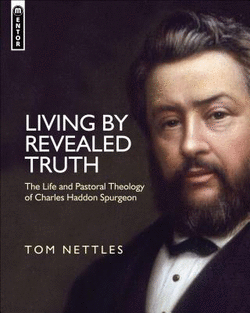
LIVING BY REVEALED TRUTH: The Life and Pastoral Theology of Charles Haddon Spurgeon – Tom Nettles (2013) Part 4

1781911223_bChapter 3: The Metropolitan Tabernacle

The construction of the Metropolitan Tabernacle was a watershed moment in Spurgeon’s ministry.  Nettles remarks, “He believed that the completion of the Tabernacle signaled an advance for the gospel in the whole city.”  Spurgeon’s new pulpit became the sounding board for the doctrines of grace which began in London but echoed around the globe as his  sermons were being printed by the thousands.

Spurgeon articulated and proclaimed a strong Calvinistic message, never compromising the core planks that were formulated at the Synod of Dort.  He preached with a style that was narrative driven but doctrinally rich.

Chapter 4: Preaching the Whole Counsel

The author highlights Spurgeon’s passion to preach Scripture in its entirety.  Dr. Nettles beautifully summarizes the essence of Spurgeon’s ministry: “This is the main glory of ministry, to preach Christ – his substitution, that he became a curse for us, dying the just for the unjust in the stead of his people.  Christ must be preached in a lively, earnest, spiritual manner in order for him to be set forth plainly as crucified, even as Paul did before the Galatians.”

Spurgeon’s bold style is emphasized: “We must preach Christ courageously … Pray the message in before you preach it out.”

While Spurgeon did not necessarily preach verse by verse, he was an expository preacher.  The author notes, “For Spurgeon, true exposition meant, in Puritan fashion, using the whole Bible and all its doctrines in the unfolding of any one portion of Scripture.”  And preaching expository message, for Spurgeon meant doctrine must be the backbone of every sermon: “Full submission to the authority of Scripture demanded that one be ready to embrace every doctrine of the Word of God.”  For Spurgeon, watering down the message was tantamount to compromise.

At the end of the day, faithfulness in the pulpit meant proclaiming the power of the cross.  This is gospel preaching.  Spurgeon declared, “I believe that the best, surest, and most permanent way to fill a place of worship is to preach the gospel, and to preach it in a natural, simple interesting, earnest way.”  Powerful words for pastors to heed in the 21st century – preachers who all too often capitulate to the demands of culture and marginalize the message to appease carnal listeners.

LIVING BY REVEALED TRUTH: The Life and Pastoral Theology of Charles Haddon Spurgeon – Tom Nettles (2013) Part 3

1781911223_bChapter 2: Made for Gospel Ministry

Dr. Nettles continues to guide readers on a fascinating account of Spurgeon’s ministry by beginning with his first sermon and first pastorate.  Spurgeon himself admitted, “I felt my own inability to preach.”  Yet the rookie preacher acknowledged from the beginning that God had his number.  Spurgeon affirmed the irresistible sovereign grace that God wielded upon his life, the One who “had plucked me as a brand from the burning, and set me upon a rock, and put a new song in my mouth, and established my goings.”

Spurgeon affirmed the doctrines of grace at the beginning of his ministry and finished strong as a five point Calvinist.  He proclaimed, “I am a Calvinist … It is Calvinism they want in London, and any Arminian preaching will not be endured.”  My how times have changed.  These days, a tepid Arminianism dominates many pulpits, especially in America.  And when the doctrines of grace wane, the church diminishes in power and gospel effectiveness.  But most of all, the glory of God is obscured.

One notable feature is the power that was manifest in Spurgeon’s pulpit from the onset of his ministry.  He remarked, “The pulpit is no place for weak, stunted, deformed, wretched-looking men.”  He maintained his commitment to Calvinism with bold resolve while at the same time fleeing from the erroneous doctrine of hyper-Calvinism.  Indeed, this man was made for gospel ministry.

LIVING BY REVEALED TRUTH: The Life and Pastoral Theology of Charles Haddon Spurgeon – Tom Nettles (2013) Part 2

1781911223_bChapter 1: Birth to New Birth

Living By Revealed Truth Begins where any biography ought to begin – at the beginning.  Spurgeon was born on June 19, 1834 and was influenced at an early age by dead writers: “The old writers, who are, by far, the most sensible – for you will notice that the books that were written about 200 years ago by the old Puritans have more sense in one line than there is in a page of our new books – and more in a page than there is in a whole volume of our modern divinity!”  Spurgeon was influenced by the likes of John Owen, Stephen Charnock, and John Bunyan – men who would inform his theological mind for the duration of his ministry.

The author unfolds the fascinating story of Spurgeon’s conversion and rise to pulpit ministry.   Spurgeon reports, “Ah me, how I seemed offended against the justice of God; I was impure and polluted, and I used to say, ‘If God does not send me to hell, He ought to do it.’  I sat in judgment upon myself, and pronounced the sentence that I felt would be just.”  He continues, “Then I was brought down to see my corruption, my wickedness, my filthiness, for God always humbled the sinner whom He means to save.”

Spurgeon’s testimony is remarkable, especially given the postmodern aversion to proclaiming the sinfulness of sin and the efficacy of the substitutionary atonement.  For example, Tony Crank, Senior pastor of the One Love Church recently opined, “Some churches have become the kind of place where you point the finger, and you condemn and rebuke and you’re really quick to do it, and so I think that is definitely lending itself to people not wanting anything to do with church and thinking church sucks!”  Evidently the kind of approach that Crank opposes is precisely the kind of ministry that was instrumental in Spurgeon’s entry into the kingdom of God.

The Puritan writer, Samuel Bolton agrees with Spurgeon’s approach and opposes Pastor Crank: “When you see that men have been wounded by the law, then it is time to pour in the balm of Gospel oil.  It is the sharp needle of the law that makes way for the scarlet thread of the gospel.”

Spurgeon’s conversion is instructive and his subsequent ministry informs the conscience of anyone who seeks to reach lost people.  He remarked, “To preach in this great building the self-same gospel in the same simple tones.  Sinners, look to Christ and be saved.”  Spurgeon taught a simple lesson that every pastor must heed.  Sinners must be confronted with their sin.  They must understand how they have violated God’s holy law.  And they must be exhorted to look to Christ, to believe in Christ, to embrace his salvific benefits that he purchased on the cross.

LIVING BY REVEALED TRUTH: The Life and Pastoral Theology of Charles Haddon Spurgeon – Tom Nettles (2013) Part 1

1781911223_bLiving by Revealed Truth: The Life and Pastoral Theology of Charles Haddon Spurgeon by Tom Nettles is a magnum opus if I ever saw one.  The subtitle nicely summarizes the path that is set before readers as they study the rich biography of the Prince of Preachers and gain insight into the theological landscape that dominated his ministry for almost 40 years.

The introduction leaves no room for ambiguity.  Spurgeon was a Bible man, an uncompromising pastor who loved to proclaim the truth of Scripture.  One man captures the essence of the British pulpiteer, when someone inquired about the secret of Spurgeon’s effectiveness after his death: “Two things; first, he had one single object before him always, ‘to win souls for God by preaching Christ, and Him crucified and risen’; second, his own personal faith in Christ was always feeding on Christ as revealed in Holy Scripture.”

Eighteen marvelous chapters are packed into this book of nearly 700 pages.  Over the next several days, I intend to present the high points, noting the strengths of the book and any criticisms that may arise.  One thing is sure: Spurgeon was a towering figure in 19th century England and he continues to wield a mighty influence on preachers in the 21st century.  His influence on this preacher has been inestimable.  His integrity, passion for truth, love of evangelism, and heart for people is a mighty boon for the soul.  I’m looking forward to the journey!

DIVINE SOVEREIGNTY – Jonathan Edwards

  images

 ““Be still, and know that I am God. I will be exalted among the nations, I will be exalted in the earth!”” (Psalm 46:10, ESV)

Psalm 46:10 is the basis of Jonathan Edward’s spine tingling sermon, entitled The Sole Consideration, That God is God, Sufficient To Still All Objections To His Sovereignty.  Six thoughts form the basis for the sermon:

1. In that he is God, he is an absolutely and infinitely perfect being; and it is impossible that he should do amiss.

2. As he is God, he is so great, that he is infinitely above all comprehension; and therefore it is unreasonable in us to quarrel with his dispensations, because they are mysterious.  If he were a being that we could comprehend, he would not be God.

3. As he is God, all things are his own, and he hath a right to dispose of them according to his own pleasure.

4. In that he is God, he is worthy to be sovereign over all things.

5. In that he is God, he will be sovereign, and will act as such.

6. In that he is God, he is able to avenge himself on those who oppose his sovereignty.

These six biblical propositions were received well as they thundered from the pulpit of the 18th century Puritan divine.  But how are these realities received today?  What do people think about God?  Edwards provides clues as he suggests that some people struggle with what he calls “little thoughts of God.”  He continues, “The truth is, men have low thoughts of God, or else they would willingly ascribe sovereignty to him in this matter.”  The problem that Edwards addressed almost 300 years ago has become somewhat of an epidemic today.  Open theism, process theology, neo-orthodoxy (just to name a few) have captured the minds of many pastors and are polluting the streams that once flowed unhindered in the academy and the church.

Jonathan Edwards offers a stern warning to anyone who would dare oppose the sovereignty of God.  His warning is coupled with an invitation to delight in the God who is all-together sovereign.  The final words of the sermon bend the ear, warm the heart, and challenge the mind: “Those of you who have been long seeking salvation, but are in great terrors through fear that God will destroy you, consider what you have heard, be still and know that he is God … Consider who he is that disposes and orders these things.  You shall consider it; you shall know it: he will make all men to know that he is God.  You shall either know it for your good here, by submission, or to your cost hereafter.”

I AM A CHURCH MEMBER – Thom S. Rainer (2013)

I remember reading a book in Seminary entitled, The Death of the Church.  Frankly, any notion of the final demise of the church runs counter to the promise 1433679736_lmade by our Lord in Matthew 16:18 namely – the gates of hell shall not prevail.”  And while the church is, in the final analysis, an indestructible organism, it does appear to be waning in America, especially among the so-called Millennial generation.  Thom S. Rainer offers thoughtful and timely advice for the church in his latest work, I Am a Church Member. 

Rainer’s work gets to the heart of the matter by reminding readers that the notion of church membership is intensely biblical: “Now you are the body of Christ and individually members of it” (1 Corinthians 12:27, ESV).  Six commitments undergird this biblical imperative:

1. I Will be a Functioning Church Member

2. I Will Be a Unifying Church Member

3. I Will Not Let My Church Be About My Preferences and Desires

4. I Will Pray for My Church Leaders

5. I Will Lead My Family to Be Healthy Church Members

6. I Will Treasure Church Membership as a Gift

Each commitment is grounded in Scripture and conveyed in gracious and meaningful ways.  The author challenges readers but never comes across in a legalistic or demeaning way.  He hits the biblical balance with great wisdom and skill.

I Am a Church Member is helpful for both parishioners and pastors alike.  It is a solid boost of encouragement to Christ followers in a day that is characterized by apathy and laziness.

4 stars

SMALL BOOKS THAT LARGE-MINDED CHRISTIANS SHOULD READ

The cut-and-paste, fast food generation is growing increasingly intolerant of lengthy books and articles.  Many bloggers embrace the notion that if a given post is longer than the length of the screen, that the post is too long.  People won’t take the time to read it.  While I generally resist this notion, I will admit the importance of making good Christian literature available that is short, readable, and valuable.  Tragically, most short books are not worth the paper they’re printed on!  However there are exceptions to the rule.  The books noted below are small books that should be read by large-minded Christians.  These books, while short, pack a punch and prove to be a valuable source of encouragement for people.

0851510272_b

1590520459_b

1590523261m

0851514782m

1054-lifeofGod-SoulofMan.ai

THINK CHRISTIANLY: Looking at the Intersection of Faith and Culture – Jonathan Morrow

“Think Christianly.”  Francis Schaeffer embossed these words on the hearts and minds of 0310328659_bevangelicals during the later part of the twentieth century.  Schaeffer’s plea to cultivate a Christian worldview is at the heart of the book under consideration.  Evidently, Shaeffer’s call to think Christianly made its way into the fabric of yet another Christian writer.  Jonathan Morrow’s work, “Think Christianly” searches out the best way to intersect an informed biblical worldview with culture; a worldview that never compromises the truth – yet makes well-paved inroads into the lives of people who have yet to trust Christ.

Part One: Understanding Our Intersection

Morrow stresses the importance of understanding culture.  He utilizes Kevin Vanhoozer’s excellent definition: “Culture is the environment and atmosphere in which we live and breathe with others.”  The author adds, “Culture is simply what people make of the physical stuff on our planet as they relate to one another.  The world, on the other hand, is hostile to life with God and his kingdom.  So while Christians can’t help but be involved in the culture-making process, we must never become friendly toward the world.”  Morrow strikes the biblical balance between being engaged with culture and maintaining a robust Christian worldview.

He issues a challenge to equip the next generation for the betterment of the gospel (a challenge that this writer included in his doctoral dissertation).  At the heart of this challenge includes several key components:

  • Mentors are crucial to spiritual development.
  • Peers are critical to developing a vibrant faith.
  • A robust biblical worldview.
  • Spiritual training and discipleship.
  • A compelling vision of the Christian life.

Part Two: Preparing to Engage

The second section continues to build the case for thinking Christianly by challenging readers to cultivate a biblical worldview.  The author utilizes James Sire’s excellent summary statement: A worldview is a “commitment, a fundamental orientation of the heart, that can be expressed as a story or in a set of presuppositions which we hold about the basic construction of reality, and that provides the foundation on which we live and move and have our being.”

Morrow contrasts three dominant worldviews – Naturalism, Postmodernism, and Christian Theism and urges readers to understand competing worldviews and more importantly to embrace the Christian worldview.  He borrows the superb work of Ronald Nash which poses a three-fold test to every worldview:

1) Is it rational?

2) Is it livable?

3) Does it originate from an authoritative source?

Additionally, the author urges readers to develop a well-trained Christian mind by reading good Christian books, learning the principles of logic, and applying that knowledge in the real world.

Part Three: Areas We Must Engage

In the final section, the author applies his thesis to broad areas of culture.  He challenges readers to apply their Christian worldview to the media, justice, faith and science, among other things.  He includes a helpful appendix that provides helpful suggestions for churches to engage with their culture in biblically informed ways.

Summary

Think Christianly resonated with me from start to finish.  The book is a reflection of what I sought to develop several years ago with the formation of a ministry called, Veritas Fellowship, a teaching ministry that aimed at equipping the Christian mind and cultivating a Christ-centered worldview.  The church stands at the crossroads and faces an important challenge to raise up a new generation of Christian thinkers and Christian leaders.  Think Christianly is an important step in the right direction.  College students, parents, and Christian workers should read and digest Jonathan Morrow’s excellent work.  They will be challenged and edified and better equipped to reach a lost world with the gospel of Jesus Christ.

GOD’S GRAND DESIGN: The Theological Vision of Jonathan Edwards – Sean Michael Lucas (2011)

For twenty-five years, I have read and re-read books by Jonathan Edwards and about Jonathan1433514451_b Edwards.  The books about Jonathan Edwards are weighty and worthwhile.  Some Edwardsian quotes seem to appear in nearly every volume.  For instance, “Absolute sovereignty is what I love to ascribe to God.”  Or, “True religion, in great part, consists in holy affections.”  These Puritan treasures never wear out, get old, or bore this reader.  Rather, they only magnify the supreme value of reading old books, especially books by and about Jonathan Edwards.  Sean Michael Lucas’ work, God’s Grand Design is no exception.

Lucas sets out to unpack the theological vision of Jonathan Edwards in this moderately sized work.

Part One: Redemption History

Part one explores Redemption History which begins most fittingly with a discussion on the glory of God, arguably the Puritan divine’s favorite topic.    Lucas notes, “Far from focusing on a merely individual salvation, Edwards rooted his understanding of the Christian life in the cosmic purpose of God himself – namely, for God to glorify himself and enjoy himself forever.”  The author does a notable job at nailing the high points and accurately reflects the theology of Jonathan Edwards.  He writes with great lucidity and provides ample citations from primary resources.

Part Two: Redemption Applied

Part two is an excellent overview of Edward’s view on religious affections, virtue, and the means of grace.  The author caps off his discussion with Edward’s vision of the Christian life – a life that is compared to a journey heavenward.  He explores Edward’s passion for living and dying well – all to the glory of God.  Built into his discussion is Edward’s pastoral goal to help his flock arrive to heaven safely.  Edwards notes, “It is sweet to the soul to love Christ.  It is an holy affection that fills the soul with sweetness.  And then you will have the pleasure of living a life of communion with Christ, which will be a very sweet life.”  .  Indeed, his passion was to help Christ-followers live with all their hearts to the glory of God.

God’s Grand Design captures the vision of Jonathan Edwards faithfully and joyfully.  It is a welcome friend to first time readers and a solid reminder for long time admirers of America’s greatest intellectual.

4 stars

ROBERT GRIFFIN III: Athlete, Leader, Believer – Ted Kluck (2013)

Robert Griffin III: Athlete, Leader, Believer by Ted Kluck introduces readers to the1595555749_b legendary quarterback who leads the Washington Redskins.   RG3 singlehandedly re-energized the Washington Redskins in his first year as starting quarterback and has inspired thousands of young people to emulate his abilities as an athlete and his faith on and off the field.

The subtitle, “Athlete, Leader, Believer” accurately describes the basic elements of the book.  Unfortunately, most of the book is geared to all things “athletic” by surveying statistics and offering “SI like” analysis of the game of football.  While RG3’s leadership qualities and personal faith in Christ are discussed, they are presented with broad strokes which leave the  reader with more questions than answers.

The author knows his subject.  He knows sports and he certainly knows the game of football.  He writes with a great deal of transparency and isn’t starstruck by celebrities like most Americans.  He writes with a measure of humility and realism that is hard to find, especially amongst sports writers.  One wonders if a series of interviews with RG3 would have made the book more interesting.

This is a book I really wanted to like.  I anticipated its arrival and devoured it in a few days.  But sometimes expectations overshadow the final product.   Here’s the bottom line.  When I read a biography, I want to be better informed and educated.  But more than that, I want to walk away inspired (The only exception to this rule is when I read a biography about a murderer like Joseph Stalin or a heretic like Pelagius!)  Kluck’s book informed.  This much is true.  But it left me rather uninspired.

Make no mistake.  RG3 is certainly worth reading.  The book is interesting but disappointing at several levels.   Trent Dilfer nicely summarizes RG3: “He’s handled the enormity of the job as well as anybody can … It makes me want to move to the DC area and become a fan.  For the next 10-12 years this is going to be a special, special story.”  I may be uninspired but I’ll be watching as the RG3 story unfolds.

3 stars

I received this book free from the publisher through the BookSneeze®.com  book review bloggers program. I was not required to write a positive review.