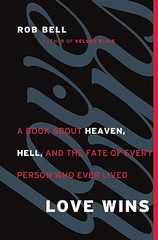
 A few weeks ago, I was rudely awakened in the middle of the night. It wasn’t the doorbell. It wasn’t a phone call. And it wasn’t the dog scratching on the back door. My cell phone was blinking. And it was blinking relentlessly. A post by Justin Taylor stared me in the face. “Rob Bell – Universalist?” Before his book even hit the shelves (or was wirelessly sent to thousands of Kindles), the chatter commenced. John Piper sent a tweet that read, “Farewell, Rob Bell.” Before the book was published, Tim Challies offered the first critical review. Many reviews followed which include the likes of Dr. Al Mohler and Kevin DeYoung. Have these theologians and bloggers been too critical of Rob Bell? Have they jumped the gun and pointed an unnecessary finger of admonition? Does “love win” in the way that Bell proclaims in his latest book?
When I first started reading Love Wins, I found myself frustrated by Bell’s propensity to ask question after question. The emergent tendency to ask thought-provoking Socratic questions which force readers to fend for themselves dominate the opening chapters. However, this changes soon enough. In chapter four, Bell turns dogmatic; he steps out of the shadows and promotes his particular worldview.
When I was a kid, I remember the frustration of rummaging through the cereal box, hoping to claim the prize that was lurking below the tasty sugar-coated treats. It seemed like it took forever. Bell’s book is much like my experience as a kid. I found myself asking, “What’s this guy trying to say?” “What does he believe?” “What is he promoting?” But tragically, the analogy falls apart. There is no prize to be found. What emerges is a strange mixture of biblical teaching and man-made philosophy. Sadly, the latter dominates the former.
THE POSITIVE ELEMENTS
First, note the biblical teaching that proves to be helpful:
Confronting the Diminished Gospel
Bell tackles the typical view of the gospel that is reduced to merely “getting into heaven” or “staying out of hell.” Amid all the criticism of Love Wins, I believe Bell is onto something here. He writes, “So when the gospel is diminished to a question of whether or not a person will ‘get into heaven,’ that reduces the good news to a ticket …” He goes on to explain that when the gospel is understood this way, the joyful participation with God through Christ is minimized and people are cut off from experiencing God in personal and significant ways.
It is certainly true that the gospel involves more than heaven or hell. The gospel is an invitation to real life. Jesus came so people might have abundant life (John 10:10). He came so people could know God personally and intimately (John 17:3). He came to set the captives free and forgive sinners (Luke 3:3).
THE NEGATIVE ELEMENTS
However, Love Wins contains some very unhelpful ideas that can be construed as man-made philosophy. After carefully reading Bell’s book, I conclude that there are at least six “leaks” in Love Wins; “leaks” that should be of serious concern to evangelical Christians.
Leak 1: The Authority of Scripture is Undermined
The first “leak” concerns the authority of God’s Word. Bell writes, “At the center of the Christian tradition since the first church have been a number who insist that history is not tragic, hell is not forever, and love, in the end, wins and all will be reconciled to God” (p. 110). It is certainly true that many (including Origen) have promoted a belief in universal reconciliation. However, these beliefs do not stand at the center of the Christian tradition. Rather, these erroneous beliefs militate against the Christian tradition, and ultimately undermine the authority of Scripture.
A brief glance through the halls of church history reveal a strong denial of universal reconciliation. Leaders as diverse as Tertullian, Augustine, Aquinas, Luther, Calvin, Wesley, Edwards, and Spurgeon all believed in the reality and eternality of hell. Edwards was more direct than anyone: “This is the death threatened in the law. This is dying in the highest sense of the word. This is to die sensibly; to die and know it; to be sensible of the gloom of death. This is to be undone; this is worthy of the name of destruction. This sinking of the soul under an infinite weight, which it cannot bear, is the gloom of hell.” Edwards merely affirms what the Scripture affirms.
Spurgeon comments on unconverted people being cast into hell. He writes, “There is no bottom; and you hear coming up from the abyss, sullen moans, and hollow groans, and screams of tortured ghosts … But, in hell, there is no hope. They have not even the hope of dying – the hope of being annihilated. They are forever, forever – lost.” Like the preacher from Northampton, Spurgeon affirms what the Scripture affirms.
Bell is critical of a story we are all familiar with – a “story about God who inflicts unrelenting punishment on people because they didn’t do or say or believe the correct things in a brief window of time called life.” He argues that this “isn’t a very good story.”
Perhaps Bell is right. Maybe this doesn’t make for a good story. Here’s the problem – the story is true. The Bible promises eternal life and the forgiveness of sins for all people who turn from their sin, believe in, and follow Christ (John 3:15-16; 6:37, 47; 7:38; John 8:12; Acts 4:12; Rom. 10:9-13,17). And the Bible promises eternal judgment for the unrepentant; for those who refuse to believe in and obey Jesus (Deut. 32:40-41; 2 Thes. 1:8-9; Rom. 2:8). The apostle John adds, “Whoever believes in the Son has eternal life; whoever does not obey the Son shall not see life, but the wrath of God remains on him” (John 3:36). We find then, that the story is not only true; the story is good. It is good because it is God’s story.
Additionally, Bell undermines the authority of Scripture by posing questions that place doubt in the minds of readers; doubt about God’s love – should the doctrine of eternal torment square with reality and prove to be true. The best example emerges early in the book:
“Is this acceptable to God? Has God created millions of people over tens of thousands of years who are going to spend eternity in anguish? Can God do this, or even allow this, and still claim to be a loving God?” (p. 1).
Scripture makes absolute and unwavering assertions concerning hell, judgment, and personal accountability. To jettison these clear and unequivocal doctrinal truths is a tragic move indeed. To compromise the clear teaching of God’s Word is to undermine the authority of sacred Scripture.
Leak 2: Hell is Undermined
Hell is not necessarily denied in Love Wins. Rather, hell is merely redefined. Bell writes, “… We need a loaded, volatile, adequately violent, dramatic, serious word to describe the very real consequences we experience when we reject the good and true and beautiful life that God has for us. We need a word that refers to the big, wide, terrible evil that comes from the secrets hidden deep within our hearts all the way to the massive, society-wide collapse and chaos that comes when we fail to live in God’s world God’s way … And for that, the word “hell” works quite well. Let’s keep it” (p. 93).
This is certainly a creative play on words. But the Bible is clear. Hell is a real place where unrepentant sinners go, eternally. (Matt. 5:21-22; 27-30; 23:33; Rev. 14:9-10). It is a place where people willingly choose to go because they fail to regard God as trustworthy and because they spurn the greatness of God’s worth.
Daniel Fuller comments on the depth of depravity that God must respond to in a decisive manner: “So the enormity of people’s total depravity consists both in treating God in the worst possible way and in deterring others from knowing the unsurpassed blessing of having him work for them to do them good with his whole heart and soul. The enormity of such a crime therefore requires a punishment having a corresponding severity … We therefore conclude that it is just and right for God to consign the impenitent to an eternal hell” (The Unity of the Bible, p. 194). Hell is a place where people bear the weight of their sin because they have failed to glorify God as they ought, and where God’s justice is fully vindicated.
Hell is a place of rejection (Matt. 7:21-23). Indeed, one of the deepest cries of the human heart is, “Please accept me.” One of the most painful aspects of hell, then, will be utter rejection; eternal rejection.
Scripture teaches that hell is a place of darkness and separation (Matt. 8:5-12; 13:36-43, 47-50; 22:1-13; 24:36-51). Erwin Lutzer addresses the apparent inconsistency of hell, which is described in Scripture as a place of fire and darkness. Lutzer comments, “Another kind of ‘fire’ might be worse than literal fire. That is the fire of unfulfilled passion, the fire of desires that are never satisfied … Hell, then, is the raw soul joined to an indestructible body, exposed to its own sin for eternity” (The Agonies of Hell – Moody Monthly Magazine, May/June 2001, 22).
Hell is a place of pain and punishment, according to God’s Word. There will be weeping and gnashing of teeth (Matt. 13:41-42, 49-50; 24:50-51). John MacArthur notes, “Hell will have no friendships, no fellowship, no camaraderie, no comfort. It will not even have the debauched pleasures in which the ungodly love to revel on earth. There will be no pleasure in hell of any kind or degree – only torment, ‘day and night forever and ever'” (Rev. 20:10).
Leak 3: Sovereign Grace is Undermined
Love Wins undermines sovereign grace by subtly undercutting the doctrine of election. The author asks, “How does a person end up being one of the few?” His response:
“Chance?
Luck?
Random selection?
Being born in the right place, family, or country?
Having a youth pastor who ‘relates better to the kids?
God choosing you instead of others?
What kind of a faith is that?
Or, more important:
What kind of a God is that?” (p. 2).
Instead of embracing the clear teaching concerning election, the author maintains “all people will come to God” (p. 99). Bell seeks to support his view by appealing to texts like Psalm 65, Ezekiel 36, Isaiah 52, Psalm 22, and Philippians 2. Yet he fails to take into account the passages that disagree with the logic of his working presupposition.
Several lines of biblical reasoning contradict his view. First, Jesus teaches that many will be lost: “Enter by the narrow gate. For the gate is wide and the way is easy that leads to destruction, and those who enter by it are many. For the gate is narrow and the way is hard that leads to life, and those who find it are few” (Matt. 7:13-14, ESV).
Second, Bell fails to recognize the passages that warn people who fail to believe. A few examples demonstrate how misleading his argument is:
“But because of your hard and impenitent heart you are storing up wrath for yourself on the day of wrath when God’s righteous judgment will be revealed. ” (Romans 2:5, ESV)
“but for those who are self-seeking and do not obey the truth, but obey unrighteousness, there will be wrath and fury. ” (Romans 2:8, ESV)
“… in flaming fire, inflicting vengeance on those who do not know God and on those who do not obey the gospel of our Lord Jesus. They will suffer the punishment of eternal destruction, away from the presence of the Lord and from the glory of his might, ” (2 Thessalonians 1:8–9, ESV)
“Whoever believes in the Son has eternal life; whoever does not obey the Son shall not see life, but the wrath of God remains on him. ” (John 3:36, ESV)
Third, Bell undercuts sovereign grace by arguing that God will draw all people to himself: “… We see that Jesus himself, again and again, demonstrates how seriously he takes his role in saving and rescuing and redeeming not just everything, but everybody” (p. 150). Bell continues, “What Jesus does is declare that he and he alone is saving everybody. And then he leaves the door way, way open. Creating all sorts of possibilities. He is as narrow as himself and as wide as the universe” (p. 155). At the very least, he is sympathetic to Origin’s atonement theory, which was roundly defeated in the sixth century.
Not surprisingly, Bell cites John 12:32 to bolster his argument: “And I, when I am lifted up from the earth, will draw all people to myself.” Yet Jesus does not suggest that all people will be saved. This would contradict a host of passages that teach unconditional election. He does not mean all without exception. Rather, he means all without distinction, all kinds of people. Scripture promises that God will draw all kinds of people to himself. Representatives from every tribe, language, people, and nation will be included (Rev. 5:9-10).
Bell uses the same line of reasoning in his discussion of Romans 5:18. He writes, “Paul says that ‘one trespass resulted in condemnation for all people, so also one righteous act resulted in justification and life for all” (p. 134). Again, if Paul is promoting universal reconciliation, he contradicts his teaching on unconditional election (Rom. 8:29; 9:6-23; 11:5-7; Eph. 1:3-11; 1 Thes. 1:4; 5:9; 2 Thes. 2:13-14; 2 Tim. 1:9). And if Paul contradicts his teaching concerning election, we have an additional problem with the authority of Scripture. May it never be!
In Jesus’ high priestly prayer, we find him praying for the elect. He prays, “I am not praying for the world but for those whom you have given me, for they are yours” (John 17:9, ESV). And we find that the Father has graciously given the elect to the Son (John 17:2, 6-7, 11-12). Some, not all.
In John 10, Jesus indicates the scope of his mission, namely, those for whom he came to save:
“I am the good shepherd. The good shepherd lays down his life for the sheep” (John 10:11, ESV).
“I am the good shepherd. I know my own and my own know me” (John 10:14, ESV).
“… I lay down my life for the sheep” (John 10:15b, ESV).
And Jesus upholds the doctrine of election by adding, “But you do not believe because you are not part of my flock. My sheep hear my voice, and I know them, and they follow me” (John 10:26-27). The scope of Christ’s mission was specific in its intention. Christ came to purchase a “people for his own possession” (1 Pet. 2:9). The benefits of his death, while certainly available to all are limited in terms of efficacy. He paid the price on the cross for everyone who would ever believe.
Fourth, and most disturbing is the erroneous notion that if some people are judged eternally, God will not “get want he wants.” Bell queries, “So does God get what God wants? How great is God? Great enough to achieve what God sets out to do, or kind of great, medium great, great most of the time, but in this, the fate of billions of people, not totally great. Sort of great, a little great (p. 97). He continues, “Will all people be saved, or will God not get what God wants? … Does this magnificent, mighty, marvelous God fail in the end? (p. 98).
Bell seeks to argue his case on this basis: “People, according to the scriptures are inextricably intertwined to God … The writers of the scriptures consistently affirm that we’re all part of the same family” (p. 99). The author maintains that on this basis, God wants all people to be saved. In other words, if some of those whom God desires to be saved are ultimately lost, God has failed, and as a result, his goodness and greatness are in question.
Has Bell forgotten the separation that occurred after the Fall? Instead of being “inextricably intertwined to God,” the Bible declares that a massive gulf exists between the Creator and the creature. Sin has separated people from God (Isa. 59:2). Isaiah indicates the depth of this separation: “Their feet run to evil, and they are swift to shed innocent blood; their thoughts are thoughts of iniquity; desolation and destruction are in their highways” (Isa. 59:7, ESV). Sinners are stubborn and rebellious by nature (Isa. 5:23).
The biblical portrait is radically different than the one that Bell paints: “We have all become like one who is unclean, and all our righteous deeds are like a polluted garment. We all fade like a leaf, and our iniquities, like the wind, take us away. There is no one who calls upon your name, who rouses himself to take hold of you; for you have hidden your face from us, and have made us melt in the hand of our iniquities” (Isa. 64:6-7, ESV).
Actually, the biblical portrait concerning the sinfulness of sin in the heart of all people is devastating. Scripture teaches that sinners are born, not made (Ps. 51:5; Rom. 5:12). The heart is desperately wicked (Jer. 17:9). The apostle Paul proclaims that the heart of man is radically corrupt. He has no righteousness (Rom. 3:10), no desire for God (Rom. 3:11), no inclination to do good to the glory of God (Rom. 3:12). Additionally, sinners hate God (Rom. 8:7-8). In his work, Men Naturally God’s Enemies, Jonathan Edwards writes, “The heart is like a viper, hissing and spitting poison to God.” Sinners are dead in sin (Eph. 2:1) and enslaved to sin (John 8:34). They are unable to come to Christ apart from God’s empowerment and grace (John 6:44).
Bell insists, “… we’re all part of the same family.” Yet, God’s Word teaches that every unconverted person is hopeless apart from grace: ” … Remember that you were at that time separated from Christ, alienated from the commonwealth of Israel and strangers to the covenants of promise, having no hope and without God in the world” (Eph. 2:12, ESV).
Bell’s assertion that God “desires all people to be saved” is a biblical argument (1 Tim. 2:4; 2 Pet. 3:9). Taken at face value these passages appear to contradict the doctrine of unconditional election. But since God is true and does not have the capacity to lie or contradict himself (Tit. 1:2; Heb. 6:18), there must be an explanation this dilemma.
The heart of God is expressed in 1 Timothy 2:4 and 2 Peter 3:9. God has a heart for the nations; he truly “desires all people to be saved.” But all people are not saved. The Bible never promises that all people will be reconciled. These passages express what theologians refer to as God’s “will of command.” This is his “will of desire.” However, God’s “will of command” should not be confused with his “will of decree”, namely, his sovereign decision in eternity past to choose some for salvation and pass over others.
Scripture is clear on this matter. God is sovereign in all things, including salvation. B.B. Warfield writes, “In the infinite wisdom of the Lord of all the earth, each event falls with the exact precision into its proper place in this unfolding of His eternal plan; nothing, however small, however strange, occurs without His ordering, or without its peculiar fitness for its place in the working out of His purposes; and the end of all shall be the manifestation of His glory, and the accumulation of His praise.” Ephesians 1:4 says, “… Even as he chose us in him before the foundation of the world, that we should be holy and blameless before him.” The testimony of the biblical writers is that God predestined some to salvation, not all (Rom. 8:29-30; Eph. 1:5, 11). In the final analysis, God is glorified and yes, God gets what he wants!
Leak 4: Radical Depravity is Undermined and Human Freedom Exalted
Free will stands at the heart of Rob Bell’s argument in Love Wins. Indeed, this is the crux of the matter. His argument is vivid: At the end of the day, if some people believe and others refuse to believe, God doesn’t get want he wants. Bell argues, “Although God is powerful and mighty, when it comes to the human heart God has to play by the same rules we do. God has to respect our freedom to choose to the very end, even at the risk of the relationship itself. If at any point God overrides, co-opts, hijack the human heart, robbing us of our freedom to choose, then God has violated the fundamental essence of what love even is” (pp. 103-104).
Bell is critical of the notion that people get one chance to believe in this life. His free will argument, then, begins to hint at post-mortem evangelism. While Bell never clearly articulates what he believes, he speaks approvingly of those who have embraced universal reconciliation in church history:
“And then there are others who ask, if you get another chance after you die, why limit that chance to a one-off immediately after death? And so they expand the possibilities, trusting that there will be endless opportunities in an endless amount of time for people to say yes to God … as long as it takes, in other words” (p. 106).
“At the heart of this perspective is the belief that, given enough time, everybody will turn to God and find themselves in the joy and peace of God’s presence. The love of God will melt every hard heart, and even the most ‘depraved sinners’ will eventually give up their resistance to God” (p. 107).
Bell argues that some of the church fathers believed in universal reconciliation: “Central to their trust that all would be reconciled was the belief that untold masses of people suffering forever doesn’t bring God glory. Restoration brings God glory; eternal torment doesn’t. Reconciliation brings God glory; endless anguish doesn’t. Renewal and return cause God’s greatness to shine though the universe; never-ending punishment doesn’t” (p. 107).
The point of universal reconciliation is an important one for Bell. He adds, “To be clear, again, an untold number of serious disciples of Jesus across hundreds of years have assumed, affirmed, and trusted that no one can resist God’s pursuit forever, because God’s love will eventually melt even the hardest of hearts” (p. 107).
Bell continues to drive home his agenda with this shocking statement: “At the center of the Christian tradition since the first church have been a number who insist that history is not tragic, hell is not forever, and love, in the end, wins and all will be reconciled to God” (pp. 108-109).
The author continues to build an argument based on free will: “Love demands freedom. It always has, and always will. We are free to resist, reject, and rebel against God’s ways for us. We can have all the hell we want” (pp. 113-114). Bell extends his free will argument into eternity future: “So will those who have said no to God’s love in this life continue to say no in the next? Love demands freedom, and freedom provides that possibility. People take that option now, and we can assume it will be taken in the future (p. 114).
Bell’s assertions undermine radical depravity and exalt human freedom. First, radical depravity is undermined by granting the creature the ultimate power of self-determination. It is certainly true that creatures are free in one sense, namely, they do what they want to do. Jonathan Edwards reminds us, “A man never in any instance, wills anything contrary to his desires, or desires anything contrary to his Will. He goes on to say that “the Will is always determined by the strongest motive.”
Second, human freedom is exalted by granting the creature the power to do as they please in matters of salvation. The problem with this line of reasoning is that freedom never implies ability. It is true that sinful creatures are free to come to God – but not apart from God’s drawing them (John 6:44). J.I. Packer reminds us, “We have no natural ability to discern and choose God’s way because we have no natural inclination Godward; our hearts are in bondage to sin, and only the grace of regeneration can free us from that slavery” (Concise Theology, p. 86).
Bell says, “God extends an invitation to us, and we are free to do with it as we please” (p. 177). Actually, this statement is true in principle. God does extend an invitation to all. The general call is clearly taught in Scripture (Isa. 55:1; Matt. 22:14; Mark 8:34). And we are free to do as we please. But again, freedom does not imply ability. Totally depraved people are free do good or evil but only able to do evil because of the radical nature of their sinful condition (John 8:34). “With sin’s entrance man lost ability to do good, not liberty” (G.I. Williamson, The Westminster Confession of Faith, p. 86). Whenever radical depravity is undermined, human freedom is unwisely exalted.
Leak 5: The Biblical Portrait of God is Undermined
Bell paints an unfair straw man argument by pitting the attributes of God against one another. He questions the doctrine of eternal torment and in the same sentence, he puts the love of God on trial: “Is this acceptable to God? Has God created millions of people over tens of thousands of years who are going to spend eternity in anguish? Can God do this, or even allow this, and still claim to be a loving God?” (p. 1).
Bell argues against what he perceives to be inconsistency in God: “A loving heavenly father who will go to extraordinary lengths to have a relationship with them would, in the blink of an eye, become a cruel, mean, vicious tormentor who would ensure that they had no escape from an endless future of agony” (p. 173).
Moreover, Bell argues, “If God can switch gears like that, switch entire modes of being that quickly, that raises a thousand questions about whether a being like this could ever be trusted, let alone be good” (p. 173).
Bell’s argument is simple. If God claims to be loving but at the same time punishes unrepentant people in an eternal hell, he cannot possibly be loving, good, or trustworthy. The author adds, “We do ourselves great harm when we confuse the very essence of God, which is love, with the very real consequences of rejecting and resisting that love, which creates what we call hell” (p. 177). While this may sound tenable, this thinking elevates the love of God and marginalizes God’s justice.
Daniel Fuller argues in the opposite direction with the full force of biblical authority: “God cannot remain indifferent to those who are going in the opposite direction … God could not be loving to those who seek him if he did not vent the power of his wrath against those who remain impenitent. Far from being irreconcilable opposites, God’s love and wrath are simply two ways in which he makes it clear that he himself fully honors his name” (The Unity of the Bible, p. 190). In other words, if God did not demonstrate justice on unrepentant sinners, his love would be compromised; he would cease to be God.
By pitting God’s love and justice, Bell jettisons God’s simplicity. Michael Horton reminds us, “God’s simplicity resists our temptations to identify a single attribute, including love, as more definitive of God than others” (The Christian Faith: A Systematic Theology for Pilgrims on the Way, p. 499). Horton continues, “God cannot exercise love and mercy at the expense of his righteousness and justice. But this works in the other direction as well: God’s wrath is not arbitrary or capricious but is the necessary response to the violation of his justice, righteousness, holiness, and goodness.” Moreover, Horton argues, “The cross … is the only way that God can uphold his justice and his love in the salvation of covenant breakers. By definition, mercy need not be shown, but once God has decided to exercise mercy, he can do so only in a way that does not leave his righteousness, holiness, and justice behind” (p. 511). Love Wins elevates God’s love at the expense of his righteousness, holiness, and justice.
Therefore, the biblical portrait of God is undermined. A.W. Tozer rightly says, “The first step down for any church is taken when it surrenders its high opinion of God” (The Knowledge of the Holy, p. 10). Indeed, when the character of God is compromised, nobody wins.
Leak 6: The Biblical Gospel is Undermined
Finally, the thesis of the book emerges on page 118: “If we want hell, if we want heaven, they are ours. That’s how love works. It can’t be forced, manipulated, or coerced. It always leaves room for the other to decide. God says yes, we can have what we want, because love wins.” Again, Bell argues, “Restoration brings God glory; eternal torment doesn’t. Reconciliation brings God glory; endless anguish doesn’t. Renewal and return cause God’s greatness to shine through the universe; never-ending punishment doesn’t” (p. 107).
Many will be convinced by this argument. But this line of reasoning undermines the biblical gospel. The gospel is good news. The gospel is the hope of nations. The gospel promises hope, and forgiveness, and eternal life to everyone who believes. But the gospel not only includes promises; the gospel includes threats. The gospel warns the unrepentant. The gospel warns sinners of an eternal hell that awaits every person who rejects Christ.
It is true that God is glorified when sinners are reconciled. It is true that renewal glorifies God. But God’s justice is also vindicated when the impenitent pay eternally for their sin and unbelief (Rom. 9:22-23). Daniel Fuller wisely writes, “Though he finds no pleasure in punishing the wicked, he nevertheless does it as something he must do, so that without devaluing his glory, he can fully rejoice in being merciful to the penitent” (The Unity of the Bible, p. 196). John the apostle indicates that the final judgment on the impenitent will result bring glory to God: “Hallelujah! Salvation and glory and power belong to our God, for his judgments are true and just” (Rev. 19:2, ESV). Whenever eternal torment is minimized, the biblical gospel is undermined. And an undermined gospel is rendered a powerless, non-gospel.
SUMMARY
Love Wins is a classic example of theological compromise. It is a dangerous example of moving away from strong doctrinal moorings. It demonstrates the folly of drifting from the shore of truth on a flimsy raft that will sink in due time. Leaky rafts always sink!
Readers who are sympathetic to the message in Love Wins must ask, “Is Love Wins consistent with Scripture?” Careful readers will acknowledge that biblical authority is undermined which leads to the denial of some key components of orthodoxy.
Yet, there is something very healthy about Love Wins. Like the early leaders in the church; the apologists, the Puritans, and the Reformers who contended for the faith in the midst of doctrinal error, this book will force the church to revisit the doctrine of hell and articulate the doctrinal boundaries. We can be thankful to Rob Bell for sharpening those of us who are committed to the truth of God’s Word.
At the end of the day, we must acknowledge that God will get exactly what his will of decree demands: He will complete the good work he started in the every one of his elect (Phil. 1:6). The elect receive God’s mercy. The non-elect receive God’s justice (Rom. 9:14-18). And God is glorified in the vindication of the righteous and the eternal judgment of the unrighteous (Rom 9:22-23). “For from him and through him and to him are all things. To him be glory forever. Amen” (Rom. 11:36, ESV).









 Veritas et Lux