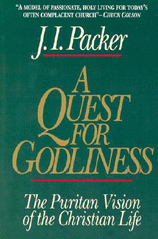
 A Quest for Godliness: The Puritan Vision of the Christian Life by J.I. Packer is a superb introduction to the English Puritans. For too long, the Puritans have been marginalized, unfairly caricatured, and relegated dusty boxes of books in the garage. Packer intends to bring the Puritans to the forefront of Christian thought, precisely where they belong.
Part One: The Puritans in Profile
J.I. Packer begins by arguing (and rightly so) that current day Christians need the Puritans. Indeed, “the Puritans exemplified maturity; we don’t. We are spiritual dwarfs.” The author reminds us that “Puritanism was at heart a spiritual movement, passionately concerned with God and godliness … Puritanism was essentially a movement for church reform, pastoral renewal and evangelism, and spiritual revival; and in addition – indeed, as a direct expression of its zeal for God’s honor – it was a world-view, a total Christian philosophy …”
Packer discusses Puritanism as a particular movement of revival. It is true that revival strikes at the core of who the Puritans were and what they sought to accomplish. Packer’s definition, then, is appropriate and accurate. “Puritanism I define as that movement in sixteenth and seventeenth-century England which sought further reformation and renewal in the Church of England than the Elizabethan settlement allowed.”
The author includes a helpful section on the practical writings of the Puritans. Central to Puritan thought was a God-centered education. They were in the strict sense of the word, “mind-educators.” Packer writes, “The starting-point was their certainty that the must must be instructed and enlightened before faith and obedience became possible … Heat without light, pulpit passion without pedagogic precision, would be no use to anyone.”
The Puritans are often painted into the corner as cold and emotionless, dry and boring. Nothing could be further from the truth. Packer rightly adds, “All the Puritans regarded religious feeling and pious emotion without knowledge as worse than useless. Only when truth was being felt was emotion in any way desirable … So the teaching of truth was the pastor’s first task, as the learning of it was the layman’s.”
Additionally, Puritans are often charged with teaching doctrine and neglecting application. Again, this is an inaccurate caricature. Rather, the Puritans were famous for preaching and teaching doctrine and always proceeding to the point of application.
Part Two: The Puritans and the Bible
John Owen is the primary Puritan discusses in this section. Owen is regarded by most to be the among the greatest of all the Puritans. He wielded and continues to wield enormous influence among Reformed theologians.
Packer zero’s in on Owen’s approach to God’s revelation. First, he describes how Owen would have reacted to the “irrationalism of the neo-orthodox idea of a ‘knowledge’ of God derived from non-communicative ‘encounters’ with him.” But he moves forward to describe the essence of Owen’s approach: “Mere rational instruction thus proves ineffective; only the illumination of the Holy Spirit, opening our heart to God’s word and God’s word to our hearts, can bring understanding of, conviction about, and consent to, the things that God declares.”
The author continues to guide the reader in understanding Owen’s understanding of the giving of revelation, the inspiration of Scripture, the authentication of Scripture and the interpretation of Scripture.
At this point, Packer moves into deeper waters as he surveys the general attitude of Puritans as interpreters of Scripture. He cites Thomas Watson: “Think in every line you read that God is speaking to you – for in truth he is. What Scripture says, God is saying.”
Part Three: The Puritans and the Gospel
In chapter eight, Packer includes his introduction to John Owen’s, “The Death of Death in the Death of Christ” and is perhaps the best chapter in the book. Packer demonstrates that “universal redemption is unscriptural and destructive to the gospel” a notion that is very unpopular in the church.
“Christ did not win a hypothetical salvation for hypothetical believers, a mere possibility of salvation for any who might possibly believe, but a real salvation for his own chosen people. His precious blood really does ‘save us all’; the intended effects of his self-0ffering do in fact follow, just because the cross was what it was. Its saving power does not depend on faith being added to it; its saving power is such that faith flows from it. The cross secured the full salvation of all for whom Christ died.”
While Packer (and Owen) argue against universal redemption; i.e. unlimited atonement, they both believe strongly in universal invitations. They reject the erroneous hyper-Calvinist notion that the gospel should only be proclaimed to the elect. Packer adds, “The question of the extent of the atonement does not arise in evangelistic preaching; the message to be delivered is simply this – that Christ Jesus, the sovereign Lord, who died for sinners, now invites sinners freely to himself. God commands all to repent and believe; Christ promises life and peace to all who do so.”
Often the preaching task is described as “bringing men to Christ.” Packer is quick to note, however: “The task of preaching the old gospel could more properly be described as bringing Christ to men (emphasis mine), for those who preach it know that as they do their work of setting Christ before men’s eyes, the mighty Savior whom they proclaim is busy doing his work through their words, visiting sinners with salvation, awakening them to faith, drawing them in mercy to himself.”
Packer’s chapter on the Puritan View of Preaching the Gospel is also excellent. “The Puritan view was that preaching gospel sermons means teaching the whole Christian system – the character of God, the Trinity, the plan of salvation, the entire work of grace. To preach Christ, they held, involved preaching all this. Preach less, they would tell us, and what you do preach will not be properly grasped.”
Part Four: The Puritans and the Holy Spirit
Part four summarizes the witness of the Spirit in Puritan thought, the spirituality of John Owen, and Owen’s view on spiritual gifts. Owen’s work, Communion With God is a classic and should be required reading for all Christians. Packer writes, “Communion with Christ then becomes a matter of acknowledging his presence in the power of his reconciling sacrifice and of observing the ordinance with reverent confidence that in it Christ comes to pledge his saving love to each one personally, so that ‘we sit down at God’s table as those that are the Lord’s friends … there being now no difference [contention] between him and us.'”
Part Five: The Puritans and the Christian Life
Part five summarizes the Puritan approach to the Lord’s Day, worship, and marriage/family.
Part Six: The Puritans in Ministry
Finally, Packer outlines the Puritan vision of the Word preached. He cites Richard Baxter: “Labor to awaken your own hearts, before you go into the pulpit, that you may be fit to awaken the hearts of sinners … When I let my heart go cold, my preaching is cold … and so I can oft observe also in the best of my hearers that when I have grown cold in preaching, they have grown cold too.”
Packer is quick to point out in the Puritan belief in the “primacy of the intellect.” He adds, “It follows that every man’s first duty in relation to the word of God is to understand it; and every preacher’s first duty is to explain it. The only way to the heart that he is authorized to take runs via the head.”
The Puritans also believed in the primacy of preaching – a message that should not go unheeded today. “Reverence for revealed truth and faith in its entire adequacy for human needs, should mark all preaching.” John Owen is emphatic, “The first and principal duty of a pastor is to feed the flock by diligent preaching of the Word.”
The Puritans had a strong belief in the sovereignty of the Holy Spirit. Packer writes, “The Puritans insisted that the ultimate effectiveness of preaching is out of man’s hands. Man’s task is simply to be faithful in teaching the word; it is God’s work to convince of its truth and write it in the heart. The Puritans would have criticised the modern evangelistic appeal, with its wheedling for ‘decisions’, as an unfortunate attempt by man to intrude into the Holy Spirit’s province. It is for God, not man, to fix the time of conversion.”
The Puritans were expository preachers. Their preaching was doctrinal. “To the question, ‘Should one preach doctrine?’ the Puritan answer would have been, ‘Why, what else is there to preach?” Packer adds, “Doctrinal preaching certainly bores the hypocrites; but it is only doctrinal preaching that will save Christ’s sheep. The preachers job is to proclaim the faith, not to provide entertainment for unbelievers – in other words, to feed the sheep rather than amuse the goats.”
CONCLUSION
A Quest for Godliness: The Puritan Vision of the Christian Life is an important book. It unpacks the most important components of Puritan thought and introduces readers to the essence of Puritan theology. It is true that we live in a different day. However, the message that the Puritans proclaimed has not changed, not will it ever change. The Puritans remind us of the importance of being faithful and refusing to capitulate to the winds of pragmatism. The Puritans remind us to faithfully preach the Word of God and share the message of God’s grace to our dying generation.
5 stars





 Veritas et Lux