Gospel People: A Call for Evangelical Integrity – Michael Reeves

Michael Reeves, Gospel People: A Call for Evangelical Integrity (Wheaton: Crossway Books), 143 pp.

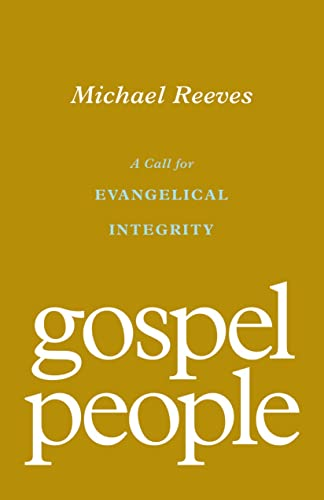
Gospel People: A Call for Evangelical Integrity is the latest work from the pen of Dr. Michael Reeves. The author issues a strong plea for Christians to live and proclaim the gospel with biblical humility.

The three components that fortify the backbone of the book include 1) Revelation from the Father, 2) Redemption by the Son, and 3) Regeneration by the Spirit. This biblical template comprises the essence of the gospel and unifies followers of Christ.

After a rigorous and illuminating discussion of the aforementioned points, the author builds momentum by calling followers of Christ to live lives grounded in humility and integrity: “It is the bearing of one refreshed by the gospel,” writes Reeves. “Captivated by the magnificence of God, such evangelicals will not be so drawn to man-centered therapeutic religion. Under the radiance of his glory, they will not want to establish their own little empires … He will loom large, making them bold to please God and not men.” Gospel integrity is the goal of every believer. Reeves paints a wonderful portrait of such a life: “They will be quick to serve, quick to bless, quick to repent, and quick to laugh at themselves, for their glory is not themselves but Christ. This is the integrity found through the lifting up of Christ in his gospel.”

Gospel People is an important book that should be devoured by Christians. The book is clear, biblical, and practical. The clarion call extended by Dr. Reeves should be heard and heeded. The result will be a renewed commitment to living as gospel people – people committed to humility, integrity, and the “faith that was once for all delivered to the saints.”

I received this book free from the publisher. I was not required to write a positive review.

Everything is Spiritual – Rob Bell

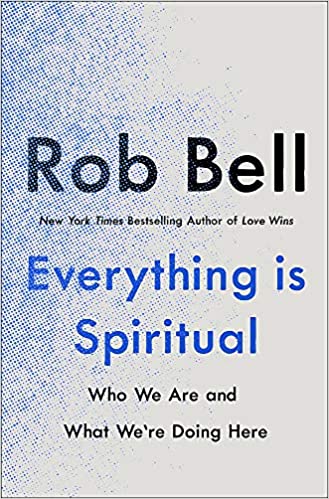
Rob Bell, Everything is Spiritual (New York: St. Martin’s Publishing Group, 2020), 310 pp.

In 2011, I reviewed Love Wins, my first book by Rob Bell. The piece prompted praise by conservatives and vicious scorn by progressive Christians and liberals. Whatever anyone thinks about Bell, one thing is for sure: the guy can write. He is a master communicator. And whenever he writes or talks, people listen.

Anyone familiar with Rob Bell knows that he is somewhat of a gadfly among evangelicals. And “gadfly” is a massive understatement. But there is something endearing about Bell. Some point to his skill. Others are impressed with his intellect. For me, I’ve always been drawn to Bell’s ability to communicate what he’s truly feeling – including insecurity, childhood pain, or unfulfilled expectations. He identifies a “generational lack of grace,” a trait that is found too often in the church. His transparency is refreshing and his candor is something that is greatly needed in our day.

While I applaud Bell’s transparency, I have expressed deep concern with some of the theological and philosophical assertions that he has proposed. His most recent book, Everything Is Spiritual is no exception. Michael Eric Dyson’s endorsement of the book provides a revealing summary:

“In Everything Is Spiritual, Rob Bell updates Teilhard de Chardin’s Catholic mysticism, makes sexier Werner Heisenberg’s quantum physics, and baptizes Jewish Kabbalah in an exciting vision of the future of human evolution. Bell challenges the notion that science and belief are at war, with his sublime fusion of Christian faith and modern evolutionary science. Bell’s book is the perfect antidote to the plague of an evangelical worldview that is captive to imperial dreams and a literalism that kills the spirit of Christianity …”

I will argue in this review that while Michael Eric Dyson truly does capture the essence of Bell’s intentions in Everything Is Spiritual, the end result is unhelpful and spiritually dangerous. Instead of illumination, readers will be left in a quagmire – with more questions than answers. And they will wander aimlessly in a spiritual wasteland, armed with an inaccurate portrait of God that leaves them hopeless without the biblical gospel.

No Final Answer

One of the common themes in Bell’s writing is ambiguity. He extinguishes certitude and exalts mystery (both of which are fundamental tenets of postmodernism). Careful readers will notice that the author is quick to pay lip service to Christian theology but swiftly degenerates into a subtle (or not so subtle man-made philosophy). The Bible warns, “For the time is coming when people will not endure sound teaching, but having itching ears they will accumulate for themselves teachers to suit their own passions, and will turn away from listening to the truth and wander off into myths” (2 Tim. 4:3-4, ESV).

Tragically, many have been deceived by Bell’s “spirit myths” over the years. For instance, in Bell’s book, What We Talk About When We Talk About God, he argues that God is “with us, for us, and ahead of us – all of us.” The notion that God is “with us,” “for us,” and “ahead of us (every single one of us) may sound good initially but falls short of the biblical model. It is true that God is “with” his people. We see this especially in the incarnation of Jesus, the One who is named Immanuel – or God with us (Matt. 1:23). Yet God is not “with” the man who has rejected the revelation of God in Christ. God is not “with” the one who rejects the Lord Jesus Christ and his gospel. “… Whoever does not obey the Son shall not see life, but the wrath of God remains on him” (John 3:36).

It is true that God is “for us” – that is to say, he is for his people. “For I am sure that neither death nor life, nor angels nor rulers, nor things present nor things to come, nor powers, nor height nor depth, nor anything else in all creation, will be able to separate us from the love of God in Christ Jesus our Lord” (Rom. 8:38–39, ESV). Yet, God is not “for” the man who repudiates the promises and purposes of God. The holy God opposes the proud (Jas. 4:6; 1 Pet. 5:5).

I referred to Paul’s warning in 2 Tim. 4:3-4 again and again as I read Everything is Spiritual. Indeed, doctrine is downplayed and orthodoxy is questioned. But not everything is ambiguous. As he did in Love Wins, Bell dogmatically casts aside the doctrine of hell: “Because some stories are better than others. Stories about a God who tortures people forever in hell shouldn’t be told. They’re terrible stories. They make people miserable. They make people want to kill themselves. Stories that insist that a few human beings are going to be okay and every other human being ever is doomed for eternity are horrible stories.”

In a magical twist, certitude suddenly reappears! Alas, the painful reality is obvious here: Anyone who bemoans doctrine is in fact, dogmatic themselves! It appears, then, that the dogmatic bark is worse than the bite.

No Final Authority

To make matters worse, no final authority is offered in Everything Is Spiritual. It is difficult to determine if Bell embraces pantheism, panentheism or some other theological construct. Whatever the case, the book makes much of God’s immanence and downplays his transcendence.

But what is missing here is a distinction between the Creator and the creature. Missing is a Creator who is sovereign over creation and rules over all. Bell’s account of God is noted in the biblical exchange with Moses who refers to himself as I AM. So far so good. But notice how Bell’s understanding of God undermines the Creator/creature distinction:

Moses wants to locate God, and what Moses gets is Everywhere. Moses wants something to wrap his mind around, and what he gets is All of it.

What an answer. Another way you could say I AM is Being Itself.

That’s past, that’s present, that’s future. All of it. Being Itself, the formless beyond any one form, animating all forms. The electricity the entire thing is plugged into. The water it’s all swimming in.

That’s every you that ever was and ever will be. All your yous.

Later, Bell refers once again to “Being Itself. I AM.” He writes, “You ground yourself in that, and you’re all of it. You root yourself in the source and Spirit beyond all these forms and categories and labels, you listen to that and follow that and you keep going.” Bell refers to this as the “collective unity of humanity,” or “the body of Christ.” He adds, “All of us humans ever, across time, all together, adding up to something. The body of Christ.”

Not only does this line of reasoning militate against the Creator/creature distinction; it misleads readers into believing that they are members of Christ’s body, when the unbelieving world is described as enemies of God and under his holy wrath.

Acts 17:22-31 reveals a Creator God who is the cosmos shaper, the kingdom shaker who lives above creation. He is the all-sufficient Ruler, Life-Giver, and Destiny Maker. And he is the righteous Judge who “commands all people everywhere to repent, because he has fixed a day on which he will judge the world in righteousness by a man whom he has appointed …” (Acts 17:30-31, ESV).

And Scripture speaks of the creature who was created by God (Gen. 2:7). The creatures (Adam and Eve) were originally free from sin but fell and as a result became sinners by nature and by choice (Gen. 3:1-7). As such, these sinful creatures have no inherent righteousness, no desire for God (Rom. 3:10-11). Subsequently, all creatures are born with a hatred in their hearts for God (Rom. 8:7-8). They are dead in sin (Eph. 2:1-3), and they are enslaved in sin; totally unable to come to Christ apart from God’s empowerment (John 6:44). These creatures are dependent upon God for everything. While they have the ability to make free choices, these choices are determined in eternity past (Acts 17:26; Prov. 19:21; 21:1). And these creatures are accountable to a righteous and sovereign Judge (Rom. 2:5-11).

As such, there is no final authority in Everything is Spiritual. Bell writes, “God is not detached from the world, up there, or above, or somewhere else, that would make God a form like everything else.” So, we are left with the strange and unbiblical blending of the Creator and the creature.

No Exclusive Path

One of the reasons that people are drawn to Bell is because he refuses to be boxed in by a religious system or creed. He is quick to jettison the traditional path and proudly promotes another route: “And then there was soul. This deeper voice within me telling me another truth, coaxing me to rethink what success even is. I had my own path, and it wasn’t this, and what you do with a path is you walk it … But walking your path, when you’re surrounded by multiple voices with strong opinions about what you should be doing, that takes tremendous spinal fortitude.”

“Spinal fortitude,” is to be commended. The problem is that Scripture points to one path – the path that Jesus describes as “narrow.” Jesus says, “Enter by the narrow gate. For the gate is wide and the way is easy that leads to destruction, and those who enter by it are many. For the gate is narrow and the way is hard that leads to life, and those who find it are few” (Matt. 7:13-14).

One of the primary arguments in Bell’s book is that “everything is spiritual.” He refers to Christ, who holds all things together: “All of it. All of us. Everybody, everywhere, in Christ.” He rightly notes how every person is created with dignity and honor and possesses “infinite worth and value.” But things take a tragic turn for the worse. For the one who pursues his own path, according to Bell, is something of a radical. In a stunning admission, Bell acknowledges: “The radical is not the person who wandered off the path into the deep weeds. The radical is the one who went back to the origins, to the roots, to how it all began. Sometimes the tribe has lost its way, sometimes the ones claiming to be orthodox, correct, pure ones have gone off the rails, sometimes it’s the mother ship that has lost its bearing, and it’s the radical who’s actually rediscovering the true path.”

Radicals like Jan Hus and Martin Luther rediscovered the true path when they embraced biblical authority and the gospel of Jesus. But Bell is not referring to these stalwarts of the faith. Rather, he is referring to those who dare to break free from the chains of orthodoxy. After all, writes Bell, “You aren’t an object, you aren’t a pawn … you possess Spirit. Personal, intimate, infinite, knowing, Spirit. You reflect the divine, present in each of us. You’re in Christ.

No exclusive path is necessary since we are “in Christ,” according to Bell. This theme emerged clearly in Love Wins as Bell undercut sovereign grace by arguing that God draws all people to himself. He writes, “ … We see that Jesus himself, again and again, demonstrates how seriously he takes his role in saving and rescuing and redeeming not just everything, but everybody.”

But Scripture stands in opposition to this theme. The Bible never declares that all people are “in Christ” as Bell supposes. Rather, each person is born in Adam and experiences death as a result (Rom. 5:12-21). Jesus never promises to rescue and redeem all people. Rather, people are assured that they will receive eternal life and forgiveness if they turn from their sin and trust the Lord Jesus Christ (John 3:15-16; 6:37, 47; 7:38; 8:12; Acts 4:12; Rom. 10:9-13, 17). When a person trusts in Christ alone for their salvation, then and only then, are they truly “in Christ.”

Bell’s “gospel” is described as “the divine announcement that you are loved and accepted exactly as you are, that everything has been taken care of, that everything you’ve been striving to earn has been yours the entire time, that you belong, in exactly this condition that you are currently in, nothing additional required or needed.” Readers are left, then, with more ambiguity. Whose “gospel” is Bell describing? And does this “gospel” tolerate sin? Does this “gospel” lay down demands? Is surrender required? Belief? Repentance? Is this “gospel” inclusive or is it exclusive? Is this “gospel light?” Or is this the “gospel” that Scripture refers to as a “different gospel” (Gal. 1:6)?

The matter of the gospel has eternal implications. The apostle Paul warns the Christians in Galatia to beware of those who “distort the gospel of Christ” (Gal. 1:7). He continues, “But even if we or an angel from heaven should preach to you a gospel contrary to the one we preached to you, let him be accursed. As we have said before, so now I say again: If anyone is preaching to you a gospel contrary to the one you received, let him be accursed” (Gal. 1:8-9, ESV).

The biblical gospel or the “good news” of God begins with God. It declares that God is sovereign and holy. It tells us that God created people for his glory (Isa. 43:7). It tells us that people are sinners by nature and by choice (Rom. 3:23; 5:12). The gospel warns us that God is just and that he has the right to punish sin and that unrepentant people will endure the wrath of God for eternity (Rom. 6:23; John 3:36). The gospel tells us about a Savior who will destroy death and rescue his creatures from the power of sin and the penalty of sin. And one day this gospel will rescue followers of Jesus from sin’s very presence.

The gospel distinguishes between the Creator and the creature. Peter Jones adds, “The Bible warns us not to worship the creation but to worship and serve only the Creator. The starting point of gospel truth is that God the Creator, in the three persons of the divine Trinity – Father, Son and Holy Spirit – is the one and only God and that all which is not God was created by him … The Christian faith maintains a separateness between God and His creation.”1 The gospel makes provision for sin, exalts the crucified and risen Savior, and reconciles sinners to a holy God.

Tragically, the biblical gospel is jettisoned in Everything is Spiritual. The gospel is reduced to a “divine announcement” of acceptance. This soft, inclusive “gospel” is a different gospel that Scripture condemns (Gal. 1:6, 9).

Summary

“Everything is spiritual.” The very idea sounds so very, well … spiritual. And people who flock to read the musings of Bell continue in a trancelike state like they’ve been doing for years. But the author makes a very revealing statement near the end of the book. He writes, “I want to help people rediscover the wonder and awe of their existence.” Yet, no final answer is given. No final authority is offered. And no exclusive path is revealed. Instead of rediscovering “the wonder and awe of their existence,” readers are left wandering in an existential fog, unaware of the Creator God who made all things for his glory; the transcendent God who sovereignly rules and reigns; the God who sent his Son to rescue sinners, redeem them, and bless them with eternal life.

Michael Eric Dyson refers to Bell’s book as “a perfect spiritual antidote to the plague of an evangelical worldview that is captive to imperial dreams and a literalism that kills the spirit of Christianity.” Nothing could be further from the truth. The message that Rob Bell presents in this book is anything but spiritual. Instead, it offers a syncretistic concoction of worldly philosophy that leads the unsuspecting on a path to divine judgment. That’s a far cry from an antidote. Poison doesn’t cure disease. Poison kills the unsuspecting.

  1. Peter Jones, Gospel Truth, Pagan Lies: Can You Tell the Difference? (Enumclaw: Winepress Publishing, 1999), 23-24.

Death By Living – N.D. Wilson

_225_350_Book.903.cover

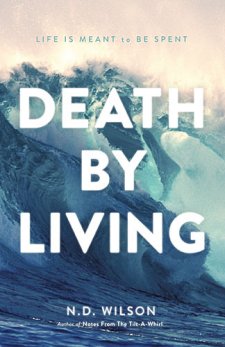
Grasshoppers, swings, dirt, traffic jams, puppy dogs, and blue skies. N.D. Wilson appears to be captivated by everyday objects and everyday situations. He appears to be captivated by life. Living life is what his new book is meant to convey – really living life. But living also means dying.  So the author wordsmiths his way into the heart of readers by painting portraits of life and death – most of which arise from his own life and the lives of his family and extended family.

Death by Living is a plea for people to living life as God intends. In other words, to quote Red from Shawshank Redemption, “Get busy livin’ or get busy dying.” Wilson challenges readers to get busy living which of course will culminate with death: “How much of the vineyard can we burn first? How fast can we run? How deeply can we laugh?  Can we ever give more than we receive? How much gratitude can we show? How many of the least of these can we touch along the way? How many seeds will we get into the ground before we ourselves are planted?”

A theme that runs through Wilson’s work is that life is a story. Life is a story that each of us participates in. Indeed, we write our stories every day.  But the author maintains, “there is a difference between asserting that life is a story and actually living life like a story. And there is another difference between living life-like a story and living life like a good story.”  Living life like a story, therefore, is part and parcel of the Christian life.

The author helps readers see what real living looks like: “Grabbing will always fail. Giving will always succeed … Our children, our friends, and our neighbors will all be better off if we work to accumulate for their sakes … Don’t leave food uneaten, strength unspent, wine undrunk.”

Wilson urges readers to live with all their might. And while he never mentions Jonathan Edwards, I hear a strong Edwardsian influence throughout the book. Edwards himself penned 70 resolutions that reflect many of the propositions in Death by Living. One of those resolutions is to “live with all my might, while I do live” (Resolution 6). Nate Wilson argues in the same vein, which of course, is undergirded by America’s greatest intellectual: “Laugh from your gut.  Burden your moments with thankfulness. Be as empty as you can be when that clock winds down. Spend your life.  And if time is a river, may you leave a wake.”

Death by Living will elicit laughter – lots of laughter.  I found myself reading portions of Wilson’s work to my wife and she would laugh with me.  In fact, I haven’t laughed so hard in a while!  Some won’t find Wilson’s humor funny – which makes me laugh even harder!

Death by Living may prompt tears. There is a realism here that is hard to come by these days. This author speaks in candid terms.  Taking prisoners simply isn’t an option.  All the cards are on the table.  Readers are left to determine a whether the “hand they’ve been dealt” will result in joyful, Christ-saturated living or death by a thousand qualifications.  Far too many have simply thrown in the towel.  Wilson argues from an entirely different perspective as he encourages readers that “life is meant to be spent.”

One reviewer compares Wilson to John Eldredge – what is likely meant to be a compliment. Sure, whatever.  I prefer as I have done elsewhere [See my review: Notes From the Tilt-a-Whirl] to compare Wilson to Dennis Miller, G.K. Chesterton, and C.S. Lewis – no doubt a true compliment!  Death by Living is about the gospel but it never comes across in “preachy” tones.  It’s a celebration of a life lived and ended well.  It’s about a life that is lived passionately and faithfully.  Death by Living is about living with gusto; about living with passion; about living to honor Christ.  But real living also requires dying.  We are called to finish strong and die well – all to the glory of God!

I received this book free from the publisher through the BookSneeze®.com  book review bloggers program. I was not required to write a positive review. 


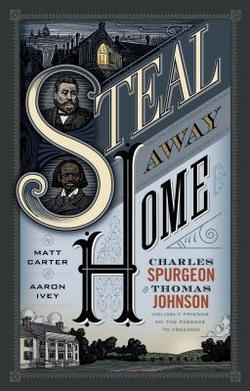
Steal Away Home – Matt Carter and Aaron Ivey

chMatt Carter and Aaron Ivey, Steal Away Home, Nashville: B&H Publishing Group, 2017, 294 pp. $14.60
Church history is filled with stories of courage, adventure, adversity, and persecution. From the exile of Athanasius, the martyrdom of John Rogers and William Tyndale, or Luther’s trial at Worms, these stories are well-known and we are quick to pass them along to the next generation.

Steal Away Home by Matt Carter and Aaron Ivey is a tale that will be new to many readers, however.  It was certainly new for me! The story involves two men from backgrounds that have very little in common. C.H. Spurgeon was the Prince of Preachers, a refined man with a rich theological heritage who occupied the pulpit in Victorian England. He was well-known around the world. He was a best-selling author and recognized by thousands. Thomas Johnson was a simple slave boy who was unjustly shackled in colonial America. He was known by few and treated like an animal. His slave master worked him to the bone on the Virginia tobacco fields.

Jesus Christ liberated Thomas Johnson. He freed him from the power and the penalty of sin. President Abraham Lincoln rescued Thomas Johnson from the sin of slavery. The Emancipation Proclamation, which Lincoln regarded as the crowning achievement of his presidency, liberated Thomas from his slave master. Jesus Christ liberated Thomas from the slave master of sin.

Through a series of Providential events, Thomas Johnson found himself at the front door of C.H. Spurgeon in London. After his training was complete, he and his wife made their way to Cameroon, West Africa in 1879.

PERSONAL TAKEAWAYS

Steal Away Home is a work of historical fiction. It becomes clear at the outset, however, that the authors spent many hours researching the details of this intriguing story. My hope is that a few personal takeaways will prompt many people to enter rich world of the 19th century and absorb some life-altering lessons.

1. The Humanization of C.H. Spurgeon

I have been reading Spurgeon and books about the Prince of Preachers for almost thirty years. This book brilliantly captures the essence of Spurgeon and is not afraid of revealing his warts, weaknesses, and worries. It is a breath of fresh air for anyone who is under the false notion that the famous preacher from London lived a life of ease. Spurgeon’s doubt and lifelong battle with depression is highlighted and his fears are revealed.

2. The Horror of Slavery

Most Americans recognize that slavery is a perpetual “black eye” on our nations’ history. But few understand the gravity of what these innocent African Americans endured. Carter and Ivey masterfully reveal the pitiful nature of slavery through the eyes of Thomas Johnson. Sympathetic readers will feel genuine grief as they walk with Johnson and experience the horror of his chains.

3. The Hallowed Ground of Friendship

Steal Away Home reminds readers of the importance and value of friendship. The friendship fostered by Spurgeon and Thomas is grounded in grace and nurtured by honest communication, genuine fun, rich encouragement, and biblical accountability. Like David and Jonathan, these two men are examples of friendship that glorifies God. Indeed, “A man of many companions may come to ruin, but there is a friend who sticks closer than a brother” (Prov. 18:24). Indeed, friendship is hallowed ground that too few men tread upon.

4. The Hope of the Gospel

Finally, this story shows how the gospel operates in the real world. Apart from grace, Charles Haddon Spurgeon and Thomas Johnson were dead in trespasses and sins, without hope and without God. Indeed, apart from grace, Spurgeon and Johnson were both spiritual slaves. Both men, however, were set free as they cast their hope on the Lord Jesus Christ. In the course of their very different earthly paths, they wound up on the same spiritual path, which ultimately led them both to the Celestial City!

Steal Away Home encouraged me personally and moved my soul in ways that most books only hope to do. Matt Carter and Aaron Ivey stepped up to the plate and hit the ball out of the park.  Their work will no doubt be a contender for book of the year.  I commend their work wholeheartedly!

I received this book free from the publisher. I was not required to write a positive review.

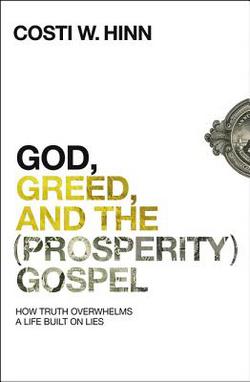
God, Greed, and the (Prosperity) Gospel – Costi Hinn

hinnCosti W. Hinn, God, Greed, and the (Prosperity) Gospel (Grand Rapids: Zondervan, 2019), 223 pp.

The so-called prosperity gospel has been a virtual “wrecking ball,” inflicting damage on the unsuspecting, infiltrating local churches with a diabolical message of health and wealth, and inviting the wrath of a holy God. The prosperity gospel is not another version of the gospel. It is “a different gospel,” one that not only devastates and deceives – this gospel damns.

The apostle Paul addressed the church in Galatia and confronted the false gospel of his day:

I am astonished that you are so quickly deserting him who called you in the grace of Christ and are turning to a different gospel- not that there is another one, but there are some who trouble you and want to distort the gospel of Christ. But even if we or an angel from heaven should preach to you a gospel contrary to the one we preached to you, let him be accursed.As we have said before, so now I say again: If anyone is preaching to you a gospel contrary to the one you received, let him be accursed (Gal. 1:6-9, ESV).

False gospels must be confronted, as Paul addressed the Galatians who turned to the “gospel” of the Judaizers in the first-century. Costi W. Hinn confronts the prosperity gospel in his latest book, God, Greed, and the (Prosperity) Gospel. Hinn clearly defines the poisonous effects of this pernicious movement: “The prosperity gospel is here to stay and is spanning the globe, doing damage to the true gospel of Jesus Christ. It is an evil that poses as a blessing but is truly a curse. It appears to be a loving extension of God’s goodness but is arguably the most hateful and abusive kind of false teaching plaguing the church today.”

Hinn describes how he grew up and was groomed to serve alongside his famous uncle, Benny Hinn and how God revealed the diabolical underpinnings of the prosperity gospel, which led to his repentance, conversion, and departure from the movement.

The author describes the origins of the prosperity gospel and the core elements with all of its trappings. He demonstrates from Scripture why prosperity teaching is abominable and warns readers to flee from its deadly influence. Hinn reveals ten reasons that the prosperity gospel is antithetical to Scripture:

  1. It distorts the biblical gospel.
  2. It insults God’s nature.
  3. It confuses the atonement.
  4. It demeans Jesus Christ.
  5. It twists Scripture.
  6. It is motivated by love for money.
  7. It produces false converts.
  8. It overcomplicates faith.
  9. It ruins Christianity’s witness.
  10. It abuses vulnerable people.

Thoughtful and discerning readers will take these principles to heart and be careful to guard the biblical gospel.

Costi Hinn does not shy away from controversy. But he also speaks the truth in love and his arguments are grounded in grace. God, Greed, and the (Prosperity) Gospel is sure to raise eyebrows. Hinn’s work is a labor of love that will serve the church well. And it will surely draw some people out of this false system and lead them to the truth.

I received this book free from the publisher. I was not required to write a positive review.

John Calvin: For a New Reformation

calDerek W.H. Thomas and John W. Tweeddale, Ed. John Calvin: For a New Reformation (Wheaton: Crossway, 2019), 608 pp.

Over two thousand years of church history have produced a wide assortment of Christian leaders, theologians, and churchmen.  One man who exerted an enormous amount of influence in his day was John Calvin. In recent years, theologians and pastors have revived an interest in Calvin including, A Godward Gaze: The Holy Pursuit of John Calvin, by yours truly.

The most recent and comprehensive offering is an edited volume by Derek W.H. Thomas and John W. Tweeddale. This massive volume that spans over 600 pages includes contributions from well-known scholars such as Stephen Nichols, Steven Lawson, Burk Parsons, Paul Helm and others. The afterward by R.C. Sproul is a fitting conclusion from the man who should be credited for restoring an interest in Reformed theology in the twentieth-century church. Dr. Sproul’s words are especially moving and significant, since this is his last published writing before his death in 2017.

John Calvin: For a New Reformation is arranged in two parts. Part 1 explores the life and work of John Calvin. The contributors share a wealth of biographical information on Calvin including his early years, conversion, and friendships. Especially significant is the piece by Steven Lawson that summarizes the expository preaching of Calvin.

Part 2 explores the teaching of John Calvin. The contributors weigh in on several doctrinal subjects including the providence of God, the person and work of Christ, predestination, the sacraments, perseverance of the saints, and Calvin’s approach to eschatology. Edward Donnelly’s chapter, The Christian Life stands out the most. Donnelly helps readers see the pastoral heart of Calvin, which is undergirded by four central features of the Christian life: self-denial, cross—bearing, meditation on the future life, and the present life. Donnelly shows how Calvin lived an authentic and transparent Christian life, which inspired thousands of people in the sixteenth century and continues to inspire people in our day.

Additionally, Donnelly shows readers how Calvin lived in constant fellowship with the Lord and submitted daily to his lordship. “We are God’s,” writes Calvin. This acknowledgment was the very essence of Calvin’s Christian life. Also, Calvin was committed to mortifying idolatry and serving other people.

Over the years, I have read dozens of books about the French Reformer, John Calvin. This book is among the best. Thomas and Tweeddale should be commended for assembling such a worthy team of writers who celebrate a man that continues to wield a mighty influence on individual lives and the church of Jesus Christ.

I received this book free from the publisher. I was not required to write a positive review.

Encouragement for the Depressed – C.H. Spurgeon

Charles H. Spurgeon, Encouragement for the Depressed (Wheaton: Crossway Books, 2020), 102 pp.

He was the greatest preacher of the nineteenth century. And he is only of the most important preachers in the history of the church. Heralded as the Prince of Preachers, this man was also afflicted with a host of physical ailments for most of his adult life. He was also a victim of depression. His name – Charles Haddon Spurgeon.

Encouragement for the Depressed by C.H. Spurgeon is one of the recent titles in Crossway’s Short Classics series. Designed to preserve classic texts from some of the most well-known Christian writers, the series also aims to gain some new readers.

Spurgeon’s essay is an exposition of Zechariah 4:10a, which says, “For whoever has despised the day of small things …” The work is divided into two distinct parts.

Encouragement for the Depressed

The first part sets out to encourage Christians who battle depression. Spurgeon, as noted above, fought depression throughout his life. Yet, he is quick to remind his readers to refuse to be governed by feelings. “He that lives by feelings,” writes the preacher from London, “will be happy today and unhappy tomorrow; and if our salvation depended upon our feelings, we should be lost one day and saved another, for they are all as fickle as the weather, and go up and down like a barometer.”

Spurgeon assures the despondent that God is with them. “Satan trembles when he sees the weakest saint upon his knees, “ writes William Cowper. Indeed, the grace of God abounds when the people of God are drowning in sorrow. And Zechariah affirms, “Not by might, nor by power, but by my spirit, says the LORD.”

The Minister’s Fainting Fits

Part two speaks candidly about the propensity for depression, even among God’s people. Spurgeon specifically notes that pastors fall prey to this vicious monster. Always the realist and biblicist, Spurgeon says, “Glory be to God for the furnace, the hammer and the file.”

Encouragement for the Depressed is a powerful antidote. This short book is a call to arms for Christians who battle despondency. There are no therapeutics here. Spurgeon only offers the cure which is nothing less than the Lord Jesus Christ and his gospel.

I received this book free from the publisher. I was not required to write a positive review.

Strange New World – Carl R. Trueman

Carl R. Trueman, Strange New World (Wheaton: Crossway Books, 2022), 204 pp.

The sexual revolution of the 60’s fundamentally changed the cultural landscape in North America. Yet, percolating beneath the surface was an even more diabolical worldview; a worldview that many are unfamiliar with. Even those who have engaged with the history of Western civilization may be jolted when the implications become clear.

The Strange New World by Carl R. Trueman pulls back the veil and alerts us to the underlying ideologies that have catapulted our current views about self and sexuality in the Western world. Trueman shows readers in a precise and shocking way how men have forgotten God and presents reasons for their tragic decision. This book is essentially a retooling of Trueman’s remarkable work, The Rise and Triumph of the Modern Self. It will serve the needs of a wider reading audience and provide a more accessible platform, which in the end should reach more people.

The driving argument of Trueman’s work is this: “The issues we face today in terms of sexual politics are a symptom or manifestation of the deeper revolution in selfhood that the rise and triumph of expressive individualism represents.” The goal of the author is achieved and is undergirded by meticulous research from multiple angles – theological, sociological, psychological, and beyond.

Strange New World should be celebrated for its candor and penetrating analysis of the human condition. It sufficiently lays the groundwork for more study and deeper discussions in the coming days.

I received this book free from the publisher. I was not required to write a positive review.

The Bucket List

The Bucket List, starring Morgan Freeman and Jack Nicholson is about two very different men who are both diagnosed with terminal diseases. One of the men, upon learning of his condition, decides to draft a “bucket list.” The list would include achievements and things to see before he “kicks the bucket.” After viewing the film, I began to re-visit my bucket list:

  • Attend a baseball game at every major league park in America
  • Visit the Metropolitan Tabernacle in London
  • Walk the streets of Geneva where John Calvin ministered
  • Stand at the Castle Door in Wittenberg
  • Climb the stairs of the Lincoln Memorial

A bucket list is an important tool because it helps a person discern what is most important in life. What is on your bucket list? Who would you want to see? What would you want to accomplish? Where would you travel?

We know that the Apostle Paul had some important goals in his life. But if Paul had a bucket list, what would be on it? Philippians 1:12-18 is a window into the heart of Paul:

I want you to know, brothers, that what has happened to me has really served to advance the gospel, so that it has become known throughout the whole imperial guard and to all the rest that my imprisonment is for Christ. And most of the brothers, having become confident in the Lord by my imprisonment, are much more bold to speak the word without fear. Some indeed preach Christ from envy and rivalry, but others from good will. The latter do it out of love, knowing that I am put here for the defense of the gospel. The former proclaim Christ out of selfish ambition, not sincerely but thinking to afflict me in my imprisonment. What then? Only that in every way, whether in pretense or in truth, Christ is proclaimed, and in that I rejoice …

At the top of Paul’s “bucket list” is that the gospel of Jesus Christ would spread to every man and woman and every boy and girl in great power to the glory of God. And indeed, the gospel spread like wildfire in the ancient world. The gospel would eventually explode in Europe and Africa and China. The gospel would ignite all around the world! What caused this gospel to progress with such great power?

The Gospel Progressed Because of Ferocious Persecution

The Method God Used

Imagine serving on a team that was commissioned to help promote the flourishing of the gospel. What methodology would you employ? Would you initiate a massive advertising campaign? Would you pump money into a missions program? Or perhaps you enlist the help of an army of volunteers?

In the first century, God providentially used Paul’s imprisonment to cause the powerful spread of the gospel. This persecution came as no surprise to the apostle and should not surprise us either. Jesus told the disciples,

Behold, I am sending you out as sheep in the midst of wolves, so be wise as serpents and innocent as doves. Beware of men, for they will deliver you over to courts and flog you in their synagogues, and you will be dragged before governors and kings for my sake, to bear witness before them and the Gentiles. When they deliver you over, do not be anxious how you are to speak or what you are to say, for what you are to say will be given to you in that hour” (Matt. 10:16–19, ESV).

One of the methods that God used and continues to use to advance the gospel is persecution.

The Meaning Behind God’s Method

Paul refers to the advance of the gospel. The word advance comes from the Greek term prokopei which refers to the progress of an army. It comes from a verb that means “to cut down in advance.” It describes the removing of any barriers which would hinder the progress of an army.1 Paul’s imprisonment took place so that the gospel might advance in a mighty way. The end result is that people would benefit greatly and God would be greatly glorified.

Verse 13 describes a flourishing gospel; one that became known “thought the whole imperial guard.” “The praetorian guard,” writes John MacArthur, was likely a group of nearly ten thousand soldiers who were stationed throughout Rome to keep the peace and protect the emperor.”2 Paul glories in this gospel which became known “to all the rest” for the great name sake of Jesus, his Savior.

The Model Prisoner

The apostle Paul was chained to a Roman guard (Acts 28:16). Consequently, the guards circulated in and out as their shifts changed which gave Paul a remarkable opportunity to bear witness to Christ. No doubt, the guards would have witnessed his body language and learned things about him that would have otherwise been difficult if not impossible. In short, God used this model prisoner to serve as an ambassador for Christ.

No less than one hundred years later (A.D. 155), Polycarp of Smyrna would also serve as a model prisoner and give his life for his Savior. After his arrest, the judge ordered Polycarp to renounce Jesus. The judge promised that if he would swear by the emperor and curse Christ, he would be set free. Polycarp’s response is priceless: “For eighty-six years I have served him, and he has done me no evil. How could I curse my king, who saved me?”3When the judge threatened to burn him in the pyre, Polycarp simply answered that the fire would only last a moment, whereas the eternal fire would never be extinguished. After Polycarp was tied to the post in the pyre, he gazed into the heavens and prayed aloud, “Lord Sovereign God … I thank you that you deemed me worthy of this moment, so that, jointly with your martyrs, I may have a share in the cup of Christ … I bless and glorify you.”4The gospel progressed because of ferocious persecution. Notice two principles that will serve us in our generation.

First, remember to maintain an eternal perspective. God’s in his providence permits persecution so that Christ might be proclaimed. We may reason, “In order for the gospel to progress in a country like China, communism must be rooted out.” But the reality is this: Communism continues and the underground church is flourishing! God’s providence may close doors that open others doors. Paul maintained an eternal perspective. He maintained his passion for the spread of the gospel and made the best of every opportunity.

Second, allow persecution to strengthen your resolve for proclaiming the gospel of Christ. When you are ridiculed for believing in a personal Creator who fashioned the world, be encouraged. Continue to proclaim the truth, despite the ferocious persecution. When you are mocked for believing in absolutes, be encouraged in that truth and proclaim it despite the ferocious persecution. And when you are challenged for believing that Jesus is the only One who can forgive sin, be encouraged in that truth and proclaim it, despite the ferocious persecution.

How did the gospel progress in the first century? It progressed in large measure because of ferocious persecution. But the gospel also progressed because it was fearlessly proclaimed.

The Gospel Progressed as it was Fearlessly Proclaimed

The persecution of Paul not only helped advance the cause of the gospel; it strengthened the resolve of Christians to preach the uncompromising message of the gospel.

The Definition of Proclamation

The Greek term for preach in verse 15 means “to be a herald; to proclaim with authority.” This message must be listened to and obeyed. Paul sets forth this imperative to herald the truth in 2 Timothy 4:2-4. He writes,

Preach the word; be ready in season and out of season; reprove, rebuke, and exhort, with complete patience and teaching. For the time is coming when people will not endure sound teaching, but having itching ears they will accumulate for themselves teachers to suit their own passions, and will turn away from listening to the truth and wander off into myths.

Martin-Lloyd Jones says, “The most urgent need in the Christian church today is true preaching; and as it is the greatest and most urgent need in the church, it is the greatest need of the world also.”5 And Steven Lawson adds, “True biblical preaching is authoritative in nature and body proclaims God’s Word without compromise or apology.”6 Such is the call of every Christ-follower who fearlessly proclaims the truth.

The Defining Marks of Proclamation

Two marks, in particular, emerge in Philippians 1:14-17. First, proclamation must be confident. Peithō, the Greek term which is translated, confident means “to have faith; to be persuaded of a thing concerning a person – in this case, the Lord Jesus Christ.” Romans 8:38-39 highlights the confidence that believers enjoy: “For I am sure (peithō) that neither death nor life, nor angels nor rulers, nor things present nor things to come, nor powers, nor height nor depth, nor anything else in all creation, will be able to separate us from the love of God in Christ Jesus our Lord” (Romans 8:38–39).

Second, proclamation must be bold and fearless. Paul stresses the importance of speaking the word boldly without fear (Phil. 1:14). The word translated bold means to “endure; to have courage.” Dr. Luke refers readers to the courage of Paul the apostle, who proclaimed the truth “with all boldness and without hindrance” (Acts 28:31). Such a ministry marks the one who is committed to the proclamation of God’s Word.

William Tyndale was a man who modeled the marks of bold proclamation. Born in 1494, he attended Oxford, Magdalen Hall, and Cambridge Universities. A student and adherent of the Protestant Reformation, Tyndall engaged in numerous debates with Roman Catholics. One Catholic leader mocked Tyndale: “We are better to be without God’s laws than the Pope.” Never content to put up with heresy, Tyndale replied, “I defy the Pope and all his laws. If God spare my life ere many years, I will cause the boy that drives the plow to know more of the scriptures than you.”

Tyndale was a confident, bold, and fearless theologian and scholar who translated the Bible into an early form of Modern English, likely with Luther’s help in Wittenberg. But he was arrested and imprisoned for 500 days. He was tried for heresy and treason in a kangaroo court and ultimately convicted. He was sent to be strangled and burnt at the stake in the prison yard on October 6, 1536. The final words were, “Lord, open the king of England’s eyes.”

Unfortunately, not everyone has the courage of Tyndale. In fact, Paul tells us that there are two different kinds of preachers.

The Different Kinds of Preachers

Some preach Christ “from envy and rivalry” (v. 15). Paul explains that this man proclaims Christ out of selfish ambition. Such a man is not sincere and proves to be unfaithful in the final analysis (v. 17).

Some preach Christ from “good will.” Paul says the motivation of this man is love (v. 16). Such a man understands that the apostle was providentially placed in prison for the defense of the gospel.

The Gospel Progressed as it was Faithfully Proclaimed

“What then? Only that in every way, whether in pretense or in truth, Christ is proclaimed, and in that I rejoice. Yes, and I will rejoice” (Phil. 1:18).

The gospel refers to the “glad tidings of the kingdom of God” or the “good news.” It is the proclamation of the grace of God which is manifest and pledged in Christ.

Jesus was born of the Virgin Mary. He lived a perfect life and was tempted in every way as we are, yet without sin (Heb. 4:15). He perfectly kept the law of God. Jesus died for our sins in accordance with the Scriptures; he was buried and raised on the third day in accordance with the Scriptures (1 Cor. 15:3). Jesus was glorified and seated at the right hand of the Father. He bore the wrath of God on the cross for everyone who would ever believe (Rom. 3:25). He redeemed us from the curse of the law by becoming a curse for us (Gal. 3:13). Jesus became our substitute on the cross (2 Cor. 5:21). He reconciled us to God by making peace by the blood of his cross (Col. 1:20). He made us right with God so that we might have peace with God (Rom. 5:1). And Jesus forgives sinners and enables them to stand holy in the very presence of God.

CONCLUSION

In the first century, the gospel progressed because of ferocious persecution, fearless proclamation, and faithful preaching. It was the gospel of Jesus Christ that motivated the apostle Paul. Proclaiming Christ and hearing that Christ was being preached was his passion. The apostle writes, “But I do not account my life of any value nor as precious to myself, if only I may finish my course and the ministry that I received from the Lord Jesus, to testify to the gospel of the grace of God” (Acts 20:24).

I had the pleasure of visiting a small church in a former communist country a few years ago. The pastor was so proud of the little structure which was smaller than most elementary school classrooms. I noticed a sign above the pulpit, written in a language unfamiliar to me. I asked the pastor, “What does that sign say?” With a smile on his face, he said through a translator, “We preach Christ crucified!

What would it look like if each one of us committed ourselves to fearlessly and faithfully proclaiming the gospel of Jesus Christ? What would it look like if we committed ourselves to fearlessly and faithfully proclaiming the gospel in the sphere where God has placed us?

The gospel progressed because of ferocious persecution, fearless proclamation, and faithful preaching. Will you make it a goal to proclaim the gospel of Jesus fearlessly and faithfully, despite the persecution that surrounds you? May gospel proclamation become a part of every Christ-followers bucket list!

  1. See William Barclay, The Letters to the Philippians, Colossians, and Thessalonians (Philadelphia: The Westminster Press, 1975), 20.
  2. John F. MacArthur, Philippians (Chicago: Moody Press, 2001), 61.
  3. Cited in Justo L. Gonzalez, The Story of Christianity – Vol. 1 (San Francisco: Harper Collins Publishers, 1984), 44.
  4. Ibid, 44.
  5. Martin Lloyd-Jones, Preaching and Preachers (Grand Rapids: Zondervan Publishing House, 1971), 9.
  6. Steven J. Lawson, Famine in the Land: A Passionate Call For Expository Preaching (Chicago: Moody Publishers, 2003), 42.

Susie: The Life and Legacy of Susannah Spurgeon – Ray Rhodes

Ray Rhodes Jr, Susie: The Life and Legacy of Susannah Spurgeon (Chicago: Moody Press, 2018), 294 pp.

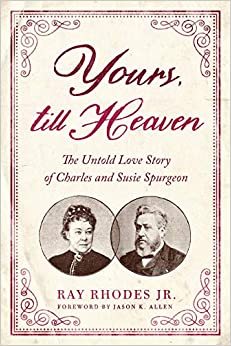
Behind every great man is a great woman – or so the saying goes. The same could be said about the mighty men of God: “Behind every godly man is a godly woman.” Such is the case of the Prince of Preachers, Charles Haddon Spurgeon. In his book, Susie: The Life and Legacy of Susannah Spurgeon, Ray Rhodes Jr. introduces Spurgeon’s wife and reveals how this godly woman stood behind the famous Baptist pastor.

Very little has been written about Susannah Spurgeon. This makes Rhodes’ book somewhat of a landmark book that will educate and encourage students of Spurgeon. The book is an inside look at the Spurgeon’s marriage and ministry and helps readers understand how they navigated their way through trials, including physical suffering and persecution.

The book reveals the stalwart faith of Susannah Spurgeon and highlights her rock-solid support of her husband. It also shows how she ministered to poor pastors in London and around the world through her Book Fund and was instrumental in planting a church in the memory of her beloved husband.

This work is best summed up in Susie’s timeless words, “Look to Jesus.” “This message,” writes the author, “she offered to non-Christians and Christians alike. She would say to every Christian grieving over, fighting against, and hating their sin, or suffering through physical or emotional pain to look to Christ for help.”

Susie: The Life and Legacy of Susannah Spurgeon is a deeply moving book – one that is sure to inspire many and encourage anyone who is enduring the loss of a loved one. Susannah Spurgeon is a model of Christian maturity who lived Coram Deo, ”before the face of God.”

I received this book free from the publisher. I was not required to write a positive review.