Matthew McCullough, Remember Heaven: Meditations on the World to Come for Life in the Meantime (Wheaton: Crossway Books, 2025), 157 pp.
Heaven is not only the final resting place for the people of God; it is what they long for the most. Yet, too many times, Christians become fixated on earthly things. Matthew McCullough’s book, Remember Heaven: Meditations on the World to Come for Life in the Meantime is an encouraging reminder to focus on our future home.
McCullough sets the parameters early in the book. He writes, “I want to show that the issue is not whether you love this world and its joys, its people and their needs. The question is whether you have any hope beyond this world and what it has to offer. In other words, he reframes the trajectory for Christians and challenges them to orient their hearts and minds heavenward. He adds, “Heavenly-mindedness is absolutely vital because what we want or expect from our future has a huge effect on our experience in the meantime. We humans are future-oriented creatures whether we like it or not.”
The author argues his case for heaven with skill and biblical fidelity. Seven chapters drive readers deeper into the reality of heaven, each one touching on a theme that resounds with gospel hope. The wisdom of the Puritans saturates this work, which bolsters its credibility and invites a more thorough investigation of our heavenly home.
John Bunyan offers this stunning insight as he describes the travelers in The Pilgrim’s Progress at the end of their journey:
Thus therefore they walked on together; and as they walked, ever and anon these trumpeters, even with joyful sound, would, by mixing their music with looks and ges-tures, still signify to Christian and his brothers how welcome they were into their company, and with what gladness they came to meet them.
Remember Heaven is an invitation to “set your minds on things that are above, not on things that are on earth” (Col. 3:2).
I received this book free from the publisher. I was not required to write a positive review.
Reading is a discipline that allows us to explore new frontiers and supercharge our intimacy with God. It is one of God’s appointed means of helping us grow in our knowledge of Christ and love for him. Yet many Christians are reluctant to read and as a result, are spiritually malnourished.
A Christian Reading Manifesto is a brief rationale and apologetic for Christ-followers. It is both a challenge and an invitation to enter the world of reading to help accelerate sanctification and Christian growth.
Endorsements
“Dr. David Steele is a reader! I don’t know another person as deeply committed to a daily, disciplined pattern of reading and learning as this seasoned pastor and author. His new book, A Christian Reading Manifesto: A New Resurgence of Learning, is designed to help other Christians embark on a literary journey. Steele begins by pointing out how reading fuels our minds for productive thinking and ignites our hearts with a greater love for God. Recognizing the obstacles which hamper serious reading, the author offers helpful insights on how to avoid the lure of digital media and mind-numbing images. I was personally motivated by his encouragement to read ‘with the aim of becoming a lifelong learner.’ The ‘added value’ of Steele’s book is a list, categorized topically, of books he has read and recommends. This bibliography is a treasure that is worth the price of the book! I enthusiastically endorse and recommend David Steele’s, A Christian Reading Manifesto.”
— DR. J. CARL LANEY, Professor Emeritus, Western Seminary, Portland, OR; author of The Divorce Myth.
“Dr. Steele provides a fresh look at an age-old idea: that believers should know what they believe and prioritize their lives accordingly. A Christian Reading Manifesto is a must-read for any believer making an effort to reorient their lives toward that which matters: to return to the purer and baser points of spirituality, to take their souls seriously, to remind themselves that there are resources that have been and are being neglected, and to love God with all of their minds. I highly recommend Dr. Steele’s work and will be recommending it to my congregation.”
— DR. DANNY GARDNER, Senior Pastor, Highland Baptist Church, Westminster, CO
“As a Christian Educator, I am grateful for Dr. Steele’s faithfulness to doctrinal truth, the written Word and the great books of the faith. A Christian Reading Manifesto is a timely and compelling call to action that inspires the next generation of Christians to sharp eyes, soft hearts and sanctified minds.
I had the blessing and honor of studying school leadership under David Steele’s father. David continues his father’s legacy of clear, faithful teaching that balances faith, excellence and scholarship. This book is a clear reflection of those values. I want to encourage you to prayerfully join Dr. Steele in his celebration and call to become a Christian reader!”
— BOB RUHLMAN, Superintendent of Schools, Christian Unified Schools, El Cajon, CA
“Whether you are new to the Christian faith or a seasoned saint, I encourage you to read A Christian Reading Manifesto. Your mind will be enriched, your heart will be encouraged, and your feet will be set to action as you are exhorted to put into practice what you’ve read, while continuing in your journey of studying sound Christian literature. A Christian Reading Manifesto is a treasure to help you to grow in your discernment so that your faith can be Word-grounded and Word-shaped in this present age.”
— DAVE JENKINS, Executive Director, Servants of Grace Ministries, Executive Editor, Theology for Life, Host and Producer, Equipping You in Grace, and Contending for the Word; author of Contentment: The Journey of a Lifetime.
ME:“Doc, I cycle 100 miles a week, burn at least 10,000 calories a week, take fish oil, and I’m eating better. I even take advantage of “nature’s broom” by eating oatmeal almost every day. However, my cholesterol just won’t drop.
DOCTOR: “Because of family history and genetics, you simply won’t be able to lower your cholesterol without a statin.”
So for the several years, I’ve taken a well-known statin and the results have been favorable. However, Drs. Jonny Bowden and Stephen Sinatra disagree with the notion that lowering cholesterol prevents heart disease. Their book, The Great Cholesterol Myth contains an argument that pumps feverishly through the arteries of this book: The real causes of heart disease include four key factors, namely – inflammation, oxidation, sugar, and stress. The authors contend the real tragedy is the fixation with cholesterol which has produced an industry that boasts over $30 billion a year in the statin market. In a shocking statement, both authors maintain, “Cholesterol does not cause heart disease.”
Bowden and Sinatra point out that cholesterol is vital for healthy living: “Cholesterol is an essential molecule without which there would be no life, so important that virtually every cell in the body is capable of synthesizing it.” For over fifty years, the so-called lipid hypothesis has dominated the medical community which essentially states that “saturated fat runs up cholesterol levels, and elevated cholesterol leads to heart disease.” The hypothesis has never been proved but continues to rule in the hearts and minds of most Americans.
One of the most helpful aspects of The Great Cholesterol Myth is the discussion about the importance of coenzeme Q10 (better known as CoQ10) which serves an important nutrient, a sort of fuel source for the heart. Statins deplete CoQ10 which may lead to muscle pain, weakness, and fatigue. Yet none of the doctors that have prescribed a stain in my case have ever mentioned that importance of supplementing with CoQ10. The authors plead with readers who take statins to immediately begin supplementing their cholesterol lowering drug with CoQ10 – a minimum of 200 mg daily.
Dr. Sinatra admits that he still prescribes statins on occasion but “almost exclusively to middle-aged men who’ve already had a first heart attack, coronary intervention, or coronary artery disease.” He argues, “Statin drugs are anti-inflammatory, and their power to reduce inflammation is more much important than their ability to lower cholesterol. But [and here’s the clincher] we can lower inflammation (and the risk for heart disease) with natural supplements, a better diet, and lifestyle changes such as managing stress.”
The authors reveal a fascinating study that includes five factors that significantly lowered the risk for heart disease:
1. Don’t smoke.
2. Drink alcohol in moderation.
3. Engage in moderate-to-vigorous exercise for at least half an hour a day on average.
4. Maintain a healthy weight (BMI under 25).
5. Eat a wholesome, low-glycemic (low-sugar) diet with plenty of omega-3 fats and fiber.
Notice that lowering cholesterol is painfully absent from the list. Perhaps this is why, as the authors note, “Cholesterol is a relatively minor player in heart disease and a poor predictor of heart attacks. More than half of all people who are hospitalized with heart attacks have perfectly normal cholesterol levels.”
The heart of the book explores the real culprit behind heart disease. The authors dogmatically claim “the true cause of heart disease is inflammation” or as they put it, “acute inflammation hurts, but chronic inflammation kills.” Second, oxidation is one of the sure signs of inflammation, which leads to a fascinating conclusion, namely – the only time cholesterol becomes troubling is if it’s oxidized (or damaged). Third, the authors note that “sugar is a far greater danger to your heart than fat ever was.” They go on to demonstrate that “the number one dietary contributor to heart disease is sugar.” Finally, stress is included as a major cause of heart disease.
Bowden and Sinatra wonder out loud if statins will become the next medical tragedy – quite comforting to anyone who has relied on statins for years on end! Side-effects are explored, which is well documented, and side-effects which I have personally experienced. But the alarming news is that some researchers are warning that statins may contribute to Alzheimers, thinking skills, and memory. One researcher comments, “Cholesterol changes the shape of the protein to stimulate thinking and memory.” But the fact that is most often repeated is ability of statins to deplete the body of CoQ10. “The depletion of CoQ10 is one of the most important negative effects of statins, and the one that is pretty much responsible for a host of common side effects involving muscle pain, weakness, and loss of energy.” To summarize, the authors maintain the risk of using statins outweighs the rewards.
Finally, Bowden and Sinatra explore how supplements can lead to heart health such as vitamins, antioxidants, and omega-3 fats included in wild salmon. Additionally, they recommend that stain users immediately begin to supplement their diet with CoQ10. “Just as a gasoline engine can’t work without spark plugs, the human body can’t work without CoQ10.”
I am not ready to pitch my statin until my doctor recommends doing so. But The Great Cholesterol Myth has got me thinking. And it has led to some concrete action steps such as implementing CoQ10 into my daily diet. I’m actually looking forward to my next doctor visit – where my list of questions will be long. Let’s just say, I’ll be getting my money’s worth that day!
Kevin DeYoung, The Nicene Creed (Wheaton: Crossway Books, 2025), 93 pp.
“After the Bible, the Nicene Creed may be the most important Christian text ever written.” So writes Kevin DeYoung in his book, The Nicene Creed. The author sets the stage by supplying the historical background behind this ancient document. A dispute arose in Alexandria, Egypt in AD 318 when Arius began to fan the heretical flame which eventually led to the Council of Nicaea.
The beauty of DeYoung’s book is that he walks through the Nicene Creed, line by line, giving readers ample time to digest the statements and compare them with Scripture. The statements from the Nicene Creed may also be set in contrast to the heretical musings of Arius, not to mention modern day cults like the Watch Tower Society and The Church of Jesus Christ Latter Day Saints.
The Nicene Creed is the perfect place to begin for anyone who is seeking a greater knowledge of church history and the importance of orthodoxy. The combination of clear writing and passion for biblical truth make this book an essential tool in every Christian’s library.
I received this book free from the publisher. I was not required to write a positive review.
David Mathis, A Little Theology of Exercise (Wheaton: Crossway Books, 2025), 109 pp.
Christians rightly reject the ancient heresy of Gnosticism. This diabolical worldview maintains that spirit is good and body is evil. Yet many Christians unwittingly embrace a sort of Gnosticism when they neglect and minimize the body. A sedentary lifestyle is the norm in many churches, where exercise is viewed as a necessary evil.
David Mathis sets the record straight in his helpful and illuminating book, A Little Theology of Exercise. The book is as brief as it is bold. It offers a gracious rebuke to anyone who downplays exercise. But positively, it affirms and encourages Christians to commit to the discipline of exercise. The author writes, “One of the reasons I take exercise seriously, rather than neglecting it, is precisely because of how it serves the joy, strength, and stability of my soul.” He argues that “exercise makes happier humans, and God made humans to be happy – in him.”
Part 1: Move the Body
Mathis establishes the foundation in part one. His aim is to demonstrate that exercise is a distinctly Christian idea. There is an anti-body sentiment that Scripture opposes. 1 Timothy 4:4-5 says, “For everything created by God is good, and nothing is to be rejected if it is received with thanksgiving, for it is made holy by the word of God and prayer.”
Our bodies were formed by God and belong to God. Therefore stewardship of the body is not only essential as a part of Christian discipleship; it plays a key part of what it means to glorify God.
Mathis holds that God is for the body. As such, he commends exercise. As important as maintaining a physically fit body is, spiritual health is our primary concern. This theme is missing in the vast majority of books that commend exercise. Also missing, is the hope of glorification in eternity future. “Our future,” writes the author, “will be forever embodied – beyond our best imagining.” For Christians, “the dishonor of death will give way to the glory of resurrection.” Philippians 3:20-21 says, “But our citizenship is in heaven, and from it we await a Savior, the Lord Jesus Christ, who will transform our lowly body to be like his glorious body, by the power that enables him even to subject all things to himself.”
Part 2: Condition the Soul
The rationale for exercise is presented in part two. Our aim is to glorify God in our bodies. We also commit ourselves to exercise for optimal brain health. The benefits are numerous and the documentation is staggering for anyone with ears to hear.
An important rationale for exercise that Mathis presents involves seeking satisfaction in Christ. “God made our bodies to be healthier and happier as they move … Without bodily movement and exertion, our brains don’t get all the help they need to stay balanced and happy,” writes Mathis.
But the missing link the author provides involves the pursuit of joy in God. “Body stewardship stands or falls on whether it supports the pursuit of joy in God.” This emphasis, one that is missing is most books devoted to exercise, is what sets this resource apart. The focus is spiritual health and God-centered joy!
In the end, physical exercise will help meet the needs of others in love. In other words, when our bodies are in optimal shape, we have the stamina and strength to reach out to others and make a difference in the kingdom of God.
A Little Theology of Exercise should be devoured by Christians. David Matthis puts his finger on a subject that has been neglected for too long in the church. Perhaps one day, we’ll look back and thank him for establishing a new trajectory of health, happiness, and holiness – with the aim of glorifying God and finding our daily joy in him.
I received this book free from the publisher. I was not required to write a positive review.
Anyone familiar with John Owen will recognize that he is without a doubt the titan of the Puritans. This seventeenth British theologian was a prolific author who always directed his attention Godward.
The Complete Works of John Owen, volume 19 is the most recent edition from Crossway Books. This elegant work is packed with sermons from the Commonwealth and Protectorate (1650 – 1659). Owen is a man of his times. His writing may be cumbersome for the contemporary reader. He writes at a level that most American readers are not accustomed to. Yet, his arguments are worth tracing out and studying.
Volume 19 contains nine sermons that focus on themes concerning providence, the advance of the kingdom, the gospel of Jesus Christ, and the glory of God. Readers will be captivated by Owen’s knowledge of Scripture and love for the Savior.
I received this book free from the publisher. I was not required to write a positive review.
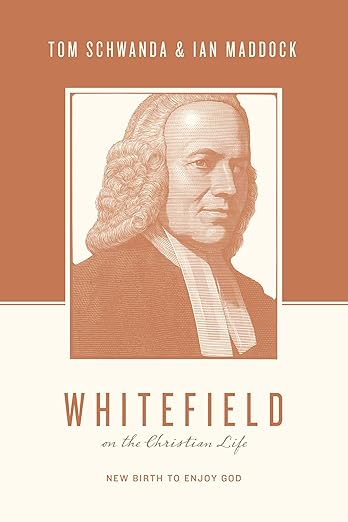
Tom Schwanda and Ian Maddock, George Whitefield on the Christian Life: New Birth to Enjoy God (Wheaton: Crossway Books, 2025), 207 pp.
One of the most pivotal figures of the 18th century was the British evangelist, George Whitefield. Born in 1714, this man faithfully preached the gospel and evangelized nations. He preached over 18,000 sermons during his short life and impacted countless people for the sake of the kingdom.
Whitefield on the Christian Life: New Birth to Enjoy God by Tom Schwanda and Ian Maddock is a riveting read. The authors introduce Whitefield in clear terms and engaging prose. Whitefield is portrayed as a man who valued both the head and the heart.
Schwann and Maddock do not leave any “stone unturned.” They not only focus on the noteworthy aspects of Whitefield’s life and ministry; they also wrestle with some of the more controversial themes, especially his perspective on slavery, which held a death grip on colonial America.
Whitefield is rightly portrayed as a man who refused to compromise the truth. He delivered the truth with power and passion. Another biographer, Arnold Dallimore, writes about the God-centered stature of George Whitefield: “And what manner of men will they be? Men mighty in the Scriptures, their lives dominated by a sense of the greatness, the majesty and holiness of God, and their minds and hearts aglow with the great truths of the doctrines of grace.” Oh, that Christians in this age would model the Whitefield approach. May their hearts be consumed with nothing but the greatness of God. May the sovereign Savior draw people from every tribe and nation.
I received this book free from the publisher. I was not required to write a positive review.
One of the last things my aunt, who served at HCJB, told me before she went to be with the Lord was this: “Never neglect Christian biographies.” Those words always stuck with me. I heeded that advice and have never looked back. Christian biographies have led me to the jungles of Ecuador with Jim and Elizabeth Elliot, the shores of China with Hudson Taylor, the heat of theological controversy with Athanasius, the flames of martyrdom with Ridley and Latimer, and journeys across the Atlantic with George Whitefield.
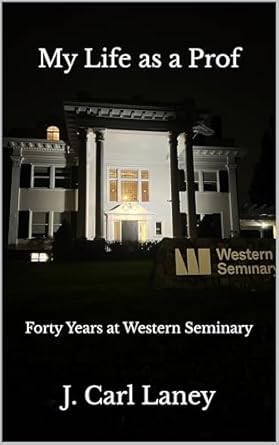
My Life as a Prof by J. Carl Laney is an inside look at the life of a seminary professor. This book is a precious jewel that should not be overlooked, especially for pastors, missionaries, and Christian leaders.
Dr. Laney’s book guides readers on a journey that reaches back to celebrate a forty-year teaching tenure at Western Seminary in Portland, Oregon. The great strength of this work is Carl’s transparency. He reveals everything he experienced on his journey as a seminary professor – from triumph to tragedy, and everything in between.
The book also ventures outside the classroom, providing readers with a deeper understanding of Dr. Laney’s heart for discipleship and evangelism as he shares his experiences leading students in the “outdoor classroom” on wilderness expeditions and his numerous trips to Israel, accompanied by students. Also included are encouraging stories that flow out of Dr. Laney’s experience as a pastor and author.
My Life as a Prof is packed with God-centered inspiration and challenges. It was deeply encouraging for me to read about a seasoned theologian, professor, pastor, mentor, husband, father, and grandfather – a man who puts Jesus Christ above all and jealously guards the glory of God.
Open the morning newspaper. Watch the evening news. Pay careful attention to the culture that surrounds us. The culture that surrounds us will prompt you to protest. You will be cajoled to complain. You will feel the steady pull of pundits who invite you to join their campaign. Emotions will range from fear to frustration. Anger dominates much of the time. When anger doesn’t reign, anxiety is sure to take its place.
Followers of Jesus Christ have a higher calling. We must be discerning and live distinctly Christian lives (1 Pet. 1:14-17). A little phrase is tucked away in Romans 5:11 that helps refocus our attention on what really matters:
“More than that, we also rejoice in God through our Lord Jesus Christ, through whom we have now received reconciliation.”
“We also rejoice in God.” This is exactly the opposite of what our culture demands. Rejoicing in God, then, is countercultural. God also commands it!
Paul’s argument in this unit of thought in Romans chapter 5 ends on a high note. The guilty have been pardoned (v. 9). The condemned have been saved (v. 9). Enemies have been reconciled (v. 10). The posture of rebellion has turned to a posture of joy!
Do you want to impact lives? Would you like your life to mirror God’s image? Do you want to glorify the great God of the universe? Refuse to bow down to the idols of the age. Refuse to get caught up in the pettiness that characterizes our day. Choose today to rejoice in God!
John Piper, Providence (Wheaton: Crossway Books, 2021), 710 pp.
2020-2021 were years of pain, suffering, and anguish. COVID-19 impacted countless lives, crushed the economy, overwhelmed our health care system, and influenced the presidential election. By mid-December, the virus claimed over 300,000 lives in the United States alone. We were told what is classified as “essential” and what is not deemed “essential.” Stay-home-stay orders, social distancing, and wearing masks became a normal part of daily lives.
The lockdowns had a devastating effect on thousands of people. Businesses were permanently closed, many churches stood at a standstill, and hopelessness ruled in many hearts. One report suggested that suicide rates among young adults skyrocketed due to the pandemic.
In the midst of this crushing heartache, John Piper released his newest book, Providence. I received an advance copy and began diligently reading this massive book, weighing in at over 700 pages.
Dr. Piper lures in readers with a four-fold invitation:
An invitation into a biblical world of counterintuitive wonders.
An invitation to penetrate through words into reality. While the term “providence” is not found in Scripture, the reality of providence occurs on every page of the Bible.
An invitation into a God-entranced world.
An invitation to know God in a more intimate way.
Once readers become aware of the theological terrain that lies ahead, the 700 pages to follow are much less daunting.
The book is arranged in three parts. Part one explores a definition and a difficulty. The difficulty wrestles with the notion of divine self-exaltation. Piper discusses the typical negative creaturely response to a God who finds pleasure in exalting himself. The author demonstrates that anyone who resists the idea of a self-exalting God has fallen prey to a sinister mindset. Indeed, “The idea that God is unattractive to us because he acts for his own glory cloaks a deeper resistance: he is unattractive because he is God.”
Part two focuses on the ultimate goal of providence. Three areas are discussed which include:
God’s ultimate goal in providence before creation and in creation.
The ultimate goal of providence in the history of Israel.
The ultimate goal of providence in the design and enactment of the New Covenant
The great benefit of part two is delighting in the big picture of God’s providence. From before creation, to the cross, and the final glorification of the elect, we find God orchestrating every detail for his glory and for our good. As Piper writes, “God is supremely committed to the display of his glory for the admiration and enjoyment of all who will have it as their supreme treasure.”
Part three reveals the nature and extent of providence. The author skillfully demonstrates how God’s providence reigns over all things including the weather, world leaders, circumstances, and the demonic realm. Piper shows how God’s providence superintends over sin and triumphs in conversion.
In the end, Piper gloriously describes the final achievement of providence in the return of Christ, the glorification of his elect, and his reign on the New Earth. He writes, “The great goal of providence is the shining forth of the glory of God in the holiness and happiness of his people through Jesus Christ.”
My own experience as I neared the end of Providence was a keen sense of disappointment that the book was drawing to a close. Frankly, Providence helped me maintain a God-centered perspective, even in the midst of a tumultuous year.
Providence is a theological tour de force. It is heart-warming, mind-riveting, and soul-shaping. My hope is that Piper’s great accomplishment, dare I say his magnum opus, will have a similar impact on countless people around the world. There is no question that John Piper’s Providence will be one of the most read and treasured books of 2021.
I received this book free from the publisher. I was not required to write a positive review.



 Veritas et Lux