Called to Preach – Steven J. Lawson

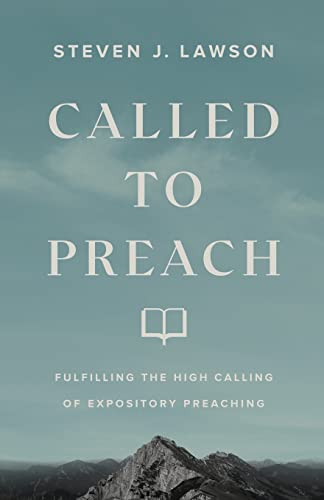
Steven J. Lawson, Called to Preach (Grand Rapids: Baker Books, 2022), 203 pp.

Etched into the fabric of the cosmos is a special call. This call is the highest responsibility that any man will ever receive. This is the call to preach God’s Word. In his most recent book, Called to Preach: Fulfilling the High Calling of Expository Preaching, Dr. Steven J. Lawson invites readers on a journey where they will discover this sacred task.

Lawson raises the stakes in the very first sentence: “In every generation, the church of Jesus Christ rises or falls with its pulpit.” This theme explodes throughout the book as the author unveils the supreme importance of preaching.

Lawson argues, “To exposit the word is the most strategic assignment ever entrusted to any person.” As such, he unpacks several identifying benchmarks that help aspiring preachers discern whether they are called to the supreme task of preaching.

The author explores the mandate of preaching by pointing preachers to 2 Timothy 4:1-5. The first two verses set the stage for what follows:

I charge you in the presence of God and of Christ Jesus, who is to judge the living and the dead, and by his appearing and his kingdom: preach the word; be ready in season and out of season; reprove, rebuke, and exhort, with complete patience and teaching. (2 Timothy 4:1–2, ESV)

The nine imperatives in 2 Timothy 4:1-5 are expounded upon as preachers are encouraged to obey every aspect of the preaching mandate. “This kind of preaching commanded by Paul,” writes Lawson, “must be recovered and restored to the contemporary pulpit.”

Preachers are admonished to exalt the Lord in their pulpit ministries. Lawson adds, “Our greatest subject in the pulpit is always God. We must preach the glory of God first and foremost, before we declare anything else, and prioritize God for who He is … If our preaching is to be powerful, we must be preoccupied with the declaration of God.”

The remainder of the book is practical in nature. The author helps preachers gain traction in the study and offers a wealth of help in crafting a sermon manuscript. Once the study is complete and the manuscript is drafted, readers are offered counsel in delivering the message. Lawson urges pastors to preach with humility, authority, clarity, simplicity, intensity, urgency, and with accuracy.

Called to Preach is a veritable treasure trove for preachers. As one who looks to Steven Lawson as the most influential living preacher in my life, this book is not only a welcome addition to my library; it is a huge encouragement to keep preaching. Such a charge means that every preacher must equip the saints for the work of the ministry; he must call sinners to turn from their sin and turn to Christ; he must “preach the word; be ready in season and out of season; reprove, rebuke, and exhort, with complete patience and teaching” (2 Timothy 4:1–2, ESV).

Called to Preach should be required reading for every preacher – from the first year Seminarian to the seasoned shepherd. Oh, that the Lord would raise up men of God who dig into this fine book and execute the biblical principles that Dr. Lawson presents.

LIBERTY AND TYRANNY: A Conservative Manifesto – Mark Levin

1416562850_bMark Levin’s book, Liberty and Tyranny made quite a splash when it was originally published in 2009.  Even though the book is a bit dated now, I think it’s relevance is even greater now that President Obama’s failed policies have taken root.  The rotten fruit of liberalism litters the American landscape – conservatives are faced with the challenge of cleaning up the mess.

Levin lays his cards on the table at the beginning: “Conservatism is a way of understanding life, society, and governance.”  Indeed, conservatism is a worldview; a way of seeing the world and playing a part within it.

All of the arguments in Liberty and Tyranny find their genesis in the minds of the founding fathers: “The founders understood that the greatest threat to liberty is an all-powerful central government, where the few dictate to the many.”  Or as President Reagan once said, “The most frightening thing to hear when answering the door is, ‘Where from the government and we’re here to help.'”

Liberty and Tyranny is really an exposé on the Statist ideology.  Of course, the Statist is consumed with power as we have seen displayed in the Obama administration.  Levin makes it clear that the “Conservative does not despise government.  He despises tyranny … The Conservative is alarmed by the ascent of a soft tyranny and its cheery acceptance by the neo-Statist.  He knows that liberty once lost is rarely recovered.  He knows of the decline and eventual failure of past republics.  And he knows that the best prescription for addressing society’s real and perceived ailments is not to further empower an already enormous federal government beyond its constitutional limits, but to return to the founding principles.”

So with the backing and historical muscle of the Founding Fathers, the author presents a cogent case for Conservatism  by confronting Statism with bold arguments and common sense American values.  He tackles matters of the free market, welfare state, environmentalism, and immigration among others.

I highly recommend Liberty and Tyranny by Mark Levin.  It will serve as an encouragement to most Americans but will be a source of irritation for social progressives.

Reenchanting Humanity: A Theology of Mankind – Owen Strachan

owenOwen Strachan, Reenchanting Humanity: A Theology of Mankind (Geanies House: Christian Focus Publications, 2019), 418 pp.

I was recently asked by a parishioner to evaluate a professing Christian author. My response was tenuous as the author under consideration is notoriously difficult to nail down. Is he a Calvinist or an Arminian? A Complementarian or an Egalitarian? Does he affirm the authority, inherency, and infallibility of Scripture? One may never know. Frankly, it would be easier to nail jello to a wall than decipher the theological commitment of the author in question!

One of the many reasons, I appreciate Owen Strachan so much is that he is the polar opposite of the author above. Agree or disagree, readers always know where Dr. Strachan stands. His latest book is no exception.

Reenchanting Humanity: A Theology of Mankind is a book that is desperately needed by the church in our day. Many in the church have lost their bearings (some appear to have lost their minds). The journey to the Celestial City has been sidetracked by compromise, theological error, and political correctness. Instead of sailing to our heavenly home with biblical fidelity, scores of people have surrendered their oars and are dog-paddling in a different direction. Rather than affirming what the Scripture affirms about mankind, they embrace the ideology of the zeitgeist. Instead of tethering their view of mankind to Christ, they cling to the flimsy and flawed view of culture.

A Theological Antidote to Compromise

Reenchanting Humanity is a theological antidote to the rampant compromise which is currently polluting the church and corroding the pillars of the Christian mind. But Reenchanting Humanity is more than an antidote. It is more than a defensive reaction to the godless ideology that infects the church. Rather, it is an offensive biblical bombshell that destroys error and bolsters the Christian worldview.

The lofty aim of Reenchanting Humanity is “to give future pastors of Christ’s church great confidence in the doctrine of man.” Strachan’s hope is that “those facing many challenges to this doctrine from inside and outside the church, will gain strength from or rigorously biblical and theological study of theocentric anthropology.”

Rooted in the Imago Dei

Dr. Strachan’s goal is achieved in the space of 418 pages. He anchors this tour in anthropology by demonstrating that creatures are made in the imago Dei. In other words, we have been created by God – for his glory. As such we have intrinsic value. He rightly notes, “Mankind is not an accident; mankind is the special creation of almighty God. By recapturing the biblical account of human origins, we recapture human dignity, human worth, and our own identities.”

But the Bible clearly describes how creatures sinned and fell far from God. Strachan skillfully shows readers the many consequences of the fall and helps them decipher where work, sexuality, race and ethnicity, technology, and justice fit in a fallen world.

The chapter entitled, Contingency is thought-provoking, challenging, and illuminating. The author writes, “Humanity was, is, and will be contingent. We are wholly dependent on God, wholly under divine control, and wholly and unalterably beings made by God.” He continues, “We need God. We depend on him for existence, but just as significantly, we depend on him for purpose, meaning, and the discovery of hope. Take away the Lord, and all is futile.” And so the fact of contingency weighs heavily on creatures. Tragically, however, many either refuse to acknowledge their contingent status or give up entirely. But Strachan reminds us, “The biblical portrait of man’s temporality drives us not to despair but to worship God. Once reconciled to the reality of our finitude on the earth, we may reverse our natural instincts and adopt a mind-set of savoring all the wonder, mystery, beauty, pain, promise, challenge, and purposefulness of our God-given days.”

Consistent, Compelling, and Countercultural

Reenchanting Humanity is clear, consistent, compelling, comprehensive, and countercultural. These important attributes will likely make the book vulnerable to criticism and mark out the book as a target for detractors. But readers who maintain their allegiance to Scripture will appreciate Strachan’s approach, which is relentlessly biblical and faithful to the truth.

Quite frankly, I found Reenchangting Humanity enthralling. Strachan never backs away from controversy and he is unafraid of telling the truth about the condition of mankind. But the book concludes with a majestic crescendo as the author guides readers to the Lord Jesus Christ and the story of the second Adam: “Truly, he is the new humanity, and he is leading a new exodus to the new heavens and the new earth. He is the salvation and ontological restoration we so desperately need; his new covenant blood washes us clean, makes us new creations, and gives us new names.”

A History of Western Philosophy and Theology – John Frame

frameThe Word of God is emphatic about our role as we enter the marketplace of ideas. The apostle Paul sounds the warning in Colossians 2:8 – “See to it that no one takes you captive by philosophy and empty deceit, according to human tradition, according to the elemental spirits of the world, and not according to Christ.” Scripture instructs Christ-followers, “For the weapons of our warfare are not of the flesh but have divine power to destroy strongholds. We destroy arguments and every lofty opinion raised against the knowledge of God, and take every thought captive to obey Christ …” (2 Corinthians 10:4–5, ESV).

John Frame maintains and promotes such a mindset in his latest offering, A History of Western Philosophy and Theology (HWPT). The discipline of philosophy, which is defined as “the disciplined attempt to articulate and defend a worldview,” is broken down into three subdivisions including metaphysics, epistemology, and value theory. Readers familiar with Frame’s work will immediately recognize his commitment to perspectivalism, a powerful grid for thinking which includes three perspectives: normative, situational, and existential. This commitment has been clearly articulated and defended in his Lordship series, a series of books which are essential tools in every pastor’s library.

HWPT is dedicated to Dr. Cornelius Van Til, whose influence is evident throughout the book. Readers who are entrenched in Van Til’s methodology will quickly recognize themes such as the Creator-creature distinction and the charge that non-Christian thought lapses into the intellectual bankruptcies of rationalism and irrationalism.

On a large-scale, HWPT leads readers on a fascinating journey that educates, contextualizes, and warns.

Education

Frame has a reputation for educating not only his Seminary students but a rather broad reading audience. HWPT is no exception. The author gives readers an up-close look at the history of western thought. Unlike the typical tour of philosophy and theology, Dr. Frame provides readers with the proper lens with which to view such ideas. The book is built on the immutable, authoritative, infallible, inerrant Word of God. Readers are alerted in advance that the author carries certain presuppositions, above all – an allegiance to sacred Scripture. The author clearly reveals the presuppositions which guide his writing and inform his worldview:

As a Christian, I am committed to a worldview that comes from the Bible: God the Creator, the world as his creation, man made in his image, sin and its consequences as our predicament, Christ’s atonement as our salvation, his return as the consummation of all things.

Such an admission is rare in the world of philosophy. Frame’s candor should be respected and greatly appreciated by believer and non-believer alike.

Context

HWPT stands alone by contextualizing the various philosophic movements and the thinkers who represent those movements. The author helps readers understand how various philosophers influence future generations and worldviews. Such an approach is greatly needed, especially among undergraduate students who often see philosophy in bits and pieces instead of a unified whole.

Warning

The most helpful aspect of HWPT is the warning extended by Dr. Frame, a warning that takes Colossians 2:8 and 2 Corinthians 10:5 to heart. The author demonstrates how various philosophers have influenced generations and have contributed to the erosion of the Christian mind. These thinkers, most of whom continue to rule from the grave are exposed and for their futile thinking, which generally follows Van Til’s charge of being rationalistic and irrational at the same time.

I commend HWPT to pastors, Bible College students, Seminary students and Christ-followers who have a passion to see the picture in the world of philosophy and theology. HWPT is a serious book for serious Bible students. It is a book that I will return to again and again. May God use John Frame’s latest work to glorify the great God of the universe and encourage a new generation of Christian theologians, philosophers, pastors, and leaders.

Soli Deo Gloria!

I received this book free from the publisher.   I was not required to write a positive review.

Death By Living – N.D. Wilson

_225_350_Book.903.cover

Grasshoppers, swings, dirt, traffic jams, puppy dogs, and blue skies. N.D. Wilson appears to be captivated by everyday objects and everyday situations. He appears to be captivated by life. Living life is what his new book is meant to convey – really living life. But living also means dying.  So the author wordsmiths his way into the heart of readers by painting portraits of life and death – most of which arise from his own life and the lives of his family and extended family.

Death by Living is a plea for people to living life as God intends. In other words, to quote Red from Shawshank Redemption, “Get busy livin’ or get busy dying.” Wilson challenges readers to get busy living which of course will culminate with death: “How much of the vineyard can we burn first? How fast can we run? How deeply can we laugh?  Can we ever give more than we receive? How much gratitude can we show? How many of the least of these can we touch along the way? How many seeds will we get into the ground before we ourselves are planted?”

A theme that runs through Wilson’s work is that life is a story. Life is a story that each of us participates in. Indeed, we write our stories every day.  But the author maintains, “there is a difference between asserting that life is a story and actually living life like a story. And there is another difference between living life-like a story and living life like a good story.”  Living life like a story, therefore, is part and parcel of the Christian life.

The author helps readers see what real living looks like: “Grabbing will always fail. Giving will always succeed … Our children, our friends, and our neighbors will all be better off if we work to accumulate for their sakes … Don’t leave food uneaten, strength unspent, wine undrunk.”

Wilson urges readers to live with all their might. And while he never mentions Jonathan Edwards, I hear a strong Edwardsian influence throughout the book. Edwards himself penned 70 resolutions that reflect many of the propositions in Death by Living. One of those resolutions is to “live with all my might, while I do live” (Resolution 6). Nate Wilson argues in the same vein, which of course, is undergirded by America’s greatest intellectual: “Laugh from your gut.  Burden your moments with thankfulness. Be as empty as you can be when that clock winds down. Spend your life.  And if time is a river, may you leave a wake.”

Death by Living will elicit laughter – lots of laughter.  I found myself reading portions of Wilson’s work to my wife and she would laugh with me.  In fact, I haven’t laughed so hard in a while!  Some won’t find Wilson’s humor funny – which makes me laugh even harder!

Death by Living may prompt tears. There is a realism here that is hard to come by these days. This author speaks in candid terms.  Taking prisoners simply isn’t an option.  All the cards are on the table.  Readers are left to determine a whether the “hand they’ve been dealt” will result in joyful, Christ-saturated living or death by a thousand qualifications.  Far too many have simply thrown in the towel.  Wilson argues from an entirely different perspective as he encourages readers that “life is meant to be spent.”

One reviewer compares Wilson to John Eldredge – what is likely meant to be a compliment. Sure, whatever.  I prefer as I have done elsewhere [See my review: Notes From the Tilt-a-Whirl] to compare Wilson to Dennis Miller, G.K. Chesterton, and C.S. Lewis – no doubt a true compliment!  Death by Living is about the gospel but it never comes across in “preachy” tones.  It’s a celebration of a life lived and ended well.  It’s about a life that is lived passionately and faithfully.  Death by Living is about living with gusto; about living with passion; about living to honor Christ.  But real living also requires dying.  We are called to finish strong and die well – all to the glory of God!

I received this book free from the publisher through the BookSneeze®.com  book review bloggers program. I was not required to write a positive review. 

Standing on the Authority of God’s Word

As we embark on yet another year, the challenges before us may seem daunting. We live in a culture that relies heavily on hunches, intuitions, and feelings. The emphasis on the subjective has led many to deny biblical Christianity and reject any notion of truth. The witty British writer, G.K. Chesterton poetically described the plight of postmodern culture: “Once people stop believing in God, the problem is not that they will believe nothing; rather the problem is that they will believe anything.” 

Given the dismal postmodern attitude toward authority, where are we to turn? Perhaps more than ever, we as disciples of Jesus need a solid rock to stand on or the waves of syncretism, pluralism and false teaching may sweep us away. We must, therefore, begin and end with the Bible as the source of divine revelation from God.

The Word of God is our highest authority. Therefore, we also need to become acquainted with the supreme value of Scripture and the benefits it brings to our daily lives. Understanding the transcendent worth of God’s Word not only helps us grow more deeply in love with the Savior; it helps point our generation to the truth that can be found in Jesus Christ alone. Consider a few valuable qualities of God’s Word found in Psalm 19:7.

God’s Authoritative Word

First, the Word of God is perfect. Psalm 19:7 plainly says, “The law of the LORD is perfect.” The Hebrew word translated perfect means “complete, whole or sound.” It is in accord with what is true. So we can confidently approach God’s Word with the full assurance that the truth presented corresponds to reality. God’s Word is not a trifle or a fad. It is perfect in every way and demands our unwavering allegiance.

Psalm 19:7 secondly reveals that God’s Word is the means of conversion. “The law of the LORD is perfect, converting the soul.” In other words, apart from God’s Word, conversion is impossible. Calvin indicates that while God is revealed in general revelation, the “spectacles of faith” are needed to rightly perceive and receive God. “It is needful that another and better help be added to direct us aright to the very Creator of the universe . . . So the Scripture, gathering up the otherwise confused knowledge of God in our minds, having dispersed our dullness clearly shows us the true God.” Spurgeon adds force to the argument that God’s Word is the means of conversion: 

The great means of the conversion of sinners is the Word of God, and the more closely we keep to it in our ministry the more likely we are to be successful . . . Try men’s depraved nature with philosophy and reasoning, and it laughs at your efforts to scorn, but the Word of God soon works a transformation. 

So people everywhere must submit to God’s Word and recognize the biblical truth that salvation belongs to the Lord. 

Third, the Word of God is reliable and trustworthy. “The statutes of the LORD are trustworthy, making wise the simple” (Ps. 19:7b, NIV). “Your righteousness is everlasting and your law is true” (Ps. 119:142). “O Sovereign LORD, you are God! Your words are trustworthy, and you have promised good things to your servant” (2 Sam. 7:28). God’s Word is the anchor of truth for believers who live in a world that balks at the notion of truth. It is the firm foundation where believers may confidently rest, knowing that the sacred Scriptures will never disappoint for they are utterly reliable and trustworthy. 

When Luther stood before the Diet at Worms and was asked to repudiate his books and the “errors they contain,” he replied:

Unless I am convicted by Scripture and plain reason – I do not accept the authority of popes and councils, for they have contradicted each other – my conscience is held captive to the Word of God. I cannot and will not recant anything, for to go against conscience is neither right nor safe. God help me, Amen. 

May God grant us the rigor and courage of Luther as we hold the authoritative Word of God high in the unique culture where God has providentially placed us.

The 7 Resolutions: Where Self-Help Ends and God’s Power Begins – Karl Clauson

Karl Clauson, The 7 Resolutions: Where Self-Help Ends and God’s Power Begins (Chicago: Moody Press, 2022), 185 pp.

The self-help industry has grown over the years at a fevered pace and doesn’t show any signs of slowing down. The major problem with this movement is that change is only temporary without God’s grace and the gospel of his Son. Karl Clauson addresses this dilemma in his recent book, The 7 Resolutions: Where Self-Help Ends and God’s Power Begins.

Clauson rightly argues, “Self-help” is a threat to God’s children. The temptation to fight our battles in our strength and not with Holy Spirit power dates back to the Fall.” The commitment to depending on the triune God and the power of the gospel is at the very center of Clauson’s appeal in this book.

The author urges his readers to make a series of resolutions which include:

  1. Join God
  2. Think Truth
  3. Kill Sin
  4. Choose Friends
  5. Take Risks
  6. Focus Effort
  7. Redeem Time

Each resolution is carefully unpacked with biblical fidelity and winsomeness. Clauson is a master storyteller and utilizes his gift with appropriate personal illustrations throughout the book.

The ultimate aim of Christ-centered transformation is seen throughout as Clauson pleads his case. New Christians will likely benefit the most from the approach in The 7 Resolutions but seasoned followers of Christ will benefit from the timeless wisdom in this timely book.

I received this book free from the publisher. I was not required to write a positive review.

The White Flag Unfurled

wf

These are troubling times. We live in a day which is marked by theological error and apostasy. Leaders are falling, truth is routinely maligned, and compromise is celebrated. A glance across the cultural milieu reveals an unfurled white flag. The white flag has been hoisted high and a diabolical deal has been struck. This flag reveals a horrifying reality which must be addressed, namely – final surrender in the church.

The White Flag: When Compromise Cripples the Church diagnoses our current condition and offers biblical action steps for marching forward in a way that glorifies God. It is call to faithfulness in age that is characterized by weak knees, passivity, and capitulation. It instills courage in weary Christ-followers who toil in a post-Christian era.

“Here is a passionate call from a pastor’s heart, from a man widely read, who sees with great clarity the difficult situation the church now faces, with opposition without and weakness and compromise within, who believes the battle will be won by the faithful believing and by the courageous teaching and proclaiming of the Word of God.”

DR. PETER JONES, Director, TruthXchange, Author of “The Other Worldview,” Escondido, CA

“David Steele is a champion for the truth of God’s word.The White Flag not only exposes the destructive enemy of doctrinal compromise that threatens the contemporary church; it inspires godly courage in all believers to stand firm in defending the truth of Scripture no matter the cost. Read this excellent book to be blessed and emboldened by its timely message.”

WAYNE PICKENS, Founding pastor of Homestead Country Gathering, La Grande, OR

“Dr. David Steele exposes a clear and present danger threatening our churches. This is a biblical, bold, urgent call-to-arms reminding us that our Commander-in-Chief has entrusted us to a “Precious Treasure” that must be protected as well as proclaimed.”

NATE PICKOWICZ, Author of Reviving New England and How to Eat Your Bible.

Order your copy of The White Flag: When Compromise Cripples the Church here!

The End of Creation: Soli Deo Gloria

The Sum of the Matter

The first verse in the Bible is a monumental statement that reverberates with earth-shattering implications for the formation of a Christian worldview: “In the beginning, God created the heavens and the earth” (Gen. 1:1, ESV). Do not miss the magnitude of this statement. Do not downplay the significance of this vital piece of revelation. And be careful to embrace what the Scriptures affirm. Ignoring the clear revelation of God’s truth, in the final analysis, proves to be a costly mistake that will have consequences that extend into eternity.

The German astronomer, Johannes Kepler, accepted biblical revelation and understood the importance of giving credit where credit is due: “The chief aim of all investigations of the external world should be to discover the rational order and harmony which has been imposed on it by God.”1To do any less would be tantamount to theological treason. So Kepler does not minimize God’s creative activity; he magnifies it. He does not marginalize the miracle of creation; he marvels at it!

A Tragic Turn

Tragically, some thinkers have not followed Kepler’s lead. These skeptics have discounted Genesis 1:1 and cast the revelation of God into the cosmic rubbish bin. Charles Darwin, who popularized the notion of “natural selection” in his book, Origin of Species also rejected the clear account of creation. Ironically, he is buried in Westminster Abbey. Darwin may be gone but his atheistic ideology continues to dominate the thoughts of many minds, especially in the university.

Carl Sagan, who was a great champion of Darwinian evolutionary theory penned these well-known words: “The Cosmos is all that is or was or ever will be. Our feeblest contemplations of the Cosmos stir us – there is a tingling in the spine, a catch in the voice, a faint sensation, as if a distant memory, of falling from a height. We know we are approaching the greatest of mysteries.”2 He continues, “Evolution is a fact, not a theory.”3 Such banter may appeal to the itching ears of evolutionists but fails to hold up when scrutinized at the tribunal of truth.

Or consider Richard Dawkins, another defender of Darwin’s evolutionary theory. His rejection of the creation account leads him to a view of God which is blasphemous at best: “The God of the Old Testament is arguably the most unpleasant character in all fiction: jealous and proud of it; a petty, unjust, unforgiving control-freak; a vindictive, bloodthirsty ethnic cleanser; a misogynistic, homophobic, racist, infanticidal, genocidal, filicidal, pestilential, megalomaniacal, sadomasochistic, capriciously malevolent bully.”4 The Word of God offers a stern rebuke to this kind of unbelieving thought.

A Rational Christian Response

It doesn’t take long to discern some of the catastrophic consequences of giving God’s revelation a vote of “no-confidence.” Francis Schaeffer understood the vast importance of Genesis 1:1. He understood that if we set aside the reality of creation, our worldview collapses. He writes, “Unless our epistemology is right, everything is going to be wrong.”5 The discipline of epistemology addresses the matter of knowledge. That is, it helps unpack what we know about what we know. Schaeffer continues, “The infinite-person God is there, but also he is not silent; that changes the whole world.”6Schaeffer helps us understand that God exists and he has revealed himself, that is, he has spoken. Or to use Schaeffer’s words, “He is not silent.”

The End for Which God Created the World

That fact that God not only exists but has also revealed himself is a massive reality that every person must come to terms with. This stunning truth should find us on our knees with outstretched arms. It should prompt a humble offer thanksgiving to the living God. But there’s more – Jonathan Edwards understands the motive behind God’s act of creation. He argues that the end for which God created the world was self-communication: ”Seeing that Christ created the world only to communicate his excellency and happiness, hence we learn, that all the excellency, virtue and happiness of the godly is wrought in them by Jesus Christ.”7 The implication of this Edwardian vision of creation are far-reaching and have important practical implications.

So the end of creation is uniquely focused upon God. That is, creation is Godward. Creation is God-centered. In one of his greatest literary achievements, A Dissertation Concerning the End For Which God Created the World, Jonathan Edwards demonstrates this God-centeredness: “What God says in his word, naturally leads us to suppose, that the way in which he makes himself his end in his work or works, which he does for his own sake, is in making his glory his end … God communicates himself to the understanding of the creature, in giving him the knowledge of his glory; and to the will of the creature, in giving him holiness, consisting primarily in the love of God; and in giving the creature happiness, chiefly consisting in joy in God. These are the sum of that emanation of divine fulness called in Scripture, the glory of God.8

Consider three important implications of discounting the biblical creation account:

First, discounting the reality of biblical creation leads to a skewed epistemology. And a skewed epistemology, will by definition, influence the way we think about everything else. When God is taken out of the picture or removed from the marketplace, we are left wandering in a wasteland in search of answers. “If God does not exist,” writes Dostoevsky, “then everything is permitted.” The eclipse of God leaves us helpless, hopeless, and lost in a quagmire of meaninglessness.

Second, discounting the reality of biblical creation impugns the character and trustworthiness of God. Scripture is clear about the creation account:

For by him all things were created, in heaven and on earth, visible and invisible, whether thrones or dominions or rulers or authorities—all things were created through him and for him. And he is before all things, and in him all things hold together. (Colossians 1:16–17, ESV)

When you send forth your Spirit, they are created, and you renew the face of the ground. (Psalm 104:30, ESV)

Where were you when I laid the foundation of the earth? Tell me, if you have understanding. Who determined its measurements—surely you know! Or who stretched the line upon it? On what were its bases sunk, or who laid its cornerstone, (Job 38:4–6, ESV)

When you send forth your Spirit, they are created, and you renew the face of the ground. (Psalm 104:30, ESV)

Anyone who discards what God has made plain calls God’s character into question and heaps a great insult upon the worth of his name. Anyone who dares impugn the character of God stands on the precipice of eternal judgment.

Third, discounting the reality of biblical creation fails to glorify God, which is the end of creation. Isaiah 43:7 says, “Everyone who is called by my name, whom I created for my glory, whom I formed and made.” Think about the tragic irony of rejecting the creation account. The creature who was created to glorify God stands in defiance and mocks the One who gave him breath.

The glory of God is the end of creation. The heavens declare his glory (Ps. 19:1). Is it any wonder that sinful men seek to distort what God has made plain in Scripture?

Soli Deo Gloria!

  1. Johannes Kepler, Cited in Charles Colson and Nancy Pearcey, How Now Shall We Live? (Wheaton: Tyndale House, 1999), 51.
  2. Carl Sagan, Cosmos (New York: Ballantine Books Trade, 1980), 1.
  3. Ibid, 27.
  4. Richard Dawkins, The God Delusion (Boston: Houghton Mifflin Company, 2006), 31.
  5. Francis A. Schaeffer, The Complete Works of Francis A. Schaeffer: A Christian Worldview, Volume One, A Christian View of Philosophy and Culture (Wheaton: Crossway Books, 1982), 275-276.
  6. Ibid, 276.
  7. Jonathan Edwards, The Works of Jonathan Edwards, vol. 13, The “Miscellanies,” ed. Thomas A. Schaefer, (New Haven: Yale University Press, 1994), 277.
  8. The Works of Jonathan Edwards, vol. 1, A Dissertation Concerning the End For Which God Created the World, ed. Edward Hickman (Carlisle: The Banner of Truth, 1834), 107, 119.

Sinners in the Hands of a Loving God – Brian Zahnd

zhand

COMMENDING JONATHAN EDWARDS

I will never forget a very special evening with a small group of Christ-followers at the McLean home.  My good friend, Don suggested that we read Sinners in the Hands of an Angry God by Jonathan Edwards in one sitting – on our knees.  And so a group of middle-aged adults gathered in Don’s living room alongside several children (whose knees were much more nimble) – and we read Edward’s classic sermon – on our knees.  It is a moment I will not soon forget.  We were humbled.  We were drawn into the very presence of God.  And like the 18th-century congregation in Enfield – we were cut to the quick.

Sinners in the Hands of an Angry God is not only one of the most well-known sermons in American history; it is one of the most powerful sermons ever preached on American soil.  In one sermon, the Puritan divine highlights both the awesome wrath of a holy God and the matchless grace and tenderhearted love of Jesus Christ.

The sermon is derived from Deuteronomy 32:35 – “Their foot shall slide in due time.”  The doctrine that Edwards sets forth is simple: “There is nothing that keeps wicked men at one moment out of hell, but the mere pleasure of God.”

Edwards concludes with a strong application which is meant to awaken sinners and flee from the wrath of God.  Current readers (along with the original Enfield congregation) are faced with a momentous decision as Edwards warns them to the sobering reality of God’s wrath: “There is the dreadful pit of the glowing flames of the wrath of God; there is hell’s wide gaping mouth open; and you have nothing to stand upon, nor anything to take hold of; there is nothing between you and hell but the air; it is only the power and mere pleasure of God that holds you up.”

Readers are challenged to take advantage of “the door of mercy wide open” which beckons them to receive the grace of God in Christ. The concluding words of the sermon leave sinners with an important decision; the most important decision they will ever make: “Therefore, let every one that is out of Christ, now awake and fly from the wrath to come.  The wrath of Almighty God is now undoubtedly hanging over a great part of this congregation.  Let every one fly out of Sodom: “Haste and escape for your lives, look not behind you, escape to the mountain, lest you be consumed.”

CONDEMNING JONATHAN EDWARDS

The congregation in Enfield was humbled and mercifully drawn to the Savior as literally, thousands have since been Edwards first preached his sermon on July 8, 1741. But not everyone is eager to receive the biblical message that Edwards preaches. Sinners in the Hands of an Angry God has received a fair amount of criticism over the years.  It has been and continues to be maligned and caricatured.  Often found on a list of required reading for college English courses, the sermon is mocked for its candid language and scary images.  Many readers simply cannot stomach the God that Edwards presents or submit to the God that Edwards loves and serves.

Brian Zahnd’s new book, Sinners in the Hands of a Loving God: The Scandalous Truth of the Very Good News is the latest thunderbolt against the Edwardsean vision of God. Zahnd argues that Edwards depicts God as a “sadistic juvenile dangling spiders over a fire.”1 He likens Edwards’s vision of hell to “the Almighty’s eternal Auschwitz.”2 And Edwards’s vision of God is compared to a “sadistic monster.”3

Zahnd’s work is a best-selling release in the Christology category on Amazon. It has been highly touted by well-known authors. And it has received rave reviews on Amazon as readers are drawn to a softer version of God and a worldview which is miles away from Reformed theology. But does this popular book stand up to the scrutiny of Scripture? Does Mr. Zahnd’s critique of Reformed stalwarts like Jonathan Edwards and John Calvin have any merit? At least four major concerns surface in Mr. Zahnd’s book.

CONCERNS WITH SINNERS IN THE HANDS OF A LOVING GOD
The Portrait of God

The first concern is regarding the portrait of God. Readers will quickly discover that the portrait of God in this book is painted with a different kind of brush which renders an altogether different portrayal of God. What we find is a God utterly devoid of wrath. To be fair, Mr. Zahnd affirms the existence of God’s wrath and divine anger in Scripture but maintains these biblical realities are only metaphors, none of which are designed to be taken literally. And “liberalizing a divine metaphor,” according to Zahnd “always leads to error. We easily acknowledge that God is not literally a rock and not literally a hen, but we have tended to literalize the metaphor of divine anger.”4 But Zahnd confuses anthropomorphic language that attributes body parts to God or compares him to a rock or a hen or an eagle with the reality of God’s wrath. Instead of affirming the plain teaching of Scripture, Zahnd simply says, “God is not wrath.”5

Once the author dispenses with any literal notion of God’s wrath, he is able to make the following sweeping statement about God’s character: “The revelation that God’s single disposition toward sinners remains one of unconditional love does not mean we are exempt from the consequences of going against the grain of love. When we live against the grain of love we suffer the cards of self-inflicted suffering. This is the ‘wrath of God.’”6

So instead of facing God’s all-consuming wrath, unrepentant sinners are merely enduring a season of “self-inflicted suffering.” Time does not permit a detailed examination of the myriad of passages that point to God’s wrath. But notice, for example, a holy God’s response to sin in Psalm 5:5-7.

For you are not a God who delights in wickedness; evil may not dwell with you. The boastful shall not stand before your eyes; you hate all evildoers. You destroy those who speak lies; the LORD abhors the bloodthirsty and deceitful man.

R.C. Sproul helps dismantle the idea that God loves all sinners unconditionally:

I can think of no more pernicious lie to destroy people’s souls than this, which some preachers are spreading around the world: God loves you unconditionally. No, he does not. If we do not meet the conditions that he established for us in creation, then God will send us to hell forever. That is what the Bible says, even though the culture does not. He requires perfect obedience. Unless that condition is met, none of us will ever step inside the courts of heaven. Unless the terms of the covenant of creation are kept perfectly, we will rendezvous in hell, where we justly belong because of our disobedience.7

God’s response to sin in Psalm 5:5-7 may sound severe to the typical postmodern ear. But the Scriptural reality of God’s wrath stands. Despite the overwhelming biblical evidence, though, Zahnd categorically rejects the wrath of God. He argues, “You have nothing to fear from God. God is not mad at you. God is never going to be mad at you.”8

“The true biblical test of any theology,” writes Stephen Wellum, “is whether it accounts for all of the biblical data.”9 While a few select passages that concern God’s wrath are selected from the Old Testament in Zahand’s work (and ultimately explained away as “metaphors”), the New Testament reality of God’s wrath is simply set aside. Passages such as Matthew 3:7; John 3:36; Romans 1:18-19; 2:5; 5:9 and Colossians 3:6 are strangely missing. One wonders how 2 Thessalonians 1:5-10 would be explained in a book that discounts the wrath of God:

This is evidence of the righteous judgment of God, that you may be considered worthy of the kingdom of God, for which you are also suffering— since indeed God considers it just to repay with affliction those who afflict you, and to grant relief to you who are afflicted as well as to us, when the Lord Jesus is revealed from heaven with his mighty angels in flaming fire, inflicting vengeance on those who do not know God and on those who do not obey the gospel of our Lord Jesus. They will suffer the punishment of eternal destruction, away from the presence of the Lord and from the glory of his might, when he comes on that day to be glorified in his saints, and to be marveled at among all who have believed because our testimony to you was believed.

A.W. Tozer was deeply concerned about views concerning God that failed to match the teaching of Scripture. He writes, “It is my opinion that the Christian conception of God current in these middle years of the twentieth century is so decadent as to be utterly beneath the dignity of the Most High God and actually to constitute for professed believers something amounting to a moral calamity.”10 The pattern that Tozer identified in those days continues in our day, even among people who bear the name of Christ. That pattern is repeated in Sinners in the Hands of a Loving God.

The Prescription for Forgiveness

Like many other popular pastors and teachers, Zahnd repudiates penal substitutionary atonement. Influenced by Jürgen Moltmann’s, Crucified God, the author makes these general assertions:

  • “The cross is many things, but it is not a quid pro quo to mollify an angry God.”11
  • “Yes, it was a murder that God knew would happen – because of our addiction to sin and violence – but God’s foreknowledge of this killing doesn’t mean that it was God’s will for Jesus to be murdered.”12
  • “The cross is not a picture of payment; the cross is a picture of forgiveness. Good Friday is not about divine wrath; Good Friday is about divine love.”13
  • “The cross is not the place where God vents his wrath on Jesus. The cross is the place where human fear and anger are absorbed into God’s eternal love and recycled into the saving mercy of Christ.”14

All these statements are clear indications that the author rejects penal substitutionary atonement. Zahnd echoes the rantings of Steve Chalke who has likened penal substitution to “cosmic child abuse.” Zahnd writes, “The cross is not where God finds a whipping boy to vent his rage upon; the cross is where God saves the world through self-sacrificing love. The only thing God will call justice is setting the world right, not punishing an innocent substitute for the petty sake of appeasement.”15

Zahnd agrees with the conclusion of Tony Jones’ book, Did God Kill Jesus? Both writers agree and emphatically declare that God did not kill Jesus. Zahnd continues, “Among the many problems with Calvin’s theory of the cross is that it turns God into a petty tyrant and a moral monster. Punishing the innocent in order to forgive the guilty is monstrous logic, atrocious theology, and a gross distortion of the idea of justice.”16 Zahnd continues, “A theory of the cross that says it was God who desired the torture and murder of Jesus on Good Friday turns the Father of Jesus into a cruel and sadistic monster. It’s salvation by divine sadism.” 17

What are we to make of these revealing statements which ridicule penal substitutionary atonement? To begin with, anyone who compares God to a “sadistic monster” should rethink their strategy and repent. The reality is this: “Penal substitution,” writes Roger Nicole, is the vital center of the atonement, the linchpin without which everything else loses its foundation.”18 Emil Brunner cuts through the theological fog and offers this timely advice: “… He who understands the Cross aright – this is the opinion of the Reformers – understands the Bible, he understands Jesus Christ.”19

Zahnd maintains that God knew about the cross but never “willed” the horrific events of the cross. However, two passages in the book of Acts show the sovereignty of God in salvation and demonstrate God’s involvement in the cross from start to finish:

Men of Israel, hear these words: Jesus of Nazareth, a man attested to you by God with mighty works and wonders and signs that God did through him in your midst, as you yourselves know— this Jesus, delivered up according to the definite plan and foreknowledge of God, you crucified and killed by the hands of lawless men (Acts 2:22–23, ESV).

for truly in this city there were gathered together against your holy servant Jesus, whom you anointed, both Herod and Pontius Pilate, along with the Gentiles and the peoples of Israel, to do whatever your hand and your plan had predestined to take place (Acts 4:27–28, ESV).

Affirming the love and mercy of God at the cross but discounting his wrath is wrongheaded, dangerous, and unbiblical. R.C. Sproul laments, “A god who is all love, all grace, all mercy, no sovereignty, no justice, no holiness, and no wrath is an idol.”

Finally, the reckless abandonment of penal substitutionary atonement undercuts the gospel of Jesus Christ. Penal substitutionary atonement is not an invention of Calvin – it is the plain teaching of Scripture. Christ bore the penalty for our sins. Christ was the substitute for every sinner that would ever believe.

We deserved wrath – yet Jesus stands in as our substitute (Heb. 9:26). We were the enemies of God and separated from him because of our sin – yet Jesus reconciled us to God (Isa. 59:2; Col. 1:20-22; 2 Cor. 5:18-19). We were slaves to sin, yet Jesus was our redeemer (John 8:34, 36; Mark 10:45; Col. 1:13; Eph. 1:7). We deserved the wrath of God – yet Jesus was our propitiation (Rom. 3:25; 1 John 2:2, 4:10) and satisfied the righteous demands of the law by absorbing the white-hot wrath of the Father.

We have an unshakable hope because we are saved from the wrath of God and saved through the Son of God. These realities give rise to a new way of living. These realities spark new motivation. These truths propel us into the future and enable us to live our lives to the glory of God!

The Paltry Nature of Scripture

The problems in Zahnd’s book intensify when one considers his view of Scripture. To be clear, the author claims to have a high view of Scripture. However, his view must be clarified:

When I point out that the Bible is the penultimate word of God that points us to the ultimate Word of God who is Jesus, I do so as a person with a high view of Scripture and a lifelong commitment to the Bible. When we speak of the Word of God, Christians should think of Jesus first and the Bible second. It’s Jesus who is the true Word of God, not the Bible.20

Earlier, in an attempt to strip the Bible from any kind of wrath, Zahnd writes emphatically, “The Bible is not the perfect revelation of God; Jesus is.” This convenient hermeneutic allows the author to bypass any form of divine wrath and bears a strange resemblance to the neo-orthodox notion that the Bible is not the Word of God; rather it contains the word of God.

“Jesus is greater than the Bible,” according to Zahnd. Indeed, “Jesus is the Savior of all that is to be saved … including the Bible. Jesus saves the Bible from itself! Jesus shows us how to read the Bible and not be harmed by it.”21 This unwarranted pitting of the Bible against Christ is a subtle move that opens a Pandora’s box which only invites doctrinal error and confusion. It is an unnecessary hermeneutical hurdle that trips the unsuspecting and ultimately undermines the authority, infallibility, and inerrancy of Scripture. Paul clearly affirms that Scripture is “breathed out” by God (2 Tim. 3:16).

We believe, however, that the Bible is God’s absolute truth for all people, at all times; it is our final authority for discerning truth. And we reject any clever hermeneutical hurdles that minimize doctrinal propositions, even realities that make us uncomfortable.

The Preoccupation with Mystical Experience

The final concern in Sinners in the Hands of a Loving God makes sense of the previous unsettling theological problems, namely, a preoccupation with mystical experience. Listen to the author as he explains the pathway that led him away from the biblical vision of God: “But it wasn’t primarily reading theologians like Hans Urs von Balthasar, Henri Nouwen, and Stanley Hauerwas that led me away from an angry-God theology; it was mostly mystical experiences in prayer …”22 Zahnd continues, “… But having learned to sit with Jesus in contemplative prayer, I have discovered by my own experience (emphasis mine) that what John said is true: God is light and in him there is no darkness at all. God is the eternal life of self-giving love. There is no darkness. No anger. No violence. No retribution. Only love.”23

But do we come to understand the purposes, plans, and attributes of God through contemplative prayer? Certainly not! There are only two clear routes to knowing God. First, we come to a knowledge of God through general revelation (Ps. 19:1-4). General revelation will not lead people to a saving knowledge of Christ but it makes them sufficiently accountable to God (Rom. 1:19-20).

Second, we come to a knowledge of God through special revelation. We know God through the Lord Jesus Christ (John 17:3). We come to know him by becoming familiar with his attributes. Thomas Watson says, “God’s glory lies chiefly in his attributes, which are the several beams by which the divine nature shines forth.”24

And we come to know God through the Scriptures. It is the Bible that reveals an accurate portrait of God for us. One must never make human experience the starting point in theology. “To do so,” Louis Berkhof warns, “drags God to man’s level. It stresses God’s immanence at the expense of his transcendence. The final result is God made in the image of man.”25 This is exactly what emerges in Sinners in the Hands of a Loving God. Whenever experiences trumps Scripture, the inevitable result is theological error.

HOW SHALL WE THINK ABOUT GOD?

A false representation of God and the gospel of the Lord Jesus Christ is simply unacceptable. Yet, false views of the living God continue to be proclaimed and variations of the gospel continue to be propagated. A.W. Pink lamented, “How vastly different is the God of Scripture from the ‘god’ of the average pulpit!”26

I offer three important principles that will help shape the Christian mind and enable readers to approach God with reverence and worship him in a way that is consistent with Scripture.

1. Always distinguish between the Creator and the creature

Tozer writes, “To think of the creature and Creator alike in essential being is to rob God of most of His attributes and reduce Him to the status of a creature. It is, for instance, to rob Him of His infinitude: there cannot be two unlimited substances in the universe. It is to take away His sovereignty: there cannot be two absolutely free beings in the universe, for sooner or later two completely free wills must collide.”27

2. Banish idolatrous thoughts of God

Tozer adds, “Low views of God destroy the gospel for all who hold them.”28 We must strive to worship God rightly and maintain steadfast allegiance to his Word, which is our reliable guide for determining his plans, purposes, and attributes. For “among the sins to which the human heart is prone, hardly any other is more hateful to God than idolatry, for idolatry is at bottom a libel on His character. The idolatrous heart assumes that God is other than He is – in itself a monstrous sin …”29

3. Commit to thinking biblically about God

Steven Lawson offers a fitting challenge that every person needs to hear: “I believe that the greatest issue facing the church in any century is a proper understanding of who God is. What is needed in the contemporary church today is a steady diet of the attributes and perfections of God. It is our high theology that produces high doxology … Until there is a right knowledge of God, there will never be the right knowledge of self, nor the proper remedy applied to our own inners lives.”30

Sinners in the Hands of a Loving God will no doubt attract the attention of many people. It will be received by people who are unwilling to submit to the biblical portrait of God. My desire is not to be argumentative or divisive but to invite Brian Zahnd to reconsider his assertions concerning God. For Zahnd’s views lead the unsuspecting down a path that rejects a biblical portrait of God and repudiates penal substitutionary atonement. Such views lead readers on a trajectory that will, in the final analysis, lead to a spiritual wasteland. These views are bolstered by other popular writers. But truth is not a matter of majority rule – Truth is determined by God and his infallible Word.

CONCLUSION

God is still angry with sinners. His wrath is being revealed from heaven against ungodly people (Rom. 1:18). And the wrath of God will be unleashed on every person who refused to turn from sin and trust in the Lord Jesus Christ: “If a man does not repent, God will whet his sword; he has bent and readied his bow; he has prepared for him his deadly weapons, making his arrows fiery shafts” (Ps. 8:12-13).

The words of Jonathan Edwards were true on July 8, 1741. And Edwards’ words remain true today: “The bow of God’s wrath is bent and the arrow made ready on the string, and justice bends the arrow at your heart and strains the bow; and it is nothing but the mere pleasure of God, and that of an angry God, without any promise or obligation at all, that keeps the arrow one moment from being made drunk with your blood.”31

But Edwards was never content to leave his hearers without hope. He was always eager to draw the attention of people to the saving grace and mercy that flows freely from the cross: “God has magnified his free grace towards you, and not to others; because he has chosen you, and it pleased him to set his love upon you. O! what cause is here for praise! What obligations you are under to bless the Lord who hath dealt bountifully with you, and magnify his holy name! What cause for you to praise God in humility, to walk humbly before him.”32

The lament of A.W. Tozer gives us pause and instructs us in a day which is fraught with theological error: “What comes into our minds when we think about God is the most important thing about us.”33 May be bow low in humility before this great and awesome God. May we delight in him and affirm each attribute that the Scriptures reveal. May our minds be ignited with zeal for his name. May our hearts be filled with joy as we contemplate his majesty. May our lips proclaim his goodness and his glory. And may our hands and feet be mobilized to share the saving message of the gospel for the joy of the nations!

I received this book free from the publisher. I was not required to write a positive review.

  1. Brian Zahnd, Sinners in the Hands of a Loving God (Colorado Springs: Waterbrook, 2017), 3.
  2. Ibid, 5.
  3. Ibid, 11-12.
  4. Ibid, 17.
  5. Ibid, 202.
  6. Ibid, 18.
  7. R.C. Sproul, Truths We Confess: A Layman’s Guide to the Westminster Confession of Faith – Volume One: The Triune God (Phillipsburg: P&R Publishing, 2006), 216-217.
  8. Ibid, 19.
  9. Stephen Wellum, Christ Alone: The Uniqueness of Jesus as Savior (Grand Rapids: Zondervan, 2017), 228.
  10. A.W. Tozer, The Knowledge of the Holy (Lincoln: Back to the Bible, 1961), 2.
  11. Brian Zahnd, Sinners in the Hands of a Loving God, 82.
  12. Ibid, 84.
  13. Ibid, 86.
  14. Ibid, 115.
  15. Ibid, 86.
  16. Ibid, 101.
  17. Ibid, 102.
  18. Roger Nicole, Cited in Stephen Wellum, Christ Alone: The Uniqueness of Jesus as Savior  (Wheaton: Crossway, 2017), 194.
  19. Emil Brunner, Cited in Ibid, 195.
  20. Ibid, 50.
  21. Ibid, 57.
  22. Ibid, 204.
  23. Ibid, 205.
  24. Thomas Watson, A Body of Divinity (Edinburgh: Banner of Truth, reprint 1692), 55.
  25. Louis Berkhof, Systematic Theology (Grand Rapids: Eerdmans, 1939), 54.
  26. A.W. Pink, The Attributes of God (Grand Rapids: Baker Book House, 1975), 11.
  27. A.W. Tozer, The Knowledge of the Holy, 8.
  28. Ibid, 3.
  29. Ibid.
  30. Steven J. Lawson, Expositor: A Conversation on Preaching – Preaching the Pastoral Epistles (May/June 2015), 39.
  31. The Works of Jonathan Edwards, vol. 2 Sinners in the Hands of an Angry God, ed. Edward Hickman (Carlisle: The Banner of Truth Trust, 1834), 9.
  32. The Works of Jonathan Edwards, vol. 1, The Justice of God in the Damnation of Sinners, ed. Edward Hickman (Carlisle: The Banner of Truth Trust, 1834), 679.
  33. A.W. Tozer, The Knowledge of the Holy (Lincoln: Back to the Bible, 1961), 1.