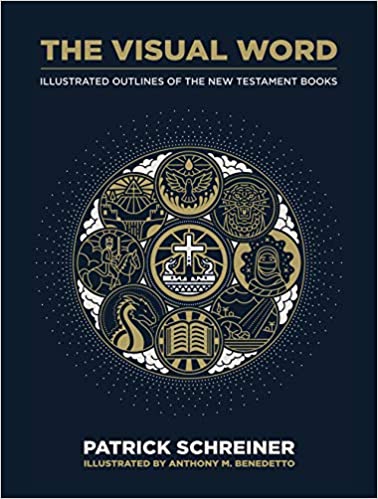
Patrick Schreiner, The Visual Word: Illustrated Outlines of the New Testament Books (Chicago: Moody Publishers, 2021), 179 pp.
The Visual Word: Illustrated Outlines of the New Testament Books by Patrick Schreiner is a real delight. First, the book is absolutely beautiful. Moody Publishers pulled out all the stops on this project by producing an extra-large book, suitable for a coffee table that is graced with vivid colors and top-quality binding and pages.
In addition to the quality design, Anthony M. Benedetto provides stunning illustrations throughout the book to help readers cement key truths and principles found in the biblical text.
Dr. Schreiner reveals his purpose in the introduction and provides the necessary background for The Visual Word. Schreiner says, “I believe one of the most important things to do when reading the Bible is to read it contextually. This book helps readers see the big picture and enables them to put the biblical pieces together in an objective fashion; one that does justice to the biblical text.,
Schreiner’s second purpose concerns the visual nature of learning. Most students are helped considerably by linking key truths to an image of some kind. The Visual Word makes good use of this by teaming up with Anthony Benedetto.
Each New Testament book is introduced with a key statement and a general overview of the book. Next, a one-page image is employed that gives readers a quick visual summary of the book. The remainder of the chapter is devoted to unpacking the units of thought, each of which is supported by one of Benedetto’s beautiful images.
It would be impossible to give this book too much praise. It is suitable for beginning Bible students and veteran preachers, teachers, and theologians. Even after teaching the Bible for 30 years, I will be turning to The Visual Word each time I begin a new expository study in a New Testament book.
Many thanks to Patrick Schreiner and Anthony Benedetto for this fine work.
I received this book free from the publisher. I was not required to write a positive review.
Sam Allberry, What God Has to Say about Our Bodies (Wheaton: Crossway Books, 2021), 201 pp.
Anthropology has become a hot topic in recent days. Nancy Pearcey gifted the church with her book, Love Thy Body: Answering Hard Questions About Life and Sexuality. Gregg R. Allison made a solid contribution with his book, Embodied: Living as Whole People in a Fractured WorldReenchanting Humanity: A Theology of Mankind – Owen Strachan. And Owen Strachan presented the most comprehensive treatment in his important book, Reenchanting Humanity: A Theology of Mankind. Sam Allberry joins the anthropological parade with his work, What God Has to Say about Our Bodies.
Allberry makes his case in three sections – created bodies, broken bodies, and redeemed bodies.
Created Bodies
The author begins by noting that God’s creatures are “fearfully and wonderfully made” (Ps. 139:14). Allberry adds, “We could not begin to measure the value of our body, however, it looks and however we feel about it.” The stress here is on the inherent dignity and worth of the body. Surely, this is a much-needed reminder for followers of Christ, especially those who rightly emphasize the depravity of mankind.
Allbery reminds readers that God created males and females. This basic reality is largely forgotten in our culture and is even being recklessly cast aside by progressive thinkers. Males and females are image-bearers, created with a distinct purpose, namely – to glorify God.
Broken Bodies
Allbery maintains his allegiance to the authority of Scripture by holding that God’s image-bearers have dignity and worth before God. Yet, they have been subjected to futility. Sin has introduced shame and brokenness. As such, each creature is brought into this world with a posture of defiance before God. “The greatest evidence of our bodily brokenness,” writes Alberry “is simultaneously ubiquitous and forced out of our minds so that we tend not to notice its significance – our bodies die” (Gen. 2:16-17; Heb. 9:27).
Redeemed Bodies
The author focuses his attention on some of the glorious aspects of the body by reminding readers that their bodies are temples of the Holy Spirit (1 Cor. 6:19-20). The body, therefore, must be presented to God as a living sacrifice (Rom. 12:1-2). The themes here are unfortunately neglected by many evangelicals as they downplay the body and refuse to properly nourish it and use it in a way the glorifies the Lord.
The book ends on a triumphant note as the author directs the attention of the reader to the promise of a glorified body. The author notes, “The resurrection of Jesus makes our own resurrection as his people a certainty.” Our future, then, is one that is filled with great hope as we long for the day when we will receive a glorified body.
Allberry’s work is greatly needed in our day when secular voices overemphasize the body and when local churches downplay the body. What God Has to Say About Our Bodies strikes the biblical balance by turning our attention to sacred Scripture.
I received this book free from the publisher. I was not required to write a positive review.
J. Garrett Kell, Pure in Heart (Wheaton: Crossway Books, 2021), 188 pp.
Scripture provides clear marching orders for us on matters that pertain to purity (1 Thess. 4:3-4; 1 Pet. 1:14-16; 2 Tim. 2:22).
J. Garrett Kell recognizes the biblical mandate for purity and helps readers develop a game plan in their battle against sin in his book, Pure in Heart.
Part 1: Promise of Purity
Jesus says, “Blessed are the pure in heart for they shall see God” (Matt. 5:8). This mighty promise undergirds part one of the book and beckons each person to pursue God with holy passion. The longing to see God fuels the resolve, then, of every follower of Christ.
Kell summarizes, “Purity is an orientation of the faith-filled heart that flees the pleasures of sin and pursues the pleasures of God by the power of the Holy Spirit.”
This premise runs throughout the book in the hopes that readers will find their ultimate pleasure in the living God. As the psalmist writes, “You make known to me the path of life; in your presence there is fullness of joy; at your right hand are pleasures forevermore” (Ps. 16:11).
Part 2: Pathways to Purity
The second half of the book is oriented to application. Readers are encouraged to “feed their affections” by feasting on Scripture, spending time in prayer and fasting, focusing on Christ-centered music, and being captivated by God’s creation. In the end, what severs the attraction with sin is the sight of God and all his holiness and the heavenly home that awaits God’s elect.
Principles of accountability and biblical admonition are offered. Confession of sin is focused on and biblical repentance is a key aspect of part two. Kell adds, “When we succumb to sin, our flesh is inflamed, our peace quenched, our godly desire sapped, our joy smothered, our prayer hollowed, our resolve weakened, and our communion with God and others hindered.”
Pure in Heart: Sexual Sin and the Promises of God is a much-needed book in a culture that is drowning in sensuality. Young men will especially benefit from Kell’s timely pastoral counsel. In the end, they will be drawn to a God that offers eternal life and the most satisfying relationship in the universe.
I received this book free from the publisher. I was not required to write a positive review.
Jon Harris, Christianity and Social Justice: Religions in Conflict (Ann Arbor: Reformation Zion Publishing, 2021), 146 pp.
Christianity and Social Justice by Jon Harris is a user-friendly reference that shows the distinct differences between biblical Christianity and social justice. The book reads like a trail guide that illumines the path of truth and highlights the dangers of social justice.
Harris is quick to point out that social justice is indeed a religion. As such, it is a worldview – one that is at odds with the historic Christian faith. The author presents a brief history of the social justice movement – one that is informed in inspired by Marxism. Categories of thought have been imported from a Marxist worldview and have made their way into contemporary culture and the church of Jesus Christ.
The author reveals how theological liberalism continues to infiltrate the church. This liberalism, which was confronted in the twentieth century by Carl F.H. Henry, Gresham Machen, and Francis Schaeffer is making a comeback and is tragically welcomed by Christian leaders in our generation.
Christianity and Social Justice targets woke Christianity, social justice epistemology, social justice metaphysics, and social justice ethics. It unpacks the “luggage” attached to this movement – none of which is worth salvaging. Indeed, the religion of social justice is a different gospel, one that must be discarded at once. Harris concludes, “Social justice offers what it has delivered every time it is tried: jealousy, envy, bitterness, destruction, corruption, tyranny, and ultimately, civil slavery to an impersonal, centralized bureaucracy. At this crucial moment, it is up to evangelicals, and Americans in general, to decide which path to follow.”
I commend Jon Harris for his careful research and commitment to herald the truth of God’s Word. Readers interested in continuing their study should consult Why Social Justice is Not Biblical Justice by Scott David Allen, Fault Lines: The Social Justice Movement and Evangelicalism’s Looming Catastrophe by Voddie Baucham, Christianity and Wokeness: How the Social Justice Movement Is Hijacking the Gospel – and the Way to Stop It by Owen Strachan, and Just Thinking About the State by Darrell Harrison and Virgil Walker.
Dane Ortlund, Deeper (Wheaton: Crossway, 2021), 186 pp.
Christians have long been on a quest for the “holy grail” of the Christian life. The popular Keswick conferences that emerged in England in 1875 called it the “victorious Christian life.” Charismatics seek a so-called “second blessing.” Tragically, many evangelicals roll up their sleeves and seek supernatural transformation via will-power or works. These well-meaning followers of Christ are genuinely seeking something great in their Christian journey. They want something more. They are in need of transformation. They merely want to go deeper. Each of the above proposals falls short of the biblical model of sanctification and leaves Christians confused, disillusioned, and discouraged.
Dane Ortlund’s newest book addresses both the need and the desire to go deeper into the Christian life. Deeper: Real Change for Real Sinners is a book about sanctification. The book strikes the biblical balance between vigorous God-centered striving and trusting the Holy Spirit to produce sanctification. Scripture is clear on this matter:
Therefore, my beloved, as you have always obeyed, so now, not only as in my presence but much more in my absence, work out your own salvation with fear and trembling, for it is God who works in you, both to will and to work for his good pleasure. (Phil. 2:12–13, ESV)
Ortlund offers nine meditations that push and encourage readers to a biblical model of sanctification. But more important than a model, the author suggests that “we grow specifically by going deeper into the gospel, into the love of Christ and our experienced union with him … we are reflecting on the way our souls must go out to God in Christ to desire, to long for, to receive, to dwell in, to thank him for his endless love. The gospel comes to us in the Scriptures, and in prayer we receive and enjoy it.”
Ortlund is not impressed with sanctification strategies or gimmicks; nor does he offer a series of steps that produce sanctification. Deeper is a book that pleads with Christians to do one thing: LOOK TO CHRIST!
Be astonished at the gracious heart of Jesus Christ, proven in his atoning work in the past and his endless intercession in the present. Receive his unutterable love for sinners and suffers. Stop resisting. Let him draw near to you. Gaze upon him.
Here is a book that is exceedingly warm, theologically rich, informed by Puritanical wisdom, and deeply personal and practical. I commend Deeper and trust that many will benefit from this wonderful book.
I received this book free from the publisher. I was not required to write a positive review.
Pornography has a stranglehold on countless men and women in our culture. There was a day when one needed to seek porn out but with the rise of the internet, pornography stalks the unsuspecting through means of a phone, computer, or television. Sadly, many of these are naively lured into grievous sin and find themselves in a pattern of defeat.
Ray Ortlund is burdened for people entrapped in the sin of pornography; he also has a burden to see the industry burn to the ground. In his book, The Death of Porn, the author addresses the hearts of men in particular. His aim is to see men become men of integrity who play a vital role in building a world of nobility.
The Death of Porn is a unique book, written with a personal and pastoral tone. It is a simple read and practical in nature. The driving factor in Ortlund’s book is not psychology or self-help. At the very center of the book is the gospel of Jesus Christ. In six short letters, Pastor Ortlund addresses Sons as he would address one of his own.
Part one, Reintroducing the Charactersfocuses on three specific characters: 1) Men who struggle with sexual sin, 2) Women who have been hurt by the porn industry, and 3) The Lord Jesus Christ. Jesus is presented as the conquering Lion, the One who reigns over sin and resurrected from the grave. But Jesus is also presented as the Lamb who was slain. At the heart of this discussion is the need to understand that Jesus is both the Lion and the Lamb:
It helps us that the roaring Lion and the sacrificial Lamb are one and the same person. He respects us enough to confront our sins. But he also values us enough to pay for our sins – at cost to himself alone. Jesus is building his new kingdom in a surprising way. He gives porn stars their dignity back, and he gives porn consumers their honor back. He loves doing this.
This Lion and Lamb calls sinners to the foot of the cross to repent and believe. He calls sinners to drink from the fountain of his grace, the only fountain that truly satisfies. Ortlund urges readers to draw near to the Lord Jesus Christ:
But this letter is about our true King. And I’m asking you to hand yourself over to him. Then he’ll plunge your past under his own blood. And he will provide everything you’re going to need – moment by moment – as he leads you into your future.
Part two, Reimagining the Future offers readers hope for the future as the death of porn becomes a reality. Ortlund assures his Son with timely encouragement: “You’re on the right side of history, not because of your resolve but because of his resurrection.” This is a crucial point as many struggling men attempt to break the power of porn via will-power or promises that are eventually broken. In the end, however, the only One who can rescue men from pornography is the Lord Jesus Christ and the message of the gospel.
The author builds on this hopeful theme by summarizing how to fight well. First, What You’re Fighting For. He adds, “When you take up the fight against evil, you are planning a noble thing. You are standing for a noble thing. If you ever feel like a coward in the face of the battle, you can pivot immediately, turn from your fear back to Jesus, and brace yourself again for the fight.”
Second, How You Can Fight Well. Ortlund encourages his Son to remember that God is with him and rejoices over him. This point assumes that the battle against sin is ongoing until we reach the shores of the Celestial City. He urges, “Let’s support one another as we fight for our integrity. But let’s never make room for sin – even in our thoughts.”
Third, What Winning Will Cost You. The author challenges his Son to be killing sin by the power of the Holy Spirit (Rom. 8:13). Such an endeavor will obviously be costly and will be worth every ounce of gospel-centered obedience. Ortlund concludes, “Jesus calls you to fight for his new world of nobility … joyously, decisively, repeatedly.”
In the fifth letter, Sons are encouraged to work together. The author exhorts him, “ … You, with your brothers, will create a new world of nobility. Moving forward shoulder to shoulder, you can starve that predatory Beast – the porn industry.”
Ortlund underscores the importance of transparency. He draws on James 5:16 and encourages his Son to confess sin, pray with like-minded brothers, which ultimately leads to healing. The sum of the matter is deeply encouraging:
Your brotherhood can go viral. It can easily multiply, leaping over barriers, reaching men far away, men you might never even meet in this life. But in our sick world, healing is a powerful force. Your new freedom of heart can flow out, by the grace of God, reaching even the darkest places of porn. God can do that through you – the real you, with other real men.
The final letter focuses on making a world of difference. Ortlund writes, “Jesus is calling you to build a new world of nobility, to the furthest extent of your influence, for the rest of your life. And he’s in the fight with you.” He includes practical proposals that will enable men to make a maximum impact in their world.
My hope is that The Death of Porn reaches thousands upon thousands of young men who need a strong and biblical challenge from a seasoned pastor who cares about the legacy of the next generation. That legacy involves men committed to holiness and integrity; men who are building a world of nobility.
We are living through one of the most tumultuous times in American history. It seems like every day a new challenge surfaces. We face trials, temptations, suffering, and grief. We hear rumors about the fate of our Republic. Conspiracy theories are at a fevered pitch. None of this should surprise us. In Jesus’s day he told his disciples:
And you will hear of wars and rumors of wars. See that you are not alarmed, for this must take place, but the end is not yet. For nation will rise against nation, and kingdom against kingdom, and there will be famines and earthquakes in various places. All these are but the beginning of the birth pains. “Then they will deliver you up to tribulation and put you to death, and you will be hated by all nations for my name’s sake. And then many will fall away and betray one another and hate one another. And many false prophets will arise and lead many astray. And because lawlessness will be increased, the love of many will grow cold. But the one who endures to the end will be saved. And this gospel of the kingdom will be proclaimed throughout the whole world as a testimony to all nations, and then the end will come (Matthew 24:6–14, ESV).
Jesus has a way of bringing us back to ground zero. He always tells the truth and he always has our best interests in mind. Is it any wonder that Paul admonished the Ephesian believers to put on the armor of God? He writes:
Stand therefore, having fastened on the belt of truth, and having put on the breastplate of righteousness, and, as shoes for your feet, having put on the readiness given by the gospel of peace. In all circumstances take up the shield of faith, with which you can extinguish all the flaming darts of the evil one; and take the helmet of salvation, and the sword of the Spirit, which is the word of God, praying at all times in the Spirit, with all prayer and supplication. To that end, keep alert with all perseverance, making supplication for all the saints, and also for me, that words may be given to me in opening my mouth boldly to proclaim the mystery of the gospel, for which I am an ambassador in chains, that I may declare it boldly, as I ought to speak (Ephesians 6:14–20, ESV).
In order to be battle ready, we need the courage of Christ. We need to put on the armor of Christ. And we need to stand strong for Christ.
The Puritan William Gurnall writes, “To stand is the opposite of to flee or to surrender. A captain who sees his men retreating or on the verge of surrender gives the order, ‘Stand!’ and every soldier worthy of his calling responds at once to his captain’s voice. In like manner, every Christian is to respond to God’s call to ‘Stand!’ – or, in other words, steadfastly to resist and never yield to the attacks of Satan.”1 Taking such a stand means that we not only stand for Christ; we also stand against some things. We stand against:
An ungodly world. Paul warns us about the kosmos (world) in his letter to the church in Colossae. He writes, “See to it that no one takes you captive by philosophy and empty deceit, according to human tradition, according to the elemental spirits of the world, and not according to Christ” (Colossians 2:8).
An ungodly agenda. Scripture describes the essence of this agenda in 2 Timothy 3:1-5. I encourage you to read through this section of Scripture and become familiar with this ungodly agenda.
An ungodly enemy. Satan is our enemy, a foe who is backed by a horde of evil demons. They are Satanic ambassadors who do the bidding of the prince of darkness. They seek to hinder the work of the ministry (1 Thes. 2:18). They work with all their might to stir up pride among the people of God. Ultimately, their aim is to destroy (John 10:10).
Prepared for Battle
Are you battle ready?
Do you have the courage of Christ?
Are you wearing your spiritual armor each day?
Are you standing strong for Christ?
J.C. Ryle reminds us, ““Take away the gospel from a church and that church is not worth preserving. A well without water, a scabbard without a sword, a steam-engine without a fire, a ship without compass and rudder, a watch without a mainspring, a stuffed carcass without life, all these are useless things. But there is nothing so useless as a church without the gospel.”2
Let us stand strong for the sake of Christ.
William Gurnall, The Christian in Complete Armor (Edinburgh: Banner of Truth Trust, 1655), 285. ↩
J.C. Ryle, Light From Old Times (Edinburgh: The Banner of Truth, 2015), 45. ↩
Michael J. Kruger, Surviving Religion 101 (Wheaton: Crossway Books, 2021), 262 pp.
Skepticism is alive and well in America. One of the hottest beds of skepticism, especially towards historic Christianity is found in the university system. It is common for Christian students to enter the university with a faith that professed. Somewhere along the way, however, some of these students admit that they never truly possessed saving faith.
Dr. Michael Kruger’s book, Surviving Religion 101: Letters to a Christian Student on Keep the Faith in College is specifically addressed to his daughter, Emma – a freshman at the University of North Carolina at Chapel Hill. Kruger addresses a host of topics including meaning, morality, the problem of evil, the resurrection, unbelief, science, evolution, philosophy, the authenticity of the New Testament manuscripts, among other things.
The great strength of this book is the blend of scholarship and fatherly wisdom. Neither are sacrificed. Rather, this author writes with stunning theological depth that a young person can understand. The touch of a father is seen throughout the book and gains momentum as the book draws to a close.
The postscript is a powerful polemic that will capture both the heart and the mind of the reader. Skipping it would be a grave mistake. Youth pastors, grandparents, and parents should purchase Surviving Religion 101 and help equip the next generation of Christian leaders. Together, we can stand against the skepticism that is gaining momentum and see the next generation of Christian leaders rise above it all.
I received this book free from the publisher. I was not required to write a positive review.
John Piper, The Supremacy of God in Preaching (Wheaton: Crossway Books, 2021).
I first read The Supremacy of God in Preaching by John Piper in the early nineties. I remember the deep impact it made on my life, ministry, and most of all – my preaching. Since that initial read, I’ve lost track of how many times I’ve read this excellent book. Crossway Books has since picked up the publishing rights and commissioned John Piper to add additional material in a revised and expanded edition.
Part 1: Why God Should Be Supreme in Preaching
Dr. Piper argues, “The goal of preaching is the glory of God reflected in the glad submission of the human heart.” This theme of God’s glory matches the theme of the Bible and Redemptive history and should motivate every man who enters the pulpit with a Bible in hand.
The author demonstrates how God’s righteousness and the pride of man are obstacles to fulfilling the glorious goal of preaching. Therefore, the ground of preaching is the cross of Christ. Piper argues, “Without the cross, the righteousness of God would demonstrate itself only in the condemnation of sinners, and the goal of preaching would abort – God would not be glorified in the gladness of his sinful creatures. His righteousness would simply be vindicated in their destruction … The cross witnesses to the infinite worth of God and the infinite outrage of sin.”
Good preaching is dependent on the Holy Spirit. The Spirit illuminates the Bible and enables preachers to proclaim the truth of God’s Word in great power.
Finally, preaching must include gravity and gladness. Piper explains, “Gladness and gravity should be woven together in the life and preaching of a pastor in such a way as to sober the careless soul and sweeten the burden of the saints.”
Part 2: How to Make God Supreme in Preaching: Guidance From the Ministry of Jonathan Edwards
Part two shows readers how Jonathan Edwards influenced the preaching ministry of John Piper. The high points of Edwards’s life and theology are presented. But the real treasure lies in the principles that Piper presents that summarize how Edwards made God supreme in his life and his preaching. Piper offers ten characteristics of the Puritan divine’s preaching that is worth repeating here:
Stir up holy affections
Enlighten the mind
Saturate with Scripture
Employ analogies and images
Use threat and warning
Plead for a response
Probe the workings of the heart
Yield to the Holy Spirit in prayer
Be broken and tenderhearted
Be intense
Part 3: After Thirty-Three Years: God Still Supreme in Preaching and Ministry
The final section includes new material that is worth the price of the book. Dr. Piper speaks from the heart as he reaffirms all that he has taught in the book. Additionally, he presents thirty reasons why it is a great thing to be a pastor. Each of these is worth reading again and again.
Summary and Evaluation
The Supremacy of God in Preaching is not a typical preaching book. It does not unpack homiletical principles or preaching mechanics. Rather, it sets forth the case for biblical preaching and urges (and even begs) preachers to remember that the goal of preaching is “the glory of God in the glad submission of his creation.”
The Supremacy of God in Preaching is a landmark book. This book should be included in every homiletics course. This book should be in every pastor’s library. And this book should be read on a regular basis by every pastor. It sets pastors straight by calling them to stand and deliver. It motivates them to put the glory of God on display and cast aside triviality and duplicity. May John Piper’s plea be heard and heeded by the next generation of preachers. The sheep will reap the benefit of such a ministry.
I received this book free from the publisher. I was not required to write a positive review.
J.I. Packer, The Heritage of Anglican Theology (Wheaton: Crossway Books, 2021), 372 pp.
J.I. Packer went to be with the Lord in July 2020. Nearly a year later, we are blessed with a wealth of theological jewels in Dr. Packer’s posthumous work, The Heritage of Anglican Theology. This resource is a collection of lectures compiled from the author’s course he taught at Regent College. The original intent of these lectures was to provide introductory source material for students who sought to understand the basics of Anglicanism.
The Church of England is a topic that is historically and theologically rich. “Evangelical catholicity” and ”catholic evangelicalism” are two terms that Packer uses to refer to the Church of England. He utilizes David Bebbington’s four-point description of evangelicalism to help readers discover the core of Anglicanism:
Bible-based
Cross-centered
Conversion-minded
Mission-attuned.
Packer adds an additional descriptor. “Church-focused” reminds the people of God that “one’s relationship with God is the most important thing in any person’s life and ought always to have priority.”
The history of the monarchy is discussed which gives readers an inside look at the origins of Anglicanism. In this context, Packer adds an additional list of important adjectives that sum up the essence of Anglicanism. His list includes 1) Biblical, 2) Liturgical, 3) Evangelical, 4) Pastoral, 5) Episcopal, 6) National, 7) Ecumenical. At the heart of this discussion is the strong allegiance to the authority of Scripture.
Packer presents a fairly comprehensive sweep of Anglican history beginning with the English Reformation and proceeding to the theology of the Puritans. Additionally, the author surveys the Oxford Movement, Anglo-Catholicism, and speaks to the current trends in Anglicanism.
Perhaps the most striking feature of this work is the attention given to doctrine. Packer strenuously argues the importance of doctrine in the Anglican church. As such, he urges his readers to grow more familiar with the Thirty-Nine Articles, which nicely summarize the essence of Anglicanism.
The Heritage of Anglican Theology is a needed volume in an age that has largely forgotten the importance of church history and theological tradition. While this volume has much value, it may be too much for some readers to digest. Having said that, I urge anyone who has an interest in the history of Anglicanism to explore Dr. Packer’s work and glean the high points. Don’t get overwhelmed in the minutia. Be sure to catalog the major headings that help summarize the core teaching and history of Anglicanism.
I received this book free from the publisher. I was not required to write a positive review.






 Veritas et Lux