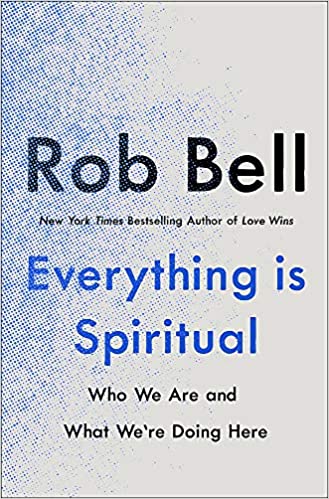
Rob Bell, Everything is Spiritual (New York: St. Martin’s Publishing Group, 2020), 310 pp.
In 2011, I reviewed Love Wins, my first book by Rob Bell. The piece prompted praise by conservatives and vicious scorn by progressive Christians and liberals. Whatever anyone thinks about Bell, one thing is for sure: the guy can write. He is a master communicator. And whenever he writes or talks, people listen.
Anyone familiar with Rob Bell knows that he is somewhat of a gadfly among evangelicals. And “gadfly” is a massive understatement. But there is something endearing about Bell. Some point to his skill. Others are impressed with his intellect. For me, I’ve always been drawn to Bell’s ability to communicate what he’s truly feeling – including insecurity, childhood pain, or unfulfilled expectations. He identifies a “generational lack of grace,” a trait that is found too often in the church. His transparency is refreshing and his candor is something that is greatly needed in our day.
While I applaud Bell’s transparency, I have expressed deep concern with some of the theological and philosophical assertions that he has proposed. His most recent book, Everything Is Spiritual is no exception. Michael Eric Dyson’s endorsement of the book provides a revealing summary:
“In Everything Is Spiritual, Rob Bell updates Teilhard de Chardin’s Catholic mysticism, makes sexier Werner Heisenberg’s quantum physics, and baptizes Jewish Kabbalah in an exciting vision of the future of human evolution. Bell challenges the notion that science and belief are at war, with his sublime fusion of Christian faith and modern evolutionary science. Bell’s book is the perfect antidote to the plague of an evangelical worldview that is captive to imperial dreams and a literalism that kills the spirit of Christianity …”
I will argue in this review that while Michael Eric Dyson truly does capture the essence of Bell’s intentions in Everything Is Spiritual, the end result is unhelpful and spiritually dangerous. Instead of illumination, readers will be left in a quagmire – with more questions than answers. And they will wander aimlessly in a spiritual wasteland, armed with an inaccurate portrait of God that leaves them hopeless without the biblical gospel.
No Final Answer
One of the common themes in Bell’s writing is ambiguity. He extinguishes certitude and exalts mystery (both of which are fundamental tenets of postmodernism). Careful readers will notice that the author is quick to pay lip service to Christian theology but swiftly degenerates into a subtle (or not so subtle man-made philosophy). The Bible warns, “For the time is coming when people will not endure sound teaching, but having itching ears they will accumulate for themselves teachers to suit their own passions, and will turn away from listening to the truth and wander off into myths” (2 Tim. 4:3-4, ESV).
Tragically, many have been deceived by Bell’s “spirit myths” over the years. For instance, in Bell’s book, What We Talk About When We Talk About God, he argues that God is “with us, for us, and ahead of us – all of us.” The notion that God is “with us,” “for us,” and “ahead of us (every single one of us) may sound good initially but falls short of the biblical model. It is true that God is “with” his people. We see this especially in the incarnation of Jesus, the One who is named Immanuel – or God with us (Matt. 1:23). Yet God is not “with” the man who has rejected the revelation of God in Christ. God is not “with” the one who rejects the Lord Jesus Christ and his gospel. “… Whoever does not obey the Son shall not see life, but the wrath of God remains on him” (John 3:36).
It is true that God is “for us” – that is to say, he is for his people. “For I am sure that neither death nor life, nor angels nor rulers, nor things present nor things to come, nor powers, nor height nor depth, nor anything else in all creation, will be able to separate us from the love of God in Christ Jesus our Lord” (Rom. 8:38–39, ESV). Yet, God is not “for” the man who repudiates the promises and purposes of God. The holy God opposes the proud (Jas. 4:6; 1 Pet. 5:5).
I referred to Paul’s warning in 2 Tim. 4:3-4 again and again as I read Everything is Spiritual. Indeed, doctrine is downplayed and orthodoxy is questioned. But not everything is ambiguous. As he did in Love Wins, Bell dogmatically casts aside the doctrine of hell: “Because some stories are better than others. Stories about a God who tortures people forever in hell shouldn’t be told. They’re terrible stories. They make people miserable. They make people want to kill themselves. Stories that insist that a few human beings are going to be okay and every other human being ever is doomed for eternity are horrible stories.”
In a magical twist, certitude suddenly reappears! Alas, the painful reality is obvious here: Anyone who bemoans doctrine is in fact, dogmatic themselves! It appears, then, that the dogmatic bark is worse than the bite.
No Final Authority
To make matters worse, no final authority is offered in Everything Is Spiritual. It is difficult to determine if Bell embraces pantheism, panentheism or some other theological construct. Whatever the case, the book makes much of God’s immanence and downplays his transcendence.
But what is missing here is a distinction between the Creator and the creature. Missing is a Creator who is sovereign over creation and rules over all. Bell’s account of God is noted in the biblical exchange with Moses who refers to himself as I AM. So far so good. But notice how Bell’s understanding of God undermines the Creator/creature distinction:
“Moses wants to locate God, and what Moses gets is Everywhere. Moses wants something to wrap his mind around, and what he gets is All of it.“
“What an answer. Another way you could say I AM is Being Itself.“
“That’s past, that’s present, that’s future. All of it. Being Itself, the formless beyond any one form, animating all forms. The electricity the entire thing is plugged into. The water it’s all swimming in.”
“That’s every you that ever was and ever will be. All your yous.”
Later, Bell refers once again to “Being Itself. I AM.” He writes, “You ground yourself in that, and you’re all of it. You root yourself in the source and Spirit beyond all these forms and categories and labels, you listen to that and follow that and you keep going.” Bell refers to this as the “collective unity of humanity,” or “the body of Christ.” He adds, “All of us humans ever, across time, all together, adding up to something. The body of Christ.”
Not only does this line of reasoning militate against the Creator/creature distinction; it misleads readers into believing that they are members of Christ’s body, when the unbelieving world is described as enemies of God and under his holy wrath.
Acts 17:22-31 reveals a Creator God who is the cosmos shaper, the kingdom shaker who lives above creation. He is the all-sufficient Ruler, Life-Giver, and Destiny Maker. And he is the righteous Judge who “commands all people everywhere to repent, because he has fixed a day on which he will judge the world in righteousness by a man whom he has appointed …” (Acts 17:30-31, ESV).
And Scripture speaks of the creature who was created by God (Gen. 2:7). The creatures (Adam and Eve) were originally free from sin but fell and as a result became sinners by nature and by choice (Gen. 3:1-7). As such, these sinful creatures have no inherent righteousness, no desire for God (Rom. 3:10-11). Subsequently, all creatures are born with a hatred in their hearts for God (Rom. 8:7-8). They are dead in sin (Eph. 2:1-3), and they are enslaved in sin; totally unable to come to Christ apart from God’s empowerment (John 6:44). These creatures are dependent upon God for everything. While they have the ability to make free choices, these choices are determined in eternity past (Acts 17:26; Prov. 19:21; 21:1). And these creatures are accountable to a righteous and sovereign Judge (Rom. 2:5-11).
As such, there is no final authority in Everything is Spiritual. Bell writes, “God is not detached from the world, up there, or above, or somewhere else, that would make God a form like everything else.” So, we are left with the strange and unbiblical blending of the Creator and the creature.
No Exclusive Path
One of the reasons that people are drawn to Bell is because he refuses to be boxed in by a religious system or creed. He is quick to jettison the traditional path and proudly promotes another route: “And then there was soul. This deeper voice within me telling me another truth, coaxing me to rethink what success even is. I had my own path, and it wasn’t this, and what you do with a path is you walk it … But walking your path, when you’re surrounded by multiple voices with strong opinions about what you should be doing, that takes tremendous spinal fortitude.”
“Spinal fortitude,” is to be commended. The problem is that Scripture points to one path – the path that Jesus describes as “narrow.” Jesus says, “Enter by the narrow gate. For the gate is wide and the way is easy that leads to destruction, and those who enter by it are many. For the gate is narrow and the way is hard that leads to life, and those who find it are few” (Matt. 7:13-14).
One of the primary arguments in Bell’s book is that “everything is spiritual.” He refers to Christ, who holds all things together: “All of it. All of us. Everybody, everywhere, in Christ.” He rightly notes how every person is created with dignity and honor and possesses “infinite worth and value.” But things take a tragic turn for the worse. For the one who pursues his own path, according to Bell, is something of a radical. In a stunning admission, Bell acknowledges: “The radical is not the person who wandered off the path into the deep weeds. The radical is the one who went back to the origins, to the roots, to how it all began. Sometimes the tribe has lost its way, sometimes the ones claiming to be orthodox, correct, pure ones have gone off the rails, sometimes it’s the mother ship that has lost its bearing, and it’s the radical who’s actually rediscovering the true path.”
Radicals like Jan Hus and Martin Luther rediscovered the true path when they embraced biblical authority and the gospel of Jesus. But Bell is not referring to these stalwarts of the faith. Rather, he is referring to those who dare to break free from the chains of orthodoxy. After all, writes Bell, “You aren’t an object, you aren’t a pawn … you possess Spirit. Personal, intimate, infinite, knowing, Spirit. You reflect the divine, present in each of us. You’re in Christ.”
No exclusive path is necessary since we are “in Christ,” according to Bell. This theme emerged clearly in Love Wins as Bell undercut sovereign grace by arguing that God draws all people to himself. He writes, “ … We see that Jesus himself, again and again, demonstrates how seriously he takes his role in saving and rescuing and redeeming not just everything, but everybody.”
But Scripture stands in opposition to this theme. The Bible never declares that all people are “in Christ” as Bell supposes. Rather, each person is born in Adam and experiences death as a result (Rom. 5:12-21). Jesus never promises to rescue and redeem all people. Rather, people are assured that they will receive eternal life and forgiveness if they turn from their sin and trust the Lord Jesus Christ (John 3:15-16; 6:37, 47; 7:38; 8:12; Acts 4:12; Rom. 10:9-13, 17). When a person trusts in Christ alone for their salvation, then and only then, are they truly “in Christ.”
Bell’s “gospel” is described as “the divine announcement that you are loved and accepted exactly as you are, that everything has been taken care of, that everything you’ve been striving to earn has been yours the entire time, that you belong, in exactly this condition that you are currently in, nothing additional required or needed.” Readers are left, then, with more ambiguity. Whose “gospel” is Bell describing? And does this “gospel” tolerate sin? Does this “gospel” lay down demands? Is surrender required? Belief? Repentance? Is this “gospel” inclusive or is it exclusive? Is this “gospel light?” Or is this the “gospel” that Scripture refers to as a “different gospel” (Gal. 1:6)?
The matter of the gospel has eternal implications. The apostle Paul warns the Christians in Galatia to beware of those who “distort the gospel of Christ” (Gal. 1:7). He continues, “But even if we or an angel from heaven should preach to you a gospel contrary to the one we preached to you, let him be accursed. As we have said before, so now I say again: If anyone is preaching to you a gospel contrary to the one you received, let him be accursed” (Gal. 1:8-9, ESV).
The biblical gospel or the “good news” of God begins with God. It declares that God is sovereign and holy. It tells us that God created people for his glory (Isa. 43:7). It tells us that people are sinners by nature and by choice (Rom. 3:23; 5:12). The gospel warns us that God is just and that he has the right to punish sin and that unrepentant people will endure the wrath of God for eternity (Rom. 6:23; John 3:36). The gospel tells us about a Savior who will destroy death and rescue his creatures from the power of sin and the penalty of sin. And one day this gospel will rescue followers of Jesus from sin’s very presence.
The gospel distinguishes between the Creator and the creature. Peter Jones adds, “The Bible warns us not to worship the creation but to worship and serve only the Creator. The starting point of gospel truth is that God the Creator, in the three persons of the divine Trinity – Father, Son and Holy Spirit – is the one and only God and that all which is not God was created by him … The Christian faith maintains a separateness between God and His creation.” The gospel makes provision for sin, exalts the crucified and risen Savior, and reconciles sinners to a holy God.
Tragically, the biblical gospel is jettisoned in Everything is Spiritual. The gospel is reduced to a “divine announcement” of acceptance. This soft, inclusive “gospel” is a different gospel that Scripture condemns (Gal. 1:6, 9).
Summary
“Everything is spiritual.” The very idea sounds so very, well … spiritual. And people who flock to read the musings of Bell continue in a trancelike state like they’ve been doing for years. But the author makes a very revealing statement near the end of the book. He writes, “I want to help people rediscover the wonder and awe of their existence.” Yet, no final answer is given. No final authority is offered. And no exclusive path is revealed. Instead of rediscovering “the wonder and awe of their existence,” readers are left wandering in an existential fog, unaware of the Creator God who made all things for his glory; the transcendent God who sovereignly rules and reigns; the God who sent his Son to rescue sinners, redeem them, and bless them with eternal life.
Michael Eric Dyson refers to Bell’s book as “a perfect spiritual antidote to the plague of an evangelical worldview that is captive to imperial dreams and a literalism that kills the spirit of Christianity.” Nothing could be further from the truth. The message that Rob Bell presents in this book is anything but spiritual. Instead, it offers a syncretistic concoction of worldly philosophy that leads the unsuspecting on a path to divine judgment. That’s a far cry from an antidote. Poison doesn’t cure disease. Poison kills the unsuspecting.
- Peter Jones, Gospel Truth, Pagan Lies: Can You Tell the Difference? (Enumclaw: Winepress Publishing, 1999), 23-24. ↩





 Veritas et Lux