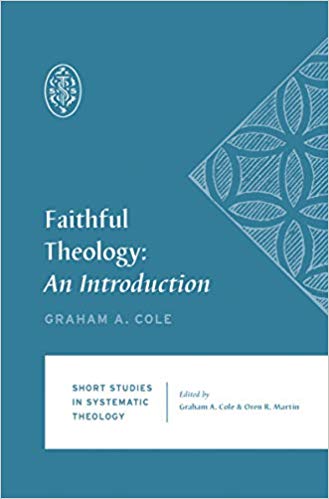
Faithful Theology: An Introduction – Graham A. Cole (2020)

Graham A. Cole, Faithful Theology: An Introduction (Wheaton: Crossway, 2020), 118 pp.

“The case can be made that every Christian is a theologian because every Christian has a theology, whether well thought out or not.” That is the first sentence in Graham Cole,’s book, Faithful Theology: An Introduction. Dr. Cole’s aim is to present a workable method, a way of doing theology.

Five important components help shape the author’s theological method. 1) The Word of Revelation, 2) The Witness of Christian Thought and Practice, 3) The World of Human Brokenness, 4) The Work of Wisdom, and 5) The Way of Worship.

Each area makes up a short chapter and guides readers on a path that ultimately leads to a theological methods that is biblical and practical. Faithful Theology: An Introduction truly is an entry point for aspiring theologians. But it is also a stunning reminder for those who have given their lives to the study of theology. Readers will be impressed with the brevity and the number of theological jewels that surface in this little book.

I received this book free from the publisher. I was not required to write a positive review.

4 Chair Discipling – Dann Spader

Dann Spader, 4 Chair Discipling: What Jesus Calls Us to Do (Chicago: Moody Press, 2014), 154 pp.

In the summer of 1991, I was introduced to Dann Spader and Sonlife Ministries. Spader’s philosophy of ministry would have a profound impact on my life and ministry that extends to this day. His most recent book, 4 Chair Discipling: What Jesus Calls Us To Do explores Jesus’s pattern for disciple-making and is a summary of what I learned almost thirty years ago in my introduction to Sonlife.

The four chairs represent four seasons in a person’s life. Each chair includes a challenge and an ultimate aim. Acknowledging these seasons help disciple makers reach out to the needs of people and respond to them appropriately.

Chair one represents an unconverted person. The challenge is “Come and see” (John 1:39). The ultimate aim is to see this person turn from his sin and trust Christ for his salvation.

Chair two represents a new believer. The challenge is “Follow me” (John 1:43). Such a person learns the basics of the Christian life in the second chair.

Chair three represents a worker, a growing believer. The challenge is “Follow me and fish for people” (Matt. 4:19). This person learns about ministry opportunities and is equipped to minister to the needs of other people.

Chair four represents a disciple-maker. The challenge is “Go and bear fruit” (John 15:16). The respective chairs combine to form a philosophical framework for disciple-making that includes the categories of win (chair 1), build (chair 2), equip (chair 3), and multiply (chair 4). The author notes, “The growth from Chair 1 to Chair 4 is God’s great design for disciples of Jesus. This development can only be accomplished in the power of the Holy Spirit.”

Spader’s philosophy of ministry has been great boon to my ministry and has provided a biblical framework for disciple-making. 4 Chair Disciplining is a worthy explanation of the philosophy that made Sonlife so successful and breathed life into the heart of countless youth ministries around the world.

I received this book free from the publisher. I was not required to write a positive review.

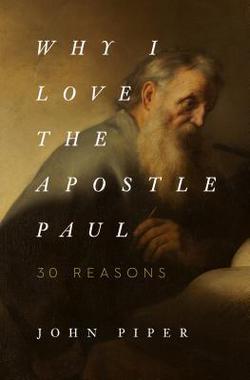
Why I Love the Apostle Paul – John Piper (2019)

John Piper, Why I Love the Apostle Paul (Wheaton: Crossway, 2019), 204 pp.

The aim of John Piper’s most recent book is to help readers get to know Paul the apostle. Piper’s motive is that Paul’s “God-entranced soul and his unparalleled vision of Jesus Christ and the authenticity of his life would move you to admire him and believe his message and embrace his Lord.”

The name of the book is Why I Love the Apostle Paul. Thirty reasons are supplied in short, readable chapters as Dr. Piper unpacks the heart and soul of one of the greatest thinkers and theologians of all time.

This book reveals the underbelly or the foundations of Piper’s well-known Christian hedonism. Many have fought against the very notion of such a worldview. Some have cast it aside as heretical; others have discounted it or marginalized its value. The arguments for Christian hedonism that Piper presents are not only biblical; they are robust, logical, mind-shaping, and heart-warming. The central thought of Piper’s Christian hedonism is this:

“God is most glorified in us when we are most satisfied in him.”

Piper’s latest offering, while not necessarily an apologetic for Christian hedonism, is a worthy defensive and brilliant articulation of the philosophy which has undergirded the author’s life and ministry.

Quite frankly, Why I Love the Apostle Paul is an enthralling book. It is certain to open many eyes to the depth, breadth, majesty, and beauty of the gospel. The deep biblical realities that Dr. Piper unfolds are powerful and encouraging. This is a book that deserves to be read over and over again!

I received this book free from the publisher. I was not required to write a positive review.

Spurgeon’s Sorrows – Zack Eswine

spurgeonI have a friend who was born in 1834.  That would make him 183 years old.  He went home to be with Jesus in 1892 – at the peak of his ministry and in the prime of his life.  I have often asked why God takes the heroes of the faith so soon – Jonathan Edwards, John Bunyan, and John Calvin all died in their 50’s.  David Brainerd and Jim Elliot died before they reached the age of 30.  While the question is interesting to ponder, the question is not ours to ask.  Enter the Creator —

Who is this that darkens counsel by words without knowledge? (Job 38:2, ESV).

You know, for you were born then, and the number of your days is great (Job 38:21, ESV).

And the LORD said to Job: ‘Shall a faultfinder contend with the Almighty?  He who argues with God, let him answer it’ (Job 40:2, ESV).

I have been learning from my friend, C.H. Spurgeon for nearly 25 years now.  He has taught me many lessons.  He introduced me to Pilgrim’s Progress by John Bunyan, a book he read over 100 times in his short life.  Spurgeon has taught me the importance of expositional preaching.  On many occasions, he has reminded me about the importance of the role of the Holy Spirit in preaching, not to mention living the Christian life.  He has inspired courage and conviction and prompted me to be unwavering, even in the darkest of days.

But one of the greatest lessons I’ve learned from my British friend is how to deal with melancholy.  Zack Eswine helps highlight some of those lessons in his book, Spurgeon’s Sorrows.  The subtitle accurately reflects the basic theme of the book, Realistic Hope for those who Suffer from Depression.  

Spurgeon’s Sorrows is arranged in three parts.  Part One walks readers through the basics of depression.  What is it?  How can one recognize it?  What is spiritual depression?  Part Two presents a path for helping people who suffer from depression.  And Part Three is a practical section that offers practical assistance for dealing with depression.

Chapter nine is worth the price of the book as the author directs readers to the promises of God and shows how Spurgeon utilized this habit of claiming the promises of Jesus in his daily walk with God.

Spurgeon’s Sorrows is a short book filled with biblical counsel for people who battle depression and provides help for anyone who is reaching out to folks who are wading through the Slough of Despondence.  In the final analysis, readers are encouraged to cling to their Savior who promises to walk with them through every valley.

The Lord is my shepherd; I shall not want. He makes me lie down in green pastures. He leads me beside still waters (Psalm 23:1–2, ESV).

The Puritanical Genius of Mike Pence

A well-known Washington Post article revealed some fascinating tidbits about Vice President Mike Pence and his wife, Karen. At the top of the list, was Pence’s proclamation in 2002 that, “he never eats alone with a woman other than his wife.”1 The article revealed what many Americans have learned in recent months about Mike and Karen Pence, namely, that these people fear God and take their wedding vows seriously.

One would think that such a story would not draw much press or criticism. Think again, as the liberal media pounced on Pence and sought to portray his views as Puritanical and out of step with the modern milieu. Such views are better relegated to the stone age, at least in the minds of “cultured” people.

For example, Jessica Valenti writes that Pence’s position is “all a part of his deeply retrograde worldview.”2 Writing with deep sarcasm, Valenti considers the values of Pence to militate against the tenor of the times: “It’s an insulting view of men, a limiting role for women – we’re there to either entice or domesticate – and an archaic take on gender roles more generally.”3

Valenti accuses Pence of being a “misogynist,” a truly bizarre accusation, especially in light of the honor that the Vice President pays to his wife. This egalitarian banter is both unfair and unproductive, putting words in Pence’s mouth and making judgments that are simply untrue. And these ridiculous accusations are light-years away from anything that resembles graciousness. So much for left-wing tolerance.

While the liberal media wastes precious time and ink, attacking the Vice President with straw man arguments, perhaps there are some lessons to learn for the rest of us. What kind of wisdom does Vice President Pence possess that other men could learn from? How can we learn from the Puritanical genius of Mike Pence?

He Understands the Power of the Flesh

The Vice President is well aware of what Scripture says about the human heart. Jeremiah 17:9 says, “The heart is deceitful above all things, and desperately sick; who can understand it?” The Bible clearly states that people of faith battle indwelling sin; this sin is smoldering in the heart of every person and will make the best of every opportunity. It will strike when we least expect it. The apostle Paul, a man who penned much of the New Testament, was aware of the diabolical nature and strategy of sin: “For I know that nothing good dwells in me, that is, in my flesh. I have the desire to do what is right, but not the ability to carry it out. For I do not do the good I want, but the evil I do not want is what I keep doing. Now if I do what I do not want, it is no longer I who do it, but sin that dwells within me” (Rom. 7:18-20, ESV).

The Puritanical genius of Mike Pence is his keen awareness of the power of the flesh and the wisdom to steer clear from this ominous monster, no matter what the cost.

He Upholds the Sanctity of Marriage

The Vice President made a vow of faithfulness to his wife, Karen. Unlike some men in our culture, Mike Pence intends on making good on those vows. The standards that guide his life honor both his wife and honor his God. These standards demonstrate a rock-solid allegiance to Karen and help him love her in a sacrificial way, as Christ loved the church (Eph. 5:25). These standards place his marriage above the expectations of the world. Such a stance will no doubt draw the ire of his detractors but his aim is to please his Savior, not the attention of worldly people (Acts 5:29).

The Puritanical genius of Mike Pence is his deep understanding of his marriage vows and commitment to keep his word.

He Undermines Any Attempts to Question His Character

When the Vice President chooses to live above reproach, as we have recently learned, he short-circuits anyone who would seek to destroy him or cast a dark shadow on his life and reputation. Of course, anyone can cast stones and make spurious claims. But the wisdom of Pence helps protect him from any unsubstantiated claims. Such wise living is consistent with biblical principles and sound judgment, for “One who is wise is cautious and turns away from evil, but a fool is reckless and careless” (Proverbs 14:16, ESV).

The Puritanical genius of Mike Pence is his wisdom to avoid any situations that might do harm to his personal life or marriage.

He Underscores the Value of Integrity

The former congressman, J.C. Watts once opined, “Character is doing the right thing when nobody’s looking. There are too many people who think that the only thing that’s right is to get by, and the only thing that’s wrong is to get caught.” Vice President Pence understands the importance of integrity and demonstrates this valuable virtue in the way he lives his daily life and in the way he leads. He understands that integrity takes a lifetime to build but can be destroyed in a moment.

The Bible unveils the importance of integrity which supports the values that Mr. Pence embraces:

May integrity and uprightness preserve me, for I wait for you. (Psalm 25:21, ESV)

He stores up sound wisdom for the upright; he is a shield to those who walk in integrity … (Proverbs 2:7, ESV)

Whoever walks in integrity walks securely, but he who makes his ways crooked will be found out. (Proverbs 10:9, ESV)

The integrity of the upright guides them, but the crookedness of the treacherous destroys them. (Proverbs 11:3, ESV)

Whoever walks in integrity will be delivered, but he who is crooked in his ways will suddenly fall. (Proverbs 28:18, ESV)

The Puritanical genius of Mike Pence involves living a life that is marked by integrity.

Final Thoughts

We have seen that some people consider the worldview of Mike Pence to be “retrograde.” Such criticism argues that his values are a negative influence on our culture and that his views move us in the wrong direction. Of course, nothing could be further from the truth. The worldview that Pence promotes helps advance a cause that all Americans should cherish – one that values faithfulness, honesty, and integrity.

J.I. Packer compares the New England Puritans to “California’s Redwoods”4 which tower above the earth and demand the attention of onlookers. Packer says, “The Puritans made me aware that all theology is also spirituality, in the sense that it has an influence, good or bad, positive or negative, on its recipients’ relationship or lack of relationship to God.”5Mike Pence is not a Puritan in the strict sense and never claimed to be one. Yet the Puritans would be proud of his values as he cherishes. They would commend Pence for his influence on people in the executive branch. And they would compliment him for the example he sets forth for the American people

God made a promise to Solomon that we would do well to remember: “And as for you, if you will walk before me, as David your father walked, with integrity of heart and uprightness, doing according to all that I have commanded you, and keeping my statutes and my rules,” (1 Kings 9:4, ESV)

The wisdom that the Vice President displays in maintaining proper relationships and boundaries is consistent with 1 Kings 9:4. This kind of wisdom is desperately needed at the highest levels of the federal government. But it is also needed across America – in our classrooms, board rooms, courtrooms, sanctuaries, and media outlets.

When the dust settles, the Vice President may be battered and bruised by the liberal press.  He may bear the marks of unjust persecution.  But his strong values and commitment to purity will help preserve a strong marriage.  He will stand side-by-side with his treasured bride and enjoy the benefits of a clean conscience.

Americans should pray for Mr. Pence and ask God to enable him to walk with integrity before his God. We should pray that God protects his marriage and family. We should pray for God to grant much wisdom as he serves our nation in the days ahead. We as Americans should be thankful for the Puritanical genius of Vice President Mike Pence.

  1. See Ashley Parker, Karen Pence is the Vice President’s “Prayer Warrior,” Gut Check and Shield (Washington Post, 28 March, 2017).
  2. Jessica Valenti, The Real Reason Mike Pence Refuses to Dine Alone with Women (Alternet, 31 March, 2017).
  3. Ibid.
  4. J.I. Packer, A Quest For Godliness: The Puritan Vision of the Christian Life(Wheaton: Crossway Books, 1990), 11.
  5. Ibid, 15.

Center Church – Timothy Keller

I have been reading books about the church for almost thirty years now. Most of the best material is being churned out by Mark Dever and the boys at 9Marks. Tim Keller’s, Center Church is a welcome guest in the growing list of books on ecclesiology.

Keller sets out to communicate one central message which is summed up in the subtitle: Doing Balanced Gospel-Centered Ministry in the City. Center Church is encyclopedic in nature. It covers every subject conceivable and is a helpful tool in every pastors prospective tool chest.

The discussion about gospel contextualization (chapter 7) is deeply encouraging and highly instructive. The author notes, “Contextualization is not – as is often argued – ‘giving people what they want to hear.’ Rather, it is giving people the Bible’s answers, which they may not at all want to hear, to questions about life that people in their particular time and place are asking, in language and forms they can comprehend, and through appeals and arguments with force they can feel, even if they reject them..”

Keller warns against the temptation to use contextualization as a clever means of compromise (which I find many pastors doing). He adds, “The call to contextualize the gospel has been – and still often is – used as a cover for religious syncretism. This means not adapting the gospel to a particular culture, but rather surrendering the gospel entirely and morphing Christianity into a different religion by over adapting it to an alien worldview.”

Center Church is filled with helpful instruction on doing gospel ministry in the city. It is a long read but worth plodding through for the treasures along the way.

Highly recommended for pastors who love the gospel!

A Puritan Theology: Doctrine For Life – Joel Beeke and Mark Jones (2012)

A comprehensive assessment of A Puritan Theology: Doctrine for Life by Joel Beeke and Mark Jones is something akin to sharing one’s thoughts or emotions while gazing at the Grand Canyon, Niagara Falls, the Statue of Liberty, or the Lincoln Memorial.  This magnum opus is like oxygen for the barren soul, light for a blind man, a symphony for a deaf man, and a Super Bowl ring for a lame man.

A Puritan Theology is exactly what it suggests.  The authors meticulously walk readers through each branch of systematic theology and discuss the typical view that was embraced by the Puritans.  Where the Puritans disagree, the authors are careful to represent each side with graciousness.  The book is nothing to trifle with.  It is a veritable tome that just falls short of 1,000 pages.  But readers should not be intimidated by the sheer volume; rather they should make their way through this valuable book, noting key insights and marking Puritan writers they were previously unfamiliar with.

While the entire book is worthy of a careful read, several chapters stand out as especially significant.  I enjoyed Chapter 4 – Stephen Charnock on the Attributes of God, Chapter 5 – The Puritans on the Trinity, Chapter 6 – John Owen on Communion with the Triune God, Chapter 10 – The Puritans on Providence, and Chapter 44 – John Bunyan’s Preaching to the Heart.  A few additional chapters are worth examining in some detail.

Chapter 26 – The Puritans on Understanding and Using God’s Promises

Beeke and Jones’ remark, “The promises are the pathways where Christ meets the soul.”  It is critical to have a correct understanding of God’s promises.  Additionally, it is important to distinguish between different kinds of promises.  For instance, “Absolute promises make known a certain and sovereign purpose, while conditional promises reveal what God will do if the fulfillment of those promises glorifies Him and is best for His people.”

Christians must make right use of God’s promises.  The Puritan Andrew Gray is cited in this regard and notes ten specific ways to make right use of God’s promises:

1. Believing the promises greatly promotes the difficult work of mortification.

2. Believing the promises helps a Christian in the spiritual and heavenly performance of prayer.

3. Believing the promises upholds a Christian afflicted by spiritual desertions and temptations.

4. Believing fosters patience and submission in the midst of the saddest afflictions.

5. Believing helps a Christian distance himself from the world and live more as a pilgrim on earth.

6. Believing is the mother of much spiritual joy and divine consolation and helps a Christian to express praise.

7. Believing is a notable means to attain spiritual life.

8. Believing raises a Christian’s esteem of the thing promised.

9. Belief is the door through which the accomplishment of the promise enters.

10. Believing secures the advantages mentioned in 2 Peter 1:4: we are brought to the blessed conformity with God that we lost in the fall, and we put off the ugly defilements that are Satan’s images on our souls because of the fall.

The authors point to the Puritans who urged their readers to pray the promises of God which involve submission to the will and way of God.

Chapters 42 and 43 – The Puritans on Preaching 

My two favorite chapters in this work focused on the biblical mandate of preaching God’s Word.  The Puritans, the authors note, “had a profound sense that God built His church primarily by the instrument of preaching,” an appropriate place to begin, given the reluctance of so many men to preach strong, dogmatic, theologically-informed, expository sermons.   “The Puritans were earnest preachers who made it their aim to please God rather than people.”

The authors point to the power of Puritan preaching who “preached out of a biblical framework to address the mind, the conscience, and the heart.”  Beeke and Jones add, “The Puritans thus reasoned with sinners through plain preaching, using biblical logic to persuade each listener that because of the value and purpose of life as well as the certainty of death and eternity, it was foolish not to seek and serve God … The Puritans understood that a mindless Christianity fosters a spineless Christianity.

There is no doubt that the Puritans aimed straight for the mind – but never to the exclusion of the heart: “Puritan preaching wooed the heart passionately … The Puritans used compelling preaching, personal pleading, earnest praying, biblical reasoning, solemn warning, joyful living – any means they could – to turn sinners from the road of destruction and to God via the mind, the conscience, and the heart – in that order.”

The Puritans were convinced that preaching must by definition, be doctrinal preaching: “The Puritans believed that to live well, people must know doctrine.”  J.I. Packer concurs: “Doctrinal preaching certainly bores the hypocrites, but it is only doctrinal preaching that will save Christ’s sheep.  The preacher’s job is to proclaim the faith, not to provide entertainment for unbelievers.”

The Puritans simply believed that preaching was the primary way to nourish the flock of God.  John Owen writes, “The first and principal duty of a pastor is to feed the flock by diligent preaching of the Word.”  Beeke and Jones offer a challenge to readers: “It is not enough just to read the Puritans.  We need the authentic, biblical, intelligent piety of the Puritans in our hearts, our lives, our sermons, and our churches.”

The Puritan approach to the pulpit is a powerful antidote to the sappy preaching that is so prevalent, especially in American pulpits.  It is a vivid reminder that preaching stands at the center of God’s purposes for the church.

Chapter 52 – Puritan Theology Shaped by a Pilgrim Mentality

J.I. Packer notes, “Puritans saw themselves as God’s pilgrims traveling home, God’s warriors battling against the world, the flesh, and the devil; and God’s servants under orders to do all the good they could as they went along.”  The authors picks up on these pilgrim portrait by showing how the Puritans lived the Christian life in practical terms.  First, they had a biblical outlook.  Thomas Watson (my favorite Puritan) and John Cotton are given as examples of men who sought to live their lives in a biblical framework.

Second, they had a pietist outlook – that is to say, they feared the Lord.  Beeke and Jones continue, “The genius of genuine Reformed piety is that it marries theology and piety so that head, heart, and hand motivate one another to live for God’s glory and our neighbor’s well-being.”

Third, they had a churchly outlook.  The authors explain, “We can learn much from the Puritans, especially when so many churches today give scant attention to purity in worship and put all their emphasis on what pleases people rather than God.  The Puritans did the opposite.  Their goal was to please God through holy worship.  The question was never, ‘What do I want in worship?’ but always, ‘What does God want in worship?'”

Fourth, they had a warfaring outlook.  There was a battleground mentality that the Puritans embraced, striving always to battle “the triple-headed enemy” by the power of the Spirit, through the instrumentality of God’s Word.  The authors reflect the mentality of the typical Puritan: “The Christian fights against the devil, the world, and his old nature by looking to Jesus and using the armor of His provision to stay upright as he progresses from this world to the next.”

The Puritans were indeed on a spiritual pilgrimage.  In the final analysis, the authors note: “They can teach us, as no other group of writers in church history, how to live a disciplined life to God’s glory without falling into dead orthodoxy or deadly legalism.”

Summary

A Puritan Theology is a labor of love that should be cherished by the church for years to come.  It should be read for helpful theological insight.  It should be read devotionally.  The contents are bound to equip, encourage, and rebuke.  For me personally, the Puritans have been a deep source of encouragement, especially concerning the nature of God, the promises of God, the sovereignty of God, the lordship of Christ, sanctification, and the ministry of the Holy Spirit.  Of course, no one surpasses the courage demonstrated by the Puritans as they sought to faithfully live the Christian life in the power of the Spirit.

It is not uncommon for people in our generation to marginalize and malign the Puritans.  Even more disturbing, it is not unusual to find people who caricature the Puritans or assign them false motives.  I know of one personally who accused the Puritans of becoming Unitarians!  Much to the contrary, the Puritans were a godly lot who battled sin and believed the promises of God, forever faithful on their Christian pilgrimage.  Oh, that we would learn the lesson of church history well and seek to emulate the Puritans.  May their love of Christ and his gospel permeate our hearts and minds.  May their hatred of sin enter the area of our lives.  May their disdain for the triple-headed monster – the world, the flesh, and the devil be weaved into the fabric of our worldviews.  And may their passion for God’s Word and holiness become a part of the warp and woof of our lives.

Highly recommended!

Post Christian: A Guide to Contemporary Thought – Gene Edward Veith, Jr. (2020)

Gene Edward Veith, Jr, Post Christian: A Guide to Contemporary Thought and Culture (Wheaton: Crossway, 2020), 308 pp.

Followers of Christ can always count on Gene Edward Veith Jr. to deliver up-to-date and candid analysis of our culture and its relationship to the church. Such is the case in his most recent book, Post Christian: A Guide to Contemporary Thought and Culture.

Veith’s analysis of contemporary thought and culture is sharp, clear, and crisp. He “rounds the base pads” by alerting readers to reality (part 1), the body (part 2), society (part 3), and religion (part 4). Each part is explored in great detail and subjected to the weight of biblical scrutiny.

Veith’s research is impeccable and show a depth of understanding that is hard to find these days. The presentation of his findings is objective and gracious, yet he never withholds any data for fear of offending the sensibilities of post-modern people. His approach is honest, forthright, and gracious.

While much of the book is discouraging as it reveals the true condition of the current culture and the state of the church, Veith is quick to show how followers of Christ can thrive in such a climate.

I received this book free from the publisher. I was not required to write a positive review.

A QUEST FOR GODLINESS: The Puritan Vision of the Christian Life – J.I. Packer (1990)

A Quest for Godliness: The Puritan Vision of the Christian Life by J.I. Packer is a superb introduction to the English Puritans.  For too long, the Puritans have been marginalized, unfairly caricatured, and relegated dusty boxes of books in the garage.  Packer intends to bring the Puritans to the forefront of Christian thought, precisely where they belong.

Part One: The Puritans in Profile

J.I. Packer begins by arguing (and rightly so) that current day Christians need the Puritans.  Indeed, “the Puritans exemplified maturity; we don’t.  We are spiritual dwarfs.”  The author reminds us that “Puritanism was at heart a spiritual movement, passionately concerned with God and godliness … Puritanism was essentially a movement for church reform, pastoral renewal and evangelism, and spiritual revival; and in addition – indeed, as a direct expression of its zeal for God’s honor – it was a world-view, a total Christian philosophy …”

Packer discusses Puritanism as a particular movement of revival.  It is true that revival strikes at the core of who the Puritans were and what they sought to accomplish.  Packer’s definition, then, is appropriate and accurate.  “Puritanism I define as that movement in sixteenth and seventeenth-century England which sought further reformation and renewal in the Church of England than the Elizabethan settlement allowed.”

The author includes a helpful section on the practical writings of the Puritans.  Central to Puritan thought was a God-centered education.  They were in the strict sense of the word, “mind-educators.”  Packer writes, “The starting-point was their certainty that the must must be instructed and enlightened before faith and obedience became possible … Heat without light, pulpit passion without pedagogic precision, would be no use to anyone.”

The Puritans are often painted into the corner as cold and emotionless, dry and boring.  Nothing could be further from the truth.  Packer rightly adds, “All the Puritans regarded religious feeling and pious emotion without knowledge as worse than useless.  Only when truth was being felt was emotion in any way desirable … So the teaching of truth was the pastor’s first task, as the learning of it was the layman’s.”

Additionally, Puritans are often charged with teaching doctrine and neglecting application.  Again, this is an inaccurate caricature.  Rather, the Puritans were famous for preaching and teaching doctrine and always proceeding to the point of application.

Part Two: The Puritans and the Bible

John Owen is the primary Puritan discusses in this section.  Owen is regarded by most to be the among the greatest of all the Puritans.  He wielded and continues to wield enormous influence among Reformed theologians.

Packer zero’s in on Owen’s approach to God’s revelation.  First, he describes how Owen would have reacted to the “irrationalism of the neo-orthodox idea of a ‘knowledge’ of God derived from non-communicative ‘encounters’ with him.”  But he moves  forward to describe the essence of Owen’s approach: “Mere rational instruction thus proves ineffective; only the illumination of the Holy Spirit, opening our heart to God’s word and God’s word to our hearts, can bring understanding of, conviction about, and consent to, the things that God declares.”

The author continues to guide the reader in understanding Owen’s understanding of the giving of revelation, the inspiration of Scripture, the authentication of Scripture and the interpretation of Scripture.

At this point, Packer moves into deeper waters as he surveys the general attitude of Puritans as interpreters of Scripture.  He cites Thomas Watson: “Think in every line you read that God is speaking to you – for in truth he is.  What Scripture says, God is saying.”

Part Three: The Puritans and the Gospel

In chapter eight, Packer includes his introduction to John Owen’s, “The Death of Death in the Death of Christ” and is perhaps the best chapter in the book.  Packer demonstrates that “universal redemption is unscriptural and destructive to the gospel” a notion that is very unpopular in the church.

“Christ did not win a hypothetical salvation for hypothetical believers, a mere possibility of salvation for any who might possibly believe, but a real salvation for his own chosen people.  His precious blood really does ‘save us all’; the intended effects of his self-0ffering do in fact follow, just because the cross was what it was.  Its saving power does not depend on faith being added to it; its saving power is such that faith flows from it.  The cross secured the full salvation of all for whom Christ died.”

While Packer (and Owen) argue against universal redemption; i.e. unlimited atonement, they both believe strongly in universal invitations.  They reject the erroneous hyper-Calvinist notion that the gospel should only be proclaimed to the elect.  Packer adds, “The question of the extent of the atonement does not arise in evangelistic preaching; the message to be delivered is simply this – that Christ Jesus, the sovereign Lord, who died for sinners, now invites sinners freely to himself.  God commands all to repent and believe; Christ promises life and peace to all who do so.”

Often the preaching task is described as “bringing men to Christ.”  Packer is quick to note, however: “The task of preaching the old gospel could more properly be described as bringing Christ to men (emphasis mine), for those who preach it know that as they do their work of setting Christ before men’s eyes, the mighty Savior whom they proclaim is busy doing his work through their words, visiting sinners with salvation, awakening them to faith, drawing them in mercy to himself.”

Packer’s chapter on the Puritan View of Preaching the Gospel is also excellent.  “The Puritan view was that preaching gospel sermons means teaching the whole Christian system – the character of God, the Trinity, the plan of salvation, the entire work of grace.  To preach Christ, they held, involved preaching all this.  Preach less, they would tell us, and what you do preach will not be properly grasped.”

Part Four: The Puritans and the Holy Spirit

Part four summarizes the witness of the Spirit in Puritan thought, the spirituality of John Owen, and Owen’s view on spiritual gifts.  Owen’s work, Communion With God is a classic and should be required reading for all Christians.  Packer writes, “Communion with Christ then becomes a matter of acknowledging his presence in the power of his reconciling sacrifice and of observing the ordinance with reverent confidence that in it Christ comes to pledge his saving love to each one personally, so that ‘we sit down at God’s table as those that are the Lord’s friends … there being now no difference [contention] between him and us.'”

Part Five: The Puritans and the Christian Life

Part five summarizes the Puritan approach to the Lord’s Day, worship, and marriage/family.

Part Six: The Puritans in Ministry

Finally, Packer outlines the Puritan vision of the Word preached.  He cites Richard Baxter: “Labor to awaken your own hearts, before you go into the pulpit, that you may be fit to awaken the hearts of sinners … When I let my heart go cold, my preaching is cold … and so I can oft observe also in the best of my hearers that when I have grown cold in preaching, they have grown cold too.”

Packer is quick to point out in the Puritan belief in the “primacy of the intellect.”  He adds, “It follows that every man’s first duty in relation to the word of God is to understand it; and every preacher’s first duty is to explain it.  The only way to the heart that he is authorized to take runs via the head.”

The Puritans also believed in the primacy of preaching – a message that should not go unheeded today.  “Reverence for revealed truth and faith in its entire adequacy for human needs, should mark all preaching.”  John Owen is emphatic, “The first and principal duty of a pastor is to feed the flock by diligent preaching of the Word.”

The Puritans had a strong belief in the sovereignty of the Holy Spirit.  Packer writes, “The Puritans insisted that the ultimate effectiveness of preaching is out of man’s hands.  Man’s task is simply to be faithful in teaching the word; it is God’s work to convince of its truth and write it in the heart.  The Puritans would have criticised the modern evangelistic appeal, with its wheedling for ‘decisions’, as an unfortunate attempt by man to intrude into the Holy Spirit’s province.  It is for God, not man, to fix the time of conversion.”

The Puritans were expository preachers.  Their preaching was doctrinal.  “To the question, ‘Should one preach doctrine?’ the Puritan answer would have been, ‘Why, what else is there to preach?”  Packer adds, “Doctrinal preaching certainly bores the hypocrites; but it is only doctrinal preaching that will save Christ’s sheep.  The preachers job is to proclaim the faith, not to provide entertainment for unbelievers – in other words, to feed the sheep rather than amuse the goats.”

Conclusion

A Quest for Godliness: The Puritan Vision of the Christian Life is an important book.  It unpacks the most important components of Puritan thought and introduces readers to the essence of Puritan theology.  It is true that we live in a different day.  However, the message that the Puritans proclaimed has not changed, not will it ever change.  The Puritans remind us of the importance of being faithful and refusing to capitulate to the winds of pragmatism.  The Puritans remind us to faithfully preach the Word of God and share the message of God’s grace to our dying generation.

The Preacher’s Catechism – Lewis Allen (2018)

allen

Allen Lewis, The Preacher’s Catechism (Wheaton: Crossway, 2018), 216 pp.

I am a big fan of catechisms. So when I learned about The Preacher’s Catechism by Lewis Allen, I was intrigued. Actually, I jumped at the chance to read and review this book. Little did I know that this powerful little book would break me and convict me. It would mold and challenge me. It would encourage and edify me. The Preacher’s Catechism is remarkable in a myriad of ways, a few of which I will briefly describe below.

The Preacher’s Catechism is a book targeted to preachers. While some may consider this narrow target audience as ill-conceived, this strategy works well and helps accomplish the ultimate ends of the author.

Three convictions govern this book, which are set forth in the opening pages:

  1. The church needs preachers who last and thrive.
  2. Preachers must understand how preaching works, and how their souls work.
  3. The Westminster Shorter Catechism is an outstanding resource for the heart needs of every preacher.

With the governing convictions in place, Allen Lewis determines to utilize the pattern of the Westminster Shorter Catechism by targeting specific questions and answers to preachers. The book is arranged in four parts:

Part 1: The Glory of God and the Greatness of Preaching

Part 2: Jesus for Preachers

Part 3: Loving the Word

Part 4: Preaching with Conviction

Summarizing the essence of The Preacher’s Catechism is an impossible task. But at its very heart is a series of gospel-centered challenges and soul-stirring encouragements. This work is like a theological battering ram that is designed to crush pride, self-sufficiency, false motives and deeds of the flesh. But make no mistake. The author does not intend to merely convict preachers; his ultimate aim is to encourage them. Once the feeble scaffolding of the flesh is sufficiently toppled, the author winsomely directs the attention of preachers to the cross. “Listeners need to know that the preacher is contented in his God and rejoicing in his Savior,” writes Allen. He continues, “When our lives as preachers are filled with a sense of amazement about the grace that is ours in Christ, others start asking questions about that grace and seeking it for themselves.”

To call The Preacher’s Catechism a success would be a profound understatement. For this book captures what is truly important about pastoral ministry. It is a vivid reminder to keep the main thing the main thing. It serves preachers by admonishing them and encouraging them. But in the final analysis, it leads preachers back to the cross. It graciously beckons them to not only preach Christ crucified but to cherish the old rugged cross and lay claim to the saving benefits that Christ wrought for his elect.

I received this book free from the publisher. I was not required to write a positive review.