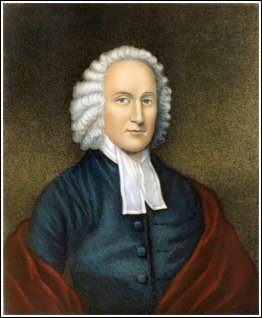
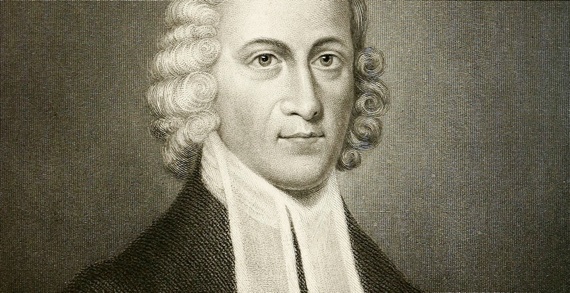
The Most High A Prayer Hearing God – Jonathan Edwards (1735)

jonathan-edwards

Psalm 65:2 is Edwards text in the winter of 1735, January 8.

O you who hears prayer, to you shall all flesh come.

Doctrine – It is the character of the Most High, that he is a God who answers prayer.

Four headings drive the sermon.

1. The Most High is a God that Hears Prayer

Though he is infinitely above all, and stands in no need of creatures; yet he is graciously pleased to take a merciful notice of poor worms in the dust.

Edwards argues that God not only accepts the supplications of all the saints; he does so willingly with favor.  He adds, “While they are praying, he gives them sweet views of his glorious grace, purity, sufficiency, and sovereignty; and enables them, with great quietness, to rest in him, to leave themselves and their prayers with him, submitting to his will, and trusting in his grace and faithfulness.”

2. He is Eminently Such a God

Edwards provides several examples of how God answers prayer:

  • In his giving such free access to him by prayer.
  • That God is eminently of this character, appears in his hearing prayer so readily.
  • That the Most High is eminently one that hears prayer, appears by his giving so liberally in answer to prayer.
  • That God is eminently of this character, appears by the greatness of the things which he hath often done in answer to prayer.
  • This truth appears, in that God is, as it were, overcome by prayer.

3. Reasons for the Doctrine

A crucial point that Edwards makes is that God answers prayer because “he is a God of infinite grace and mercy.”

  • He hath by his blood made atonement for sin; so that our guilt need not stand in the way, as a separating wall between God and us, and that our sins might not be a cloud through which our prayers cannot pass.
  • Christ, by his obedience, has purchased this privilege, viz, that the prayers of those who believe in him should be heard.
  • Christ enforces the prayers of his people, by his intercession at the right hand of God in heaven.

Application

Edwards draws out many practical applications, the chief of which alerts the saints to make good use of prayer; to be prayer warriors in this wicked age.

Seeing we have such a prayer-hearing God as we have heard, let us be much employed in the duty of prayer: let us pray with all prayer and supplication: let us live prayerful lives, continuing instant in prayer, watching thereuto with all perseverance; praying always, without ceasing, earnestly, and not fainting.

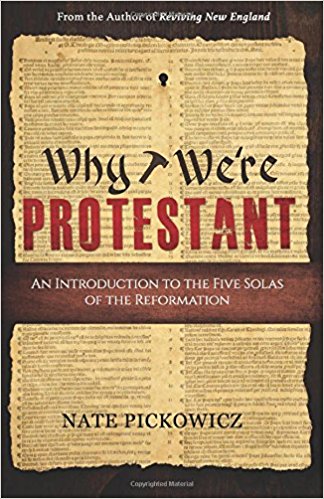
Why We’re Protestant – Nate Pickowicz (2017)

why we're prot

“Justification is the article upon which the church stands or falls.” So said Martin Luther as he battled for reform in the eye of the sixteenth-century storm that we know as the Protestant Reformation. The Reformers rediscovered the truth and beauty of the gospel message and proclaimed it faithfully and forcefully. Their allegiance to the gospel inform and inspire us as we strive to follow in their footsteps.

Nate Pickowicz beautifully summarizes the spirit of the Reformers in his most recent book, Why We’re Protestant: An Introduction to the Five Solas of the Reformation. First, the author clearly describes the “gospel crisis” that emerged in the sixteenth century. The crisis involves a fundamental disagreement on how sinners are justified. The answers proposed by Rome and the sixteenth century Protestants are clear. The answer proposed by Rome falls short of the biblical benchmark and leads sinners to a pathway of destruction. The Protestant reply is faithful to Scripture and leads sinners on a pathway to the Celestial City.

The essential message of the Reformation is captured in the five solas – grace alone, faith alone, Christ alone, Scripture alone, and to God alone be the glory. Pickowicz guides readers on a journey that unfolds these remarkable truths in a way that is winsome, historically accurate, and faithful to Scripture.

Why We’re Protestant is a veritable battering ram and a boon for the truth of the gospel of Jesus Christ. As we draw near to the five hundredth anniversary of the Reformation, I commend this fine work and trust that God will use it to fortify a new generation of reformers who exalt the person and work of the Lord Jesus Christ!

Preaching and Teaching With Imagination – Warren Wiersbe (1997)

Preaching and Teaching With Imagination is a book whose goal is to help preachers so proclaim the Word that the people who hear them will experience the power of God’s truth changing their lives.  It argues that biblical preaching must be accompanied by a vivid imagination.  It rejects the “conveyor-belt” mentality of dispensing knowledge which merely fills minds and notebooks.  Dr. Wiersbe writes, “We have forgotten that the bridge between the mind and the will is the imagination, and that truth isn’t really learned until it’s internalized.”

The book includes three major sections.  The first addresses imagination and life.  Here the author contrasts the communication styles of Hushai and Ahithophel.  Hushai is presented as one who speaks in pictures and addresses the imagination.  Ahithophel, on the other hand, is seen as a left brained, analytical thinker who communicates to the mind alone.  The argument is that preaching must help put pictures into the gallery of their minds which reveal the beauty of the Lord.

Section two deals with the numerous ways that Scripture communicates by way of imagination.  Word pictures are presented from Genesis to Revelation and give the preacher a better idea of how to use words creatively.  The key according to this section is to balance images with concepts.

Section three discusses the role the imagination can have on a variety of preaching settings including biographical and evangelistic preaching, funerals, holidays and special occasions.

Preaching and Teaching With Imagination is a very helpful book.  It encourages creativity and imagination without dismissing the crucial disciplines of exegesis, hermeneutics and biblical theology.  The irony is that many times in graduate school, students are discouraged from doing what Wiersbe is prescribing.  This book is balanced.  It encourages the preacher to present images along with concepts.  It emphasizes using words to turn ears into eyes so that people see the truth and in turn want their lives to change.  The documentation and extensive footnotes are extremely helpful.  Finally, Dr. Wiersbe’s book is about transformation.  It seeks to use preaching as a means of life change.

I Will: Nine Traits of the Outwardly Focused Christian (2015)

rainThom S. Rainer, I Will: Nine Traits of the Outwardly Focused Christian Nashville: B&H Publishing Group, 2015, 198 pp. $10.48

“I want hymns in the worship service.” “I want sermons that are practical and tug on my emotional apron strings.” “I want a slick youth program.” “I want the worship team to dress up.” “I want a quarterly business meeting.” “I want, I want, I want.” This is the lament of many twenty-first century Christians. It is a cry that has been informed by our consumer-based culture. It is an inward cry that makes a plea on the basis of personal preference.

That is the subject of Thom Rainer’s excellent little book, I Will: None Traits of the Outwardly Focused Christian. Rainer contrasts the inward pleas above with a response that is outward. Instead of “I want,” he urges Christians to begin with “I will.” “It is about learning how to have complete joy in your service through your church,” Rainer writes. “It is about becoming a fully functioning member of the body.

The author argues that right attitudes (“I am”) lead to right actions (“I will”). “Do nothing from selfish ambition or conceit, but in humility count others more significant than yourselves. Let each of you look not only to his own interests but also to the interests of others” (Phil. 2:3-4, ESV). Readers are therefore encouraged to commit to the following right actions:

  1. I Will Move From “I Am” to “I Will”
  2. I Will Worship With Others
  3. I Will Grow With Others
  4. I Will Serve
  5. I Will Go
  6. I Will Give Generously
  7. I Will Not Be a Church Dropout
  8. I Will Avoid the Traps of Churchianity
  9. I Will Make a Difference

There is nothing original here – just biblical admonition for Christ-followers who desire to make a maximum impact with their lives to the glory of God. Readers who are troubled by Rainer’s challenges should look deeply at their own motives and their commitment to the local church.

Personally, I was deeply encouraged by Rainer’s timely book. I Will is a reminder that a self-focused approach to Christianity will only do harm and discourage the household of faith. The nine traits that Rainer advances will serve the church well and prompt spiritual growth among the faithful flock of God.

I received this book free from the publisher. I was not required to write a positive review.

A Black-And-White Proposal: Farewell To Fuzzy Thinking

Donald Miller raises the banner for “fuzzy thinking” in a recent blog post entitled, “The Problem with Black-and-White Thinking” (re-posted on relevantmagazine.com).  His main thought: “Black-and-white, either-or thinking polarizes people and stunts progressive thought.”  Additionally, he holds that this kind of thinking stunts our “ability to find truth.”

DEFENDING THE GOOD IN MILLER’S PROPOSAL

Miller admits that there is such a thing as right and wrong.  He also admits the existence of absolute truth.  So Miller does not advocate full-fledged relativism.  For this, we can be thankful.  In fact, even though his posting is loaded with difficulties, Miller does include some helpful suggestions worth considering:

First, Miller suggests, “Disengage your ego from your ideas.”  This point is well taken because many times a particular view is so tied to one’s ego that it becomes virtually impossible to separate fact from fiction.

Second, Miller encourages, “Understand there is much you don’t understand.”  He rightly adds, “We begin to think in black-and-white when we assume we know everything.”  While he does not press the point of Christian humility (as he should – pardon the black- and white thinking), it seems to be a part of his overall argument.

Third, Miller seems to argue in essence, that charity and grace ought to be a part of conversations and even arguments.  This implied pointer ought to be a part of daily life, where conversations and arguments produce more light than heat and stimulate deeper thinking about a given subject.

DISMANTLING THE BAD IN MILLER’S PROPOSAL

There are four problems that emerge, including unwarranted assumptions that must be dismantled.

Black-and-White Thinking Demonizes the Opposition

Miller advances the common notion that black-and-white thinking is polarizing; a bad thing. Again, “Black-and-white, either-or thinking polarizes people and stunts progressive thought.”  He adds, “… We begin to believe whatever thought-camp we subscribe to is morally good and the other morally bad, thus demonizing a threatening position.”

But this is not necessarily the case.  One can advance a dogmatic view but do so in a humble, yet decisive way.  After gaining a hearing with the philosophers in Athens, Paul presents an argument that could be construed as black-and-white:  “The times of ignorance God overlooked, but now he commands all people everywhere to repent, because he has fixed a day on which he will judge the world in righteousness by a man whom he has appointed; and of this he has given assurance to all by raising him from the dead” (Acts 17:30, ESV).

Paul does polarize his audience.  Notice their response.  “Now then they heard of the resurrection of the dead, some mocked.  But others said, ‘We will hear you again about this'” (Acts 17:32).  The polarization that occurs is a necessary part of proclaiming the gospel message.  “For the word of the cross is folly to those who are perishing, but to us who are being saved it is the power of God” (1 Cor. 1:18, ESV).

Jesus employs a similar strategy when he confronts the Jews in John 8:  “Whoever is of God hears the words of God.  The reason why you do not hear them is that you are not of God” (v. 47, ESV).  Jesus does not demonize his hearers.  He merely tells them the truth.  Again, polarizing – but necessary.

These Jews maintained, “We are offspring of Abraham and have never been enslaved to anyone.  How is it that you can say, ‘You will become free?'” (John 8:33, ESV).  Jesus polarizes his Jewish audience when he says,”Truly, truly, I say to you, everyone who commits sin is a slave to sin” (John 8:34, ESV).  Oh, the horror of polarization!  But Jesus does not leave them without hope.  He adds, “So if the Son sets you free, you will be free indeed” (John 8:36).

I would argue that when people are polarized, this can prove to be very helpful. When a truth claim is presented, one either accepts or rejects the claim.  If one accepts the claim but disagrees, thoughtful dialogue may continue.  So instead of “stunting progressive thought” and “stunting our ability to think and find truth” as Miller claims, black-and-white thinking can actually lead to the discovery of truth.

Black-and-White Thinking Assumes Arrogance

Miller continues in his diatribe against black-and-white thinking:  “It [black-and-white thinking] allows us to feel intelligent without understanding, and once we are intelligent, we feel superior.  People who don’t agree with us are just dumb.”  Honestly, Miller’s charge may prove quite accurate at times.  It is true that black-and-white thinking may lead to arrogant behavior and a haughty spirit.  But this does not have to be the case.  One can embrace and promote a dogmatic view and do so in a spirit of gentleness and humility.  This much is demanded in the Scripture.

Scripture instructs believers to “speak the truth in love” (Eph. 4:15) and demonstrate compassion, kindness, humility, meekness, and patience with one another (Col. 3:12).  Additionally, God’s Word instructs believers to speak in a way that demonstrates gentleness and respect (1 Pet. 3:16).  Paul admonishes Timothy, “And the Lord’s servant must not be quarrelsome but kind to everyone, able to teach, patiently enduring evil, correcting his opponents with gentleness …” (2 Tim. 2:24-25a).  In other words, there is a place for admonition (which by the way requires black-and-white thinking).  But the admonition must be laced with gentleness and kindness.

For instance, Jesus says, “I am the light of the world.  Whoever follows me will not walk in darkness, but will have the light of life” (John 8:12, ESV).  What is Jesus saying here?  He graciously tells his listeners that if they reject his lordship, they will walk in darkness.  Again, he polarizes his audience but speaks the truth in love.  There is no hint of arrogance.  Indeed, this is the sinless Son of God! Jesus adds, “I told you that you would die in your sins, for unless you believe that I am he you will die in your sins” (John 8:24, ESV).

It is simply naive to automatically assume that black-and-white thinking inevitably leads to arrogance.  Christ-followers, then, must make truth claims with boldness and humility.  Recognizing the danger of pride and arrogance, they must season their words with grace and gentleness.  They must be winsome in their approach to communicating the truth.

Black-and-White Thinking Discourages Open Dialogue

This point is implied when Miller encourages people to walk away from a conversation that becomes characterized as black-and-white.  He says, “When the conversation becomes about defending one’s identity, it’s time to politely move on.”  He goes on to say that “these discussions go nowhere and don’t help me find truth.”  Miller unfairly draws a conclusion that black-and-white arguments result in “defending one’s identity.”  This is certainly a possibility – but is not inevitable.

A few years ago, Whoopi Goldberg and Joy Behar walked off their own set on The View when the conversation got heated with Bill O’Reilly.  They walked away from a black-and-white conversation as Miller encourages.  O’Reilly who was and is usually unashamedly black-and-white was construed as an uncaring and insensitive person, based on some comments he made about the 911 attacks.  Some would argue that Miller’s prediction came to pass; that O’Reilly’s strong stand was tied to his identity.   The fact is that when Goldberg and Behar made their exit, the dialogue stopped – and became even more heated and controversial.  Moreover, O’Reilly was not the only person on the set who promoted black-and-white thinking!

Black-and-White Thinking Assumes the Impossibility of Certainty

Built into the framework of Miller’s argument is at the very least, an implicit suspicion of certainty.  Since Miller admits the existence of absolute truth and since he rejects relativism, he must embrace that some truth is certain.   But where will this suspicion of certainty lead in the long run?

Some progressive-types may be tempted to hop on the postmodern bandwagon and condemn “certainty” as a worn out product of the Enlightenment (a position that is amusing because it is dripping with so much certainty!)

I am less concerned with Don Miller at this point.  He’s too smart to make absolute statements against absolute truth.  What concerns me is what some will do with his antipathy to black-and-white thinking. What concerns me deeply are those who take the next step into uncertainty because they have not examined the logic (or irrationality) of their presuppositions.  What concerns me is that full-fledged relativism is just around the corner.

John Piper sums up the essence of relativism: “No one standard of true and false, right and wrong, good and bad, or beautiful and ugly, can preempt any other standard.  No standard is valid for everyone” (Think: The Life of the Mind and the Love of God, 98).  This relativistic way of thinking is knocking on the door of the church and in some cases has already barged in.

DISTURBING ELEMENTS OF FUZZY THINKING

Fuzzy Thinking Does Not Work in the Real World

Fuzzy thinking will not fly when it comes to raising children: “Please be home by 10:00 p.m. or feel free to do whatever you want.”  Fuzzy thinking will not fly when a police officer stops you for speeding.  Fuzzy thinking doesn’t work very well at the bank.  It doesn’t work on the basketball court. And it certainly does not fare well on the operating table.  Fuzzy thinking will always lead to a bad grade in philosophy class (and every other course).  Fuzzy thinking cannot stand up to the brutal reality of absolute truth.

Fuzzy thinking didn’t work for Jesus either.  Imagine the difficulty in pointing sinners to the Father in John 14 if Jesus had employed fuzzy thinking.  He would have been forced to say, “I am one of the many ways to the Father.  Everyone gets to heaven so long as their motives are right.”  But instead, Jesus speaks in absolute, black-and-white terms: “I am the way, and the truth, and the life.  No one comes to the Father except through me” (John 14:6, ESV).  He not only makes an absolute truth claim concerning his identity; he utilizes a universal negative and makes it clear that “no one comes to the Father except through me.”

Jesus utilizes black-and-white thinking throughout his ministry.  Notice his absolute truth claims:

“Whoever believes in the Son has eternal life; whoever does not obey the Son shall not see life, but the wrath of God remains on him” (John 3:36, ESV).

“But whoever drinks of the water that I will give him will never be thirsty forever.  The water that I will give him will become in him a spring of water welling up to eternal life” (John 4:14, ESV).

“God is spirit, and those who worship him must worship in spirit and truth” (John 4:24, ESV).

“Truly, truly, I say to you, whoever hears my word and believes him who sent me has eternal life.  He does not come into judgment, but has passed from death to life” (John 5:24).

Fuzzy Thinking Does Not Work in the Pyre

If fuzzy thinking does not work in the real world, then it certainly does not work in the midst of persecution.  The martyrs of historic Christianity lived and died because of black-and-white thinking.

On his way to martyrdom, Ignatius wrote seven black-and-white letters that have proven to be very valuable documents to help our understanding of early Christianity.

When Polycarp faced execution for his Christian faith, the judge promised a quick release if Polycarp swore allegiance to the Emperor and vowed to curse Christ.  Polycarp responded, ““For eighty-six years I have served him, and he has done me no evil.  How could I curse my King, who saved me?”

When the judge threatened him with burning him alive, Polycarp simply answered that the fire that was about to be lit would only last a moment, whereas the eternal fire would never go out.  After Polycarp was tied to the post in the pyre, he looked up and prayed out loud: “Lord Sovereign God . . . I thank you that you have deemed me worthy of this moment, so that, jointly with your martyrs, I may have a share in the cup of Christ . . . For this . . . I bless and glorify you” (Justo L. Gonzalez, The Story of Christianity – Volume I, 39-48).

And consider the example of William Tyndale.  Tyndale courageously opposed anyone who quenched the work of the Spirit or despised God’s Word.   Again, Spirit enabled black-and-white thinking fueled his resolve.

One time a clergyman told Tyndale, “We are better without God’s laws than the pope’s.”  Tyndale’s black-and-white thinking prompted a decisive response: “I defy the Pope and all his laws; and if God spares my life, I will cause the boy who drives the plow in England to know more of the Scriptures than the Pope himself.”

Ignatius, Polycarp, and Tyndale held fast to the good (1 Thes. 5:21).  John MacArthur describes this imperative as “a militant, defensive, protective stance against anything that undermines the truth or does violence to it in any way.  We must hold the true securely; defend it zealously; preserve it from all threats.  To placate the enemies of truth or lower our guard is to violate this command.”

Fuzzy Thinking Minimizes the Role of Reason and Logic

Miller argues that black-and-white thinking would never make it “through the door of an undergraduate course in logic.”  Much to the contrary, the law of non-contradiction teaches us that a statement and its opposite cannot both be true at the same time and in the same sense.

Ron Nash reminds us, “The presence of contradiction is always a sign of error.  Hence, we have a right to expect a conceptual system to be logically consistent, both in its parts (its individual propositions) and in the whole.  A conceptual system is in obvious trouble if it fails to hang together logically” (Worldviews in Conflict, 55).

In other words, every worldview needs to be subjected to the law of non-contradiction.  When a contradiction emerges, the worldview must be abandoned.  Without black-and-white thinking, this worldview test passes by the wayside and discernment vanishes.

The root of this discussion concerning black-and-white thinking is tied to the formation of a worldview.   And in order for a worldview to be plausible, it must be able to be lived out in the real world.  Francis Schaeffer reminds us, “We must be able to live consistently with our theory” (The God Who is There, 121).

So in the final analysis, black-and-white thinking is not problematic.  Indeed, black-and-white thinking is not only philosophically tenable; it is an essential part of living the Christian life.  Without black-and-white thinking, it would be impossible to choose between two competing alternatives.  Without black-and-white thinking, theological and philosophical assertions would all receive equal acclaim, which is to say that truth at the end of the day is a matter of personal preference.

Whenever someone begins to back away from absolutes, reason and logic suddenly become unwelcome in the house of irrationality; a house that is destined to collapse under its own weight.  Peter Kreeft demonstrates the importance of logic: “If an argument has nothing but clear terms, true premises, and valid logic, its conclusion must be true” (Socratic Logic, 32).  Fuzzy thinking, however, tends to minimize the role of reason and logic, which at the end of the day proves not only unrealistic, but irrational.

Additionally, fuzzy thinking militates against the Law of the Excluded Middle.  James Nance and Douglas Wilson define this law: “Any statement is either true or false … it excludes the possibility of a truth value falling somewhere in the middle of truth or false” (Introductory Logic, xi).

Here’s the funny thing.  I am quite certain that Miller embraces these philosophical laws.  The problem is when he discourages black-and-white thinking, he unwittingly begins to whittle away at laws of logic which flow from the nature of God.  The downhill descent eventually leads to full-blown relativism.  Again, I am not concerned so much with Miller.  I am convinced that he would never go this route.  I am concerned, however, with those who are convinced by his arguments against black-and-white thinking.

DETERMINING A PROPOSAL REGARDING  BLACK-AND-WHITE THINKING

Donald Miller focuses on the so-called problems of black-and-white thinking.  I argue that Christian testimony and gospel witness will begin to erode to the degree that black-and-white thinking deteriorates.  Indeed, the essence of the gospel will erode to the degree we embrace fuzzy thinking.  Therefore, I submit the following proposal:

1. Black-and-White Thinking Should be Encouraged – Not Discouraged

Black-and-white thinking should be encouraged on biblical, philosophical, and practical grounds.  Sometimes, such thinking is criticized as “hair-splitting.”  Yet this black-and-white “hair-splitting” was indispensable as Athanasius challenged the arch-heretic, Arius.  This kind of thinking was a necessary part of formulating the doctrine of the Trinity and affirming the two natures of Christ; i.e. fully God and fully man.

Black-and-white thinking led to the formation of the major creeds and catechisms including the Apostles’ Creed, Nicene Creed, Chalcedonian Creed, the Heidelberg Catechism, and the Westminster Confession of Faith.

Black-and-white thinking should be encouraged.  For whenever black-and-white thinking is discouraged, the net result is theological error and irrationality.

2. Black-and-White Thinking is Essential to Christian Epistemology

Francis Schaeffer warned the church in 1968:  “We are fundamentally affected by a new way of looking at truth.  This change in the concept of the way we come to knowledge and truth is the most crucial problem facing America today” (The God Who Is There, 6).  In other words, “absolutes imply antithesis.”  The working antithesis is that God exists objectively (in antithesis) to his not existing.

The loss of antithesis (or repudiating black-and-white thinking) in American culture led to what Dr. Schaeffer coined the “line of despair” or giving up all hope of achieving a rational unified answer to knowledge and life.

So Christians must rise above the level of despair and affirm a Christ-saturated epistemology.  They recognize that truth is a unified whole.  They understand that there is no disparity between faith and reason.  In other words, faith and reason are not out of contact with each other.  They embrace what Nancy Pearcey refers to as “total truth.”

3. Black-and-White Thinking is Essential to Healthy Christian Living

Christ-followers who recognize that truth is unified understand this fundamental reality:  They know that black-and-white thinking is essential to the Christian life.  They recognize real good and real evil: “Ponder the path of your feet; then all your ways will be sure.  Do not swerve to the right or to the left; turn your foot away from evil” (Prov. 4:26-27, ESV).

Because Christians understand that “absolutes imply antithesis” they speak and live in terms of black-and-white:

“Whoever is steadfast in righteousness will live, but he who pursues evil will die.  Those of crooked heart are an abomination to the LORD, but those of blameless ways are his delight.  Be assured, an evil person will not go unpunished, but the offspring of the righteous will be delivered” (Prov. 11:19-21).

“Whoever speaks the truth gives honest evidence, but a false witness utters deceit” (Prov. 12:17).

4. There Should Be No Dichotomy Between Bold, Black-and-White Convictions and a Gracious Offering of Truth Claims

For instance, Jesus proclaims a series of woes on the Pharisees in Matthew 23.  His black-and-white thinking is actually stunning.  Yet at the end of chapter 23, we find him lamenting over Jerusalem: “O Jerusalem, Jerusalem, the city that kills the prophets and stones those who are sent to it!  How often would I have gathered your children together as a hen gathers her brood under her wings, and you would not!” (v. 37).

5. Black-and-White Truth Claims Should be Set Forth With Decisive Humility

On the one hand, Christ-followers must maintain their commitment to absolute truth claims.  They must do so vigorously and decisively.  They must boldly proclaim the truth in the marketplace of ideas.  And they must point to Christ, who is the essence of truth, apart from whom, knowledge is impossible.

On the other hand, Christ-followers must believe, proclaim, and defend black-and-white truth with Spirit-enabled humility: “But this is the one to whom I will look: he who is humble and contrite in spirit and trembles at my word” (Isa. 66:2b, ESV).  They must passionately proclaim truth “with all humility and gentleness, with patience, bearing with one another in love …” (Eph. 4:2, ESV).  And they must teach and defend the truth and embrace the framework of 2 Timothy 2:24.  “And the Lord’s servant must not be quarrelsome but kind to everyone, able to teach, patiently enduring evil, correcting his opponents with gentleness …”

SUMMARY

I hear what Don Miller is saying and I suspect that he’s concerned with Christ-followers who demonstrate less than loving behavior.  He would be right to be concerned.  Indeed, Christ is the most loving person that ever existed or will ever exist.  But Christ was also a black-and-white thinker.  The prophets were black-and-white thinkers.  The apostles were black-and-white thinkers.  And the martyrs were black-and-white thinkers.

Miller’s position could be construed to mean something like this: “We need less truth and more love and grace.”  I am quite confident that this is not his intention.  Similarly, my position could be construed to promote the following: “We need less love and more truth.”  Of course, this is not my argument either.  Rather, as Christians, we are called to both!  We are called to speak the truth – and we are called to engage in this ministry of proclamation with love, gentleness, and humility.

The funny thing is that Miller uses black-and-white thinking to argue against black-and-white thinking.  So at worst, his argument is self-refuting.  At best, perhaps there is hope for the future because, in the final analysis, Miller embraces black-and-white thinking after all!

If Miller is concerned primarily with the promotion of personal opinions, fine.  If he is concerned with soliciting dogmatic statements in gray areas that concern cultural matters like music and one’s choice of the best Italian restaurant, I have no quarrel.  But when it comes to matters of eternal significance, black-and-white thinking is essential.

We live in a world of absolutes.  And absolutes demand humble and decisive proclamation.  May Christians continue to proclaim and defend black-and-white propositional truth to the glory of Jesus Christ.  My black-and-white proposal: Farewell to fuzzy thinking!

“I know that truth stands and is mighty forever, and abides eternally, with whom there is no respect of persons.” – John Hus, Czech reformer, black-and-white thinker and martyr (1412)

Veritas et Lux!
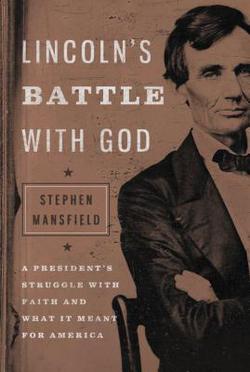
Lincoln’s Battle With God: A President’s Struggle With Faith and What It Meant For America (2012)

linStephen Mansfield, Lincoln’s Battle With God: A President’s Struggle With Faith and What It Meant For America Nashville: Thomas Nelson, 2012, 254 pp. $13.31

The sixteenth president of the United States is dearly beloved by conservatives and liberals alike. He is known for his exemplary leadership, uncompromising character, and love for liberty. Yet his approach to God and the Christian life is something that is either assumed or neglected altogether. Either option shows a certain amount of naivety and must be challenged. Stephen Mansfield’s book, Lincoln’s Battle With God: A President’s Struggle With Faith and What it Meant for America addresses this matter in a way that is educational and inspiring.

Mansfield presents Lincoln as one who was raised in a strict Calvinistic home which was discarded during his teenage years. During his legislative years in Illinois, he was referred to by friends and associates as the “infidel.” One friend spoke candidly about Lincoln’s early rejection of the Christian faith: “Lincoln denies that Jesus was the son of God as understood and maintained by the Christian world.”

Yet, when Lincoln began his bid for the White House, his antipathy toward historic Christianity appears to cool. In his earlier days, some considered him to be an atheist, yet as he progressed in politics, his worldview begins to shift. He is a man who as Mansfield writes, “believes in a God who exerts some degree of sovereign rule in human affairs … whatever the case, he appears to have emerged from his season of ‘infidelity’ and moved toward a less skeptical view of Christian truth.”

Pastor James D. Smith may have played an important role in Lincoln’s view of religion. Smith was a scholar in his own right and was welcomed by Lincoln for his rational approach to Scripture. He stood head and shoulders about some of the revivalists who were excessive in their methodology, not to mention their theological foibles. Whatever the case, Smith was convinced that Lincoln was converted under his ministry. “It is a very easy matter to prove,” writes Smith, “that while I was Pastor of the 1st Presbyterian Church of Springfield, Mr. Lincoln did avow his belief in the Divine Authority and Inspiration of the Scriptures.” Considerable debate has taken place and continues to this day whether or not Lincoln put his faith in Christ at this point.

But in 1850, Lincoln son Eddie grew ill and eventually died on February 1. Most agree that significant change in Lincoln’s worldview occurred during this time. Mansfield writes, “Had Lincoln become a Christian? We cannot know definitively. We do have reason to suspect, though, that something had changed in his ongoing battle with God … A process of spiritual broadening had clearly begun.”

The author continues to document the ongoing theological development in Lincoln and argues convincingly that a work of grace had likely taken place. Later speeches and letters force one to conclude that at the very least, Lincoln had turned a theological corner; at the very best, a true conversion had taken place. Much of Lincoln’s correspondence and especially his speeches give evidence of a truly converted man.

Lincoln’s Battle With God is an illuminating look at one of the most influential leaders in American history. Mansfield writes objectively and provides a depth of research that guides readers into the inner recesses of our 16th president’s heart. I commend Steven Mansfield for offering such a heartfelt book and encourage many to enjoy the fruit of his labor.

The Vanishing American Adult – Ben Sasse (2017)

sasseBen Sasse, The Vanishing American Adult New York: St. Martins Press, 2017, 306 pp. $16.75

Senator Ben Sasse is concerned. He is concerned about the next generation. To put it bluntly, Sasse argues in so many words that we are experiencing a crisis of maturity. Young people are being raised to be lazy, self-indulgent, ungrateful, and unproductive citizens.

The Vanishing American Adult by Ben Sasse focusses on “rebuilding a culture comprised of resilient, literate, thoughtful individuals.” Tragically, many Americans fail to achieve this high standard. In a fascinating twist of irony, one of the first reviews I read on Amazon (which incidentally rated this book with one star) weighed in: “Did not hold my attention. I got very bored.” Such a comment only heightens the appeal that Sasse makes and should prompt this reviewer to reconsider.

After brilliantly articulating our propensity to be passive, Sasse proposes five character building habits:

  1. Discover the body its potential and its frailty, and the many diverse stages of life that lie ahead – by breaking free of the tyranny of one generation.
  2. Develop a work ethic.
  3. Embrace limited consumption.
  4. Learn how to travel and to travel light.
  5. Learn how to read and decide what to read.

The author develops each character building habits and provides “stepping stones” at the conclusion of each chapter. Readers who participate will no doubt be encouraged and will likely take great steps to repudiate the prevailing passivity that dominates American culture.

The Vanishing American Adult is a much-needed corrective and will benefit many readers. The crisis that Senator Sasse presents is real and dangerous. Left unchecked, this crisis will lead to the the steady erosion of American culture and the loss of virtue. Thankfully, Sasse offer workable solutions to “stop the bleeding.” My hope is that many will listen, learn, and change. The future generations will thank us.

What Can a 509-Year Old Man Teach Us?

July 10, 2018 marks the 509th birthday of John Calvin.  But the streamers and balloons are nowhere to be found.  Simply put, we live in a day that is so wrapped up in technology and new inventions that we tend to forget the lessons of the past, especially the lessons of dead guy.

Calvin’s life was a pilgrimage that was characterized by God’s providential grace.  It was God’s providential grace that led him from place to place, equipping him for a lifetime of ministry.  It was God’s providential grace that sustained him during his period of exile and sheltered him through the storm.  It was God’s providential grace that empowered him to write and preach and shepherd the people of God for the glory of God.  It was God’s providential grace that brought Calvin “through many dangers, toils and snares.”  Indeed, it was God’s providential grace that rescued his soul from hell and seated him in the heavenly places in Christ Jesus” (Eph. 2:6).  And it was God’s providential grace that led Calvin to assume a particular posture that is best articulated in Isaiah 66:1-2.

Notice three things about the Genevan Reformer.  First, Calvin was a humble man.  C.J. Mahaney lays bare the heart of a humble man: “Humility is honestly assessing ourselves in light of God’s holiness and our sinfulness.”  And the Scriptures demand this kind of humility.  “Finally, all of you, have unity of mind, sympathy, brotherly love, a tender heart, and a humble mind” (1 Pet. 3:8, ESV).

Calvin was humble before his God.  He understood that he was a recipient of God’s grace (Rom. 3:24) and that he had been saved by grace alone, through faith alone, in Christ alone (Eph. 2:8-9).  Consequently, he understood that his only boast was in the cross-work of Christ (1 Cor. 2:2; Gal. 6:14).  Calvin understood the absolute contrast between the sinfulness of man and the majesty of God, what many have referred to as the Creator-creature distinction.  He writes, “Men are never duly touched and impressed with a conviction of their insignificance until they have contrasted themselves with the majesty of God.”

Calvin was humble before people.  He understood that humility is the foundation of Christian character.  The libertines of the 16th century were naming their dogs after Calvin – but Calvin remained humble despite the hatred hoisted upon him.  Calvin opines, “I have always been exceedingly delighted with the words of Chrysostom, ‘The foundation of our philosophy is humility’ and still more with those of Augustine.  If asked, ‘What are the precepts of Christianity?’ I will answer, ‘First, humility, second and third humility.”

Second, Calvin was a contrite man.  The contrite is one who is “stricken, smitten, or crushed in spirit.”  John Calvin was a man of Christ-exalting contrition.  His contrition was Christ-exalting because he knew that Christ was the One he had offended and that Christ alone could free him from his sin.  No work could forgive him, no prayer could forgive him; no priest could forgive him.

As beneficiaries of the Protestant Reformation, this is a truth we too often take for granted.  Even worse, some professing Evangelicals have begun to subtly fall under the spell of the Roman Catholic Church and either forget free grace or ignore it all together.  Perhaps it is time for a new Reformation; a radical rekindling of the precious truths that drove Calvin, Luther, Zwingli, and Knox to their knees in contrition as they celebrated the free grace that was theirs in Christ alone!

Third, Calvin trembled at God’s Word.  He revered the truth of God’s Word.  Steve Lawson adds, “Calvin stood firmly on the chief cornerstone of the Reformation – sola Scriptura, or ‘Scripture alone.’  He believed Scripture was the verbum Dei – the Word of God – and it alone should regulate church life, not popes, councils, or traditions.  Sola Scriptura identified the Bible as the sole authority of God in His church, and Calvin wholeheartedly embraced it, insisting that the Bible was the authoritative, inspired, inerrant, and infallible Word of God.”

Calvin responded to the truth of God’s Word.  He was a sinful man who had a heart that desperately sought to respond obediently to the Word of God.  To that end, he preached the Word of God faithfully with all the passion he could muster!

Calvin rejoiced in the truth of God’s Word – even difficult doctrines.  He rejoiced in difficult doctrines like predestination and conscious eternal punishment.  He rejoiced in mysterious doctrines like the Trinity and the hypostatic union.  And he rejoiced in paradoxical doctrines like the sovereignty of God and the responsibility of man.

So what can a 508-year-old man teach us?

Calvin understood that people are transformed by truth

We live in an age where technique is king and pragmatism is queen.  The church has fallen prey to this vicious cycle.  We tend to do what works and invest in what brings results.  Steve Lawson writes, “The church is always looking for better methods in order to reach the world.  But God is looking for better men who will devote themselves to his biblically mandated method for advancing his kingdom, namely, preaching – and not just any kind of preaching, but expository preaching.”  In a day when preaching is being downplayed and theology is being ignored, we need to remember what Calvin understood, namely, people are transformed by truth.

Calvin understood and modeled the need for courage in times of adversity and persecution

Calvin lived in a time when Protestants were being burned at the stake because they were being transformed by the truth.  He was committed to boldly proclaiming the truth no matter what the cost.    Calvin adds, “If, while conscious of our innocence, we are deprived of our substance by the wickedness of man, we are, no doubt, humanly speaking, reduced to poverty; but in truth our riches in heaven are increased: if driven from our homes, we have a more welcome reception into the family of God; if vexed and despised, we are more firmly rooted in Christ; if stigmatized by disgrace and ignominy, we have a higher place in the kingdom of God; and if we are slain, entrance is thereby given us to eternal life.  The Lord having set such a price upon us, let us be ashamed to estimate ourselves at less than the shadowy and evanescent allurements of the present life.”

Calvin reminds us of the sinfulness of humans and the utter need for God’s grace

The flaws in Calvin himself remind us of the sinfulness of sin.  He was deeply aware of his own sin.  But he was also acutely aware of the reality of grace.  His life bears witness to this: He was simul iustus et peccator – simultaneously righteous and sinful..

Calvin reminds us what one man on a mission can accomplish in Christ’s strength

My good friend and colleague, Pastor Wayne Pickens rightly says, “God uses people to reach people.”  God used an ordinary man for an extraordinary purpose.  Or as David Hall writes, “A single man with heart aflame changed the world.”

Calvin reminds us of the sufficiency of Christ and his work on the cross for sinners

The cry of Calvin’s heart was the Lord Jesus Christ.  He constantly pointed sinners to Christ and his cross.

May the life of John Calvin serve as an inspiration to live the Christian life with vibrancy to the glory of God.  May his courage embolden each of us in the difficult days ahead.  When the days grow dark, persecutions escalate, and our freedoms begin to erode, may we remember the motto still etched in Genevan stone, “post tenebras lux,” after darkness light.  May his humility, contrition, and trembling before the Word of God mark our lives as well.  And may the contemporary pulpit be a reflection of Calvin’s pulpit; may men of God stand behind the sacred desk and faithfully deliver to unchanging truths of Scripture so that saints might be strengthened, edified, convicted, encouraged, and equipped!

Calvin agrees, “Let them edify the body of Christ.  Let them devastate Satan’s reign.  Let them pasture the sheep, kill the wolves, instruct and exhort the rebellious.  Let them bind and loose, thunder and lightning, if necessary, but let them do all according to the Word of God.”

The Preciousness of Time – Jonathan Edwards (1734)

Time is a precious commodity that must be treasured.  Such is the argument in jonathan-edwardsJonathan Edward’s piece entitled, The Preciousness of Time and the Importance of Redeeming It.

The subject of time was no stranger to Edwards.  He thought about the “improvement” of time often.  Even in his famous 70 resolutions, he addressed the matter of time.

Resolution # 5

Resolved, never to lose one moment of time; but improve it the most

profitable way I possibly can.

It would serve us well, then, to consider the precious matter of time from Jonathan Edwards’ perspective.

Section 1: Why Time is Precious

Jonathan Edwards states four reasons why time is precious.

  1. Because a happy or miserable eternity depends on the good or ill improvement of it.
  2. Time is very short, which is another thing that renders it very precious.
  3. Time ought to be esteemed by us very precious, because we are uncertain of its continuance.
  4. Time is very precious, because when it is past, it cannot be recovered.

Edwards argues in respect to to time, “…When once that [time] is gone, it is gone for ever; no pains; no cost will recover it.”  So typical is this eternal perspective that flows so freely from the pen of the Northampton preacher.  Tragically, many Christ-followers are not following the counsel of this godly man as they squander their time with worldly pursuits.  He reminds us, “Eternity depends on the improvement of time; but when once the time of life is gone, when once death is come, we have no more to do with time; there is no possibility of obtaining the restoration of it, or another space in which to prepare for eternity.”

Section 2: Reflections of Time Past

In section 2, Edwards encourages believers to reflect on time which has been granted in order to prepare for eternity.  Indeed, the argument goes, “Your future eternity depends on the improvement of time.”  He challenges readers, “How have you let the precious golden sands of your glass run?”

Section 3: Who Are Chiefly Deserving of Reproof From the Subject of the Preciousness of Time

Edwards begins section three with a discussion of how people waste their time: “There is nothing more precious, and yet nothing of which men are more prodigal.”  He demonstrates the kinds of people are who reproved for their negligence in this area.

  1. Those who spend a great part of their time in idleness.
  2. They are reproved by this doctrine who spend their time in wickedness, who do not merely spend their time in doing nothing to any good purpose, but spend it to ill purposes.
  3. Those are reproved by this doctrine, who spend their time only in worldly pursuits, neglecting their souls.

Section 4: An Exhortation to Improve Time

“Time is money.”  So goes the conventional wisdom of the day.  Edwards essentially agrees as he argues, “If you have a right conception of these things, you will be more choice of your time than of the most fine gold.”  He exhorts readers with four  bold propositions:

  1. You are accountable to God for your time.
  2. Consider how much time you have lost already.
  3. Consider how time is sometimes valued by those who are come near to the end of it.
  4. Consider what a value we may conclude is set upon time by those who are past the end of it.

Section 5: Advice Respecting the Improvement of Time

Edwards concludes his piece by offering three encouragements with respect to time.

  1. Improve the present time without any delay.
  2. Be especially careful to improve those parts of time which are most precious.
  3. Improve well your time of leisure from worldly business.

The notion of “improving” time is seen throughout the writings of Jonathan Edwards.  He gave a great deal of thought to it and chose to live wisely in light of his discoveries.  Indeed, Jonathan Edwards sought to “live with all his might unto the Lord.”  By God’s grace he accomplished resolution # 5: Resolved, never to lose one moment of time; but improve it the most profitable way I possibly can.

“Therefore, spend not such opportunities unprofitably, nor in such a manner that you will not be able to give a good account thereof to God.  Waste them not away wholly in unprofitable visits, or useless diversions or amusements.”

– Jonathan Edwards


Reset: Living a Grace-Paced LIfe in a Burnout Culture (2017)

resetDavid Murray, Reset: Living a Grace-Paced Life in a Burnout Culture. Wheaton: Crossway Books, 2017, 208 pp. $10.86

Have you ever wondered what it would be like to step into the ring with Sugar Ray Leonard or Ray “Boom Boom Mancini? David Murray may be a self-described soccer player but in his most recent book, Reset: Living a Grace Paced Life in a Burnout Culture, the pastor/theologian puts on the boxing gloves and dishes out a series of blows. The unsuspecting reader would expect these “jabs” to result in pain and dejection. But nothing could be further from the truth.

Each “punch” in Murray’s book is unleashed with a motivation of biblical instruction and grace. While the “jabs” may sting initially, thoughtful readers will come to terms with the author’s overall strategy, which is to encourage Christian men to slow down and drink in the pure waters of free grace.

Murray identifies the latent legalist that resides in every follower of Christ, that part that desires credit for a job well done, points for faithfulness in ministry, or adulation for efforts expended in the kingdom of God. The solution, of course, is grace.

Grace runs through of the remaining chapters that focus on everything from leading with humility in the home and the local church to practical things like spiritual disciplines, time management, diet, and exercise.

Several features captured my attention and as a result moved my affections.

Biblical

First, and foremost, Murray’s work is biblical. Anyone familiar with his ministry will not be shocked by this revelation. The wisdom of sacred Scripture saturates the principles presented and drives an agenda that is uniquely God-centered.

Transparent

The author does not write from an ivory tower. Rather, he walks with fellow pilgrims as a man who struggles with indwelling sin and faces daily challenges that require carefully formulated and biblical responses. Murray’s transparency is one of the great strengths of the books and will no doubt convince his readers to follow his lead.

Practical

Third, Reset is practical. Murray offers a host of timeless principles that encourage robust Christian living and not only help recalibrate weary soldiers but also revitalize the most burned out Christian leaders.

Gospel-Centered and Grace-Saturated

Finally, Rest is God-centered. I poured over this book in one day and was encouraged and uplifted. Yes, at times I felt the sting of the “punch.” But each blow that Murray delivers is laced with grace and seasoned with the love and wisdom of a seasoned shepherd.

There is so much to commend here. My hope is that many men will be built up and emboldened to continue the Christian race with passion, power, and conviction.