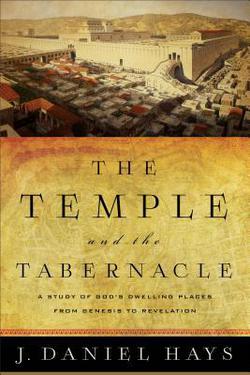
The Temple and the Tabernacle – J. Daniel Hays

J. Daniel Hays, The Temple and the Tabernacle: A Study of God’s Dwelling Places From haysGenesis to Revelation Grand Rapids: Baker Books, 2016, 208 pp. $11.89

A good book review will help readers determine the good, the bad, and the ugly in a given title. There is nothing bad or ugly in J. Daniel Hays’ new work, The Temple and the Tabernacle. In fact, describing the contents of this book as “good” would be a massive understatement. Dr. Hays sets out to explore the majesty and importance of the dwelling places of God. Beginning in the Old Testament, the author works he way to the culmination of Redemptive history where we find the people of God gathered before his throne, worshipping him in the new heavens and the new earth.

A Brief Synopsis

Six features make The Temple and the Tabernacle especially noteworthy.

First, this is an absolutely beautiful book. The pages are high quality and high-quality photographs and artwork are seen throughout, illustrating different facets of the temple and the tabernacle.

Second, this work is written with different learning levels in mind. Everyone from first year Bible students to seasoned pastors will benefit from the clear writing, throughout.

Third, this work adheres to the testimony of Scripture. The author is careful to cling to the biblical record as he unpacks the various aspects of the temple and the tabernacle.

Fourth, this work explains the big picture, without discounting the details. Hays notes, “Remember that the whole point of building the tabernacle is to create a proper place for the presence of God to dwell in the midst of his people and to travel with them.”

Fifth, this work is Christ-centered. In a book like this, it would be easy to get caught up in the minutia by focusing on the finer elements of the temple and tabernacle. The author does spend a considerable amount of time helping readers understand these things. But as he observes at the beginning of the book, “We want to move beyond the ‘stones’ to grasp the eternal theological truths being revealed to us about God through his presence in the temple/tabernacle.”

The author clearly describes the distinction between an Old Testament economy and the beauty of the new covenant:

“The system of encountering the presence of God that Christ inaugurates is superior to the old tabernacle system at every point. His one perfect sacrifice eliminates the need for any more blood sacrifices, and through this sacrifice Christ provides perfect cleansing for his people, declaring them to be completely ‘holy’ before God … Thus the sacrifice of Christ and the new covenant that he inaugurated enable Christians today to encounter the presence of God in worship and service in a direct manner. He dwells inside each of us.”

Finally, this work exalts God in his majestic holiness. Readers will immediately be struck with awe as they encounter the Old Testament portrait of God, learn of his absence due to Israel’s apostasy, and filled with wonder as they come face-to-face with Jesus in his return to the temple. The author notes, “When the second temple is built, first during the time of Haggai and then by King Herod the Great, there is no mention of the return of the presence of God to dwell in the temple. The presence of God does not return to the temple until Jesus Christ walks through its gates.”

The Temple and the Tabernacle is a book I’ve waited for since my days as a Bible College student. The scholarship is impeccable, and the high points of the Christian worldview appear throughout. Readers will be encouraged as they are reminded of the great reality of the temple and tabernacle. But more than this, they will be motivated to worship God in all his holiness.

I received this book free from the publisher. I was not required to write a positive review.
Release the Prisoners!


Andy Farmer, Trapped Greensboro: New Growth Press, 2016, 180 pp. $17.99

Thousands of Americans flock to Alcatraz, the penitentiary in San Francisco Bay. Of course, this intimidating fortress has since closed its doors to violent criminals and lawbreakers. Brave guests may choose to stand for a few moments in one of the tiny cells and imagine what it would be like to be locked up for years and possibly even serve a life sentence.

Imagine being incarcerated for a moment. Your freedoms would be severely curtailed. Your abilities would be stifled. Your options would be limited. Such is the life of an inmate.

While some may imagine the horror of being detained for an indefinite period of time, thousands of people experience this every day. A multitude of people live in a self-imposed prison – in bondage to eating disorders, pornography addiction, substance abuse and a host of other activities that leave them hopeless and discouraged.

Andy Farmer addresses the real problem of addiction in his new book, Trapped. The subtitle, Getting Free From People, Patterns, and Problems accurately describes the heart of this author as he offers hope and freedom to people who would otherwise continue to live in a prison house of sin and shame. Indeed, the purpose of the book is to point readers to a redemption story that can set them free.

The author presents several real life examples of people who face a self-imposed prison. He argues that redemption is possible; that hope is possible as people turn to Christ for deliverance.

Real redemption, Farmer suggests is:

  • Freedom from the curse of the Law (Gal. 3:13).
  • Freedom from slavery to sin (John 8:34).
  • Freedom from the sentence of death (Rom. 7:4-6).
  • Freedom from the guilt of our trespasses and sins (Eph. 1:7).
  • Freedom from the oppression of Satan (Heb. 2:15).
  • Freedom from the deceptive snares of the world (2 Peter 2:18-21).

Redemption, according to Farmer is “a holy freedom.” He adds, “The Bible gives us the wonderful news that we weren’t simply redeemed from sin, we were redeemed for God. We have been brought out of sin into the gracious and loving reign of our Redeemer King.” So true freedom is not a commitment to autonomy; rather true freedom delights in living for God and glorifying God!

This God-glorifying approach to life runs counter to the therapeutic model and secular approaches to counseling. The God-glorifying model in this book encourages weary travelers to embrace the grace of their freedom, embrace the identity in their freedom, and embrace their calling in their freedom.

Ultimately, the author seeks to lead imprisoned people out of their traps. The topic of addiction is addressed from a biblical perspective. Addiction is presented as a “full-bodied worship of an idol that controls and defines its subject.” Farmer shows how the “gospel of redemption is the only treatment that brings the power, change, and hope that can transform broken addicts into whole-hearted worshippers of God.”

Summary

There is much to commend here. At least three features make the book a necessary tool on every pastor’s shelf and every biblical counselor’s desk:

First, the book presents a realistic look at addiction from a seasoned pastor. Farmer acknowledges the pain of addiction, the guilt of addiction, and the bondage of addiction.

Second, the book includes a robust treatment that is Bible-saturated and gospel-centered from start to finish. When so many are rushing to the local counselor or therapist for worldly advice, Trapped offers real help that is grounded in godly wisdom.

Finally, the book is grace-enabled. The author is quick to point readers to the all-sufficient grace of God: “God promises that as you walk that way, he will give grace for change, light for the path, and mercy for stumbles along the way.”

My prayer is that Trapped will be an encouragement to many people; that they will experience the life-transforming effects of the gospel. May many prisoners find their freedom in Christ and be delivered from their bondage forever.  So release the prisoners! “For freedom Christ has set us free …” (Gal. 5:1a).

I received this book free from the publisher. I was not required to write a positive review.
Resting in Free Grace – Resisting the Free Grace Movement

grudem

Wayne Grudem, Free Grace Theology: How Free Grace Diminishes the Gospel. Wheaton: Crossway, 2016, 160 pp. $11.42

Theological disputes have a tendency of generating more heat than light. The controversy surrounding the so-called Free Grace movement is no exception. Ever since the landmark book by John MacArthur was published, The Gospel According to Jesus, competing camps have vigorously fought to maintain their ground. Indeed, both positions including the Free Grace view and the so-called Lordship position have fought as if their lives depended upon it.

But the debate did not find its genesis in the musings of John MacArthur. The debate is as old as the Protestant Reformation itself. The age-old questions remain: How does a sinful person stand in the presence of a holy God? On what basis is this sinner justified? What role (if any) do works play at the moment of justification? Is sanctification a necessary component of the Christian life? And, are works a necessary result of justification?

Disheartened, discouraged, and dismayed. These three terms do not adequately describe my thoughts about the initial reviews of Wayne Grudem’s new book, Free Grace Theology: 5 Ways It Diminishes the Gospel. One review observes, “Wayne Grudem is a Reformed Calvinist, so his views are skewed through Calvinist lenses.” The initial reviews fail to show any degree of constructive interaction with the book. One wonders if these early reviewers even bothered to read the book.

The Free Grace movement, whose primary tenets are found in Zane Hodges book, Absolutely Free. In that book, Hodges maintains,

… Lordship thought abandons the straightforward meaning of the word ‘believe’ and fills the concept of saving faith with illegitimate complications. The result is that the saving transaction is made much more complex than it actually is. But salvation really is simple and, in that sense, it is easy. After all, what could be simpler than to ‘take the water of life freely.’

The primary tenets of the Free Grace movement include:

  • A two-tiered discipleship, or two classes of believers, those who believe but do not follow Christ and those who believe and cast all their hope and future on Christ.
  • No calls to repentance in evangelism.
  • Giving assurance to people who are backslidden or have denounced the Christian faith.
  • Rejecting the notion that good works accompany justifying grace.

Dr. Grudem’s primary contention is that the New Testament clearly teaches two principles which stand in opposition to the Free Grace movement:

  1. Repentance from sin (in the sense of remorse for sin and an internal resolve to forsake it) is necessary for saving faith.
  2. Good works and continuing to believe necessarily follow from saving faith.

Grudem’s arguments against the Free Grace movement are summarized below:

First, the Free Grace movement misunderstands the doctrine of justification by faith alone and as a result, fails to truly teach the doctrine that Luther said, “is the doctrine upon which the church stands or falls.”

Second, the Free Grace movement undermines the gospel by refusing to require repentance in the proclamation of the gospel.

Third, the Free Grace movement offers false assurance to people who make a profession of faith, but may in the final analysis not possess saving faith.

Fourth, the Free Grace movement fails to emphasize the fiducia component of faith, that is, a personal trust or adherence to Christ.

Fifth, the Free Grace movement embraces interpretations that are highly unlikely.

These arguments against the Free Grace movement are further explained in the five chapters of the book. My own view is that Dr. Grudem has succeeded in successfully refuting this movement. He should be commended for the gracious tone throughout this work. He does engage in rigorous polemic but does so without caricaturing his opponents. While he argues strenuously against the Free Grace movement, he admits it is not a false gospel. However, it is a diminished gospel.

Some may argue that the so-called Lordship controversy (a term that Grudem dislikes) is over. However, nothing could be further from the truth. The Free Grace movement continues to influence people and diminish the gospel. Wayne Grudem’s excellent work is a needed corrective and a gracious response to a troubling trend.

I received this book free from the publisher. I was not required to write a positive review.
 

The Bride(zilla) of Christ

kluckTed Kluck & Ronnie Martin, The Bride(zilla) of Christ: What To Do When God’s People Hurt God’s People. Colorado Springs: Multnomah Books, 2016. 198 pp. $10.15

Anyone familiar with the writing of Ted Kluck knows that he’s an expert at keeping real, sharing from the heart, and applying the truth of the gospel to everyday living. In his new book, The Bride(Zilla) of Christ, Kluck teams up with Ronnie Martin to answer an important question that is also the not so subtle sub-title of the book: What To Do When God’s People Hurt God’s People.

Both authors have a fair amount of experience in the local church and have many stories to tell. Anyone who has been around the church for any length of time will no doubt, have similar stories to tell. Honest people will admit that some of these stories are bad ones: Church splits, gossip, adultery, division, and a host of other sins have a tendency to emerge in the church, just like any organization.

Kluck and Martin write from different perspectives – but are both settled in the fact that the gospel speaks to every hurt. It is the gospel that has the power to reconcile severed relationships. And most of all, the gospel reconciles a holy God with a sinful people.

Writing a fair and honest review is difficult for me because I have been a big fan of Ted Kluck for several years now. Having said that, I must admit that the book is written in a rather haphazard way. Perhaps the intent was to write a book from the heart that didn’t read like a theological treatise. If that’s the case, mission accomplished.

The “scattered feel” of the book does not, however, detract from the overall message. Kluck and Martin clearly describe some of the church hurts and heartaches but are quick to prescribe the healing balm of the gospel.

A few quotes made the book worth reading for me. My hope is that these citations will motivate readers to give the book at try:

“Every time we use our hurt as a reason to disconnect, isolate, disassociate, or abandon, we’ve not understood the forgiveness we have in Christ and how it needs to manifest itself to others.”

“Whenever we let our minds gravitate to the heart that’s been leveled at us, we are simultaneously forgetting the hope that Christ extended to us on the cross.”

“The shocking thing to come to grips with is that we’re not any better than the people who have hurt us, even when that hurt has been a one-way bullet fired right into our heart.”

What stands out in this work is the hope that Christ offers us in the gospel. Kluck and Martin should be commended for writing such a transparent book that has the power to encourage many people. Their book is recommended, especially for pastors who have endured a “dark night of the soul” or had the unpleasant experience of being beaten up by the sheep.

I received this book free from the publisher. I was not required to write a positive review.

What Christians Ought to Believe – Michael Bird (2016)

Michael F. Bird.  What Christians Ought to Believe: An Introduction to Christian Doctrine creedThrough the Apostles’ Creed.  Grand Rapids: Zondervan, 2016. 237 pp. $18.99

What Christians Ought to Believe by Michael F. Bird examines the Apostles’ Creed and guides readers step-by-step through this important document.

In chapters 1 and 2, the author highlights the importance of creeds. He notes, “The creeds constitute an attempt to guide our reading of Scripture by setting out in advance the contents and concerns of Scripture itself. The creeds provide a kind of ‘Idiot’s Guide to Christianity’ by briefly laying out the story, unity, coherence, and major themes of the Christian faith. In that sense, a creedal faith is crucial for a biblical faith and vice versa!”

The author highly commends the Apostles’ Creed and notes that it contains the essential elements of the Christian faith: “If you ask me, the Apostles’ Creed is probably the best syllabus ever devised for teaching basic Christian beliefs … The Apostles’ Creed is basically a bullet-point summary of what Christians believe about God, Jesus, the church, and the life to come.”

Michael Bird brilliantly not only sets for the case for the Apostles’ Creed; he does so in a winsome and understandable way. The author teaches the Creed, line by line, drawing the attention of the learner to our final standard of truth – sacred Scripture.

While much of the book is encouraging and worthy of commendation, the chapter which unveils the atonement is disappointing. Bird rightly introduces readers to the various views of the atonement and provides a basic definition for each view. However, he stumbles by not advocating penal substitutionary atonement. Bird writes, “My exegetical-theological intuition is to gravitate toward the victory theory (Christus victor) as the integrative model for the atonement since it effectively combines the motifs of recapitulation, representation, ransom, sacrifice, and triumph.” I urge readers to study Pierced For Our Transgressions, edited by Steve Jeffery, Michael Ovey, and Andrew Sach for a better look at this matter.

Overall, however, this work is a wonderful look at the Apostles’ Creed and should be welcomed by evangelicals. Teachers will find this resource to be a helpful tool in the classroom and parents are encouraged to use this book in discipleship for budding disciples.

I received this book free from the publisher. I was not required to write a positive review.
BOLD REFORMERS REFUSE TO COMPROMISE THE TRUTH

IMGP0693My grandfather, the late Rev. V.W. Steele, used to say, “Never compromise the truth.” “Don’t ever sell you soul for a mess of pottage,” Grandpa would surmise, with fire in his eyes. He understood the deadly influence of compromise, which plagued the church in his generation. He saw the crippling impact of liberalism, which waged war against the Bible and stifled the people of God. Few people listened to V.W. Steele’s counsel. Even fewer are listening today. So, compromise continues to make inroads in the lives of God’s people, in the local church, and in mainstream culture.

The Trauma of Compromise

Compromise is traumatic because it wreaks havoc on our lives. “The human spirit,” David Wells writes, “is now being moved not by profound thinking but by the experience of living in a metropolis presided over by bureaucracy, tranquilized by television, awash with the racket of closing cultures.”1 The end result of compromise is a suffocated church which is producing spiritual weaklings, unable to discern and powerless to make a difference in our world.

Explanation of Compromise

Compromise is a lowering of standards. It is, as the New Oxford American Dictionary defines it, a matter of accepting “standards that are lower than is desirable.” Such a move is not in keeping with historic Christianity. Indeed, compromise fails to honor the living God.

Compromise is a gradual erosion of what was once cherished. Typically, this deterioration is slow moving; it does not take place overnight. Rather, it is an imperceptible steady decline, which may not even be recognizable until it is too late. Like ocean waves that slowly chip away at the shores on a beautiful beach, so too, does compromise gradually erode the professing Christian who gives in to its demands.

Compromise is a cowardly pursuit. This mindset places higher regard for comfort and pleasure than the truth of God’s Word. This cowardly pursuit may feel right initially, but it eventually leads to a life of misery (Ps. 1:5-6).

Compromise is ungodly. It is man-centered. It placates and caters to the flesh. It is opposed to the things of God. In our generation, compromise is viewed as a strength instead of a vice. John MacArthur observes, “Compromise has become a virtue while devotion to the truth has become offensive.”2 Compromise is viewed as a necessary and strategic move in a pluralistic society. Compromise may look right, but if left unchecked, it always leads to disaster. The Scripture warns, “There is a way that seems right to a man, but is end is the way of death” (Prov. 16:25).

The Trial of Luther

Martin Luther understood the paralyzing effects of compromise. He saw how compromise slithered its way into the fabric of the church and began to devour the gospel, verse-by-verse and line-by-line. He witnessed how compromise in the priesthood eroded the integrity of the church from the inside out. Luther’s pilgrimage to Rome awakened him to the compromise that plagued the church. Martin Marty notes, “He expressed shock at the chaos, the filth, and the practices of locals who urinated in public and openly patronized prostitutes.”3 He watched with horror as the church he loved grew more and more like the world.

Luther never dreamed he would experience such wanton excess and sinfulness as he made his way to the holy city: “When I first saw Rome, I fell to the ground, lifted my hands, and said, ‘Hail to thee, O holy Rome.’” That impression quickly dissolved, however. He continued, “No one can imagine the knavery, the horrible sinfulness and debauchery that are rampant in Rome.”4 In Luther’s mind, the die was cast. And a new context emerged; a context that would set the stage for the Protestant Reformation.

Traits of a Person Who Refuses to Compromise the Truth

Like Luther, the apostles in the first-century church were swimming against the cultural tide. In Acts 5, their boldness landed them in prison (v. 18). But God performed miracles to advance his sovereign purposes: “But during the night an angel of the Lord opened the prison doors and brought them out” (Acts 5:19).

God instructs these men to preach the gospel: “Go and stand in the temple and speak to the people all the words of this Life” (Acts 5:20). Two imperative verbs appear in verse 20. God commands the apostles to “go” (poreúomai). And God commands these men to “speak” (laléō). Both verbs are written in the present tense, which suggests ongoing action, an unceasing ministry of proclamation – despite the persecution they will continue to face.

The response of the apostles is recorded in verse 21: “And when they heard this, they entered the temple at daybreak and began to teach. Now when the high priest came, and those who were with him, they called together the council, all the senate of the people of Israel, and sent to the prison to have them brought” (Acts 5:21). The apostles respond with obedience, decisiveness, and bold resolve. The apostles were bold reformers!

When confronted by the officials, the response of the apostles is consistent with God’s command: “The God of our fathers raised Jesus, whom you killed by hanging him on a tree. God exalted him at his right hand as Leader and Savior, to give repentance to Israel and forgiveness of sins” (Acts 5:30–31).

But pay close attention to the guiding principle that precedes the response of these bold reformers: “But Peter and the apostles answered, “We must obey God rather than men” (Acts 5:29). The Greek word translated “obey” (peitharchéō) means to trust or obey with confidence. That is to say, the apostles placed supreme faith in the living God, so much that they were willing to obey God from the heart. This brand of bold obedience is prepared to endure the consequences and glorify God, even to the point of death.

What are the defining features of a bold reformer who refuses to compromise the truth? What unshakeable and unbreakable principles will guide bold reformers down a path that stands strong and steadfast before God?

A bold reformer is committed to the truth of the gospel

Bold reformers do not read the opinion polls. They do not canvas the neighborhood to see what people are interested in hearing. They do not smooth out the rough edges of the gospel in order to gain a wider hearing. They listen to God’s Word; they obey God’s Word; they surrender to the lordship of Christ. Bold reformers are committed to the veracity of the gospel.

A bold reformer is willing to take risks for the sake of the gospel

John Piper makes a strong case for taking risks for the sake of the gospel: “It is the will of God,” writes Piper, “that we be uncertain about how life on this earth will turn out for us. And therefore it is the will of the Lord that we take risks for the cause of God.”5 Piper continues, “If our single, all-embracing passion is to make much of Christ in life and death, and if the life that magnifies him most is the life of costly love, then life is risk, and risk is right. To run from it is to waste your life.”6

A commitment to boldness and taking risks for the sake of the gospel is a countercultural pursuit, one that will draw blank stares from some people and invite stern criticism from others. Yet, a willingness to take risks is a crucial qualification on the bold reformer’s resume. Owen Strachan likewise urges Christ-followers to take risks. He writes, “We’re saved to plunge headlong into a life of God-inspired, Christ-centered, gospel-driven risk. We don’t know when the Master is returning; we don’t know what may come of our efforts. We’re not guaranteed any earthly results. But we are called to work while there still is time.”7

So, bold reformers cut against the cultural grain. They step out in faith and trust God with the results. They go places where others fear to tread and they leave the results with God. And they may, in the final analysis, pay the ultimate price but will also reap a heavenly reward. A bold reformer is willing to take risks for the sake of the gospel.

The world does not need a compromised church. The compromised church will give the world what they want, not what they need. The compromised church says, “The world is tired of expository preaching.” The compromised church says, “We don’t exercise church discipline on the unrepentant—we just love them.” The compromised church says, “Tone down the message.”

The world does need bold reformers who refuse to compromise the truth! The world needs Christians who say what they mean and mean what they say. The world needs believers who value conviction and maintain fidelity to the Word of God. The world needs blood-bought Bible folks, people who are willing to go to any length to be numbered among the obedient. Herman Bavinck rightly identifies such a person, a theologian who bears the marks of a bold reformer: “Bound by revelation, taking seriously the confessions of the church, a theologian must appropriate the Christian faith personally. This is a liberating reality; it made it possible for heroic figures such as Martin Luther to stand up to false teaching and misconduct in the church. We must obey God rather than men.”8

May God raise up a new generation of bold reformers who draw clear lines; people who are convinced of the truthfulness of Scripture; leaders who refuse to back down. This world desperately needs to hear from bold reformers who refuse to compromise the truth!

Dr. David S. Steele is the Senior pastor at Christ Fellowship in Everson, Washington. He is the author of Bold Reformer: Celebrating the Gospel-Centered Convictions of Martin Luther. He blogs regularly at http://www.baldreformer.wordpress.com.

This article was first published at Servants of Grace.

  1. David F. Wells, No Place for Truth (Grand Rapids: Eerdmans Publishing Company, 1993), 287. ↩︎
  2. John F. MacArthur, Reckless Faith: When the Church Loses its Will to Discern (Wheaton: Crossway Books, 1994), 47. ↩︎
  3. Martin Marty, Martin Luther: A Life (New York: Penguin Books, 2004), Kindle edition, Loc. 278. ↩︎
  4. Martin Luther, Cited in Stephen Nichols, Martin Luther: A Guided Tour of His Life and Thought (), 30. ↩︎
  5. John Piper, Risk is Right: Better to Lose Your Life Than Waste It (Wheaton: Crossway Books, 2012), 30. ↩︎
  6. Ibid, 17. ↩︎
  7. Owen Strachan, Risky Gospel: Abandon Fear and Build Something Awesome (Nashville: Thomas Nelson Books, 2013), 30. ↩︎
  8. Herman Bavinck, Reformed Dogmatics (Grand Rapids: Baker Academic, 2011), 15. ↩︎

Battling Discouragement in Pastoral Ministry – C.H. Spurgeon

spC.H. Spurgeon. Autobiography, Volume 2: The Full Harvest, 1860-1892. Carlisle: Banner of Truth, 1973. 524 pp. $36.00

In his excellent piece, 21 Maxims for Discouraged Pastors, Douglas Wilson reminds us that discouragement is part and parcel of pastoral ministry. Here is a piece of advice for men in pastoral ministry. Whenever you face the fires of adversity, unjust criticism, or swim in the sea of discouragement – pick up something by Charles Haddon Spurgeon. The Full Harvest: Volume 2 is no exception to this rule.

The second volume of C.H. Spurgeon’s autobiography chronicles his life and ministry from 1860-1892. This account is a revised edition which was originally compiled by the British pastor’s wife, Susannah and Joseph Harrald.

This volume contains the high’s and low’s of Spurgeon’s ministry and demonstrates that Spurgeon was no stranger to controversy and adversity. Here is a man who battled a myriad of maladies and was plagued by chronic depression. The book shows how the Prince of Preachers overcame these barriers and trusted in his Savior to carry him through.

Perhaps the most impressive feature is Spurgeon’s resilient mindset. He endured many hardships in his London pastorate. Yet his influence remains with us today – with thousands of sermons for us read and digest.

Spurgeon was deeply committed to the doctrines of grace:

I have my own private opinion that there is no such thing as preaching Christ and Him crucified unless we preach what nowadays is called Calvinism. It is a nickname to call it Calvinism; Calvinism is the gospel, and nothing else. I do not believe we can preach the gospel, if we do not preach justification by faith, without works; nor unless we preach the sovereignty of God in His dispensation of grace; nor unless we exalt the electing, unchangeable, eternal, immutable, conquering love of Jehovah; nor do I think we can preach the gospel, unless we base it upon the special and particular redemption of His elect and chosen people which Christ wrought out upon the cross; nor can I comprehend a gospel which lets saints fall away after they are called, and suffers the children of God to be burned in the fires of damnation after having once believed in Jesus. Such a gospel I abhor.

Spurgeon’s rock-solid belief in the doctrines of grace is a testimony to the power of the gospel and the joyful journey which is promised to God’s elect.

Father, Son, and Holy Spirit: Relationships, Roles, and Relevance – Bruce A. Ware (2005)

Recent years of scholarship have surfaced some terrific books on the doctrine of the Trinity.  Father, Son, & Holy Spirit: Relationships, Roles & Relevance by Bruce A. Ware is among the best.  Dr. Bruce Ware defines and defends the doctrine of the Trinity with biblical precision, Christ-exalting passion, and theological muscle.

Chapter one unfolds the importance of the doctrine.  Ware draws the reader in by illustrating ten reasons to focus on the “wonder of the Trinity.”  Readers are given a treasure-trove of ammunition that not only demonstrates the rationale of this doctrine; it shows the practical ramifications for marriage, career, and relationships in the local church.

Chapter two surveys the long history of the doctrine.  The author shows why the early Christians accepted the Trinitarian formulation.  His explanation is rooted in both Scripture and the writings of the church fathers.

Chapters 3-5 takes an in-depth look at the respective roles of the Father, Son, and Holy Spirit.  Dr. Ware makes it clear throughout his treatment that “every essential attribute of God’s nature is possessed by the Father, Son, and Spirit equally and fully.”  Each chapter concludes with practical and powerful points of application.  There is no abstraction here.  Dr. Ware is concerned with linking truth with the affections and God-centered response.

Chapter six develops a theme that was originally explored by Christian thinkers like Augustine and Jonathan Edwards, namely – the Trinity as society or as Dr. Ware puts it, “in relational community.”  Ten key principles are presented that need to be fully digested and applied in the real world.

Dr. Ware has done in invaluable service for the church in this book.  He has unpacked the doctrine of the Trinity in a way that is clear and biblical.  He has skillfully applied this essential doctrine in a way that can strengthen a Reformed spirituality among believers.  And he has rightfully challenged the egalitarian movement with the biblical antidote that should define a new generation of Evangelicals.

Highly recommended!

5 stars

A Different Kind of Happiness – Larry Crabb

crabbLarry Crabb. A Different Kind of Happiness. Grand Rapids: Baker Books, 2016. 245 pp. $13.24

These days, happiness appear to be a hot topic. David Murray packaged several books about happiness under the title, A Bundle of Joy: Six Books on Christian Happiness. And Randy Alcorn made a very important contribution with his book, Happiness. Larry Crabb’s new book, A Different Kind of Happiness is a welcome addition and offers new insights which will encourage readers in their Christian journeys.

Crabb presents the purpose of the book at the outset: “To think through what it means to really love and to explore the truth that sets us free to relate closer to the way we wish we could, to love like Jesus.”

Four questions drive the book and help fulfill the purpose presented above:

  • Is there a kind of love, a better kind, that brings joy when it is given, not when it meets with a satisfying response from another?
  • Is there a kind of happiness that survives both the most damaging relational pain caused by another and the most discouraging and devastating of circumstances?
  • Is there a connection, a cause-effect relationship, between offering undistorted love and experiencing strong happiness?
  • Is Jesus-like happiness as a good feeling, or is it better known as a living and sustaining reality, an awareness of both loving life as it should be lived and a freedom to do so?

Crabb suggests two kinds of happiness:

“Second-thing happiness” is what we experience when life goes well. We feel blessed. We feel happy. Goals are achieved, spiritual disciplines are practiced. Ministry takes place. All these things lead to a feeling of happiness.

“First-thing happiness” is experiencing the joy of Jesus. It is the happiness that Jesus experienced during his earthly ministry. It is the joy that came as he freely gave of himself. We too, experience this kind of joy as we share the overflow of Jesus in our own lives.

A Different Kind of Happiness guides readers on the narrow path in pursuit of the kind of life that Jesus delights in giving his people. This is a weighty book, packed with personal reflection and pain. Crabb writes with a stunning degree of transparency, rarely found among Christian authors these days. He wrestles with doubt, loss, illness, adversity, and uncertainty.

Crabb is candid about the opposition he has received over the years. A few observations that may help critics, both in the past and the present include:

  • An emphasis on the gospel that is unapologetic.
  • An alignment with the New England Puritans.
  • A radically God-centered orientation.
  • A repudiation of the secular counseling model.

These observations should go a long way in appeasing Crabb’s critics and invite a new audience of readers that may have been frightened away by any negative reviews.

I don’t agree with everything Larry Crabb writes. But one thing he does: he makes me think. He makes me ponder. He asks difficult questions. This book is no exception. I invite readers to read Dr. Crabb’s latest work. Some quiet reflection and time to ponder the principles here will prompt deep encouragement and lead to a different kind of happiness.

I received this book free from the publisher. I was not required to write a positive review.

The Lordship of Christ: Serving Our Savior All of the Time, In All of Life, With All of Our Heart – Vern Poythress

Vern Poythress. The Lordship of Christ: Serving Our Savior All of the Time, In All of Life, With All of Our Heart. Wheaton: Crosswaypoy
Books, 2016. 224 pp. $14.49

The Dutch statesman, Abraham Kuyper famously said, “There is not a square inch in the whole domain of our human existence over which Christ, who is sovereign over all, does not cry: ‘Mine.’” Such is the theme of the recent book by Vern Poythress, The Lordship of Christ: Serving Our Savior All of the Time, In All of Life, with All of Our Heart.

Poythress attempts to show readers that the Lordship of Christ extends to every area of life, including politics, science, art, the future, education, and work. Nothing is excluded.

The author sets the stage by making the crucial assertion that the lordship of Christ extends to believers and unbelievers alike. No one is excluded. Every atheist, agnostic, neo-pagan, gnostic, new ager, evolutionist, and every Christian is subject to the lordship of Christ. The general tone of the book is to help readers understand the implications of living in a world where Christ is Lord over all.

Poythress carefully establishes the basis for a Christian worldview which is grounded in absolute surrender to Jesus Christ: “To confess Jesus to be Lord is to confess him to be God, the same God who is the God of Israel and who created the world.” Poythress continues, “Jesus is therefore worthy of absolute allegiance. In giving allegiance to Jesus we are at the same time giving allegiance to God the Father and God the Holy Spirit, because the three persons are God.”

At the end of the day, every person who stands under Christ’s lordship also recognizes that glorifying him brings the highest measure of satisfaction. Poythress observes, “We find our deepest satisfaction and the deepest fulfillment of who we are – who we were created to be – when we serve God: ‘Man’s chief end is to glorify God, and to enjoy him forever.’”

One of the most helpful aspects of this book is a basic repackaging of Cornelius Van Til’s apologetic method. Standing with Van Til, Poythress demonstrates the principle of antithesis (which was also popularized by Francis A. Schaeffer). The author demonstrates how knowledge is always derived from God and is therefore, never autonomous: “We must not seek knowledge autonomously, in independence from or isolation from God’s words. That is a form of rebellion, which dishonors God’s way of living. When there seems to be a tension between God’s word in Scripture and what we are learning from other sources, Scripture has the priority because it is the word of God.”

Some books are meant to be nibbled at; others are meant to be devoured. The Lordship of Christ is of the later sort. This is a serious book for anyone who is serious about pursuing Christ and glorifying him in every arena of life. College students and Seminarians should devour this wonderful book and find great freedom in living under the authority and lordship of Jesus.

I received this book free from the publisher. I was not required to write a positive review.