RAISING UP GODLY ELDERS

gospel

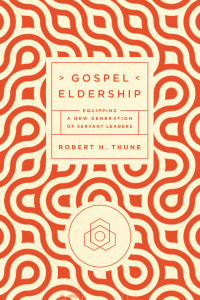
Bob Thune. Gospel Eldership. Greensboro: New Growth Press, 2016. 144 pp. $14.99

Everything rises or falls with good leadership. The fruitfulness and effectiveness of the local church is dependent upon men who exert strong, humble, and God-centered leadership. Weak men spawn weak churches. But men who living according to God’s mandate are a part of churches that thrive and produce spiritual fruit to the glory of God.

“The saying is trustworthy: If anyone aspires to the office of overseer; he desires a noble task.” So says the apostle Paul in his letter to Timothy.  Raising up biblical elders was a challenge in the first-century church. It continues to pose a tremendous challenge in our day as well. There are numerous resources that help equip biblical elders. The most notable resource is Biblical Eldership by Alexander Strauch.

However, Robert Thune’s excellent work, Gospel Eldership: Equipping a New Generation of Servant Leaders serves as a suitable companion and will no doubt be greatly used by God in the days to come.

The thesis is clear enough: “And is it not true that for a church to go deep in the gospel, its leaders must be deep in the gospel? That’s the vision and the goal behind Gospel Eldership.”

So the author presents ten lessons that provide a workable platform to train prospective elders and nurture the faith of men who currently serve as elders.

Description of an Elder
Section one discusses biblical eldership at a grassroots level. The author explores the importance of servant leadership, examines the necessity of a plurality of leadership, and walks readers through the various character qualifications the make up an elder.

Duties of Elders
Section two focusses on the important duties of elders. Elders are called upon to feed, lead, protect, and care for the church. In addition, Mr. Thune discusses the necessity of leadership that is missional and also touches on some temptations that emerge in missional leaders.

The first thing readers will notice in this work is the short, readable chapters. Each lesson is packed with biblical wisdom that point readers to the gospel. Discussion questions are included along with exercises that help apply the biblical principles.  There is much to commend in Thune’s work. But the highlight of this book is found in its repeated emphasis on the gospel. The author sets his sights on the heart of the reader. It is clear from beginning to end that the aim is heart transformation in every elder.

I highly recommend Gospel Eldership and look forward to hearing about how it encourages Christian leaders around the world.

I received this book free from the publisher. I was not required to write a positive review.
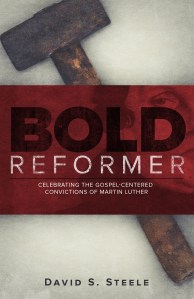
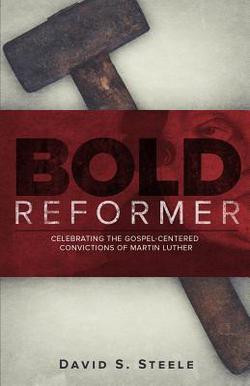
BOLD REFORMER: Celebrating the Gospel-Centered Convictions of Martin Luther – David S. Steele

1632960702_b

On April 1, 2016 my new book, Bold Reformer will be available at Amazon.com, Barnes and Noble.com, and Booksamillon.com.  Here’s a brief summary:

On October 31, 1517 Martin Luther nailed the ninety-five theses to the castle door in Wittenberg. One act of courage sparked a theological firestorm in Germany that set the world ablaze in a matter of days. Spreading like wildfire, thousands were introduced to the gospel which is received by grace alone, through faith alone, in Christ alone.

Bold Reformer: Celebrating the Gospel-Centered Convictions of Martin Luther takes readers on a journey through a remarkable period of church history. It will challenge contemporary readers to learn the lessons of courage, and perseverance. It will inspire a new generation of people to follow Jesus, obey Jesus, and worship the Savior with all their heart, soul, mind, and strength. It invites a new generation of Christ-followers to recover the gospel in their generation and make their stand as a bold reformer.

Bold Reformer is born out of personal pastoral turmoil and inspired by the courage of Martin Luther.  My hope is that many pastors, Christian leaders and Christ-followers will be encouraged as a result of reading this book; that God will propel them into the future by his grace and for his glory.

Soli Deo gloria!

MASTERING THE ART OF FREAKING OUT

Lance Hahn, How to Live in Fear: Mastering the Art of Freaking Out. Nashville: Thomas Nelson, 2016. 2034 pp. $10.350718035429_b

How to Live in Fear: Mastering the Art of Freaking Out by Lance Hahn is a book that addresses a variety of fears, including various anxiety disorders. The book is arranged in three parts and is summarized below:

Part 1: My Story
In Part one, the author shares in some detail his personal battle with fear and anxiety. He should be commended for the depth of transparency and his willingness to share his struggles with readers.  He should be especially acknowledged for his willingness to share his battles as a pastor.

Part 2: Our Journey Together
In Part two, Lance Hahn discusses some of the root causes of fear and anxiety. He reveals how our false assumptions lead to unwanted fears which typically begin to spiral out of control.
The author includes a helpful section on the pros and cons of medication, a controversial topic that some Christ-followers are simply unwilling to discuss. I found Hahn’s comments illuminating and thoughtful.

Finally, Pastor Hahn includes some meaningful suggestions on how to steal clear from the pit of fear and anxiety. He urges readers to discipline their thoughts and focus on the needs of other people. The benefits of exercise and the habit of journaling are explored, among other things.

Part 3: The Journey With Our Father
Part three leads readers to the ultimate solution which is found in a faith walk with Christ. The attributes of God are explained and readers are encouraged to dig deep into Scripture. The author encourages readers with a basic treatment of the sovereignty of God.  The author concludes by presenting what he refers to as the three truths to treasure, namely – 1) God loves you and cares for you, 2) God is in charge, and 3) God has not abandoned you.

Summary
One of the biggest challenges of writing reviews of Christian books is being charitable to the author but also providing honest feedback for potential readers. So I’ll be honest: I struggled a bit through this book. The author is a good writer and his transparency is refreshing. He is unafraid (irony?) of revealing who he is and is more than willing to share his personal struggles, not only with his congregation but also with his readers. This truly is one of the stronger points in the book. In being willing to sympathize with readers, he invites them to participate in the drama of anxiety. No doubt, many will be encouraged by this approach.

It is true that in part three, Pastor Hahn leads fellow strugglers to the only real hope, which is faith in the Lord Jesus Christ. Readers are encouraged to rely on Christ alone. My hope is that the gospel would have been emphasized more; that the benefits of the cross would have been explored and applied in greater detail, in order to serve people who battle with fear and anxiety.

As I completed the book, my thoughts turned to new believers who would benefit from Hanh’s book. It truly is an entry-level book for people who struggle with issues that pertain to fear and anxiety. So in the final analysis, I could recommend How to Live in Fear provided they move on to other resources that unpack the gospel with greater clarity. A few recommended resources include When I Am Afraid  by Ed Welch, Spiritual Depression and Let Not Your Heart by Troubled by Martyn Lloyd-Jones, and Spurgeon’s Sorrows by Zach Eswine.

I received this book free from the publisher. I was not required to write a positive review.
3.5 stars

LESSONS FROM A HOSPITAL BED – John Piper

John Piper, Lessons From a Hospital Bed. Wheaton: Crossway, 2016. 77 pp. $7.99

piper
Lessons From a Hospital Bed by John Piper is a book for sick people. It is a book for people who face the prospect of death. That is to say, it is a book that deserves to be read by all people. For each of us are plagued by the curse of the fall (Rom. 5:12). And while we may enjoy a measure of health, each of us will stare death in the face at some point.

Lessons From a Hospital Bed grew out of two specific experiences the author had after being hospitalized himself. In Part 1, Dr. Piper discusses ten beliefs that he brought to the hospital:

1. The Bible is the Word of God and should be trusted.
2. God is good.
3. God is wise and knows everything.
4. God is totally in control.
5. Sin is the ugly origin of ugly disease.
6. Jesus Christ died and rose to save sinners.
7. Sickness is not God’s first design or final plan for this world.
8. Satan is real and cruel but not in control.
9. Healing is possible now and certain later.
10. Your life and your illness are not meaningless.

Piper presents each principle is a few short pages and provides the supporting biblical rationale for readers to consider. Indeed, these beliefs are rock-solid biblical pillars that every believer needs to revisit on a regular basis.

In Part 2, the author includes ten principles that he learned in his brief stay in a hospital bed. These principles truly get to the heart of the matter. They are practical and challenging and help encourage a robust biblical faith.

I commend Piper’s work to all people and trust that this little book will be received well. Each of us will face the grave one day. Piper’s work is sure to encourage people as they make their way to the Celestial City!

FINDING TRUTH – Nancy Pearcey (2015)

Finding Truth, by Nancy Pearcey is another fine contribution thataa deserves to be read.  The author maintains with Romans 1 that all people have access to general revelation. As such:

  • We all have access to evidence for God through creation.
  • We all suppress the evidence for God from creation.
  • We all create idols to take the place of God.
  • God gives us up to the consequences of our idols to a “debased” mind.
  • God gives us up to the consequences of our idols – to “dishonorable” behavior.

Pearcey builds upon her earlier works, both of which are best sellers.  Total Truth argued for a unified view of truth and the obliteration of sacred/secular split.   Saving Leonardo   sought to help people develop skills in critical thinking.  Finding Truth  introduces readers to five principles which help make sense of competing worldviews and make a positive case for historic Christianity.  The five strategic principles are summarized below:

  1. Identify the Idol.  Anything which is presented as eternal and unchanging is an idol.  This principle helps us get to the heart of mankind’s propensity to erect idols and bow down to them.  By way of contrast, Christianity refuses to begin with creation and an epistemological starting point.  Rather, the beginning of knowledge rests in a transcendent Creator who is sovereign over all things.
  2. Identify the Idol’s Reductionism.  Pearcey notes, “The link is that idols always lead to a lower view of human life … When one part of creation becomes deified, the other part will be denigrated.”  Reductionism, is therefore, a fool’s errand as the creation is elevated to a status that God never intends.
  3. Test the Idol: Does it Contradict What We Know About the World?  Since idols always fail to satisfy, people will begin to realize that they cannot live according to the logic of their presuppositions.  They are either forced to live in the real world – which is to oppose their worldview or they live in accordance with their worldview which contradicts reality.
  4. Test the Idol: Does it Contradict Itself?  The competing worldview, at this point becomes self-defeating.  The author notes, “Everyone who proposes a reductionist worldview must make a tacit exception for his own thinking – at least, at the moment he is stating his claims.  But that too, creates a logical inconsistency.”  Thus the worldview fails.
  5. Replace the Idol: Make a Case for Historic Christianity.  As it becomes apparent that a competing worldview fails, the apologist must make a strong case for the viability and truthfulness of the Christian worldview.  “By identifying the points where non-Christians are free-loading, we can be confident that we are addressing areas where they sense the need for something more.”

Finding Truth is an essential toolbox for thinking Christians.  Pearcey does a dual service for readers as she not only instructs them to analyze and demolish competing worldviews (2 Cor. 10:5); she encourages readers to go deeper in the Christian faith which is informed by biblical reality and rock-solid facts.   A more accurate description, however, would be a treasure chest.  This is required reading which will only enrich one’s Christian life and effectiveness in the marketplace of ideas!

5 stars

I received this book free from the publisher.   I was not required to write a positive review. 

RETHINKING HELL

hell

Christopher W. Morgan and Robert A. Peterson. Is Hell For Real Or Does Everyone Go to Heaven? Grand Rapids: Zondervan, 2011. 96 pp. $9.99

It is unusual to hear about the doctrine of eternal punishment these days. Indeed, it is rare to hear a sermon that dares to address the very notion of hell. Christopher Morgan and Robert Peterson are the editors of the excellent work, Is Hell For Real Or Does Everyone Go to Heaven?

The short and readable book includes five chapters which are authored by Albert Mohler, Robert Yarbrough, Christopher Morgan, Robert Peterson, and J.I. Packer. Each author addresses the doctrine of eternal punishment for different angles. Yet each author is committed to the biblical doctrine of hell.

The respective authors explore the reality of hell, Jesus’ teaching concerning hell, and related topics of annihilationism and universalism. Each author defends this all-important biblical doctrine and remain faithful to the teaching of Scripture.

Is Hell For Real Or Does Everyone Go to Heaven? is not meant to be a comprehensive treatment on the doctrine of hell. Rather, it serves as an introduction to this very important topic. Robert Peterson’s book, Hell On Trial: The Case for Eternal Punishment provides a more thorough defense. I recommend it highly!

TED CRUZ – THE WACKO BIRD (2015)

They call him the “Wacko Bird.”  Other words are often used to cruzdescribe the Senator from Texas: He’s accused of being “extreme,” “out of touch,” “crazy,” and  “arrogant.”  The media has caricatured him as a right-wing lunatic.  The liberals in Congress have tried to discount him and marginalize him.

After reading, A Time For Truth by Ted Cruz, I can say with confidence that the Senator is a man who means what he says and says what he means.  He is committed to conservative values and is willing to pay a personal price for standing up for those values.

A Time For Truth is the story of an immigrant’s son – a man who learned the value of hard work, honesty, and integrity at a young age.  It is the story of a Princeton graduate (cum laude) who walked away with an undergraduate degree in Public Policy.  Cruz went on to graduate magna cum laude from Harvard Law School.  The liberal law professor, Alan Dershowitz calls Cruz, “Off-the-charts brilliant.”  Yet the Senator from Texas is portrayed as a “dummy” and an “extremist.”

Senator Cruz is a fiscal conservative.  As a young man, he memorized the Constitution and now he fights every day to preserve the freedom we enjoy as American citizens.  Cruz fights for the unborn and he fights for the voiceless.  He is committed to securing the border.  He has a plan for defeating Isis.  He is a man of faith who has the best interest of our country.

A Time For Truth sets the record straight.  I have a sneaking suspicion that Senator Cruz will get the last laugh.  The Senator from Texas is unwilling to waver.  He is unwilling to back down.  He is unwilling to compromise his conservative principles.  The “wacko bird” is just getting started.  Ted Cruz has charted an determined course to the Oval Office!

Logic On Fire – The Preaching of Martyn Lloyd-Jones

1567696384_bSteven J. Lawson. The Passionate Preaching of Martyn-Lloyd Jones. Sanford: Reformation Trust, 2016. $16.00

I will never forget reading the first installment of Steven Lawson’s series in the Long Line of Godly Men Profiles. The Expository Genius of John Calvin riveted my attention and engaged my mind. This book captivated my imagination and challenged my studying habits. The first volume reminded me about the importance and preciousness of our Christian heritage and the great men of God who lined the halls of church history.

Since that first book, nine additional books have been added to the series, including the latest, The Passionate Preaching of Martyn Lloyd-Jones. Dr. Lawson includes an illuminating biographical summary of the great Welsh preacher and demonstrates how God not only regenerated his sinful heart, but also how he ordered his steps to serve as pastor of Westminster Chapel in London for most of his adult life.

A sizable portion of the book is devoted to the preaching of Lloyd-Jones. His passion for the Word of God is explained and his theological convictions are explored. For anyone who has any doubts that Lloyd-Jones was a fiery five-point Calvinist, those doubts will be extinguished here. He was a committed Reformed theologian whose sermons were drenched in the doctrines of grace.

Dr. Lawson helps readers understand the important role that theology played in the ministry of Lloyd-Jones. His sermons were doctrinally driven and theologically charged. Unlike many preachers in the present day, there was no ambiguity in Lloyd-Jones. His listeners knew exactly where he stood. The highest authority in his life was the Bible.

Additionally, the author clearly articulates the passion that Lloyd-Jones had for preaching expository sermons. “The primary task of the Church and of the Christian minister is the preaching of the Word of God,” argued Lloyd-Jones. Lawson adds, “This allegiance to expository preaching was completely foreign to most pulpits at that time in England.” Such a reminder should motivate preachers in our generation to faithfully preach expository sermons. To do any less would be treasonous and an affront to God.

The concluding chapter, Spiritually Empowered stands as one of the most interesting chapters of the book. Here, the author explores the role of the Holy Spirit in the preaching of Lloyd-Jones. The Welsh pastor strongly believed that the Holy Spirit must empower pastors, not only in during sermon preparation but also as the pastor proclaims the truth of God’s Word. Lawson accurately explains the heart of Lloyd-Jones: “First, the preacher must do his part in sermon preparation. Then God must do His part in sending the fire.”

Lloyd-Jones was a preacher with authority. But that authority was a derived authority. His authority came as he submitted to the ministry of the Holy Spirit. He says, “This, then, is the dual action of the Spirit. He takes the preacher … and gives this enabling. Then the Holy Spirit acts upon the ones who are listening and deals with their minds and hearts and wills.”

The Passionate Preaching of Martyn Lloyd-Jones is a book for aspiring preachers and veteran preachers alike. But it should not be limited to preachers exclusively. This book is for Christian leaders who need a fresh burst of encouragement. It is for Christ-followers who need inspiration as they make their way to the Celestial City.

The Passionate Preaching of Martyn Lloyd-Jones is a vivid reminder about the importance of faithful preaching. It is a reminder that behind every solid expository sermon is a man who walks with Jesus and submits to the Holy Spirit. This book is a monument of sorts that honors a great hero of the Christian faith. Indeed, this book honors a man who was very likely the most effective preacher of the 20th century.

Highly recommended!

I received this book free from the publisher. I was not required to write a positive review.

WICKED MEN USEFUL IN THEIR DESTRUCTION ONLY (1744) – Jonathan Edwards

Jonathan_Edwards_engravingThe sermon is dated, July 1744.  Jonathan Edwards is thirty-one years of age.  The title of the message is Wicked Men Useful in Their Destruction Only.  The text is Ezekiel 15:2-4.

Doctrine

If men bring forth no fruit to God, they are wholly useless, unless in their destruction.

Edwards seeks to prove his doctrine with four points.

  1. That there can be but two ways in which man can be useful, viz. either in acting, or in being acted upon.
  2. That man can no otherwise be useful actively than by bringing forth fruit to God; serving God and living to his glory.
  3. That if he bring not forth fruit to God, there is no other way in which he can be passively useful, but in being destroyed.
  4. In that way he may be useful without bearing fruit.

The key to this sermon is perspective.  Jonathan Edwards bring a God-centered perspective that readjusts the worldview of the saints.  One example is Edwards’ encouragement to Christ-followers as they gaze upon the damned in eternity future:

When the saints in heaven shall look upon the damned in hell, it will serve to give them a greater sense of their own happiness.  When they shall see how dreadful the anger of God is, it will make them the more prize his love.  They will rejoice the more, that they are not the objects of God’s anger, but of his favor; that they are not the subjects of his dreadful wrath, but are treated as children, to dwell in the everlasting embraces of his love.  The misery of the damned will give them a greater sense of the distinguishing grace and love of God to them, that he should from all eternity set his love on them, and make so great a difference between them and others who are of the same species, and have deserved no worse of God than they.  What a great sense will this give them of the wonderful grace of God to them!  and how will it heighten their praises!  with how much greater admiration and exultation of soul will they sing of the free and sovereign grace of God to them!

Application

Four thoughts are offered by way of application by Jonathan Edwards:

First —We may learn, how just and righteous God is in the destruction of those who bring forth no fruit to him.

Second — This subject ought to put you upon examining yourselves, whether you be not wholly useless creatures.  

Third — Another use of this subject may be of conviction and humiliation to those who never have brought forth any fruit to God.

Fourth — May people bring forth fruit to God’s glory.

In typical Edwardsean form, the Puritan preacher calls people to fulfill the reason for their creation, namely – to glorify the great God of the universe!