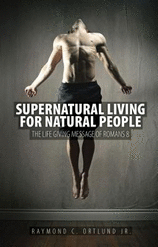
SUPERNATURAL LIVING FOR NATURAL PEOPLE – Raymond Ortlund Jr.

1781911398_lIf Ray Ortlund Jr. wrote a book about dirt, I would gobble it up.  I respect him that much.  So when Dr. Ortlund puts his hand to the plow and excavates some of the jewels that emerge in Romans chapter 8, I’m an eager learner.  Of course, Ortlund does not disappoint.  The title of the book is Supernatural Living For Natural People: The Life-Giving Message of Romans 8.  

The author carefully walks readers through Paul major arguments in Romans 8 that include key doctrinal realities including justification, mortification, vivification, among other things.

At the heart of the book is a reliance on the ministry of the Holy Spirit.  A gospel-centeredness pervades this work that serves as a “sledge hammer” that destroys legalism that is such a part of local churches: “So when the grandeur of the Christian hope comes home to our hearts, all nit-picky legalism and foot-dragging complacency are seen to be absurd.  The gospel spreads magnificence out before us.  So away with our gloomy unbelief.”  The book stands in the Reformed tradition and is undergirded by weighty Calvinistic presuppositions.

Dr. Ortlund has a unique ability that combines the mind of a scholar with the heart of a pastor.  His exegetical work is superb and his application is directed to real people who live in the real world.

Highly recommended!

UNVEILING GRACE: The Story of How We Found Our Way Out of the Mormon Church – Lynn Wilder (2013)

Unveiling Grace: The Story of How We Found Our Way Out of the Mormon Church by Lynn K. Wilder is the gripping account of a longtime member of the Mormon Church and how she and her family found their way out of a works-based religious system_240_360_Book.889.cover.  What makes the story even more fascinating is that Wilder is also a former tenured professor at Brigham Young University.

Dr. Wilder guides readers on her journey into Mormonism which lasted over 30 years and unfolds the remarkable story of their exit, all due to the biblical gospel and Christ’s saving work on the cross for her sins.  What makes the story especially enduring is the love that the author expresses for her Mormon friends.  She is careful not to build straw man arguments.  Rather, she carefully assesses the fabric of LDS theology and compares it with sacred Scripture.  When the tapestry began to unravel (which includes works-based righteousness, polytheism, baptism for the dead,  and a man-centered gospel among other things), Wilder asked more questions and subjected Mormon teaching to the scrutiny of Scripture which led to her eventual departure from Mormonism and saving faith in the biblical Jesus.

The book is a reminder to Christ-followers to pursue their Mormon friends and challenge them with the biblical gospel.  It is a testimony to sovereign grace – grace that has the power to remove the blinders from someone who has been deceived by teaching that is antithetical to Scripture.

Soli Deo Gloria!

I received this book free from the publisher through the BookSneeze®.com  book review bloggers program. I was not required to write a positive review. 

SINNERS IN THE HANDS OF AN ANGRY GOD – Jonathan Edwards (1741)

Jonathan_Edwards_engravingI’ll never forget a very special evening with a small group of Christ-followers at the McLean home.  My good friend, Don suggested that we read Sinners in the Hands of an Angry God by Jonathan Edwards in one sitting – on our knees.  And so a group of middle-aged adults gathered in Don’s living room alongside several children (whose knees were much more nimble) – and we read Edward’s classic sermon – on our knees.  It is a moment I will not soon forget.  We were humbled.  We were drawn into the very presence of God.  And like the 18th-century congregation in Enfield – we were cut to the quick.

Sinners in the Hands of an Angry God is not only one of the most well-known sermons in American history; it is one of the most powerful sermons every preached on American soil.  In one sermon, the Puritan divine highlights both the awesome wrath of a holy God and the matchless grace of Jesus Christ.

This is a sermon which has received a fair amount of criticism over the years.  It is maligned and caricatured.  Often found on a list of required reading for college English courses, the sermon is mocked for its candid language and scary images.  Many readers simply cannot stomach the God that Edwards presents or submit to the God that Edwards loves and serves.

The sermon is derived from Deuteronomy 32:35 – “Their foot shall slide in due time.”  The doctrine that Edwards sets forth is simple: “There is nothing that keeps wicked men at one moment out of hell, but the mere pleasure of God.”  This doctrine is undergirded by ten propositions:

1. There is no want of power in God to cast wicked men into hell at any moment.

2. They deserve to be cast into hell; so that divine justice never stands in the way, it makes no objection against God’s using his power at any moment to destroy them.

3. They are already under a sentence of condemnation to hell.

4. They are not the objects of that very same anger and wrath of God, that is expressed in the torments of hell: “The wrath of God burns against them, their damnation does not slumber; the pit is prepared, the fire is made ready, the furnace is now hot, ready to receive them; the flames do now rage and glow.

5. The devil stands ready to fall upon them, and seize them as his own, at what moment God shall permit him.

6. There are in the souls of wicked men those hellish principles reigning, that would presently kindle and flame out into hell fire, if it were not for God’s restraints.  There is laid in the very nature of carnal men, a foundation for the torments of hell.

7. It is no security to wicked men for one moment, that there are no visible means of death at hand.

8. Natural men’s prudence and care to preserve their own lives, or the care of others to preserve them, do not secure them a moment.

9. All wicked men’s pains and contrivance which they use to escape hell, while they continue to reject Christ, and so remain wicked men, do not secure them from hell one moment.

10. God has laid himself under no obligation, by any promise, to keep any natural man out of hell one moment.

Edwards concludes with a strong application which is meant to awaken sinners and flee from the wrath of God.  Readers are faced with a momentous decision as Edward alerts them to the painful reality of God’s wrath: “There is the dreadful pit of the glowing flames of the wrath of God; there is hell’s wide gaping mouth open; and you have nothing to stand upon, nor anything to take hold of; there is nothing between you and hell but the air; it is only the power and mere pleasure of God that holds you up.”

Readers are challenged to take advantage of “the door of mercy wide open” which beckons them to receive the grace of God in Christ.  Edwards concluding words leave sinners with an important decision; the most decision they will ever make: “Therefore, let every one that is out of Christ, now awake and fly from the wrath to come.  The wrath of Almighty God is now undoubtedly hanging over a great part of this congregation.  Let every one fly out of Sodom: “Haste and escape for your lives, look not behind you, escape to the mountain, lest you be consumed.”

The “flag” of tolerance is flying in America.  The “flag” of relativism has been unfurled in this land.  The “flag” of compromise flies high and is accepted, even within the church.  Indeed, a God-dishonoring “flag” celebrating homosexuality was unveiled at Safeco Field in Seattle a few days ago.  Jonathan Edwards raises his “flag” higher and reminds sinners (homosexuals and heterosexuals alike) that God will not tolerate their sin.  God hates their sin.  And this great God offers mercy and forgiveness for anyone who repents and believes in the Lord Jesus Christ!

MARTYN LLOYD-JONES: Advise on What to Read

martin-lloyd-jones

D. Martyn Lloyd-Jones:

My advice to you is: Read Jonathan Edwards. Stop going to so many meetings; stop craving for the various forms of entertainment which are so popular in evangelical circles at the present time. Learn to stay at home. Learn to read again, and do not merely read the exciting stories of certain modern people. Go back to something solid and deep and real.

Are we losing the art of reading? Revivals have often started as the result of people reading volumes such as these two volumes of Edwards’ works. So read this man. Decide to do so. Read his sermons; read his practical treatises, and then go on to the great discourses on theological subjects.

—D. Martyn Lloyd-Jones, “Jonathan Edwards and the Crucial Importance of Revival,”Puritans: Their Origins and Successors (Edinburgh: Banner of Truth, 1987), 369-370.

Lloyd-Jones elsewhere explained the importance of this practice in his own ministry:

In my early days in the ministry there were no books which helped me more, both personally and in respect of my preaching, than the two-volume edition of the Works of Jonathan Edwards. . . . I devoured these volumes and literally just read and reread them. It is certainly true that they helped me more than anything else. . . . If I had the power I would make these two volumes compulsory reading for all ministers!

http://thegospelcoalition.org/blogs/justintaylor/

GOD GLORIFIED IN MAN’S DEPENDENCE – Jonathan Edwards

Jonathan_Edwards_engraving“God is glorified in the work of redemption in this, that there appears in it so absolute and universal a dependence of the redeemed on him.”  This is the doctrine that Jonathan Edwards sets forth in his sermon, God Glorified in Man’s Dependence.  He provides two central anchors that support his doctrine.

“… So that no human being might boast in the presence of God. And because of him you are in Christ Jesus, who became to us wisdom from God, righteousness and sanctification and redemption, so that, as it is written, “Let the one who boasts, boast in the Lord.”” (1 Corinthians 1:29–31, ESV)

Anchor # 1: There is an absolute and universal dependence of the redeemed on God

Edwards is concerned to show how the people of God depend upon the Trinity for everything.  He demonstrates how the “redeemed have all from the grace of God.”  He reminds us that God is sovereign in the distribution of his grace, a truth that was and continues to be rarely taught from the pulpit: “God may forever deny holiness to the fallen creature if he pleases, without any disparagement to any of his perfections.”

He demonstrates how we receive all from the power of God, that is to say, “we are dependent on God’s power through every step of our redemption.  We are dependent on the power of God to convert us, and give faith in Jesus Christ, and the new nature.”

Anchor # 2: God is exalted and glorified in the work of redemption

1. Man hath so much the greater occasion and obligation to notice and acknowledge God’s perfections and all-sufficiency.

2. Hereby is demonstrated how great God’s glory is considered comparatively, or as compared with the creatures.

3. By its being thus ordered, that the creature should have so absolute and universal a dependence on God, provision is made that God should have our whole souls, and should be the object of our undivided respect.

Application

In ascribing everything to God, Edwards is primarily concerned for us to exalt in him alone.  He closes with strong words of admonition: “Let us be exhorted to exalt God alone, and ascribe to him all the glory of redemption … But this doctrine should teach us to exalt God alone: as by trust and reliance, so by praise.  Let him that glorieth, glory in the Lord.”

God Glorified in Man’s Dependence is a Semi-Pelagian sledgehammer,  destroying every ounce of human pride and self-effort.  Edwards puts the axe to Arminian axioms that while well-intentioned rob God of the glory which is rightly his.  Each line of the sermon chips away at the human propensity to receive glory and take credit for what rightly belongs to God.  Edwards reminds us that everything we have is owing to God; that he is sovereign in the distribution of his grace.  Indeed, God is glorified in man’s dependence.

NAME ABOVE ALL NAMES – Alistair Begg and Sinclair Ferguson (2013)

1433537753_l“Don’t you folks ever read your Bibles?”  These were among the first words I heard from the lips of Dr. John G. Mitchell, founder of Multnomah School of the Bible – recently renamed Multnomah University.  I’ll never forget the time Dr. Mitchell walked up to me, a man in his mid 80’s with clenched fists and asked if I wanted to fight!  Joking of course, the elder Scotsman truly loved the student body at Multnomah.  Not many months before he went to be with the Lord, we were instructed to stop applauding him as he took to the lectern.  The sound of 800 students clapping jangled his nerves and wreaked havoc on his hearing aids.  So in those last days, we merely stood as a sign of respect as the great teacher made his way to the preachers desk.  “Don’t you folks ever read your Bibles?” he would ask, with a glimmer in his eye.  He would challenge us with fiery passion to preach Christ faithfully and  to pursue holiness – all to the glory of God.  Dr. Mitchell would constantly encourage us, “I want you to know the glory of the Savior.”  He knew the Savior; he knew the saving benefits of his cross-work; and he wanted everyone to experience the same.  He wanted us to know the name above all names, the Lord Jesus Christ.

Alistair Begg and Sinclair Ferguson, who like Dr. Mitchell also hail from Scotland have an identical passion.  They want the world to know, embrace and worship –  The Name Above All Names.  The Crossway title is a solid offering that explores some core components of Christology.  The authors do not intend to present a full-orbed Christology; rather their aim is to present seven snapshots that concern the person and work of Christ:

1. Jesus Christ, the Seed of the Woman

2. Jesus Christ, the True Prophet

3. Jesus Christ, the Great High Priest

4. Jesus Christ, the Conquering King

5. Jesus Christ, the Son of Man

6. Jesus Christ, the Suffering Servant

7. Jesus Christ, the Lamb on the Throne

The book while intensely theological, is written is a devotional tone that is suitable for beginners and veterans of the Christian faith.  Like Dr. Mitchell who went before them, these Scottish writers have a passion for Christ that needs fanning in America.  Perhaps the flicker will turn into a flame!

LOGIC: A GOD-CENTERED APPROACH TO THE FOUNDATION OF WESTERN THOUGHT – Vern Poythress (2013)

1433532298_lLogic is one of the last things one would expect to hear about in a church. I have found that some Christians even have an aversion to logic – a statement which interestingly enough is not very logical! We should be thankful to men like Very Poythress who share their gifts with the church as well as the academy. One such gift is his latest book, Logic: A God-Centered Approach to the Foundation of Western Thought.

The first thing readers will notice about this work is volume. It weighs in at over 700 pages which includes a large appendix that supplement the fine work that Poythress presents.

The author organizes his book into three parts, namely – Elementary Logic, Aspects of Propositional Logic, and Enriching Logic. Readers familiar with the discipline of logic will be very familiar with the terminology that is included in the table of contents. At first glance, the book seems to have much in common with a standard textbook on logic. But the real beauty of the book is found in the relationship of logic to God. Poythress rightly shows the logic comes directly from the hand of God. Indeed, he is “the source for logic.” The other demonstrates the rationality of logic and the personal nature of logic: “Logic in this sense is an aspect of the mind of God. All God’s attributes will therefore be manifested in the real laws of logic, in distinction from our human approximations to them.”

Poythress captures the essence of preuppositional apologetics and appears to pick up where Van Til left off: “We can praise God for what he has given us in our logic and our ability to reason.” Yet, sinners suppress the truth of God’s existence. “Everywhere we are confronted with the reality of God – and everywhere we flee from this reality.”

Logic helps us discern between truth and error. Logic on its own can not tell us what is true. But it will serve as a powerful aid in the discerning process. This work by Vern Poythress is a powerful anti-venom in a toxic world that is on a death-march away from logic. Sometimes people just don’t make any sense!

MEN NATURALLY GOD’S ENEMIES – Jonathan Edwards (Part 6)

imagesEdwards pens his concluding remarks by demonstrating how God may justly withhold mercy and by offering a brief section that he entitles, practical improvement (what we would call application).

7. God May Justly Withhold Mercy

The primary argument that Edwards sets forth is basic: Since unconverted men are naturally hostile to God and prove to be his enemies, it is just with God should he chose to withhold his mercy.  Whenever mercy is supposed to be mercy, it becomes non-mercy – for mercy is under no obligation, whatsoever.  Again, should mercy become obligatory, it ceased to be mercy.

Edwards rightly says, “This doctrine affords a strong argument for the absolute sovereignty of God, with respect to the salvation of sinners.  If God is pleased to show mercy to his haters, it is certainly fit that he should do it in a sovereign way, without acting as any way obliged … [He has] liberty to choose the objects of his mercy; to show mercy to what enemy he pleases, and to punish and destroy which of his haters he pleases.”

Edwards directs three closing arguments that are directed at enemies of God:

First, how causelessly you are enemies to God.  He reminds the unconverted about the Providential designs of God; how he has showered his common grace on those who hate him.

Second, consider how you would resent it, if others were such enemies to you, as you are to God.  He adds, “Consider therefore, if you, a poor, unworthy, unlovely creature, do so resent it, when you are hated, how may God justly resent it when you are enemies to him, an infinitely glorious Being; and a Being from whom you have received so much kindness!

Third, how unreasonable is it for you to imagine that you can oblige God to have respect to you by any thing that you can do, continuing still to be his enemy.

Practical Improvement (Application)

Edwards returns to the doctrinal affirmations in Romans 5, namely, that Christ died for the ungodly; he died for his enemies.  Two primary considerations guide the Puritan divine as he closes:

First, he directs the reader to contemplate the great wonder in Christ who gave his life for the sins of everyone who would ever believe.  Each one for who Christ died was an enemy.  But note: “How wonderful was the love of God the Father, in giving such a gift to those who not only could not be profitable to him, but were his enemies, and to so great a degree!”  Edwards continues, “Though they had enmity that sought to pull God down from his throne; yet he so loved them, that he sent down Christ from heaven, from his throne there, to be in the form of a servant; and instead of a throne of glory, gave him to be nailed to the cross, and to be laid in the grave, so we might be brought to a throne of glory.”  Edwards drives home the reality of God’s love that was demonstrated for sinners who despised him.  Oh, what a love!

Second, Edwards encourages believers to modify their perspective to towards their earthly enemies: “Seeing we depend so much on God’s forgiving us, we should exercise a spirit of forgiveness towards our enemies.

Men, Naturally God’s Enemies is a well-thought out treatment of the hostility that every natural man has toward the God of the universe.  Edwards work is a reminder that is needed in the 21st century church.  While most if not all Christ-followers are quick to give lip service to the doctrine of total depravity, some still refuse to embrace the biblical portrait of man; a portrait that when painted correctly reveals the utter hostility and enmity that the natural man has toward God.  There is a great need in the church to remind the lost of their true condition before God and to admonish them to flee to the cross to find forgiveness of all their sin.  Additionally, there is a great need in reminding Christ-followers of their former condition, which will at the end of the day, ignite a heart filled with worship for the God who demonstrates his love for us!

MEN NATURALLY GOD’S ENEMIES – Jonathan Edwards (Part 5)

In this fifth post, Edwards turns his attention to the reality of restraining grace.  Additionally, he imagesexplores the reasons why natural men refuse to come to Christ.

5. Restraining Grace a Great Privilege

Edwards poses a critical question: “If all natural men are God’s enemies, what would they not do, if they were not restrained?”  Chief in Edwards mind is the bondage to sin that each natural man faces.  Indeed, anyone who commits sin is a slave to sin (John 8:34).  So with the dominion of sin in the background, Edwards demonstrates the glorious work of God’s restraining grace in the lives of the unconverted: “In hell, God lets the wickedness of wicked spirits have the reins, to rage without restraint; and it would be in a great measure upon earth as it is in hell, did not God retrain the wickedness of the world.”  He proceeds, then, to show how God prevents the carnal man from falling prey to the “highest acts of sin.”

First, whenever men are withheld from sinning by the common influence of God’s Spirit, they are withheld by restraining grace.  Essentially, Edwards argues that the unconverted would commit sin in the most heinous degree were it not for God’s restraining grace.

Second, all the restraints that men are under from the word and ordinances, is from grace. 

Third, when men are restrained from sin, by the light of nature, this also is of grace.

Fourth, when God restrains men’s corruptions by his providence, this is from grace.

Edwards closes this section by turning his attention to regenerate men and urges them to consider their need for his restraining grace as well: “Let not the godly therefore be insensible of their obligations to the restraining grace of God.  Though they cannot be said to be enemies to God, because a principle of enmity does not reign; yet they have the very same principle and seed of enmity in them, though it be mortified.  Though it be not in reigning power, yet it has great strength; and is too strong for them, without god’s almighty power to help them against it.”

6. Why Natural Men Are Not Willing to Come to Christ, and Their Dreadful Condition

Edwards states the obvious here but personal experience teaches that many people (even Christ-followers) refuse to see it: “Hence we may learn the reason why natural men will not come to Christ.  They do not come because they will not come (emphasis mine).  Edwards appeals to John 5:40 which states the principle clearly.  His assertion goes to the heart of the problem of freewill, namely, natural men are free to come but they are unwilling to come.  They freely choose to reject Christ.  Edwards adds, “They see nothing in Christ wherefore they should desire him; no beauty nor comeliness to draw their hearts to him.”

Conversely, Edwards argues that when sinners come to Christ, they do so freely: “When men are truly willing to come to Christ, they are freely willing.  It is not what they are forced and driven to by threatenings; but they are willing to come, and choose to come without being driven.  But natural men have no such free willingness; but on the contrary have an aversion.  And the ground of it that which we have heard, viz. That they are enemies of God.”

So in a few sentences, Edwards summarizes the natural inability of sinners to come of their own freewill.  It is not for lack of invitation; it is not for lack of opportunity.  Rather is it because they freely turn away from the gospel.  Simply put, they are free to come – but they are unable to come apart from a divine work of grace.  Such an understanding of man natural inability appears to be missing in many churches.  That is to say, the semi-pelagian view of the will has gained the ascendency and as a result the gospel is weakened in hearts of many.

Edwards urges sinners to consider their ruinous path:

First, if you continue in your enmity a little longer, there will be a mutual enmity between God and you to all eternity.  Edwards draws the eschatological line in the sand and demonstrates the misery of anyone who opposes the rule and reign of the Lord Jesus Christ: “If you should die an enemy to God, there will be no such thing as any reconciliation after death.  God will then appear to you in hatred, without any love, any pity, and any mercy at all.  As you hate God, he will hate you … If you be not reconciled so as to become his friend in this life, God never will become your friend after death.”  Edwards repudiates the notion of “so-called second chance evangelism and annihilationism in a stroke of the pen.

Second, if you will continue God’s enemy, you may rationally conclude that God will deal with you so as to make it appear how dreadful it is to have God for an enemy.  Edwards proceeds to show how God will manifest his holy justice on unrepentant sinners (Deut. 32:40-42).  “He will render vengeance to his enemies, and reward them that hate him … this is the terrible manner in which God will one day rise up and execute vengeance on his enemies.”