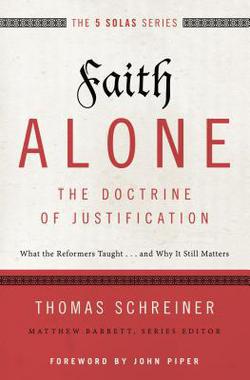
FAITH ALONE – Thomas Schreiner (2015)

Faith Alone by Thomas Schreiner is much-needed treatment of the scrinedoctrine which was rediscovered during the days of the Protestant Reformation, namely, justification by faith alone. The author makes it plain from the beginning that he does not intend to offer a comprehensive treatment of this doctrine. Rather, he guides readers through a tour of the doctrine of justification. The contours of this fascinating tour are informed by history, theology, and biblical/exegetical arguments.

Dr. Schreiner is unique among theologians as he fairly represents opposing positions and graciously refutes them. His stance toward Rome, in particular, is refreshing and sure to pose a challenge to Roman Catholic thought.

Despite the gracious intent of the author, his arguments are robust and biblical. His allegiance to the Sola Scriptura principle is evident throughout and his love for the doctrine of justification by faith alone is clear.

I commend this work highly and expect it shall receive a wide reading.

THE SURPRISING IMAGINATION OF C.S. LEWIS – Jerry Root and Mark Neal (2015)

“We have seen, whether in his fiction or nonfiction, that Lewis is alewisgiven to depictions, creating windows and images, inventing stories, developing metaphors, and crafting illustrations so his readers can see what he saw and more. He did these things that readers might better see and understand the real world.” So says Jerry Root and Mark Neal in their fascinating treatment of C.S. Lewis.

The book is The Surprising Imagination of C.S. Lewis.The authors survey the literary mountain of books written by Lewis and focus their attention on his attempts to spark the imagination of readers. From the non-fiction works, Surprised by Joy and Mere Christianity to his fiction works like The Great Divorce and The Chronicles of Narnia, Root and Neal work hard to excavate the “imaginative ore” from the deep recesses of C.S. Lewis treasure trove. Indeed, “Lewis’s use of the imagination makes it possible for us to enter into collaboration with things once outside of our vision of the world.”

Having read much of Lewis’s work, I was personally fascinated and and inspired by the authors attempts to highlight his imagination. For the works I was less familiar with, such as the Space Triology the treatment was more difficult to follow.
The authors write, “Ultimately, the imagination is a vital ‘organ of meaning’ that we must cultivate if we desire to live well, if we are to grow and change and expand our understanding of the world that God has placed us in. God calls us to know it, and to know it well.”

Overall, the authors succeed in their attempt to draw readers into the imaginative world of C.S. Lewis. They conclude on a high note by challenging readers to fight a falsified notion of the imagination: “We encourage you to fight the notion that the imagination is simply ‘make-believe’ and therefore not to be trusted. Modern science certainly has not helped to foster the imagination as a source of truth. Reason, intellect, and method are prized above all else, while imagination is patted condescendingly on the head.” In the final analysis, readers are encouraged to marry reason and imagination – all with the intention of glorifying God.

I received this book free from the publisher.   I was not required to write a positive review.


BRAND LUTHER – Andrew Pettegree (2015)

lutherHow can an unpublished, obscure Roman Catholic monk move from the shadows to the world stage in a matter of years. This is the subject of Andrew Pettegree’s book, Brand Luther. Pettegree walks meticulously through the events of the Reformer’s life; events that would mark a nation and rock the world. This is Brand Luther.

The author sets the stage by alerting readers to Luther’s fascinating background. From his birth in Eisleben to his university days in Erfurt, and his teaching days at in Wittenberg, Pettegree establishes Luther’s cultural context along with vivid allusions to the theological landscape. Ultimately, his design is to show how Luther rises to prominence in a most unusual way.

Brand Luther is unique in that it captures the pathos of the 16th century. The author delves into matters that pertain to culture, theology, economics, and personal emotion – to name a few. The author has an uncanny ability of navigating readers on the path that Luther walked and placing them in the emotional state he experienced and the physical ailments he endured. The turmoil that Luther felt and the threat of impending death looms like London fog on a cold autumn evening.

The author argues that Luther’s writing along with the establishment of the printing press are integral to his success, not to mention the gains of the Protestant Reformation: “Many things conspired to ensure Luther’s unlikely survival through the first years of the Reformation, but one of them was undoubtedly print.” The book is filled with evidence that points in this direction which bolsters the author’s thesis along the way.

Brand Luther is a serious work of history which spans nearly 400 pages but the book reads like a novel – quite an accomplishment for a scholarly work!

Essential reading for students of the Reformation!

WE CANNOT BE SILENT – R. Albert Mohler (2015)

mohlerPostmodern culture is drowning in relativism and religious pluralism. The rising tide of liberalism and theological compromise has not only washed upon the secular shore; it has come crashing in upon the evangelical church with the force of a tsunami.

Dr. R. Albert Mohler explores this rising cultural storm in his new book, We Cannot Be Silent. The author describes the so-called sexual revolution in vivid terms; terms that sober readers and awaken them to this escalating challenge.

Mohler explains that this cultural revolution did not begin with same-sex marriage, however. Rather, four developments helped usher in the redefinition of marriage, namely, birth control and contraception, divorce, advanced reproductive technologies, and cohabitation.

The author guides readers through the various stages of cultural decay which include the acceptance of same-sex marriage, the transgender revolution, and the collapse of marriage.

Dr. Mohler provides the proper paradigm for thinking and acting biblically in these troubling times:

The fundamental axiom upon which evangelical Christians must base every response to homosexuality is this: God alone is sovereign, and he alone created the universe and everything within it by his own design and for his own good pleasure. Furthermore, he showed us his creative intention through Holy Scripture – and that intention is clearly to create and establish two distinct but complementary genders or sexes. The Genesis narrative demonstrates that this distinction of genders is neither accidental nor inconsequential to the divine design.

Navigating the cultural decay is no simple task, especially when more and more people appear to accept what the Bible prohibits – even in the church. Thankfully, we have the Word of God which reveals the heart of God in these matters. Indeed, the biblical testimony is clear and compelling: Mohler adds:

Homosexuality is a sin against God and a direct rejection of God’s intention and command in creation. All sin is a matter of eternal consequence. The redemption accomplished by Jesus Christ is the only hope for sinners. On the cross, Jesus paid the price for our sins and served as a substitute for the redeemed.

We Cannot Be Silent is essential reading for Christian leaders, Christian educators, and pastors. It contains a wealth of practical information, biblical responses, and draws readers into the center of the cultural tsunami. Mohler offers hope and Bible-soaked counsel for Christians who seek answers in the midst of the storm.

But the most important aspect of the author’s book is his heart which is clearly revealed. Mohler strikes a critical balance of love and grace from start to finish. He helps readers navigate the challenging waters of postmodern culture with biblical wisdom, skill, and winsomeness. Such an approach is imperative if the church intends on reaching people for the sake of the gospel.

I applaud We Cannot Be Silent for its depth, transparency, and clear commitment to Scripture. It deserves a wide reading and is bound to make an important difference in the lives of many people.

Highly recommended!

I received this book free from the publisher.   I was not required to write a positive review.

A HISTORY OF WESTERN PHILOSOPHY AND THEOLOGY – John Frame (2015)

frameThe Word of God is emphatic about our role as we enter the marketplace of ideas. The apostle Paul sounds the warning in Colossians 2:8 – “See to it that no one takes you captive by philosophy and empty deceit, according to human tradition, according to the elemental spirits of the world, and not according to Christ.” Scripture instructs Christ-followers, “For the weapons of our warfare are not of the flesh but have divine power to destroy strongholds. We destroy arguments and every lofty opinion raised against the knowledge of God, and take every thought captive to obey Christ …” (2 Corinthians 10:4–5, ESV).

John Frame maintains and promotes such a mind-set in his latest offering, A History of Western Philosophy and Theology (HWPT). The discipline of philosophy, which is defined as “the disciplined attempt to articulate and defend a worldview,” is broken down into three subdivisions including metaphysics, epistemology, and value theory. Readers familiar with Frame’s work will immediately recognize his commitment to perspectivalism, a powerful grid for thinking which includes three perspectives: normative, situational, and existential. This commitment has been clearly articulated and defended in his Lordship series, a series of books which are essential tools in every pastor’s library.

HWPT is dedicated to Dr. Cornelius Van Til, whose influence is evident throughout the book. Readers who are entrenched in Van Til’s methodology will quickly recognize themes such as the Creator-creature distinction and the charge that non-Christian thought lapses into the intellectual bankruptcies of rationalism and irrationalism.

On a large-scale, HWPT leads readers on a fascinating journey that educates, contextualizes, and warns.

Education

Frame has a reputation for educating not only his Seminary students but a rather broad reading audience. HWPT is no exception. The author gives readers an up-close look at the history of western thought. Unlike the typical tour of philosophy and theology, Dr. Frame provides readers with the proper lens with which to view such ideas. The book is built on the immutable, authoritative, infallible, inerrant Word of God. Readers are alerted in advance that the author carries certain presuppositions, above all – an allegiance to sacred Scripture. The author clearly reveals the presuppositions which guide his writing and inform his worldview:

“As a Christian, I am committed to a worldview that comes from the Bible: God the Creator, the world as his creation, man made in his image, sin and its consequences as our predicament, Christ’s atonement as our salvation, his return as the consummation of all things.”

Such an admission is rare in the world of philosophy. Frame’s candor should be respected and greatly appreciated by believer and non-believer alike.

Context

HWPT stands alone by contextualizing the various philosophic movements and the thinkers who represent those movements. The author helps readers understand how various philosophers influence future generations and worldviews. Such an approach is greatly needed, especially among undergraduate students who often see philosophy in bits and pieces instead of a unified whole.

Warning

The most helpful aspect of HWPT is the warning extended by Dr. Frame, a warning that takes Colossians 2:8 and 2 Corinthians 10:5 to heart. The author demonstrates how various philosophers have influenced generations and have contributed to the erosion of the Christian mind. These thinkers, most of whom continue to rule from the grave are exposed and for their futile thinking, which generally follows Van Til’s charge of being rationalistic and irrational at the same time.

I commend HWPT to pastors, Bible College students, Seminary students and Christ-followers who have a passion to see the picture in the world of philosophy and theology. HWPT is a serious book for serious Bible students. It is a book that I will return to again and again. May God use John Frame’s latest work to glorify the great God of the universe and encourage a new generation of Christian theologians, philosophers, pastors, and leaders.

Soli Deo Gloria!

I received this book free from the publisher.   I was not required to write a positive review.

MESSY GRACE – Caleb Kaltenbach (2015)

Messy Grace by Caleb Kaltenbach is an insider’s look at a pastor whoA MESSY has developed a deep and growing love for the LGBT community.  Pastor Kaltenbach has a unique perspective on this subject, as he grew up with parents who were gay.

After revealing some of the details of his painful story, the author challenges the church to reach out to the LGBT community in practical ways.  What really stands out in this book is the balance between truth and grace.  Most churches and indeed, most Christians appear to land in one arena or the other.  Some professing Christians simply overlook the sin of homosexuality and give such people a pass.  Grace covers a multitude of sins.  Others, in an effort to be faithful to the Scriptures condemn the sin of homosexuality and alienate the LGBT community in the process.  The truth shall set you free.

Kaltenbach argues for a radically different approach.  His aim is to see the church demonstrate grace to the LGBT community, but never at the expense of truth.  He challenges believers to love these people who struggle deeply with their sexual identity but without compromising biblical morality.

I anticipate this book will stir up a hornet’s nest in the evangelical world.  It is a bold book.  It is a controversial book.  It will challenge conservative evangelicals.  Most important, it will reveal the heart of the Pharisee.

May Christ-followers learn from Pastor Kaltenbach’s godly example.  More importantly, may they follow the example of Jesus by reaching out and befriending people in the LBGT community.  The recent Supreme Court decision, while disturbing and discouraging actually opened a huge door to Christians.  This door will enable followers of Jesus to demonstrate love to people who are created in the image of God; people created with dignity and a purpose.  Kaltenbach warns that such a move will prove costly.  Such a move will be messy.  But messy grace is the result of life-on-life relationships which are prompted by a desire to please our great God and sovereign king.  Messy Grace is fueled by a deep desire to penetrate the nations with the gospel of Jesus Christ.

I received this book free from the publisher.   I was not required to write a positive review. 

4 stars

LAST ACT: The Final Years and Emerging Legacy of Ronald Reagan – Craig Shirley (2015)


a reagThe legacy of President Ronald Reagan is securely established in history. Liberals can scoff and moan but the fact remains; Ronald Wilson Reagan is one of the most influential Americans of all time. Indeed, Reagan is not only one of the loved and respected presidents in American history; he is also one of the most effective.

Most books focus on the life of President Reagan and work hard to establish his presidential accomplishments. Craig Shirley’s new masterpiece, Last Act: The Final Years and Emerging Legacy of Ronald Reagan takes a different approach. Shirley sets out to help readers see Reagan in a different light and in a different context. This book serves as a lens for Americans to view President Reagan in his post-presidential days, including the days which followed his diagnosis of Alzheimer’s disease.

Last Act begins with President Reagan on his death bed. The author highlights Reagan’s life and legacy from different perspectives – including friends, family, and foes. One of the constant themes that weaves through the book is the deep and abiding love that America has for the 40th president of the United States.

We would do well to listen to the words of Reagan’s old arch nemesis, Senator Ted Kennedy who offered these fitting words, upon hearing of Reagan’s death:

He brought a special grace to the White House and the country in everything he did. We often disagreed on specific issues, but he had an undeniably unique capacity to inspire and move the Nation. On foreign policy, he will be honored as the President who won the cold war. It was more than the fact that he was a superb communicator. Some attributed at least part of his success to the fact that he was a superb communicator. Some attributed at least part of his success to the fact that he had been an actor. But his deepest convictions were matters of heart and mind and spirit, and on them, he was no actor at all.

Last Act: The Final Years and Emerging Legacy of Ronald Reagan bears the marks of a book which is informed by thorough research and careful study. Craig Shirley should be commended for his clear writing and respect for the 40th president of the United States. Last Act is not only a tribute to one of the most beloved leaders in American history; it is a gift to the American people.

The legacy of Ronald Wilson Reagan speaks for itself and will continue to reverberate throughout history. Antonin Scalia notes, “Ronald Reagan needs no one to sing his praises.” Justice Scalia may be on target. But the fact remains: History will not stand by in silence. The legacy of Ronald Reagan will endure for generations.

I received this book free from the publisher.   I was not required to write a positive review.

LUTHER AND KATHARINA – Jody Hedlund (2015)

lutherHe was an Augustinian monk, transformed by the sovereign grace of God. His newly regenerated heart beat with passion for Jesus. His mind was devoted to the sacred Scripture. This former Roman Catholic turned Protestant rebel was mightily used by God to influence a nation and eventually the whole world for the sake of Christ’s gospel.

But one of the key themes in Luther’s life was the other love of his life, Katherina Von Bora. This fascinating love story emerges in Jody Hedlund’s new book, Luther and Katharina. This work of historical fiction captures the pathos of a woman who left the “safe” confines of the abbey. Safety was a relative term in the 16th century abbey, since the Roman Catholic church was plagued by corruption, heresy, abuse, and sexual sin.

Luther and Katharina underscores the heavy works-based orientation among the faithful. At one point in the story, one of the former nuns asks with chagrin, “Do you ever wonder if we should have stayed?” “What if God is displeased with us? What if He’s punishing us for forsaking our vows?” She continues, “What if we’ve thrown away our best chance at salvation.” Such a sentiment not only characterized the church in the 16th century. It is still a part of the warp and woof of the Roman works-based system.

Additionally, the book captures the tension between genders in a 16th century context. The author does a formidable job of fairly representing a male dominated culture, “without horns and without teeth,” as Luther might say.

Hedlund is a colorful writer, with an ability to turn a phrase and guide the imagination of the reader in the right direction. She demonstrates a good working knowledge of Reformation culture, including the priesthood of believers, cardinal doctrines such as justification by faith, and the repudiation of celibacy.

Luther and Katharina is a terrific historical read designed to awaken a thirst for authentic relationships which are grounded in gospel reality.

Highly recommended!

I received this book free from the publisher.   I was not required to write a positive review.

KILLING REAGAN – Bill O’Reilly (2015)

Some people love him; others hate him. But one thing is certainreagan about Bill O’Reilly. The popular host of the O’Reilly Factor makes history interesting. The “no-spin” Irish-American journalist began a series of killing books, with the publication of Killing Lincoln. This effort was followed by Killing Kennedy, Killing Jesus, and Killing Patton. O’Reilly’s latest offering, Killing Reagan has sparked a bit of controversy, since unlike the other characters, Reagan was not murdered.

Readers will not be surprised that at the heart of this book is an insiders look at the assassination attempt of President Reagan. The would be executioner, John Hinckley Jr. is rightly portrayed as a psycho-path drifter who will go to any length, including killing the President of the United States to impress the actress, Jodi Foster.

But readers may be surprised at how O’Reilly portrays the President. The author carefully paints a portrait of the 40th president and includes details that are making some readers uncomfortable and even upset. Make no mistake: the king of no-spin in unwilling to leave any stone unturned in this book.

Apart from some of the more controversial elements of the book, O’Reilly includes fascinating discussion about Reagan’s relationship with Nancy, staff members, Mikhail Gorbachev, and of course, the Iron Lady, Margaret Thatcher.

This book will draw criticism from liberals. But it will also invite the critical response of conservative who revere Ronald Reagan. But it is clear that O’Reilly writes as an unbiased journalist here. He has no bone to pick. He has no axe to grind. He merely desires a telling of the facts. The end result is a fascinating read that ultimately honors the 40th President of the United States. Killing Reagan is a memorial to one of America’s great leaders. It is a vivid reminder of the importance of freedom. This is the story of Ronald Wilson Reagan – patriot, promoter of liberty, and President of the United States of America.

UNBELIEVERS CONTEMN THE GLORY AND EXCELLENCY OF CHRIST

jonathan-edwardsThe 21st century ushered in a new emphasis that had an effect on ecclesiology and anthropology.  The so-called seeker-sensitive movement held that unregenerate people seek God.  However, the notion that unconverted people seek God is absent from the pages of Scripture.  Jonathan Edwards present the biblical case against such an idea in his sermon, Unbelievers Contemn the Glory of Christ.

The Doctrine

Unbelievers set at nought the glory and excellency of Christ.

Edwards sets forth two propositions that support his doctrine:

  1. They set at nought the excellency of his person.  Christ is a great and glorious person, a person of infinite worthiness, on which account he is infinitely esteemed and loved of the Father, and is continually adored by the angels.
  2. They set at nought his excellency in his work and office.  They are told how glorious and complete a mediator he is, how sufficient to answer all our necessities, and to save sinners to the uttermost; but they make light of it all; yea, they make nothing of it.

Four evidences are presented to support the doctrine:

  1. They never give Christ an honor on account of his glory and excellency.
  2. They have no love to him on account of his glory and excellency.
  3. Unbelievers have no desires after the enjoyment of Christ.
  4. They show that they set at nought the glory and excellency of Christ, in that they seek not a conformity to that glory and excellency.

Application

Edwards argues: “This doctrine may teach us the heinousness of the sin of unbelief, as this sin sets all the glory and excellency of Christ at nought.”

The sermon concludes with four practical applications, each of which are directed to unbelieving people.

  1. Hereby you may be convinced of the greatness of your guilt.
  2. Hereby you may be convinced of your danger.  You must needs think that such guilt will bring great wrath.
  3. You may hence be led to see how worthless many of those things in yourselves are, that you have been ready to make much of.
  4. Hence learn how justly God might forever refuse to give you an interest in Christ.  For why should God give you any part or interest in him who you set at nought, all whose glory and excellency you value not in the least, but rather trample it under your feet.

Jonathan Edward’s sermon is a vivid reminder about the serious nature of the sin of unbelief.  His heart for lost people shines brightly in this sermon.  And his love for God’s glory is manifest as well.