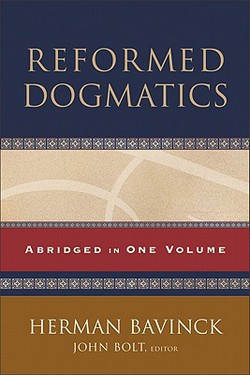
REFORMED DOGMATICS – Herman Bavinck

dogReformed Dogmatics by Herman Bavinck (1854-1921) is arranged like a standard systematic theology text and includes seven branches of theology overall.  Bavinck was a seminal thinker in his day and deserves to be read in ours.  The new abridged volume by Baker Academic is a welcome addition to the growing number of theological works in print.

The writing, while dense at times is easy to follow and offers readers a Reformed framework which stands in the tradition as writers such as Warfield, Hodge, and Edwards.

Perhaps an assortment of citations will give readers a better idea of Bavinck’s style and theological convictions:

The entire life of the Christian is dedicated to the worship of God – we are not our own; we are God’s.  We belong to God completely and always, in life and in death.

Sin, therefore, is never an arbitrary matter, merely a whimsical displeasure of a jealous God.  Sin is knowingly breaking God’s command and flows from a heart that rebels against God.

… The human heart and head can rest in God’s will, for it is the will of an almighty God and a gracious father, not that of a blind fate, incalculable chance, or dark force of nature.  His sovereignty is one of unlimited power, but also of wisdom and grace.  He is both king and father at one and the same time.

Mystery is the lifeblood of theological reflection.  From the start of its labors, dogmatic theology is shrouded in mystery; it stands before God the incomprehensible One.  This knowledge leads to adoration and worship; to know God is to live.

The content of the Christian faith is the knowledge of God in his being and in his works.

Even the abridged edition weighs in at 777 pages, so readers will need to demonstrate a measure of discipline and patience in order to reach the finish line of Dogmatic Theology.  But the time and effort will be well-spent and one dives into the deep end of the theological pool.

Highly recommend!


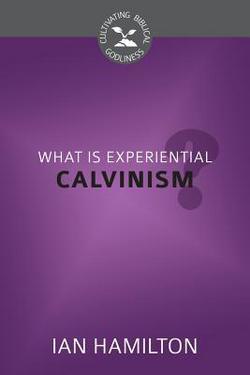
WHAT IS EXPERIENTIAL CALVINISM? – Ian Hamilton (2015)

calvinismEach year, I put together a “top ten list,” books that have personally encouraged me; books that I would commend to others.  It is unusual to include a booklet in such a list but after reading Ian Hamilton’s, What is Experiential Calvinism this book will certainly make the top ten list in 2015.

Calvinism is quite possibly one of the most misrepresented system thoughts – both in the church and in the marketplace of ideas.  Christians and non-Christians alike slice and dice this theological system into a cruel concoction which has nothing to do with Calvinism.  This twisting and maniacal maneuvering made famous by the likes of critics such as  David Hunt does nothing to serve people.  Rather, it confuses the unsuspecting and irritates those who no better.

But Hamilton makes this much clear.  While Calvinism as such is a theological system, it is much more than a system.  It is at the very warp and woof of biblical theology.  “Experiential Calvinism” writes Hamilton, has one preeminent concern: to glorify God.”

A substantial part of the book is committed to summarizing the main components of experiential Calvinism.  The author presents eight in particular.  Instead of summarizing each point, readers are encouraged to dig into Hamilton’s work so as to discover the deeper realities behind each component.  The eight points are summarized as follows:

  1. The experiential Calvinist honors God’s unconditional sovereignty.  The author cites B.B. Warfield, who argues, “Calvinists are humble souls, who, in the quiet of retired lives, have caught a vision of God in His glory and are cherishing in their hearts that vital flame of complete dependence on Him which is the very essence of Calvinism.”
  2. The experiential Calvinist cherishes God’s grace.
  3. The experiential Calvinist has a deep sense of the sinfulness of sin.
  4. The experiential Calvinist lives before God’s face.
  5. The experiential Calvinist shapes all of life by the revelation of God’s unimpeachable holiness.
  6. The experiential Calvinist is content and satisfied with scriptural worship.
  7. The experiential Calvinist pursues godly catholicity.
  8. The experiential Calvinist cultivates communion with God.

I stand with a handful of other Reformed minded people who take exception to the so-called Regulative Principle which is described in the sixth component.  Hamilton obviously writes with the best of intentions but gets boxed in by a mindset which canonized the past and neglects elements of contemporary worship.  Certainly, there is much drivel in the contemporary music scene.  But much good is being accomplished as well.  To ignore some of the songs being written by artists such as Stewart Townend, Matt Redman, and Chris Tomlin is a mistake. Perhaps 1 Corinthians 10:31 should guide this discussion about worship.

This of course, is a minor criticism in light of the whole.  Indeed, this concern is a mere “bump in the road” and should not distract readers from devouring the rest of the book.  Iain Hamilton has served the church well by boiling down the essence of Calvinism which will lead people in the right direction for all the right reasons.

What is Experiential Calvinism is a must-read.  It is both corrective and Christ-centered and offers the right blend of admonition and encouragement.  My hope is that thousands and thousands of people will literally consume this little book and benefit immensely from the godly wisdom here.

5 stars

EMPIRE’S END – Jerry Jenkins (2015)

“I preached Christ and Him crucified, and many more became empirebelievers.”  This sentence summarizes the essence of the book, Empire’s End by Jerry Jenkins.  It is the gospel of the Lord Jesus Christ that fueled the resolve of Paul the apostle.  It is the gospel that motivated his every action.  It is the gospel that he lived for.  That same gospel, he died for.

Empire’s End is historical fiction.  Anytime an author sets out to capture a historical setting in a novel, he walks a fine line.  On the one hand, this genre allows a certain flexibility and enables the writer to utilize what some have referred to as a “sanctified imagination.”  This is entirely appropriate so long as the imagination stays within biblical bounds.  On the other hand, this genre poses difficulties for some readers have difficulty separating fact from fiction.

Jenkins does a good job of painting a portrait of Saul of Tarsus, the religious zealot who is miraculously regenerated on the Damascus road.  He shows the tension that exists in this newly converted man as he faces people he hated only moments before.

Jenkins develops several biblical characters and fictional characters that keep the story moving and help show the cultural context that Paul ministered in.

While the novel reads easily and holds the attention of the reader, there is a propensity to get caught up in the story while forgetting the actual historical context.  Whether that is the fault of the author or the reader is left for the jury to decide.

Overall, Empire’s End is an enjoyable read.  The intent is clearly to magnify the great God as his purposes unfold in the life of his servant, the apostle Paul.

I received this book free from the publisher.   I was not required to write a positive review. 

3.5 stars

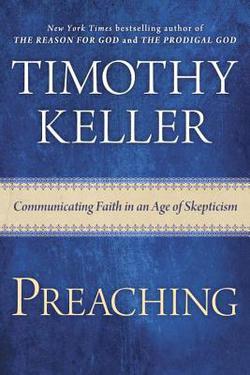
Preaching: Communicating Faith in an Age of Skepticism – Tim Keller (2015)

kellrThe two words that immediately come to mind when considering Tim Keller’s new book is this: rocket fuel.  Keller’s book is a supercharged approach to expository preaching.

Preaching: Communicating Faith in an Age of Skepticism stands alone in book market that includes several approaches to preaching.  Some books provide preachers with the nuts and bolts or the mechanics of preaching.  Others focus on the rationale for expository preaching.  Keller’s work includes both and so much more.

Readers will be drawn to a few important items that stand out in this work:

The Centrality of the Gospel

First, Keller is relentless about the necessity of gospel preaching.  He stands with C.H. Spurgeon who famously admonished preachers to “preach a text and make a beeline to the cross of Christ.”  Keller repeatedly challenges preachers to preach “Christ crucified,” to “preach Christ through every theme of the Bible.”  Wherever the preacher finds himself in the biblical text, he must alert the listener to the person of Christ and the completed work of Christ.  It is this feature that makes Keller’s work unique and should propel his work to the required reading list of every Bible College and Seminary course that pertains to preaching.

The Importance of the Heart

Second, Keller focuses on the heart in biblical preaching: 

Preaching cannot simply be accurate and sound.  It must capture the listeners’ interest and imagination; it must be compelling and penetrate to their hearts.  It is possible to merely assert and confront and feel we have been very ‘valiant for truth,’ but if you are dry or tedious, people will not repent and believe the right doctrine you present.  We must preach so that, as in the first sermon on Pentecost, hearers are ‘cut to the heart.’

Dr. Keller walks readers through a critical discussion of the heart which is “the seat of the mind, will, and emotions, all together.”  Critical to this discussion is the idea that expository preaching must move the heart to action.  Keller notes, “It is all-important, then, that preaching move the heart to stop trusting and loving other things more than God … So the goal of the sermon cannot be merely to make the truth clear and understandable to the mind, but must also be to make it gripping and real to the heart.”  Thus, Keller highlights the primacy of both the heart and the mind.  To exclude the mind in the preaching endeavor will lead to contentless preaching.  But to exclude the heart will necessarily lead to preaching which is void of application.

The standout feature of this section is Keller’s treatment of Jonathan Edwards and his approach to the heart in preaching.  Edwards refuses to pit the heart against the mind and argues for a view of preaching that integrates both.  Keller does a terrific job of expounding Edwards’s work, Religious Affections and the impact such of view has on preaching.

There is much to commend in Keller’s work on preaching.  Readers are encouraged to dive in and benefit from this godly man who has mastered the preaching task.  May the rocket fuel in Keller’s work launch many sermons into the stratosphere for the glory of God!

Other titles that will serve preachers well include The Supremacy of God in Preaching by John Piper, He is Not Silent: Preaching in a Postmodern World by Al Mohler, The Kind of Preaching God Blesses by Steven Lawson, and Preaching and Preachers by Martyn Lloyd-Jones.

I received this book free from the publisher.   I was not required to write a positive review. 

4.5 stars


Systematic Theology: An Introduction to Christian Belief – John Frame (2013)

a frameHow does one review a systematic theology by one of the leading minds of the evangelical world?  How does one summarize the thoughts of a 1,100-page book that towers with truth; a book that takes readers to the top of the theological mountain?  Anyone who attempts to read and devour Systematic Theology by John Frame will be faced with such questions.  Indeed, while the oxygen is scarce at the top of this theological peak, readers will be delighted to enjoy the view that Dr. Frame presents.  As one might expect, every branch of systematic theology is explored.  The author invites readers on a journey which introduces them to God who relates to creatures as their covenant Lord.  The three lordship attributes are articulated throughout the book – control, authority, and presence.

Several thoughts help capture the essence of this incredible book.  While some will be put off by such thoughts, my hope is that a majority of readers will be motivated and inspired to pick up Dr. Frame’s work.  This powerful book is marked by at least ten features:

  1. It is God-Centered
  2. It is Scripture-soaked
  3. It is unashamedly Calvinistic
  4. It is conservative
  5. It exposes liberal scholarship and lays bare its erroneous presuppositions
  6. It is biblical
  7. It is mind-penetrating
  8. It is heart-softening
  9. It is personal
  10. It leads readers to worship God

Systematic Theology: An Introduction to Christian Belief by John Frame is a theological tour de force.   This weighty volume is drenched with Scripture and is drowning with biblical wisdom.  I cannot think of any other writer who has influenced my thinking, outside of Jonathan Edwards himself.  This work is a true labor of love, a gift to the church, and a tool that will sharpen the minds of Christ-followers and serve as a heart-tenderizer for many years to come!

Highly recommended

5 stars

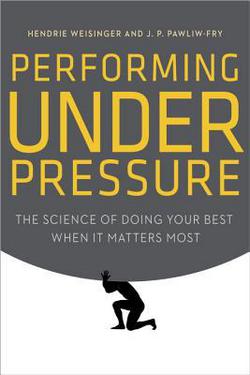
PERFORMING UNDER PRESSURE – Hendrie Weisinger and J.P. Pawliw-Fry (2015)

pressurePerforming Under Pressure: The Science of Doing Your Best When It Matters Most  is a fascinating book that seeks to provide readers with “pressure solutions” to help “immunize themselves against the sabotaging effects of pressure.”  These “pressure solutions” are, in the final analysis, the “short-term strategies for overcoming pressure.”

The authors make it clear in advance that “managing the pressure of the moment will allow you to perform closer to your capability, which increases your likelihood of being successful.”

The book is supported by thousands of hours of research and suggests that “helping people manage pressure in their lives is an untapped strategy for unleashing their creative and intellectual potential.”

Part 1 gives an overview of the nature and science of pressure.  Readers learn the difference between stress and pressure and why they feel “heat” in a pressure filled moment.  This section is truly worth the price of the book.

Part 2 includes twenty-two pressure solutions.  These strategies are designed to help readers work through periods of pressure and respond appropriately.

Part 3 includes long-term strategies and practical help for people who face pressure.  The authors encourage readers to wear a COTE of Armor, a clever acronym that stands for confidence, optimism, tenacity, and enthusiasm.  The authors reveal, “The emotional blending of confidence, optimism, tenacity, and enthusiasm makes up the fabric of that coat.  With these attributes, you can immunize yourself against pressure so that your capability isn’t diminished or compromised by it, giving yourself your best chance to succeed.”

The main criticism I offer is that the book relies heavily on evolutionary theory.  The irony of this approach is that the data presented is based on time-tested and pain-staking research.  To rely on, and place so much stock in a theory such as evolution that will never be proven, detracts from some of the otherwise sound principles.

However, readers who embrace historic Christianity (as I do) should be careful not to discount what the authors present.  For all truth is God’s truth.  There is no reason to reject a given principle if the principle is supported by Scripture, reason, and experience.

Performing Under Pressure is a worthy and helpful read.  It contains many practical suggestions that may be tailor-made to different people at different junctures.

I received this book free from the publisher.   I was not required to write a positive review. 

3.5 stars

LIVING IN THE GRIP OF RELENTLESS GRACE – Iain Duguid (2015)

graceJohn Newton said, “I am a great sinner and Christ is a great Savior.”  He was touched and transformed by God’s grace, or as Newton put it in his famous hymn, “amazing grace.”  Iain Duguid’s book, Living in the Grip of Relentless Grace draws readers into the drama that plays out in the Old Testament.

Duguid highlights the grace of God in the lives of several Old Testament saints, but focuses much of his attention  on Isaac and Jacob.

Readers who are familiar with Iain Duguid know of his deep and abiding love of the gospel and his skill in surfacing gospel realities in Bible stories.  This work is no exception.  This essays are clear, practical, and gospel-centered.  Each chapter is drowning in gospel-centered reality; reality that young preachers should familiarize themselves with.

There is so much to commend here.  But some of the author’s closing thoughts help summarize the essence of the book:

God’s sovereign purpose prevails even in the lives of wicked people … God’s work of redemption was accomplished in the midst of the most heinous sin of all history!  Through an act of human rebellion, Christ’s perfect life was offered up as an acceptable sacrifice to God the Father in our place.  By that act, we are saved.  Jacob and all his spiritual children are redeemed by sovereign, relentless grace, and we receive the blessing that God planned from all eternity.

God’s grace relentlessly pursues his people in a way that brings him glory and showcases his majesty to the nations.

Highly recommended!

I received this book free from the publisher.   I was not required to write a positive review. 
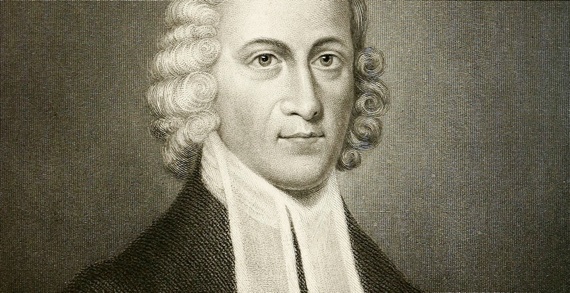


THE END OF THE WICKED CONTEMPLATED BY THE RIGHTEOUS – Jonathan Edwards

The text is Revelation 18:20 —

Rejoice over her, thou heaven, and ye holy apostles and prophets; for God hath avenged you on her.

Jonathan_Edwards_engraving

The sermon by Jonathan Edwards is comprised of four headings:

1. When the saints in glory shall see the wrath of God executed on ungodly men, it will be no occasion of grief to them, but of rejoicing.

Edwards poses an argument that is counterintuitive but biblical, nonetheless.  That saints in eternity future will not only see the wrath of God executed against the ungodly; they will rejoice at the sight of it.  Edwards gives two evidences of this:

  • That the seeing of the wrath of God executed upon the damned, should cause grief in the saints in glory, is inconsistent with that state of perfect happiness in which they are.
  • The saints in heaven possess  all things as their own, and therefore all things contribute to their joy and happiness.

2. Why the sufferings of the wicked will not be cause of grief to the righteous, but the contrary.

Edwards supplies a negative and positive rationale for why this proposition is true:

  • Negatively – It will not be because the saints in heaven are the subjects of any ill disposition; but on the contrary, this rejoicing of theirs will be the fruit of an amiable and excellent disposition: it will be the fruit of a perfect holiness and conformity to Christ, the holy Lamb of God.
  • Positively – The sufferings of the damned will be no occasion of grief to the heavenly inhabitants, as they will have no love nor pity to the damned as such.

Edwards argues that God is greatly glorified in the eternal damnation of ungodly men.  Once again, his argument appears counterintuitive but is in agreement with the biblical record.

The Northampton preacher continues to unfold  how God’s redeemed will respond at the sight God’s wrath as it is unleashed on unregenerate people:

  • They will rejoice in the seeing the justice of God glorified in the sufferings of the damned.
  • They will rejoice in it, as it will be a glorious manifestation of the power and majesty of God.  God will show his own greatness in executing vengeance on ungodly men.

3. Objections Answered

Like a good attorney, Edwards anticipates objections.  The objection is stated as follows: “Why is it not an unbecoming thing in the saints in glory to rejoice when they see the damnation of the ungodly?” Five responses are offered:

  • It is now our duty to love all men, though they are wicked; but it will not be our duty to love wicked men hereafter.
  • We ought now to seek and be concerned for the salvation of wicked men, because now they are capable subjects of it.
  • Rejoicing at the calamities of others now, rests not on the same grounds as that of the saints in glory.
  • The different circumstances of our nature now, from what will be hereafter make that a virtue now which will be no virtue then.
  • The vengeance inflicted on many of the wicked will be a manifestation of God’s love to the saints.

4. The Ungodly Warned

In the closing section, Edwards offers a stern warning to unregenerate people.

  • How destitute of any comforting consideration your condition will be, if you perish at last.
  • Consider how it will be at the day of judgment, when you shall see Christ coming in the clouds of judgment, when you shall begin to wail and cry; as knowing that you are those who are to be condemned.
  • If you now repent, before it be too late, the saints and angels in glory will rejoice at your repentance.
  • If you repent before it is too late, you yourselves shall be of that joyful company.

This sermon is a vivid reminder of the reality of hell’s torments.  But it is also a powerful reminder of God’s love and grace shown to all the elect!

THE TRELLIS AND THE VINE – Colin Marshall and Tony Payne (2009)

Over six years ago, I read The Trellis and the Vine by Colin Marshall trellisand Tony Payne.  The work was encouraging and helpful in those days but my second read through was far more significant.

The authors compare the local church to the trellis and a vine, the kind of masterpiece found in many backyards.  Marshall and Payne maintain, “Most churches are a mixture of trellis and vine.  The basic work of any Christian ministry is to preach the gospel of Jesus Christ in the power of God’s Spirit, and to see people converted, change and grow to maturity in that gospel.”  However, a problem arises when the trellis begins to overtake the vine.  When church structure becomes more important that the actual vine, something is dreadfully wrong.  Yet in many churches, ministry structure has overshadowed the vine, the ministry that involves people who are growing because of the work of the gospel.

Marshall and Payne set out to correct the emphasis from the trellis to the vine.  The fundamental working idea in the book is this: The disciple-making agenda should be the priority of each and every disciple.  In the final analysis, the goal in every church is to grow the vine, not maintain the trellis.

The book is filled with ideas to fulfill the primary objective of discipleship.  At the heart of the strategy is a commitment to train faithful people for the work of the ministry – so disciples begin making disciples.

The Trellis and the Vine provides the needed corrective that has been missing from most churches.  The message is simple and challenging.  The message is biblical.  Now – its time to get busy making disciples!

THE ETERNITY OF HELL TORMENTS – Jonathan Edwards (1739)

Jonathan_Edwards_engravingThe doctrine of hell is under attack.  The opposition to eternal punishment is more diverse than one might expect as unbelieving philosophers and some pastors in the emergent church seek to extinguish this doctrine once and for all.

In the 18th century, people opposed hell as well.  Yet it was taught with more faithfulness and fervency than most pulpits in these days.  Jonathan Edwards’ sermon, The Eternity of Hell Torments is a fitting example of this faithfulness and fervency.

The text is Matthew 25:46 – These shall go away into everlasting punishment.  Two initial observations are advanced:

  1. The duration of the punishment on which they are here said to enter: it is called everlasting punishment.
  2. The time of their entrance on this everlasting punishment.

The doctrine as also set forth:

The misery of the wicked in hell will be absolutely eternal.

With the presuppositions and doctrine in place, Edwards moves forward by advancing four key points.

1. It is not contrary to the divine perfections to inflict on wicked men a punishment that is absolutely eternal.

Edwards argues that sin deserves such a punishment, namely, “that sin is heinous enough to deserve such a punishment, and such a punishment is no more than proportionable to the evil or demerit of sin.”

It is not contrary to God’s mercy to inflict eternal punishment on sinful men. Indeed, “It would be a great defect, and not a perfection, in the sovereign and supreme Judge of the world, to be merciful in such a sense that he could not bear to have penal justice executed.”

2. The eternal death which God threatens, is not annihilation, but an abiding sensible punishment or misery.

The Scripture never hints at the God-dishonoring doctrine of annihilation – a doctrine that surfaces in Edwards day and is even more popular now.  The argument against annihilation is clearly articulated here.

3. This misery will not only continue for a very long time, but will be absolutely without end.

Edwards utilizes several exegetical, grammatical, and biblical  arguments to point readers to the reality of eternal punishment.  “Such expressions,” says the Puritan divine, “are used to set forth the duration of the punishment of the wicked, as are never used in the scriptures of the New Testament to signify any thing but a proper eternity.”

4. Various good ends will be obtained by the eternal punishment of the wicked.

Edwards presents four good ends of eternal punishment:

  • Hereby God vindicates his injured majesty.
  • God glorifies his justice.
  • God hereby indirectly glorifies his grace on the vessels of mercy.
  • The sight of hell torments will exalt the happiness of the saints forever.

He notes, “The sight of the wonderful power, the great and dreadful majesty, and awful justice and holiness of God, manifested in the eternal punishment of ungodly men, will make them prize his favor and love vastly the more; and they will be so much the more happy in the enjoyment of it.”

Application

In typical Edwardsean fashion, the author concludes by setting forth three important points of application:

  1. Be entreated to consider attentively how great and awful a thing eternity is.
  2. Do but consider how dreadful despair will be in such torment.
  3. That you may effectually escape these dreadful and eternal torments, be entreated to flee and embrace him who came into the world for the very end of saving sinners from these torments, who has paid the whole debt due to the divine law, and exhausted eternal in temporal sufferings.

And Edwards directs the attention of every reader to Christ and his gospel:

Justice therefore never can be actually satisfied in your damnation; but it is actually satisfied in Christ.  Therefore he is accepted of the Father, and therefore all who believe are accepted and justified in him.  Therefore believe in him, come to him, commit your souls to him to be saved by him.  In him you shall be safe from the eternal torments of hell.