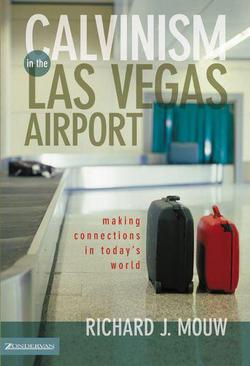
CALVINISM IN THE LAS VEGAS AIRPORT – Richard Mouw (2010)

acI am a Calvinist.  Since I paid a visit to the Las Vegas airport a few weeks ago, I felt compelled to read Richard Mouw’s book, Calvinism in the Las Vegas Airport.

The author is interested, as the subtitle suggests, in “making connections in today’s world.”  Mouw rightly notes that some Calvinists are stuck in the Netherlands and have a difficult time reaching out and relating to postmodern people.

The Basics of Calvinism

The author admits upfront that he believes that Calvinism is essential to the gospel.  Such an admission caught my attention – so I read on.

Ultimately, Dr. Mouw seeks to answer one basic question: “How can I best be a Calvinist in the twenty-first century?”  The question is well-placed and deserves an answer.

Part of the answer involves a basic explanation of the historical origins of the theological system that has been labeled, “Calvinism.”  The author rightly adds, “But unlike other traditions, Calvinism rigorously guards this emphasis on divine sovereignty by refusing to allow any other theological point to detract from it.”  Mouw continues by providing a biblical rationale for the five points of Calvinism.

The Blunder in Las Vegas

The tone of the book is warm, the discussion is thought-provoking.  And the discussion that concerns Calvinism is helpful.  Yet a problem begin to surface as the author appears to be sympathetic to inclusivism.  He speaks about unbelievers who will “bow in worship, acknowledging that Jesus is the One whom he should have named all along … and that the Savior will welcome him into the eternal kingdom.”

The author refers to another unconverted friend and wonders out loud: “Is it possible that in this process of surrendering her will to her ‘Higher Power,’ she has, at some level of her being, reached out to accept God’s offer of salvation through Jesus Christ – even though she is present psychologically incapable of articulating her experience in those terms?”

So the book takes a turn that I never expected.  Yet the author laments, ” … I can be sure that I have not wandered too far from the Calvinist path.”

At the end of the day, we find the reality of unconditional election being pitted against God’s generosity, what the author refers to as “divine stinginess.”

Mouw argues for a kinder and gentler Calvinism.  This is commendable and should be encouraged.  But compromising truth for the sake of kindness is not only wrongheaded; it fails to glorify God and in the final analysis.  Compromising truth fails to love others and serve them well.

Calvinism in the Las Vegas Airport is a worthy idea that takes off well but ends up making a crash landing on the wrong runway.

2 stars

Scary Close – Donald Miller

aI admire Donald Miller.  I admire his courage.  I admire his tenacity.  And I admire his ability to tell a story.  Make no mistake – this guy can write!  Admiring Don Miller, however, does not mean I agree with everything he believes.  There’s a good deal I disagree with.  Yet I appreciate his gifts and insight.  Such appreciation is expressed in an earlier review on Miller’s book, A Million Miles in a Thousand Years.  For me, reviewing a Don Miller book is like walking a tight rope.  On one hand, I have conservative friends who question why I even read the guy.  But Miller fans label my critique as “narrow” or “too evangelical.”

Scary Close addresses the subject of relational intimacy.  The book includes some ideas that are commendable and will be of help to many people.

Strengths in Scary Close

1. It is filled  with a stunning degree of transparency.

Miller opens up like never before.  He is quick to confess some of his previous relational blunders.  He admits his propensity to generate applause.  Yet in a moment of unfettered honesty, he admit that “applause is a quick fix.  And love is an acquired taste.”  This kind of openness and honesty sets the stage for the book and never lets up.  Miller shares his heart in a way that is noteworthy and encouraging.

2. It cherishes authenticity and rejects hypocrisy.

Scary Close is packed with moments of authenticity which help readers get to the very heart of the story.  The subtitle accurately conveys what Miller is after, namely – “dropping the act and finding true intimacy.”

At an important juncture, Miller discusses the toxic nature of judgment, that is, being judged unfairly by other people – for being ourselves.  The author suggest that this poisonous habit has invaded many relationships which “keeps us from connecting with other people.”  Ultimately, Miller does a good job at identifying some of the relational land mines the hinder genuine intimacy.

3. It celebrates human relationships.

The most memorable thing about Scary Close is that it celebrates human relationships.  The author discusses his most important relationships, the chief of which is his wife and shows how true intimacy develops.  Miller is to be commended for his willingness to share from the heart and allow readers to see how his heart operates.

Weaknesses in Scary Close

Strengths considered, there is a missing ingredient in Scary Close.  That ingredient is the gospel of Jesus Christ.  Yes, the author confesses his allegiance to Jesus.  And the author refers to God and finding rest in him.  This much is true.  But the road to authentic intimacy (which is a necessary path to travel) is paved with psychological tips and therapy which is not grounded in Scripture. Such a critique is bound to draw fire from Miller fans.  Yet Miller himself urges readers to avoid being careful, a practice which led to a temporary bout with “writer’s block.”  I apply that well-placed advice when offering critique.

So while there is much to commend in this book, in the final analysis it falls short by jettisoning the gospel.  Since the essence of the book is about reconciliation, it is disappointing to bypass the promises of the gospel which offers reconciliation with people  and reconciliation with God through his Son, the Lord Jesus Christ.  Indeed, resting in one’s relationship with God through Jesus is the key to wholeness which leads to relationships which are known for authenticity, health, and intimacy.

I received this book free from the publisher.   I was not required to write a positive review. 

RUNNING SCARED – Edward T. Welch (2007)

aRunning Scared by Edward T. Welch is a book for all people.  The author is quick to point out the struggle that people have with fear:

Fear and worry run deep in us all.

Fear and worry have meaning.  They say something.  

Fear and worry say that the world is dangerous.  

Fear and worry reveal us.  They reveal the things that we love and value.

Dr. Welch explains fear, isolates fear, and exposes this cruel task master.  Fear is examined in light of God’s Word which includes a penetrating answer for anyone willing to look carefully at God’s promises and embrace the hope held out in the gospel.

Running Scared contains over 300 pages of help for people who battle fear.  My advice: Run quickly to your computer and order a copy of Running Scared!

4 stars

OUR SOVEREIGN SAVIOR: THE ESSENCE OF THE REFORMED FAITH – Roger Nicole (2002)

a sovereignRoger Nicole is a new name for many people in the church.  But in the academy, he is a well-known name and one of the key defenders of the Reformed faith.

Our Sovereign Savior: The Essence of the Reformed Faith is a collection of articles that explain and defend the primary tenets of the doctrines of grace.  The author explores the doctrine of the Trinity, Calvinism, and specific aspects of salvation – reconciliation, propitiation, justification, and sanctification.

Nicole’s approach is typically gracious and is grounded by careful scholarship.  The book is simple enough for a beginning theology student but should not be neglected by more advanced readers.

On December 11, 2010 Dr. Nicole went to be with his Savior.  He was a gift to the church and will be missed.  But his legacy lives on as a man who was committed to articulating the Reformed faith with faithfulness and precision.

Semper Reformanda!

THE TRUE EXCELLENCY OF A MINISTER OF THE GOSPEL – Jonathan Edwards

Jonathan_Edwards_engravingIn this masterful sermon, Jonathan Edwards sets forth what sets apart
a minister of the gospel.

He establishes his doctrine at the beginning of the sermon:

‘Tis the excellency of a minister of the gospel to be both a burning and a shining light.

Six propositions guide the doctrinal assertion:

  1. I would show that Christ’s design, in the appointment of the order and office of ministers of the gospel is, that they may be lights to the souls of men.
  2. I would show what is implied in their being “burning lights.”
  3. I would show what is implied in their being “burning lights.”
  4. I would show that it is the proper excellency of ministers of the gospel to have these things united in them, to be both burning and shining lights.
  5. I would apply these things to all that Christ has called to the work of the gospel ministry, showing how much it concerns them earnestly to endeavor that they may be burning and shining lights.
  6. Show what ministers of the gospel ought to do that they may be so.

The sermon shines brightest in the first proposition as the Puritan divine explains the three-fold use of light, namely – to discover, to refresh, and to direct.

Indeed, pastors have a weighty responsibility, especially in the preaching task to show forth the light of the gospel in ways that are understandable, and in keeping with the truth of God’s Word.


HOPE BEYOND THE GRAVE WHEN A FRIEND DIES

kendal

JIM KENDALL (1967-2015)

VERSE 1 

It is not death to die
To leave this weary road
And join the saints who dwell on high
Who’ve found their home with God
It is not death to close
The eyes long dimmed by tears
And wake in joy before Your throne
Delivered from our fears

CHORUS
O Jesus, conquering the grave
Your precious blood has power to save
Those who trust in You
Will in Your mercy find
That it is not death to die

VERSE 2
It is not death to fling
Aside this earthly dust
And rise with strong and noble wing
To live among the just
It is not death to hear
The key unlock the door
That sets us free from mortal years
To praise You evermore

© 2008 Integrity’s Praise! Music/Sovereign Grace Praise (BMI)

IF I HAD LUNCH WITH C.S. LEWIS – Alistair McGrath (2014)

C.S. LewisC.S. Lewis is widely trumpeted as one of the leading Christian thinkers and apologists of the 2oth century.  His seminal works, Mere Christianity and The Problem of Pain have equipped a new generation of Christ-followers.  Creative works like The Great Divorce have stimulating the imaginations of thousands.  And who could forget his landmark series, The Chronicles of Narnia which continue to sell like hotcakes over fifty years later.

Alister McGrath is a leading authority on C.S. Lewis.  Like Lewis, the author teaches at Oxford University where his interest in Lewis blossomed.

If I Had Lunch With C.S. Lewis is a basic introduction to the life and writing of the Oxford don.  McGrath arranges a series of imaginary lunches with Lewis where they chat about subjects that matter – friendship, story-telling, learning, theology, apologetics, and suffering.

If I Had Lunch With C.S. Lewis is a perfect introduction to entry level readers who are not familiar with the literary genius.  The book offers enough information to satisfy beginners but also contains plenty of fuel for readers more familiar with Lewis.

3.5 stars


FINISHING OUR COURSE WITH JOY: Guidance From God For Engaging With Our Aging – J.I. Packer (2014)

packerGetting old is something everyone can relate to.  But at eighty-eight years of age, J.I. Packer is uniquely qualified to share biblical principles that concern the subject of aging.

Most people know that Dr. Packer is a first-rate theologian who has influenced untold thousands of people over the years.  Packer shares his God-given gifts and experience which include a tenure longer than most people can imagine in his latest book, Finishing Our Course: Guidelines For Engaging With Our Aging.

In a style that we’ve grown to love over the years, Packer expresses his heart in a youthful wittiness which is combined with a depth of theological and emotional maturity: “Aging is not for wimps,” he says.

Dr. Packer is careful to remind readers of the biblical perspective on aging: “The Bible’s view is that aging, under God and by grace, will bring wisdom, that is, an enlarged capacity for discerning, choosing, and encouraging.”  He makes a strong case for being productive in the golden years: “And my contention is going to be that, so far as our bodily health allows, we should aim to be found running the last lap of the race of our Christian life, as we would say, flat out.  The final sprint, so I urge, should be a sprint indeed.”

Such a worldview runs against conventional wisdom.  The world notion is growing old includes focusing on self, spending money on self.  There is a not so subtle brand of narcissism that is plaguing many adults; a narcissism that needs to be rooted out and replaced with God-centered ambition.  Packer helps eradicate this selfishness which is all too common in American culture, especially.

I found Finishing Our Course to be helpful on so many levels.  It contains the biblical wisdom that is necessary to inform and motivate anyone who desires to finish well – all to the glory of God.