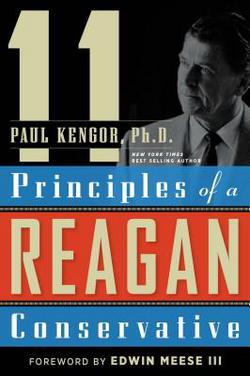
11 PRINCIPLES OF A REAGAN CONSERVATIVE – Paul Kengor (2014)

reaganRonald Reagan was a principled man.  Unlike most modern-day politicians, President Reagan governed from a set of unchangeable principles that guided his life, not to mention, his nation.

Paul Kengor presents these unshakable principles that undergirded President Ronald Reagan.  These principles of conservatism include:

1. Freedom

2. Faith

3. Family

4. Sanctity and Dignity of Human Life

5. American Exceptionalism

6. The Founders’ Wisdom and Vision

7. Lower Taxes

8. Limited Government

9. Peace Through Strength

10. Anti-Communism

11. Belief in the Individual

Kengor summarizes each principle and backs his study with a steady diet of Reagan quotes.  This is a highly readable and informative book that would be perfect for a high school student or anyone who seeks to learn more about President Ronald Wilson Reagan.

4 stars

RONALD REAGAN 100 YEARS (2011)

0062014862_bRonald Reagan 100 Years is a celebration of the life and legacy of Americas greatest president.  The chairman of the Ronald Reagan Presidential Foundation, Frederick J. Ryan, Jr. writes, “In celebrating the centennial of Ronald Reagan’s birth, we remember an extraordinary man who touched our hearts.  A man whose natural optimism gave us hope.  Whose strong principles and devotion to the cause of freedom gave us confidence.  Whose smooth, reassuring voice gave us courage.  And whose unwavering belief in the American dream made us believe in ourselves.”

Ronald Reagan 100 Years is a vivid reminder of the influence of the man who reminded us of the importance of  a strong work ethic, the peace through strength, lower taxes, and the pursuit of the American dream.  This beautiful edition is filled with memorable photographs that will stir the memories of readers and inspire them to return to the American ideal.

June 5, 2014 marks the ten-year anniversary of the death of President Reagan.  In memory of my favorite president, the next seven days will be devoted to posts that celebrate his memory.

HOW GOD BECAME JESUS – Edited (2014)

0310519594_bBart Ehrman is the James A. Gray Distinguished Professor at the University of North Carolina at Chapel Hill.  His Christological musings have caught the attention of scholars and pastors alike as he repudiates much of what passes for conservative scholarship.

Ehrman maintains that Jesus thought of himself as Messiah, but did not think of himself as God.  He argues that Paul understands that Jesus is an angelic being.  He holds that Jesus is not God.

The authors of How God Became Jesus respond critically to his Ehrman’s primary assertions, some of which are noted above. Frankly, How God Became Jesus contains a wealth of apologetic material in the title alone.  The title itself runs contrary to Ehrman’s latest work, How Jesus Became God.  

Michael Bird, Chris Tilling, Craig Evans, Simon Gathercole, and Charles Hill gather forces to respond critically to Ehrman’s arguments.  The writing is scholarly and offers a rather systematic response to Ehrman.  Readers can decide for themselves if the authors are successful.  In mind, they do succeed, although not without some concern.  There is a degree of sarcasm that surfaces in some of these responses, which in the final analysis does not pay proper honor to their opponent.  I would prefer that the responses were informed by Paul’s words to Timothy – “And the Lord’s servant must not be quarrelsome, but kind to everyone, able to teach, patiently enduring evil, correcting his opponents with gentleness” (2 Timothy 2:24-25, ESV).

I received this book free from the publisher through the BookSneeze®.com  book review bloggers program. I was not required to write a positive review. 

THE CREEDAL IMPERATIVE – Carl R. Trueman (2012)

1433521903_lSeveral months I ago, I posted a piece on Veritas et Lux entitled, “No Creed But Christ.”  I have received a great deal of traffic as a response to this post and much of the feedback has been negative.  Carl Trueman also recognizes (and repudiates) this anti-confessional agenda and affirms the importance of creeds and confessions and seeks to develop a case for the creeds and confessions in his book, The Creedal Imperative.

Trueman’s primary objective is to convince readers that “creeds and confessions are thoroughly consistent with the belief that Scripture alone is the unique source of revelation and authority.”  He also adds, “I want to argue that creeds and confessions are, in fact, necessary for the well-being of the church, and that churches that claim not to have them place themselves at a permanent disadvantage when it comes to holding fast to that form of sound words …”

The Creedal Imperative is a welcome addition to the growing list of resources that is devoted to reviving the historic creeds of the Christian faith.

SEEING BEAUTY AND SAYING BEAUTIFULLY – John Piper (2014)

1433542943_b“A word fitly spoken is like apples of gold in a setting of silver.”  So says King Solomon in Proverbs 25:11.  These wise words are the biblical basis for John Piper’s new book, Seeing Beauty and Saying Beautifully.  Nearly fifteen years ago, Dr. Piper embarked on a series of books called, The Swans Are Not Silent.  The beauty of these books is found in a combination of brevity, historical narrative, and theological depth.  The books set out to introduce key figures in the history of the church – from Augustine, Calvin, and Luther to Bunyan, Wilberforce, and Cowper.  The newest volume introduces readers to George Herbert, George Whitefield, and C.S. Lewis.

The author’s aim, as he says, is “to probe the interrelationship between seeing beauty and saying it beautifully.”  And he accomplishes his goal by pointing to Herbert, Whitefield, and Lewis by demonstrating how these men pointed others to see the beauty of Christ.

Piper spends much of his time laboring over the poetic effort of these men: “Poetic effort is the effort to see and savor and speak the wonder – the divine glory – that is present everywhere in the world God made, in the history God guides, and in the Word God inspired.”

This is the sixth volume in the Swans Are Not Silent series.  Each book stands alone and is brimming with joy and hope, which are centered in the person and work of Jesus Christ.  The newest edition is no exception.  John Piper continues to equip and encourage his readers.  Over and over again, he proves, the swans are not silent.

5 stars

Personal Productivity Unleashed With God-Centered Resolve

0310494222_bIt’s been almost twenty-five years since I first read The Seven Habits of Highly Effective People by Stephen Covey.  Since then, many of the principles that Covey explores have been a part of the fabric of my life.

A few years back, I had the opportunity to read David Allen’s best selling book, Getting Things Done.  Like Covey, he added some ammunition that helped in the area of personal productivity.

Matt Perman picks up where Covey and Allen left off.  His new book, What’s Best Next contains the best of Stephen Covey and David Allen.  But Perman’s work contains a significant difference.  And the distinction he introduces makes all the difference in the world.  Matt Perman helps readers understand how the gospel transforms the way we get things done.

What’s Best Next is filled with practical hints that will ramp up personal productivity – but never as an end in itself (which appears to be a flaw in both Covey and Allen).  Perman argues that personal productivity should have an end game.  Personal productivity, should enhance our ability to help people.  He adds, “We should care about personal productivity not simply for our own sakes but also for the sake of others.”

Anyone familiar with Covey or Allen will freely admit that these writers have the best intentions in mind.  And I have personally benefitted greatly from their work.   But Matt Perman is concerned first and foremost with the gospel of Jesus Christ.  He helps readers understand how their productivity can be enhanced in four specific areas including personal life, work life, organizational life, and society.

What’s Best Next is one of those books that is nearly impossible to review in a comprehensive way.  Principles could be explored that the author promotes and productivity hints could be shared.  But readers would inevitably be cheated – because this book is a gold mine.  It deserves to be read by every person who has a passion for the great commission and the great commandment.  Simply put, it will enhance one’s ability to serve God and people with maximum effectiveness.

The aim of Matt Perman is to “reshape the way you think about productivity and then present a practical approach to help you become more effective in your life with less stress and frustration, whatever you are doing.”  The author succeeds, and then some.  I cannot recommend it highly enough!

I received this book free from the publisher through the BookSneeze®.com  book review bloggers program. I was not required to write a positive review. 


REDEFINING LEADERSHIP – Joseph Stowell (2014)

Leaders understand the true nature of the task before them.  But true leadership must stowellbe redefined, according to Joseph Stowell.  His newest book, Redefining Leadership seeks to draw leaders to a “character driven leadership experience that will produce maximum outcomes.”

Stowell presents two distinctly different kinds of leaders: Outcome leaders and character-driven leaders.  The former are referred to as “instinctive” leaders, the later – “kingdom” leaders.  The author describes kingdom leadership which is “measured by the life of a leader who cuts a wide and impactful swath of positive influence.”  This is the kind of leader, in the final analysis, who makes a difference in God’s kingdom.

The book is arranged in three parts:

Part I: A Redefined Priority

Outcome-driven leaders focus primarily end results while character driven leaders live exemplary, God-pleasing lives.  Character-driven leaders “use their organization to build stellar people, who in turn build a thriving culture that produces maximum corporate outcomes to the fame and glory of God.”

The author address potential pitfalls and “delusions” that character-driven leaders need to avoid.  This brand of leader has his eyes fixated on the One who humbled himself and became a Servant to all, namely, Jesus Christ.

Part II: A Redefined Identity

Part 2 introduces the concept of “followership.”  The author maintains effective leaders “choose to identify themselves, first and foremost, as followers!  Followers of Jesus.”  He adds, “Only when we have a firm grasp of our identity as a follower of Jesus are we equipped to effectively lead and influence others.”  Three qualities mark the leader who is committed to the notion of followership:

  1. Follower-leaders count it an honor to follow Jesus.
  2. Follow-leaders actively pursue Christ.
  3. Follow-leaders are found in the “Way” with Him.

Part 2 proves to be the heart and soul of the book as the author spells out the importance of “moral authority” and the importance of humility in a growing leader who commits himself to the “Way” of Christ.

Part III: A Redefined Leader

The final section surveys the core competencies of a leader which is grounded in the kingdom priorities of Jesus.  This leader relies on the strength that is granted through the indwelling Christ.  Indeed, he is committed to the kingdom agenda that emerge in Matthew’s gospel.  Such a leader manifests qualities such as repentance, forgiveness, meekness, and mercy.

Redefining Leadership is a book which is totally unique.  Few books devoted to the topic of Christian leadership are filled with the depth of wisdom found in these pages.  Both young and seasoned Christian leaders would do well to pour over these pages and benefit from Dr. Stowell’s wisdom.

4 stars

I received this book free from the publisher through the BookSneeze®.com  book review bloggers program. I was not required to write a positive review. 

CHURCH ELDERS – Jeramie Rinne (2014)

Everything rises or falls with leadership.  In the local church, this kind of leadership 1433540878_bbegins with pastor/elders.  As such, I believe that the fruitfulness of our churches is dependent upon men who exert strong, humble, and God-centered leadership.  Godly leadership is informed by at least four critical assumptions:

  1. It must be anchored to the Bible.
  2. It must be guided by unshakeable convictions.
  3. It must be based on God’s blueprint – for he has an order for his church.
  4. It must be intensely spiritual.

Church Elders by Jeramie Rinne another fine selection in the 9 Marks Series, edited by Mark Dever. Rinne begins with some basic presuppositions which are designed to guide prospective elders down a path that is both biblical and practical.

The author outlines the qualifications for the office of elder as set forth in 1 Timothy 3, Titus 1, and 1 Peter 5.  The discussion is elementary but is nonetheless very helpful.  In addition, the terms for elder are surveyed (pastor, elder, overseer, and bishop).  There can be no misunderstanding that the terms are synonymous, a feature that seems to be misunderstood by many people.

Elders are called to shepherd the flock.  Therefore, they are called to:

  • Engage in relationships with the flock.
  • Minister with the intent of growing the flock in Christian maturity.

Readers should not be surprised that elders should participate in the teaching ministry of the local church.  This fact is the key factor in distinguishing between men who are called to serve as elders as opposed to deacons.  The elder must be “able to teach” (1 Tim. 3:2).  Rinne makes it clear that this teaching ministry is not limited to the public preaching of God’s Word.  It may include biblical counseling, one-on-one discipleship, classroom instruction, or small group gatherings.  The important take-away is that a qualified elder is able to teach God’s Word – which means he also has a good handle on God’s Word.

Additionally, elders are called to protect the doctrinal sideboards of a church family: “He must play both doctrinal offense and defense, ‘holding to the faithful message as taught, so that he will be able both to encourage with sound teaching and to refute those who contradict it” (Titus 1:9).

Elders are to pay attention to the flock and hold God’s people accountable to their faith commitment as well as their membership commitment.  They are charged with watching over the straying sheep.  The author notes five kinds of straying sheep which include sinning sheep, wandering sheep, limping sheep, fighting sheep, and biting sheep.

Elders must be humble men.  Rinne adds, “The simplest and most effective thing a church can do is to develop an intentional process for screening potential elders, and then be sure to select humble men.”  Men must serve in plurality.  There is no hint of a lone ranger eldership in the New Testament.  The author rightly notes that elders always serve as a team – in plurality.

Church Elders by Jeramie Rinne is a terrific introduction to the subject of biblical eldership.  Readers interested in a more comprehensive treatment may turn to Thabiti Anyabwile’s work, Finding Faithful Elders and Deacons.  For the best survey of this subject, I commend Biblical Eldership by Alexander Strauch.


THE GOSPEL: Recovering the Power That Made Christianity Revolutionary – J.D. Greear (2011)

greearJ.D. Greear’s excellent book, The Gospel: Recovering the Power That Made Christianity Revolutionary is based on a simple prayer:

“In Christ, there is nothing I can do that would make You love me more, and nothing I have done that makes You love me less.”

“Your presence and approval are all I need for everlasting joy.”

“As you  have been to me, so I will be to others.”

“As I pray, I’ll measure Your compassion by the cross and Your power by the resurrection.”

The book is a plea to the church to return to the simple gospel – that gospel that is by grace alone, through faith alone, in Christ alone.  The author seeks to convince readers to know and live the gospel.  He adds, “The goal of the gospel is to produce a type of people consumed with passion for God and love for others … Being converted to Jesus is learning to so adore God that we would gladly renounce everything we have to follow him.”

Greear’s book stands among a growing list of books that emphasize the simple gospel of grace.  This should be required reading for every Christ-f0llower!

EXPOSITIONAL PREACHING – David Helm (2014)

Some guys are telling stories from the comfort of a stool.  Others are ranting about 1433543133_bpolitics or psychology.  Many are waxing eloquent about pop culture and exploring the benefits of modern technology.  These well-intentioned fellows may hold an audience and they may attract a crowd.  But one thing is for sure: they’re not preaching.

David Helm sets the record straight in his excellent book, Expositional Preaching.  Four sections make up this book which is a part of the 9Marks Series

Contextualization 

“Contextualization in preaching is communicating the gospel message in ways that are understandable or appropriate to the listener’s cultural context.”

Helm is quick to admit that contextualization is necessary in a solid expositional preaching ministry.  However in many pulpits, contextualization has eclipsed the Bible.  The author helps preachers understand some of the tendencies that can overrule the authority of Scripture in the pulpit.

One instance that is explored is the popular devotional practice, Lectio Divina which has origins in the Roman Catholic church.  This questionable practice places more emphasis on the subjective which ends up marginalizing theological knowledge:  “Lectio Divina advocates a method that is spiritual as opposed to systematically studious.  It substitutes intuition for investigation.  It prefers mood and emotion to methodical and reasoned inquiry.  It equates your spirit to the Holy Spirit.”  Simply put, this devotional practice ignores exegetical tools and sound hermeneutical methodology.  Let the preacher beware!  Lectio Divina is only one example which is cited.  Readers can investigate the other pitfalls for themselves.

Exegesis

Second, the author alerts preachers to the importance of biblical exegesis which should drive every sermon.  Unfortunately, many preachers are bypassing this crucial aspect of sermon preparation and moving directly to application which is in the final analysis, a deadly mistake.

The overriding theme that emerges in this chapter is the importance of knowing the Word of God and understanding the original intent of the author.  But Helm warns, “Exegesis is not enough.  Done in isolation, exegesis alone can lead to preaching that is either overtly intellectual or merely imperatival.”

Theological Reflection

The author encourages a robust adherence to biblical theology and systematic theology as these disciplines inform the preaching task.  In particular, systematic theology offers at least three advantages:

1. It holds you in the faith.

2. It helps you connect to the gospel from particular genres.

3. It hones your ability to speak to non-Christians.

Today

Finally, a positive case is advanced for contextualization.  Now that the preacher has done his exegetical homework, using the tools of biblical and systematic theology, and sound hermeneutics, he may advance to work on contextualization.  He is concerned here with three important elements:

1. The makeup of his audience.

2. The arrangement of his material.

3. The application of his message.

The great strength of this book is its brevity.  The author clearly defines his terms and sets preachers on a course which is determined to lead to fruitfulness in the pulpit which will serve many congregations well in the future.  More comprehensive treatment may be found in Lloyd-Jones work, Preaching and Preachers and John Piper’s, The Supremacy of God in Preaching.