BLOOD WORK – Anthony Carter (2013)

blood workI have an aversion to blood.  A recent trip to the hospital to pray with a friend before surgery was a vivid reminder of my problem.  My intent was to be strong for my friend; to be a source of encouragement.  But as the nurse completed the IV, the “rock of strength” crumbled.

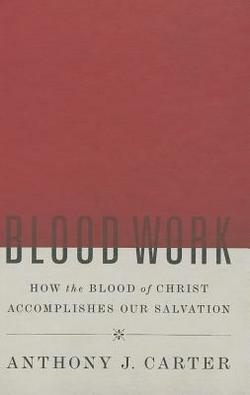
But when it one considers the high points of theology, nothing could be more important than blood.  This much is clear in Anthony J. Carter’s excellent book, Blood WorkHow the Blood of Christ Accomplishes Our Salvation.

Carter examines the work of Christ on the cross for sinners in a multi-faceted way that highlights important themes such as propitiation, justification, redemption, and sanctification.  Carter does not pretend to explore these and related themes in a comprehensive way.  Rather the important facets of the cross are introduced and applied, albeit with great care, precision, and reverence.

Carter utilizes some of the great hymns of the faith to drive home some of the pertinent points, reminding readers to return to these timeless classics.  But more important, readers are reminded to turn their attention to the blood work of Jesus Christ.

Blood Work is a terrific introduction to John Murray’s Redemption Accomplished and Applied.  Carter’s clear and winsome style should draw beginning readers in and attract their attention to writers like Murray, Packer, and Stott who have written extensively about the cross work of Christ.

GOD’S LOVE: BETTER THAN UNCONDITIONAL – David Powlison (2001)

0875526861_bHow many times have you uttered the words, “God’s love is unconditional?”  Yet the term is strangely absent from Scripture.  One might argue that other terms are absent as well, like “Trinity” and “hypostatic union.”   Of course, the terms are missing but the truth of the Trinity and the hypostatic union are clearly taught.

So what does one make of the notion of God’s “unconditional love.”  David Powlison tackles this important subject in his book, God’s Love: Better Than Unconditional.  Here’s his proposal: “God’s love is much different and better than unconditional … God cares too much to be unconditional in his love.”

Powlison is not the only one who resists the notion of God’s unconditional love.  R.C. Sproul adds, “I can think of no more pernicious lie to destroy people’s souls than this, which some preachers are spreading around the world: God loves you unconditionally.  No, he does not.  If we do not meet the conditions that he established for us in creation, then God will send us to hell forever” (Truths We Confess, Vol. I, 216).

Powlison grounds his argument with four “unconditional truths.”

1. It is true that “conditional love” is a bad thing.

2. It is true that God’s love is patient.

3. It is true that true love is God’s gift.

4. It is true that God receives people just as they are.

The author admits that the phrase “unconditional” has a “noble theological lineage in describing the grace of God.”  But the term is fraught with difficulties.  He suggests four biblical improvements:

1. There are more biblical and vivid ways to capture each of the four truths just stated.  The Bible provides much richer descriptions of God’s love than “unconditional.”

2. It is clear that unmerited grace is not strictly unconditional.  While it is true that God’s love does not depend upon what you do, it very much depends on what Christ did for you.  In that sense, it is highly conditional.

3. God’s grace is something more than unconditional in that it is intended to change the people who receive it.

4. “Unconditional love” is filled with cultural assumptions.  Such a term implies the minimizing or even elimination of expectations on the one receiving the love.

Powlison urges readers to consider the notion of “contraconditional love.”  He continues, “God has blessed me because his Son fulfilled conditions I could never achieve.  Contrary to what I deserve, he loves me.  And now I can begin to change not because I can earn his love, but because I’ve already received it.”

I commend God’s Love: Better Than Unconditional to fellow pilgrims.  It contains the biblical answer to the questions in regards to the love of God.  Readers concerned with Powlison’s thesis will be quickly persuaded and encouraged to pursue God with greater obedience and passion – an overflow of the love received from the sovereign and loving God of the universe.

5 stars

WHAT IS BIBLICAL THEOLOGY? – James M. Hamilton Jr. (2014)

Biblical Theology is “interpretive perspective reflected in the way the biblical authors 1433537710_bhave presented their understanding of earlier Scripture, redemptive history, and the events they are describing, recounting, celebrating, or addressing in narratives, poems, proverbs, letters, and apocalypses.”  So says, James Hamilton in his latest work, What is Biblical Theology?

Hamilton is no stranger to the world of biblical theology.  In 2010, he wrote God’s Glory in Salvation Through Judgment, a book that I devoured and greatly benefitted from.  In many ways, What is Biblical Theology? could serve as a sort of introduction to the earlier work as it summarizes the important discipline of Biblical Theology.

The sub-title accurately reflects the essential nature of the book: “A Guide to the Bible’s Story, Symbolism, and Patterns.”  One important question that Hamilton addresses is, “How is God going to bless Gentiles in Abraham’s seed?”  Ultimately we learn that “all families of the earth will be blessed in the seed of Abraham, Jesus the Messiah” (Gal. 3:14-16).  But Hamilton leaves no room for ambiguity here: “Gentile Christians enjoy all the blessings given to Israel in the Old Testament” (Eph. 1:3-14).

The emphasis on continuity is a breath of fresh air, especially to one like myself who was trained with the presuppositions of classical dispensationalism.  The remainder of the book explores these and related themes.  In the final sense, the author seeks to draw readers into the drama of the biblical plot line.  Of course, he should receive high marks for writing a book that mines out the deep truths of Scripture in clear and winsome ways.

Readers who are interested in other works of biblical theology should turn to The King in His Beauty by Tom Schreiner and Kingdom Through Covenant: A Biblical Understanding of the Covenants by Peter Gentry and Stephen Wellum.

5 stars


The Conscience Of A Conservative For The 21st-Century

0804138109_bThe reason that I am a Conservative can be summarized by three important influences:

1. The influence of my parents and grandparents.

2. The leadership of President Ronald Reagan which restored American exceptionalism.

3. The Conscience of a Conservative by Barry Goldwater

The Conscience of a Conservative was written by Barry Goldwater in 1961.  I didn’t read it until I was a high school student and later read it as an adult.  It left a profound mark on me and continues to wield a mighty influence.  But a new book by former U.S Representative Allen West could easily serve as the new barometer for Conservatives.  Indeed, it could easily be considered The Conscience of a Conservative for the 21st century.  Guardian of the Republic is Congressman West’s plea to restore the vision of the founding fathers.  It is his earnest appeal to return to the ideological roots that make America great.

Part I: My Conservative Roots

Part one explores the background of Congressman West, a Lt. Colonel in the military who was raised in Atlanta and influenced by his parents which shaped him into the man he is today.

Part II: Conservative Principles

Part two is a primer on a conservative ideology which stands in the tradition of President Ronald Reagan.  The author includes the basic philosophical and historical framework which undergirds a strong conservative stance.  Among these principles include limited government, fiscal responsibility, a free market, individualism, a strong national defense, and an understanding that all of man’s freedoms come ultimately from God.

West includes three “pillars of conservative thought” which include effective and efficient conservative government, peace through strength, and traditional American values.

None of these are new ideas.  But the reframing of these conservative principles is a welcome reminder which should call America back to her founding principles.

Part III: Conservatism in the Black Community

Part three may be the most interesting section.  The author calls black Americans to return to their roots – for they “fail to understand the soul of [their] souls.”  West reminds readers the reason for the establishment of the Republican Party: “the abolition of slavery through the passage of the Thirteenth Amendment.”  Yet many social programs only create dependency on the government and enslave people in the final analysis.  What’s the bottom line?  West argues that these programs are tantamount to a “twenty-first-century economic plantation.”  Slavery ended long ago, yet a new brand of slavery continues – a kind of slavery that needs to be abolished once again.

Part IV: The Future of the American Republic

Congressman West pleads with Americans to stand alert.  He challenges Americans to wrestle with some critical questions that will have an impact on the future direction of our country:

Do we want an opportunity society or a dependency society?

Do we prioritize preeminence of the individual, or dominance of the state?

Will we choose individual exceptionalism or collective relativism?

Do we value wealth creation and expansion, or wealth redistribution?

Will we bet on economic freedom or economic enslavement?

Do we stand for principle or for party?

Do we want policy or politics?

Congressman West warns readers, “If there is to be a future for this republic, we must elect good leaders, not highly marketed, well-politicized petty usurpers and impostors.”

While Congressman West has been caricatured as an “outcast” by some and a “war criminal” by others, nothing could be further from the truth.  He has been falsely maligned and his character has been unjustly impugned – all in keeping with Saul Alinsky’s horrible diatribe, Rules For Radicals.  Allen West is a breath of fresh air in a day when political expediency and opinion polls appear to rule the floor of Congress and the White House.  Congressman West is a man who says what he means and means what he says.  He is unmoved by the banter of political pundits.  And he refuses to be intimidated by the progressive agenda which is steeped in the ruinous ideology of socialism.  Allen West has led by example.  He has served our nation well.  He has guarded the Republic with honor, courage, and dignity.  Perhaps he can wield his influence in the Oval Office one day.  America would be a better place with this principled man behind the most powerful desk in the world.


The Real Concern About Heaven

0849946158_bToday, the movie Heaven is For Real hits the silver screen.  The film is based on the popular book by Todd Burpo, a Wesleyan pastor from the great state of Nebraska.  The book has experienced unparalleled success. It has sold over 8 million copies and does not appear to be losing any momentum.  First published in 2010, Heaven is For Real continues to attract Christians and non-believers alike.  On the week of April 14, 2014, the Burpo book sits strong at number two in the combined print and e-book nonfiction category on the New York Times bestsellers list.  It boasts nearly 8,000 reviews on Amazon.com, with almost 6,000 of those credited with five stars!

Whenever a faith-based movie drops, Christians tend to flock to the theater.   Many churches are bound to jump on the bandwagon and promote this motion picture which will only catapult book sales to great heights.

Heaven is For Real chronicles the testimony of Colton Burpo, a three-year-old child who experienced a life-threatening illness.  While he was thankfully never pronounced dead, during his traumatic hospitalization,  he recounts his experiences of his time in “heaven” with his parents.  The book contains several first-hand accounts that describe how “he went up out of his body,” “spoke with angels,” “sat in Jesus’ lap,” “saw the rainbow colors”, and got to pet Jesus’ “rainbow horse.”

Despite all the accolades and the interest the book is generating, there are some real problems that surface.  Heaven is for real; this much is true.  Yet the theology which emerges is deeply troubling.  Readers should carefully weigh the content with biblical discernment and discretion.  At least three general problems plague this book.

Theological Problems

Heaven is For Real promotes views about heaven that do not match the teaching of Scripture.  For instance, little Colton describes being afraid in heaven.  Colton says, “Dad, Jesus had the angels sing to me because I was so scared.  They made me feel better.”  Yet Scripture describes heaven as a place where tears and fears will be erased.  When John the Apostle describes the new heaven and a new earth, he writes, “He will wipe away ever tear from their eyes, and death shall be no more, neither shall there be mourning nor crying nor pain anymore, for the former things have passed away” (Rev. 21:4, ESV).

Colton describes his experience with the saints in heaven who actually have wings.  “Everybody’s got wings,” he says.  Evidently, Jesus is the only one in heaven who doesn’t have wings: “Jesus went up and down like an elevator,” he says.  Additionally, Colton remarks how “everyone kind of looks like angels … and have a light above their head.”  Of course, there is nothing in Scripture that even hints at the idea of saints who don wings or have halos above their heads.  This is the kind of banter that has grown popular at funerals where grieving loved ones anticipate the heavenly abode.  The only problem is that these beliefs are foreign to Scripture.

Colton eagerly describes his encounter with the Holy Spirit.  He claims to have sat next to the Holy Spirit and maintains the third member of the Trinity is “kind of blue.”  Yet the Bible never attaches a color to the Holy Spirit.  The Holy Spirit possesses all the attributes of God and stands alongside the Father and the Son.  Scripture tells us that the Holy Spirit glorifies Christ (John 16:14).  Jonathan Edwards reminds us, “There is no such thing as seeing God properly with the bodily eyes because he is a spirit; one of his attributes; that he is invisible.”

In a stunning admission, Colton refers to a deceased relative who is in heaven: “He’s got a new body.  Jesus told me if you don’t go to heaven, you don’t get a new body.”  The problem is that “Jesus” appears slightly confused because the Word of God says otherwise: “But our citizenship is in heaven, and from it we await a Savior, the Lord Jesus Christ, who will transform our lowly body to be like his glorious body, by the power that enables him even to subject all things to himself” (Phil. 3:20-21, ESV).   Jonathan Edwards adds, “When believers get to heaven, Christ will conform them to himself, he will give them his glory; they shall in their measure be made like to him; their bodies after the resurrection shall be conformed to his glorious body.”  In other words, the only person in heaven with a glorified body at this time is the Lord Jesus Christ.  His followers wait for his return to receive their glorified bodies (1 Cor. 15:42-49).

One of the preoccupations with people who claim to have toured heaven is with the various colors.  There is no doubt that heaven will be a place brimming with color (Rev. 21:9ff).  However, what is troubling in these accounts is the fascination with the colors and the minimization of God’s glory (Rev. 21:22-26).

The Bible never hints at anyone who died and went to heaven and came back to report about it (Prov. 30:4).  Scripture records four men who caught a vision of heaven and briefly reported what they saw – John the Apostle, Paul the Apostle, Ezekiel, and Isaiah.  Additionally, Scripture is clear about the destiny of people who die: “And just as it is appointed for man to die once, and after that comes judgment” (Heb. 9:27, ESV).  No second chances.  No return visits.  After death comes the judgment, not a book deal.

Biblical Problems

Heaven is For Real promotes a mindset that militates against the  Sola Scriptura principle.  Colton claims that “Angels carry swords so they can keep Satan out of heaven!”    He maintains, “Jesus wouldn’t let me have [a sword].  He said I’d be too dangerous.”  He claims to have seen Satan.  And he claims to have seen Mary kneeling before the throne of God.  The Reformers rightly said that Scripture was their highest authority.  To report this kind of information about heaven is tantamount to adding to Scripture, activity that is forbidden (Rev. 22:18-19).

All these extra-biblical revelations indicate a lack of confidence in the sufficiency of Scripture.  Ultimately, Heaven is For Real pits experience against the authority of Scripture.  The author notes, “We had taught Colton about our faith all his life.  But if he had really seen Jesus and the angels, I wanted to become the student, not the teacher.”  The humility is commendable.  But a father is charged with discipling his children and raising them in the discipline and instruction of the Lord (Eph. 6:4).

The author expresses his belief in being careful about what he says about heaven from the pulpit.  He writes, “I teach what I find in Scripture.”  Yet the author is quick to accept the testimony of a small child – even if that testimony militates against the Word of God – a dangerous practice to be sure.

A Ukrainian girl named Akiane has reportedly visited heaven and has returned to tell her story.  The author of Heaven is For Real admits, “I made a mental note for future sermons: Akiane’s story showed that God can reach anyone, anywhere, at any age – even a preschool girl in a home where his name had never been spoken.”  But Scripture disagrees with this assessment: “But how are they to call on him in whom they have not believed?  And how are they to believe in him of whom they have never heard?  And how are they to hear without someone preaching?  And how are they to preach unless they are sent?  As it is written, ‘How beautiful are the feet of those who preach the good news!’  But they have not all obeyed the gospel.  For Isaiah says, ‘Lord, who has believed what he has heard from us?’  So faith comes from hearing and hearing through the word of Christ” (Rom. 10:14-17, ESV).

Apparently, Akiane paints portraits of Christ as she saw him in heaven.  Colton appears to have verified the image as identical to the “Jesus” he saw in heaven.  The author seems to think that he has “seen the face of Jesus.”  But here is the rub.  He adds, “We still don’t have all the answers – not even close.  But now we have a picture in our minds, a picture we can look at and say, ‘Wow.'”  Yet the Word of God expressly forbids such activity (Exod. 20:4).  Calvin rightly refers to the human heart as an “idol factory.”  Each of us is vulnerable and easily led astray by images of Christ.  Again, instead of trusting the sufficiency of Scripture we are led astray by images.

Gospel Problems

Heaven is For Real contains some disturbing ideas of what constitutes the gospel.  For instance, Colton remarks, “Jesus told him to be good.”  This is nothing more than moralism.  This is a subtle brand of works-based salvation that the Scripture finds so repugnant (Isa. 64:6).  Too many people are embracing a gospel of good works; a gospel that finds sinful man making his way to a holy God.  But in the final analysis, we find a holy God making his way to sinful men by sending Jesus to die on a cross for the sins of everyone who would ever believe.  J.D. Greear beautifully summarizes this gospel: “The gospel is the announcement that God has reconciled us to Himself by sending His Son Jesus to die as a substitute for our sins, and that all who repent and believe have eternal life in Him.”  So let us cast aside a gospel of good works and embrace the biblical gospel (Gal. 1:6-8).

Summary

Make no mistake – Heaven is for real.  The Scripture reminds us of this in powerful ways.  Yet God’s Word demands readers to exercise biblical discernment, what Tim Challies refers to as “the skill of understanding and applying God’s Word with the purpose of separating truth from error and right from wrong” (The Discipline of Spiritual Discernment, 61).  Not everything in Heaven is For Real is wrong.  Not everything is unbiblical.  Some of these descriptions are taken directly from the biblical account.

My concern has less to do with the imagination of a three-year-old boy.  My greater concern is with people who believe these stories; stories which do not match the infallible authoritative Word of God.  The real concern about heaven is guarding the biblical doctrine of heaven; about embracing everything the Bible teaches about heaven and refusing to add details that militate against biblical revelation.

So let us be discerning in these days (Col. 2:8; Matt. 24:4; Mark 13:5).  Let us pray the prayer of Solomon as we evaluate books and movies in this culture.  And may we hold steadfastly to the gospel once for all delivered to the saints.

Give your servant therefore an understanding mind to govern your people, that I may discern between good and evil, for who is able to govern this your great people?”” (1 Kings 3:9, ESV)

CALVIN ON THE CHRISTIAN LIFE – Michael Horton (2014)

143353956X_bJohn Calvin is numbered among the maligned.  He was a target in the 16th century and he continues to attract the attention of the uninformed today.  Yet Calvin’s life was a pilgrimage characterized by God’s providential grace.  It was God’s providential grace that led him from place to place, equipping him for a lifetime of ministry.  It was God’s providential grace that sustained him during his period of exile and sheltered him through the storm.  It was God’s providential grace that empowered him to write and preach and shepherd people for the glory of God.  It was God’s providential grace that brought him “through many dangers, toils and snares” to coin a phrase by John Newton.  Indeed, it was God’s providential grace that rescued his soul from hell and seated him in the heavenly places in Christ Jesus (Eph. 2:6).

Michael Horton beautifully records the life, legacy, and pastoral ministry of the Genevan reformer in his latest work, Calvin on the Christian Life.  Horton honestly assesses Calvin’s role both theologically and pastorally in categories that are unique to the one of the world’s most well-known leaders.  Horton’s work is readable without being simplistic and alerts readers to some of the defining moments of Calvin’s life.   Calvin on the Christian life is a welcome guest in the ever-expanding books which survey the Protestant Reformation.


WHAT’S YOUR WORLDVIEW – James N. Anderson (2013)

What’s Your Worldview: An Interactive Approach to Life’s Big Questions by worlviewJames N. Anderson is a book that is altogether unique.  Anderson presents his goals in advance:

  1. To help readers identify and clarify their worldview.
  2. To encourage readers to consider the big questions and think through the implications.
  3. To help readers understand the important implications that exist between worldviews.

The book is unique in that it guides readers on a sort of worldview path.  Foundational questions are dealt with at the beginning of the book – questions that address matters of freewill, morality, theism, epistemology, etc.  How the reader answers these questions lead to a discussion of a given worldview.  For instance, if one holds that truth is unknowable or relative, they will be directed to the section on relativism.  If one rejects the belief in a personal, transcendent God, they will be directed to the section on atheism.

Anderson does a good job in surveying every major worldview in summary form.  The book addresses the basics of a given worldview and points out the logical, practical, and biblical inconsistencies.

What’s Your Worldview is a book that every high school student and college age student should read.  It’s very readable and provides just enough information to whet the appetite of students.  I’m eager to see how Anderson’s work will be received by campus ministers and trust that it will receive a wide reading.

TRUTH MATTERS – Andreas Kostenberger, Darrel Bock, and Josh Chatraw (2014)

truthTruth Matters: Confident Faith in a Confusing World  is an entry-level book designed as an apologetics/worldview resource for students.  The authors rightly assume that unprepared students will be assaulted in the marketplace of ideas.  Truth Matters is a step in the right direction that will be of immense help as student seek to build a Christian worldview and prepare for the onslaught of secularism.

The book is a clear and clever response to the unbelieving ideas of Bart Ehrman, a Moody Bible Institute graduate who has since abandoned the Christian faith.  Ehrman’s writings have been influential among skeptics and have caused confusion among the believing.  Kostenberger’s work helps cut through the fog of skepticism and arm Christian students to contend for the faith.

FROM HEAVEN HE CAME AND SOUGHT HER – David Gibson and Jonathan Gibson, Ed. (2013)

1433512769_bDefinite atonement is one of those pesky doctrines that prove controversial.  Ever since the formal response by the Dutch Calvinists at the Synod of Dort, the church has been wrestling with the finer points that concern the extent of the atonement.

The first verse of Samuel Stone’s majestic hymn, The Church’s One Foundation is a clear statement of the doctrine of particular redemption:

The church’s one foundation is Jesus Christ her Lord; she is a new creation by water and the Word; From heaven he came and sought her to be his holy bride; with his own blood he bought her, and for her life he died.

David and Jonathan Gibson borrow the preceding line from Stone’s hymn to make an important theological assertion, namely – Christ paid for his sheep; he paid for his bride on the cross.  In doing so, nothing was left to chance.  Christ died for the sins of everyone who would ever believe.  Hence, the authors set forth a well-reasoned and biblical case for the doctrine of particular redemption in their work, From Heaven He Came and Sought Her.

Four sections deserve the attention of readers and make a compelling case for the doctrine under consideration.

Section 1: Definite Atonement in Church History

Section 2: Definite Atonement in the Bible

Section 3: Definite Atonement in Theological Perspective

Section 4: Definite Atonement in Pastoral Practice

Each section provides a stunning amount of biblical, exegetical, and theological “legwork” which prop up this God-honoring doctrine.  The depth of scholarship is remarkable and the theologians represented is nothing short of remarkable.  David and Jonathan Gibson should be commended for assembling such a worthy group of scholars and addressing an issue that should come to the forefront of evangelical circles.  From Heaven He Came and Sought Her defends the doctrine of definite atonement in crystal clear terms that honor our triune God and magnify the work of the Lord Jesus on the cross.


HOW HIGH WILL YOU CLIMB? – John Maxwell (2014)

How High Will You Climb? by John Maxwell addresses the important subject maxwellof attitude.  The book is arranged in three parts:

Part One – The Consideration of Your Attitude

The author encourages readers to turn their attention to Christ whose attitude was always glorifying to God.  “Attitude,” Maxwell notes, “is an inward feeling expressed by behavior.”  And the author includes several helpful attitude axiom’s worth noting:

1. Our attitude determines our approach to life.

2. Our attitude determines our relationships with people.

3. Our attitude is the only difference between success and failure.

4. Our attitude at the beginning of a task will affect its outcome more than anything else.

5. Our attitude can turn our problems into blessings.

6. Our attitude can give us an uncommonly positive perspective.

7. Our attitude is not automatically good just because we are Christians.

Part Two – The Construction of Your Attitude

The author provides several basic truths that concern the construction of a godly attitude.  Each principle is cumulative and progressively builds into a posture of maturity.  Life experiences provide vehicles for building one’s attitude for the good and glorifying the Lord.

Part Three – The Crashing of Your Attitude

The author presents several practical rules to keep readers on the right attitudinal track.  Additionally, he presents several pitfalls which hinder a proper attitude.  These include fear of failure, discouragement, and the struggle of sin.

Part Four – The Changing of Your Attitude

Several choices are set forth which will help cultivate an attitude that glorifies God.

Choice 1 – Evaluate your present attitudes.

Choice 2 – Realize that faith is stronger than fear.

Choice 3 – Write a purpose statement.

Choice 4 – Have the desire to change.

Choice 5 – Live one day at a time.

Choice 6 – Change your thoughts patterns.

Choice 7 – Develop good habits.

Choice 8 – Continually choose to have a right attitude.

How High Will You Climb? is a useful book that will help many people adjust their attitudes in a Godward direction.  I personally struggle with the positive references to men like Norman Vincent Peale.  But one should be careful not to throw the baby out with the bath water.  There is enough good material to make this a worthwhile read.  Coaches and teachers can benefit from Maxwell’s timely wisdom.  Students and athletes would do well to consider the principles in this work.  Ultimately, one’s attitude should reflect the mindset of the Lord Jesus Christ.

“Have this mind among yourselves, which is yours in Christ Jesus, who, though he was in the form of God, did not count equality with God a thing to be grasped, but emptied himself, by taking the form of a servant, being born in the likeness of men.” (Philippians 2:5–7, ESV)

I received this book free from the publisher through the BookSneeze®.com  book review bloggers program. I was not required to write a positive review.