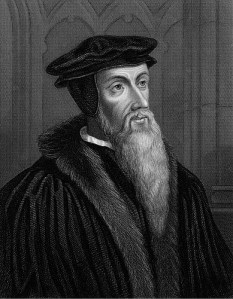
 Reformed theology has been on the rise for several years now. Some pastors are discovering the doctrines of grace for the first time; others are waking up to the beauty of Calvinism, the dogma that Spurgeon called a “nickname for biblical Christianity.” However, whenever a movement of God ascends, opposition tends to rise. Consider the push-back from the Roman Catholic Church during the days of the Reformation. Or who can forget the negative reaction to the work of God’s Spirit during the Great Awakenings.
While a new Reformation is afoot in the contemporary church, there appears to be opposition at every juncture. The newest public attack on Reformed theology comes from the pulpit of Ed Young, Senior pastor of Fellowship Church. Several days ago, Young took the last twelve minutes of his message to unleash a vicious attack on Reformed theology. This assault was not only directed at the doctrine; he also set his sights on churches and pastors committed to Calvinism.
This venom is nothing new. Spurgeon was constantly attacked for his preaching that was soaked in the doctrines of grace. Jonathan Edwards was scorned for his Calvinistic framework. And most recently, the Southern Baptist Convention is showing signs of division on matters that pertain to Soteriology.
But what is most troubling about Pastor Young’s rant is the personal nature of the attack. His chief contention: “Reformed theology leads to a deformed ecclesiology” – strong words, especially in light of Calvin’s strong ecclesiology. It was Calvin who rightly argued that the true church includes three critical components, namely – the right preaching of God’s Word, the right administration of the sacraments, and church discipline. So Young’s words should not be taken lightly. The essence of his charge is that Reformed-minded churches have distorted the truth, a serious accusation to be sure.
Pastor Young essentially argues that Calvinists have placed “God in a box.” He says, “Most of the Calvinistic churches don’t reach anybody …” He accuses Reformed believers of being apathetic at the plight of people who have yet to meet Jesus: “They pimp God not to reach people who are dying and going to hell.” He warns the young people in his church, “You are prey for these churches … It’s sexy, it’s cool, you’ve got God in a box.”
Additionally, Young accuses Calvinists’ of being arrogant: “Why are these people so mean-spirited, most of them? Why are they so Pharisaical?” This banter continues as Young fires his guns directly at the Reformed community: “Don’t you blaspheme the name of God and use God not to reach people for Jesus Christ. And if you don’t like the message, there’s the exit.”
But the accusation that will draw some of the greatest heat is Young’s contention that Calvinism presents a different gospel. He instructs his congregation, “When they say gospel [speaking of Calvinists], they don’t mean the same gospel that we do …” Young’s contention is this: Reformed theology is “ruining the church.”
“Reformed is deformed, most of it” argues Young. Pastor Young obviously has a twisted perception of Reformed theology. That much is true. But as I listened to his message, I wondered, “How shall the Reformed community respond to Pastor Young?” “What would be the most fruitful way to counter some of the claims that reflect poorly on Christ-followers who embrace a Reformed approach to Scripture?” Note three specific responses.
We must respond with graciousness and humility
The Scripture is clear on this point: “And the Lord’s servant must not be quarrelsome but kind to everyone, able to teach, patiently enduring evil, correcting his opponents with gentleness …” (2 Tim. 2:24-25a). Roger Nicole wisely writes, “We have obligations to people who differ from us. This does not involve agreeing with them. We have an obligation to the truth, and that has priority over agreement with any particular person.” We must be careful that our response is bathed in prayer and soaked in humility. It would be so easy to “lob a bomb” over the fence. But the Scripture demands a different kind of response. Ad hominem attacks are cowardly and lack the force of biblical conviction. The Word of God demands a gracious and humble response.
We must clear up any misunderstandings
First, historic Reformed theology does not limit God. Young is quick to accuse Calvinists of having “God in the box.” But nothing could be further from the truth. It is true that Calvinists are careful to worship God in a way that is prescribed in Scripture. It is true that they vigilantly guard the attributes of God and promote his character in a way that is in keeping with Scripture. But Calvinists do not limit what God can do. Young’s “God in the box” accusation does not square with the facts.
Second, Young accuses Reformed-minded churches of neglecting the plight of the lost and remaining passive in the evangelistic enterprise. This accusation has some validity to be sure. Indeed, some of these churches are content to sit on the sidelines and as a result are marginalized. In these cases, then, Young’s charge should be taken into account. However, many Calvinistic churches are reaching people by the droves. This notion that the doctrines of grace discourages evangelism must be dismantled and cast aside. Some of the most mission-minded evangelists in church history were Calvinists including William Carey and George Whitefield.
David Mathis, a committed Calvinist, is passionately committed to world missions and evangelism: “Missions is about the worship of Jesus. The goal of missions is the global worship of Jesus by his redeemed people from every tribe, tongue, and nation. The outcome of missions is all peoples delighting to praise Jesus. And the motivation for missions is the enjoyment that his people have in him. Missions aims at, brings about, and is fueled by the worship of Jesus” (John Piper, Ed. A Holy Ambition: To Preach Where Christ Has Not Been Named). Mathis continues, “Our churches should both pursue mission among our own people as well as missions among the world’s unreached peoples. One way to sum it up is to say that we can’t be truly missional without preserving a place for, and giving priority to, the pursuit of the unreached.” This sentiment is expressed in Reformed-minded churches around the globe. So let us dispense with the notion that Calvinism discourages evangelism.
Third, a belief in predestination does not preclude choice. Young quips, “I believe in election. I also believe in choice.” This subtle jab promotes a common caricature that Calvinists reject the notion of free will. But Reformed thinkers have held a robust theory of free will since the days of the Reformation. Jonathan Edwards held that one chooses according to his “strongest inclination.” Herein lies the essence of free will! Edwards held, “A man never, in any instance, wills anything contrary to his desire, or desires anything contrary to his Will.” So the unregenerate choose freely. The unregenerate chooses according to his strongest inclination.
But here is the rub. Freedom does not imply ability. And this appears to be the main bone of contention between Arminians and Calvinists. G.I. Williamson adds, “With sin’s entrance man lost ability to do good, not liberty.” For example, sinful creatures are free to fly – but they are unable to do so. Sinful creatures are free to swim under water without oxygen for an extended period of time – but they are not able to do so. A paralyzed man is free to jump out of his wheel chair and dance – but he is utterly incapable of performing this activity. Most important, sinful creatures are free to come to God – but they are not able apart from God drawing them. J.I. Packer writes, “We have no natural ability to discern and choose God’s way because we have no natural inclination Godward; our hearts are in bondage to sin, and only the grace of regeneration can free us from that slavery.” So totally depraved people are free to do good or evil but only able to do evil due to the radical nature of his sinful condition (John 6:44; 8:34).
Fourth, God’s election takes place in eternity past. Several Scriptures bear this truth out:
“even as he chose us in him before the foundation of the world, that we should be holy and blameless before him. In love he predestined us for adoption as sons through Jesus Christ, according to the purpose of his will,” (Ephesians 1:4–5, ESV)
“In him we have obtained an inheritance, having been predestined according to the purpose of him who works all things according to the counsel of his will,” (Ephesians 1:11, ESV)
“For we know, brothers loved by God, that he has chosen you,” (1 Thessalonians 1:4, ESV)
“For those whom he foreknew he also predestined to be conformed to the image of his Son, in order that he might be the firstborn among many brothers. And those whom he predestined he also called, and those whom he called he also justified, and those whom he justified he also glorified.” (Romans 8:29–30, ESV)
“You did not choose me, but I chose you and appointed you that you should go and bear fruit and that your fruit should abide, so that whatever you ask the Father in my name, he may give it to you.” (John 15:16, ESV)
Yet Young maintains in his sermon, “We keep on nominating them and God keeps electing them.” Even an Arminian would reject this kind of thinking. At least an Arminian embraces election according to foreknowledge, namely – God elected some in eternity past on the basis of foreseen faith. While clearly distinct from the Calvinistic understanding of unconditional election, it must be admitted that in both schemes, election takes place in eternity past. God’s electing grace is not carried out as the people of God “nominate” people that appear to be fit for the kingdom.
We must respond decisively
One of Young’s chief arguments is that “Reformed theology is deformed.” He adds the disclaimer, “most of it” [speaking of Reformed theology]. But the most distressing aspect of this sermon concerns the heart of the gospel. He charges Calvinists with believing a different gospel. Young says, “When they say gospel, they don’t mean the same gospel that we do. Its different.” This kind of preaching is simply indefensible. Calvinists and Arminians have been debating theological matters for almost 500 years. However, this kind of banter crosses the line.
Frankly, Pastor Young’s presentation is grieving. His arguments are not only theologically wrongheaded; they are irresponsible and careless. The irony is that every time he steps into the pulpit he stands on the shoulders of a long line of godly men; men who fought for, taught, and preached the doctrines of grace. Men like Augustine, Luther, Calvin, Knox, Spurgeon, Edwards, Bunyan, Watson, Sibbes, and Owen raised the banner of Reformed theology which proclaims that Christ is the Savior for all people, especially of those who believe” (1 Tim. 4:10, ESV). They proclaimed with Christ that “whoever comes to me shall not hunger, and whoever believes in me shall never thirst” (John 6:35, ESV). And yes, they proclaimed the gospel that says, “For God so loved the world, that he gave his only Son, that whoever believes in him should not perish but have eternal life” (John 3:16, ESV). These men proclaimed the sovereign grace of God – the grace that sets the prisoner free (John 8:36). They proclaimed the sovereign grace of God that removed the enormous barrier between a holy God and sinful people (Rom. 5:10, Col. 1:19-23). They proclaimed the sovereign grace of God that redeems unclean people from their sins (Eph. 1:7). These men of God proclaimed the gospel of Jesus Christ; the gospel that tells us the good news of Christ’s incarnation and his death on the cross, his burial, and his resurrection (1 Cor. 15:3-5).
When Pastor Young tosses out Reformed theology, he undercuts the very foundation of the Christian faith. For the essence of the Reformed faith is that sinners may be forgiven their sin – by grace alone, through faith alone, in Christ alone. The challenge for Calvinistic pastors, therefore, is to listen carefully to Young’s charges. Perhaps adjustments can be made along the way. If any of the accusations stick, repentance may be in order. But we must refuse to respond to Young in a way that is arrogant or demeaning. We must love our brother and promote a spirit of unity. Roger Nicole writes, “It is remarkable that committed Calvinists can sing without reservation many of the hymns of Charles and John Wesley, and vice versa that most Arminians do not feel they need to object to those of Isaac Watts, Augustus Toplady, or John Newton.” Perhaps we need a meeting of the minds – in order to generate more light than heat!
“Behold, how good and pleasant it is when brothers dwell in unity!” (Psalm 133:1, ESV)
 What two names are automatically associated with the word “leadership?” Answer: Kouzes and Posner. Their landmark works, The Leadership Challenge and Credibility stand head and shoulders above other leadership books. Their latest book, The Truth About Leadership continues to encourage principle-centered leadership.




 Veritas et Lux