THE BONE HOUSE – Steven Lawhead (2011)

Steven R. Lawhead’s, The Bone House is the second book in the Bright Empires Series.  Lawhead continues to develop his imaginative work in this novel – a blending of C.S. Lewis, John Bunyan, Dan Brown, and Albert Einstein.

The Bone House is a fascinating mixture of fantasy, ontology, metaphysics, science, and time travel.  But the notion of “time travel” does not exactly do justice to what the author intends to convey in his novel.  He writes more of a so-called multidimensional universe.  Speculative to be sure but it makes for interesting reading.

Lawhead builds the plot line based on volume 1.  In this work, we find Kit “traveling” on an adventure (along with a host of other characters) that lead  to destinations filled with peril and intrigue, ultimately culminating in the discovery of the Bone House.

My biggest criticism is that the story is a bit hard to follow at times.  So interested readers will do well to plunge into volume 1 before tackling this novel.  Positively, Lawhead writes with a great deal of creativity and introduces basic elements of the Christian worldview into the fabric of the story line.  Not my cup of tea – but 3 stars for a valiant effort.

I received a complementary copy of this book from the Thomas Nelson Booksneeze program.

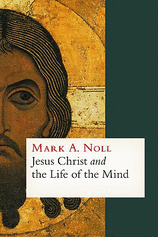
JESUS CHRIST AND THE LIFE OF THE MIND – Mark Noll (2011)

Mark Noll’s latest book, Jesus Christ and the Life of the Mind is “oxygen” for the soul.  Noll’s encouragement is greatly needed in our day.  Many find themselves suffocating in these postmodern times.  The thin air of anti-intellectualism is sucking the life out of the church.  And the poisonous winds of heresy threaten the very spiritual health of believers.

A Place to Stand

Noll assures readers of the firm foundation the Christian worldview provides.  The creeds of the early church serve as concrete blocks in this foundation: “The creeds  … offers full cause for taking seriously the fact of the physical world as created by God, but also the dramas of redemption that relativizes all terrestrial realities in eternal perspective.  It offers, in short, an ideal place from which to approach the tasks of Christian learning.”

Noll reminds readers that this world is uniquely christological.  As such, all learning should begin and end with Christ: “The light of Christ illuminates the laboratory, his speech is the fount of communication, he makes possible the study of humans in all their interactions, he is the source of all life, he provides the wherewithal for every achievement of human civilization, he is the telos of all that is beautiful.  He is, among his many other titles, the Christ of the academic road.”  Indeed, this is much-needed oxygen for the evangelical mind.

Motives for Learning

The author challenges the misplaced notion that a commitment to the Christian worldview necessarily derails a serious pursuit of scholarship.  Noll argues, “The beauties of creation reflect the fullness of the being of God; the person of Jesus Christ is God incarnate in human flesh; through learning of Jesus Christ we learn of God’s chief purpose in creating the world; that chief purpose is the manifestation of his own glory; the manifestation of God’s glory accounts for the deep origin of all that is beautiful in the world.”  So the author vividly conveys a motive for learning by pointing to Christ who creates, controls all things, and became flesh in order to redeem the people of God.

Guidance for Learning

Noll encourages readers with four general expectations that inform the Christian mind, should the great truths of John 1, Colossians 1, and Hebrews 1 be taken seriously.  The four expectations include doubleness, contingency, particularity, and self-denial.

The first expectation that Noll includes, by way of example is “doubleness” which is rooted in the Chalcedonian Creed, namely Christ is one person with two natures – fully human and fully God: “The doubleness of Christ as divine and human, which undergirds the whole edifice of Christian life and thought, is a model for studying the spheres of existence.”  Therefore, Christian scholarship will take into account the Chalcedonian formulation at every juncture.

The Atonement: A Theological Principle to Frame Scholarship

The author successfully demonstrates how an evangelical understanding of the redemptive work of Christ affects scholarly pursuit.  Drawing on John Stott’s monumental work, The Cross of Christ, Noll argues that the atonement affects scholarship in a variety of academic disciplines.

Christology: A Key to Understanding History

The key to understanding history is understanding Christ.  Central to the christological underpinnings of redemptive history is a robust view of providence.  Noll guides readers through a series of providential snapshots and seeks to correct erroneous assumptions along the way.

A Christological Invitation for Science

The author directs readers to God’s “two books,” namely – Scripture and nature in order to make scientific observation.  He posits, “The key is that if Christ is the central and unifying theme of Scripture, then Christ should be preeminent in understanding scriptural revelation about everything else, including nature.”  This notion is developed and bolstered by the musings of Galileo and B.B. Warfield.  And the presuppositions of the Chalcedonian creed help navigate readers through choppy scientific waters.

Christology: The Foundation of Biblical Study

Noll evaluates Peter Enn’s recent work concerning inspiration and incarnation.  His lengthy conclusions lead readers back to familiar ground, namely – the foundation of Christology: “If christological materials provide the right foundation for building other houses of learning, they offer the same for biblical study.”  Again, Noll seeks to guide readers to the lodestar who is Christ – “all things were made through him, and without him was not any thing made that was made” (John 1:3, ESV).

The author concludes with a helpful list of goals for anyone who is ready to take the life of Christian scholarship seriously.  Noll’s heart in this work is to move Christian scholars to action.  His goal is accomplished in this much-needed volume.  He continues, “Life in Christ is a gift that makes all things new, including the vocations of learning, but it makes things new only because of how the gift is given and who the giver is.”  May the church breath  in the oxygen that Mark Noll offers.  And may the result be a kind of scholarship that is uniquely Christ-centered  and God-glorifying!

4 stars

FATHERS AND SONS: STAND FAST IN THE WAY OF TRUTH – Douglas Bond (2008)

I have been on the lookout for a good book to read with my ten-year old son.  Fathers and Sons Stand Fast in the Way of Truth by Douglas Bond is the book I’ve been looking for.

The author addresses a host of issues that young men need to think through, evaluate, and determine where they stand.  Bond covers the Word of God, temptation, idolatry, pride, Christian thinking, self-control, speech, attitudes, competition, the Holy Spirit, doctrine, and prayer.  And this is just the beginning!

The author presses these issues – and many more. He challenges young men to make difficult choices – choices that honor God and reflect his holy character.  He challenges them to act with a distinctly Christian worldview.  Each topic relates to fathers as well.  Fathers are encouraged to discuss important matters with their sons.  Each chapter concludes with practical resolutions that young men make in the context of an accountable relationship with their dad.  These resolutions would make Jonathan Edwards proud and serve to strengthen the next generation of godly leaders.

This book will likely receive rave reviews and I am personally inclined to stamp it with five stars. But I must  disagree with Bond’s view of worship styles that emerge in Chapter 9.  However,  not everything the author writes about concerning worship should be cast aside.  I agree wholeheartedly with Bond on several points.  For instance, he writes, “One thing is indisputable: seeker-friendly services are shaped by the entertainment industry.”  However, this argument assumes that anyone who utilizes contemporary music as a style is in fact, seeker-friendly.  Nothing could be further than the truth.

Calvin is on the right track also: “We must beware lest our ears be more intent on the music than our minds on the spiritual meaning of the words.  Songs composed merely to tickle and delight the ear are unbecoming to the majesty of the church and cannot but be most displeasing to God.”

And I agree with Bond’s critique of contemporary worship music.  He writes, “Examination of contemporary church music exposes a number of problems: overfamiliarity and sentimentalism; the tendency to bring God down to man’s understanding; lyrics written by young people who are musicians first, rather than hymn poetry written by experienced, gifted Christians with theological training; the tendency to sing about what we’re singing about; simplistic repetitiveness; lack of biblical progression of thought; in short, the dumbing-down of the message in order to fit it into the entertainment medium.”

Obviously, Bond has an axe to grind and I concur – for the most part.  However, much to the chagrin of my PCA friends, all contemporary worship cannot and should not fall prey to Bond’s rightly placed critique.  Thankfully, new worship songs are being written that are God-centered, Christ-saturated, and chock full of Reformed theology.   Consider some of the songs being written by our friends at Sovereign Grace such as  Bob and Jordan Kauflin, Pat and Joel Sczebel, and Mark Altrogge.  These godly men are writing songs that rival the great work of Toplady and Newton.  For this we are thankful.  These songs draw the hearts and minds of God’s people to worship him as he is revealed in the pages of Scripture.

Overall, however, Fathers and Sons Stand Fast in the Way of Truth is a very valuable book, one that should be read and re-read by fathers and sons together.  As a father, Douglas Bond is in touch with the weighty issues that young men face.  And he demonstrates how the Word of God speaks to these issues.  May God use this work in the days ahead to strengthen the God-centered resolve of fathers and sons alike.

5 stars

THE GOSPEL AND PERSONAL EVANGELISM – Mark Dever (2007)

Mark Dever has been greatly used over the years to help and encourage pastors faithfully shepherd the flock.  He continues to exercise his gift by encouraging pastors and all Christ-followers to evangelize lost sheep – so they might be among the flock.  His book, The Gospel & Personal Evangelism is written with this end in mind.

This small book addresses the answers to some very important questions:

1. Why Don’t We Evangelize?

2. What is the Gospel?

3. Who Should Evangelize?

4. How Should We Evangelize?

5. What Isn’t Evangelism?

6. What Should We Do After We Evangelize?

7. Why Should We Evangelize?

Dever stresses the importance of the evangelistic mandate.  He emphasizes the God-centeredness of this task: “The redemption of an eternal soul is one sale that we, in our own strength , cannot accomplish.  And we need to know it, not so that we won’t preach the gospel, but so that we won’t allow the gospel that is preached to be molded by what finally gets a response.”  And Dever reminds us that failure to evangelize is, in the final analysis, tantamount to disobedience: “We do not fail in our evangelism if we faithfully tell the gospel to someone who is not subsequently converted; we fail only if we do not faithfully tell the gospel at all.”  May Dever’s words be met with faithful, passionate, Christ-centered, Word-centered proclamation – so that nations might know of God’s great love and the provision he made in his Son for everyone who believes!

BIBLICAL APOLOGETICS: HOW SHALL WE RESPOND TO UNBELIEF?

Unbelief is in the air.  Unbelief is gaining ground in postmodern culture.  Over 100 years ago, the German philosopher, Friedrich Nietzsche wrote, “I call Christianity the one great curse, the one great innermost corruption, the one great instinct of revenge, for which no means is poisonous, stealthy, subterranean, small enough – I call it the one immortal blemish of mankind.”

The bankrupt philosophy of the so-called four horsemen of atheism continues to gain in popularity.  Why?  Apparently, unbelief is in.  Unbelief is hip.  But the question that is burning a hole in the table for Christians is this: How shall we respond to unbelief?  How shall we who have a heart for lost people answer when they malign the Christian faith and mock the very foundations of historic Christianity?

The apostle Peter instructs believers to respond rightly: “But in your hearts honor Christ the Lord as holy, always being prepared to make a defense to anyone who asks you for a reason for the hope that is in you; yet do it with gentleness and respect” (1 Peter 3:15, ESV).  In other words, we must develop the mindset of an apologist (ἀπολογία).  John Frame’s definition of apologetics of helpful: Apologetics is “the discipline that teaches Christians how to give a reason for their hope … it is the application of Scripture to unbelief.”  Cornelius Van Til writes, “Apologetics is the vindication of the Christian philosophy of life against the various forms of the non-Christian philosophy of life.”  Tragically, the mandate to engage in apologetics often turns ugly.  Well-meaning Christians have turned apologetics into a nasty slug fest.  Nothing could be further from the truth.  Notice six crucial principles of biblical apologetics.

1. Apologetics involves verbal proclamation

Christians are commanded to proclaim the good news.  The Greek word, “proclaim”  (κηρύσσω) means to announce or proclaim; to preach or publish.”  St. Francis of Assisi was on to something when he quipped, “Preach the gospel and if necessary, use words.”  The point: Make sure your life matches the gospel.  However, actions alone cannot convert.  Actions must be backed up with verbal proclamation.  “So faith comes from hearing, and hearing through the word of Christ” (Romans 10:17, ESV).  Simply put, the gospel is meant to be published.  The gospel must be proclaimed.  Postmodern gurus and emergent sympathizers may be quick to downplay preaching and promote a “deeds not creeds” mentality.  Jesus disagrees: “And this gospel of the kingdom will be proclaimed throughout the whole world as a testimony to the nations, and then the end will come” (Matt. 24:14, ESV).  The first principle of apologetics involves verbal proclamation.

2. Apologetics involves bold proclamation

The New Testament apostles boldly proclaimed the truth.  Paul prayed for an extraordinary boldness (Eph. 6:19).  And Luke made it clear how bold proclamation characterized his ministry: “He lived there two whole years at his own expense, and welcomed all who came to him, proclaiming the kingdom of God and teaching about the Lord Jesus Christ with all boldness and without hindrance” (Acts 28:30-31, ESV).  We too, must boldly proclaim the Word of God without apology.  Now is the time for bold and courageous proclamation.

3. Apologetics involves logical proclamation

Peter argues that we must “always being prepared to make a defense to anyone who asks you for a reason for the hope that is in you …” (1 Peter 3:15, ESV)  “Reason” (λόγος) involves a word, an utterance or reasonable speech.  The apostle Paul was quick to reason with the thinkers that flooded the first century marketplace of ideas:

  • “And Paul went in, as was his custom, and on three Sabbath days he reasoned with them from the Scriptures” (Acts 17:2, ESV).
  • “So he reasoned in the synagogue with the Jews and the devout persons, and in the marketplace every day with those who happened to be there” (Acts 17:17, ESV).
  • “And he reasoned in the synagogue every Sabbath, and tried to persuade Jews and Greeks” (Acts 18:4, ESV).

We must be able to spell out the gospel message.  We must clearly and logically explain how a holy God created men and women in his image.  These image-bearers fell from God when they sinned which separated them from a holy God.  But God in his mercy, sent Christ – born of a virgin to live a perfect life, obey the law of God and die on the cross.  Christ satisfied  the justice of God and extinguished the wrath of God for every person who would ever believe.  On the third day, Jesus rose from the dead, conquered sin and death, opening the way to a restored relationship with God for anyone who would repent of their sin and turn to Christ alone for forgiveness.  It is our privileged responsibility to proclaim the truth of the gospel in a logically compelling way.

4. Apologetics involves hopeful proclamation

We offer a message of hope!  We offer a message that promises liberation (John 8:36).  It tells  sinners they can be forgiven; that they can be delivered from the penalty and power of sin; and one day they shall be free from the presence of sin (Luke 1:66-67; Acts 5:31; Eph. 1:7; Col. 2:13; Rom. 4:7; 1 Pet. 2:9).  Apologetics involves hopeful proclamation.

5. Apologetics involves faithful proclamation

This message of hope is for everyone.  Therefore, our task is to share this hope with people as we are given opportunity:  “And he said to them, ‘Go into all the world and proclaim the gospel to the whole creation'” (Mark 16:15, ESV).  The Great Commission involves faithful proclamation to all peoples (Rev. 5:9).

6. Apologetics involves Christ-centered proclamation

Peter makes it clear: “but in your hearts honor Christ the Lord as holy, always being prepared to make a defense to anyone who asks you for a reason for the hope that is in you; yet do it with gentleness and respect” (1 Peter 3:15, ESV).  First, we must maintain an attitude of gentleness (πραΰτης), which implies humility or an unpretentious spirit.  It involves a kind answer.  Additionally, we must be respectful (φόβος) as we engage in apologetics, a term that conveys deep admiration for another person.

Our response to unbelief is crucial.  The world is watching.  May our apologetics match the biblical model.  And may we proclaim the gospel of Jesus Christ in a winsome and compelling way.  For in the final analysis, all of God’s elect will hear and believe.

“Therefore let it be known to you that this salvation of God has been sent to the Gentiles; they will listen” (Acts 28:28).

GOD’S GLORY IN SALVATION THROUGH JUDGMENT – James Hamilton (2010)

God’s Glory in Salvation Through Judgment by James Hamilton is a theological tour de force.  The author rightly maintains that many evangelicals have lost the “theological center.”  And where there is no center, everything collapses.

Hamilton seeks to remedy this loss of a theological center by making a bold claim, namely – that there is unity in the Bible’s diversity.  His thesis is set forth at the beginning of the book and is defended for nearly 600 pages: “The glory of God in salvation through judgment is the center of biblical theology.”

The author makes it clear from the outset that he is engaged in the needed work of biblical theology: “The purpose of biblical theology is to sharpen our understanding of the theology contained in the Bible itself through an inductive, salvation-historical examination of the Bible’s themes and the relationships between those themes in their canonical context and literary form.”  The book sets out to accomplish this very task.

Prior to defending his thesis, Hamilton defines his terms: “The glory of God is the weight of the majestic goodness of who God is, and the resulting name, or reputation, that he gains from his revelation of himself as Creator,  Sustainer,  Judge, and Redeemer, perfect in justice and mercy, loving-kindness and truth.”  As such, the glory of God in salvation through judgment is:

  • God’s way of showing his glory and defining his own name.
  • the goal of God in redemptive history.
  • the pattern of the Bible’s metanarrative – creation, sin, exile, restoration.
  • the pattern of each major redemptive event in the Bible – fall, flood, exodus, exile from the land, the death and resurrection of Jesus, and the return of Christ.
  • the existential experience of individuals who are convinced of their sin, feel condemnation, trust God for mercy, and join him in seeking the glory of his great name.
  • the ground of the Bible’s ethical appeals – fear of judgment curbs behavior and keeps people on the path that leads to salvation.
  • the content of the praises of the redeemed.

With the foundation sufficiently in place, the author defends his thesis with a vengeance.  His typical pattern is to overview a book of the Bible and show how the theme of the book is consistent with his thesis.  Then, he painstakingly walks through each biblical book, linking the important themes that help shape his thesis.

I read God’s Glory in Salvation Through Judgment  from cover to cover and was greatly encouraged with Hamilton’s effort.  I intend to return to this book, each time I set out to preach or teach through a biblical book.

Hamilton concludes with a helpful application section:

“The center of biblical theology has application in the church, in Bible study, and in the prayer closet.  More significantly, it has application on the great day.  When God arises to judge the earth, he will display the glory of his justice and his mercy.  Those who have trusted in Jesus will be astonished at the mercy shown to them, and that mercy will be all the more precious in view of the everlasting display of justice God will visit on the objects of his wrath.”

5 stars

THE TRUTH OF THE CROSS – R.C. Sproul (2007)

The Christian publishing industry is an odd beast.  While thousands of people choke on heresy in books like Love Wins and The Shack, other books go practically unnoticed.  The Truth of the Cross by R.C. Sproul is one of those books that has gone largely undetected and has managed to avoid any kind of large-scale attention.

I first read The Truth of the Cross when it was released in 2007.  This week, I am re-reading Sproul’s excellent work in order to prepare for a sermon.  If you have neglected this book, you’re missing out – big time!

Dr. Sproul surveys the basics of the atonement in this little book.  He begins by discussing the necessity of an atonement.  Crucial to a an understanding of the atonement is a proper conception of the character of God and the nature of sin.  Sproul points to the apostle Paul in particular, whose “central point of importance was the cross … it was on the cross, through the cross, and by the cross that our Savior performed His work of redemption and gather His people for eternity.”

Sproul carefully urges readers to embrace a biblical understanding of God’s justice.  He rightly contends that many people overlook the justice of God – an attribute the makes the atonement necessary: “God is loving, but a major part of what He loves is His own perfect character, with a major aspect being the importance of maintaining justice and righteousness.  Though God pardons sinners and makes great provision for expressing His mercy, He will never negotiate His justice.  If we fail to understand that, the cross of Christ will be utterly meaningless to us.”  Having established the need for an atonement, rooted in the justice of God, the author proceeds to develop the remaining crucial components in Christ’s redemptive work.

Sproul skillfully guides readers on a journey, discussing the key features of the atonement.  Most important, however is the discussion that concerns substitution.  Sproul clearly articulates the importance of the penal substitutionary atonement of Christ: “In the substitution that took place at the cross, we see the glorious grace of God – the very heartbeat of the Christian faith.”  Additionally, he distinguishes expiation and propitiation, noting the importance of each.

Dr. Sproul also includes an important discussion on the extent of the atonement.  The “L” in the tulip acrostic is carefully explained in a historical and biblical context.  As most Reformed theologians, Sproul makes a distinction between the sufficiency and efficacy of the atonement.  Certainly, Christ’s redemptive work is sufficient for every person who has ever lived.  But it is effectual for the elect of God.

The Truth of the Cross offers readers a basic look at the redemptive work that Christ accomplished.  Sproul does not intend to offer the last word – which is what makes this little book so effective.  Readers interested in delving deeper are encouraged to pick up John Owen’s, The Death of Death in the Death of Christ.

4 stars

A STALWART OF THE CHRISTIAN FAITH: JOHN STOTT (1921-2011)

On July 27, 2011 one of the stalwarts of the Christian faith, John Stott went to be with the Lord.

I credit Dr. Stott with instilling an early love for theology.  His book, The Cross of Christ (1986) is one of the first serious books I read as a Bible College student.  I’ll never forget the words of Dan Jarrell, who served as the Dean of Men at Multnomah Bible College: “The Cross of Christ is one of the best books I’ve ever read.”  Indeed, Stott’s work stands as one of the preeminent works on Christ’s redemptive work.  One highlight among many stand out in The Cross of Christ: “Since Christ’s blood is a symbol of his life laid down in violent death, it is also plain in each of the four images [propitiation, redemption, justification, redemption] that he died in our place as our substitute.  The death of Jesus was the atoning sacrifice because of which God averted his wrath from us, the ransom-price by which we have been redeemed, the condemnation of the innocent that the guilty might be justified, and the sinless One being made sin for us.”  And Stott reminds pastors to deliver an uncompromised, undiluted, Christ-centered gospel: “… The responsibility of Christian teachers, preachers and other witnesses is to seek grace to expound it with clarity and conviction.  For the better people understand the glory of the divine substitution, the easier it will be for them to trust in the Substitute.”

Stott’s reminder serves to awaken a church that seems ready to compromise the gospel at every turn. A compromised gospel begins to neglect the great truths of justification by faith alone, imputation, penal substitutionary atonement, propitiation, and the wrath of God. A compromised gospel removes the rough edges of the cross.   And a compromised gospel places the focus of attention of man instead of God in all  his glory.

May the life and legacy of John Stott remind Christians to faithfully proclaim the gospel; a gospel that magnifies Christ and his redemptive work for sinners.  May his example motivate Christ-followers to stand in the gap and serve people with humility and kindness.  May each of us stand with John Stott on the final day and proclaim the words of St. Paul, “I have fought the good fight, I have finished the race, I have kept the faith” (2 Tim. 4:7, ESV).

The Prodigal God – Tim Keller (2008)

Sometimes big things do come in small packages.  The Prodigal God: Recovering the Heart of the Christian Faith by Tim Keller is one of those “big things.”

Keller tackles the Parable of the Prodigal Son.  His approach confronts the typical interpretation that fixates on the sin of the younger brother in Christ’s parable – the prodigal son.  Keller does not minimize the sin of the younger brother.  Rather, he emphasizes the heinous nature of his sin and explores the sin of the older brother as well – whose sin that is no less evil than his wayward brother.

The two brothers and their father not only set up the framework for the parable; they provide the basis for Keller’s assertions.  The younger brother is the rebel; the one who sinfully squandered his inheritance.  The older brother despised the act of mercy and grace demonstrated by the father toward the wayward son.  The younger son tries to find happiness and fulfillment through self-discovery.  The older son tries to find happiness through moral conformity.  Keller adds, “The message of Jesus’s parable is that both of these approaches are wrong.”

The remaining sections of the book redefine sin, lostness, and hope – all based on the parable under consideration.  Keller implies that all people gravitate toward one of the two brothers.  He explodes traditional categories and offers fresh encouragement to rebel types and Pharisee types.  At the end of the day, readers are challenged to repent of the sins of self-discovery and/or moral conformity.

The Prodigal God is a reaffirmation of the biblical gospel set forth in categories that are understandable to believers and unbelievers alike.  I plan to utilize this resource as an evangelistic tool.  I also plan to read this little treasure from time to time to remind myself of the gospel realities that emerge in the Parable of the Prodigal Son.

4.5 stars

WHY GOD WON’T GO AWAY – Alistair McGrath (2011)

Alister McGrath has an uncanny ability to analyze trends and synthesize core beliefs that emerge as worldviews or ideologies.  He continues to utilize his gift in his latest book, Why God Won’t Go Away.

McGrath’s book, The Twilight of Atheism was foundational in unpacking the history of unbelieving thought.  He picks up on that theme here but narrows the scope significantly.  Here he is chiefly concerned with the so-called New Atheism and their most vocal representatives – or the “Four Horsemen”, namely, Richard Dawkins, Sam Harris, Chris Hitchens, and Daniel Dennett.

In section one, the New Atheism is outlined and carefully described.  The author graciously introduces each of the Four Horsemen and their respective writings.  But McGrath is quick to point out weaknesses and inconsistencies in each writer.

In section two, McGrath spends time interacting with three themes that emerge in the New Atheism – violence, reason, and science.  Again, he is quick to point out the doublespeak and inconsistencies that are part of the warp and woof of this philosophically flawed and anti-religious worldview.

Finally, McGrath summarizes his argument in part three.  The essence of the argument is found in the title of the book – “God won’t go away.”  McGrath does not set out to defend the historic Christian faith in this work.  He has done that remarkable well in other published works.  Rather, he is merely introducing the New Atheism and responding in broad strokes.

Given the vitriolic nature of the fodder coming out of the New Atheist camp, I found Why God Won’t Go Away distinctively gracious and thoughtful.  McGrath never lets the new atheists off the hook.  But he challenges their arguments with humility and intellectual credibility.

I received this book free from the publisher through the BookSneeze.com <http://BookSneeze.com> book review bloggers program.