DISCIPLINES OF A GODLY MAN – Kent Hughes

Disciplines of a Godly Man is written with the expressed purpose of developing godliness in the life of men.  The book is based on Paul’s admonition to the young pastor Timothy: “Discipline yourselves for the purpose of godliness” (1 Tim. 4:7).  The book begins and ends with the subject of discipline.  Like bookends that encase divine truth and principles for grace filled living, Dr. Hughes makes it clear that without discipline, godliness is impossible.

The author discusses sixteen specific disciplines which are essential to living a godly life.  They include the disciplines of purity, marriage, fatherhood, friendship, mind, devotion, prayer, worship, integrity, tongue, work, church, leadership, giving, witness, and ministry.  The book is unique in that Dr. Hughes includes spiritual disciplines that are not normally discussed in books of this sort.

Many positives pervade this work.  First and most important, this book is grace filled.  There is not a hint of legalism. The author writes, “God save us from the reductionism of such legalism which enshrines spirituality as a series of wooden laws . . .”  The clear point is made that the spiritual disciplines do not merit favor with God.  Rather their very practice indicates a love, longing and a thirst for Him.  Second, the focus is on building an intimate relationship with Christ, one’s spouse, one’s family, and one’s friends.  There is no cold abstraction here.  This book aims directly at the heart.  Third, there is a bold affirmation of sanctification by faith alone.  Fourth, a helpful list a study questions is included at the end of each chapter.

Disciplines of a Godly Man should be required reading for every Christian man.  Read it, absorb it, and pass it along to another man.

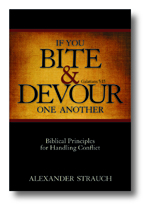
IF YOU BITE AND DEVOUR ONE ANOTHER – Alexander Strauch (2011)

Alexander Strauch serves up another “New York Steak” in his latest work, If You Bite & Devour Another.  Galatians 5:15 is the passage that drives the book as he sets forth biblical principles for dealing with conflict.

Strauch offers readers a ten step process for handling conflict in a biblical and practical manner.  The foundational principles include 1) Acting in the Spirit, 2) Acting in love, and 3) Acting in humility.  The remaining principles help readers deal with specific issues that are generally associated with conflict.  The author encourages readers to control anger, the tongue, and criticism.  Additionally, he invites readers to pursue reconciliation and peace.  Finally, Strauch focuses on dealing with false teachers and controversy with courage and integrity.

Strauch writes in a way that readers have grown accustom to over the years.  The principles are biblical and the application is always practical.  His biblical exposition is faithful to the text and the exegetical legwork is rooted in the cross work of Christ.

Pastors and elders who need help navigating the choppy waters of conflict should place an order for Strauchs’ latest “entrée,”  If You Bite & Devour One Another.

4 stars

NOTE TO SELF: The Discipline of Preaching to Yourself – Joe Thorn (2011)

I will never forget the first time I read the maxim, “Preach the gospel to yourself” in a Jerry Bridges book.  What originally appeared counter-intuitive turned out to be an important exercise in humility and a constant reminder of the grace that saved me and enables me to live the Christian life each day – all to the glory of God.

Pastor Joe Thorn writes forty-eight short notes to himself, all designed as a reminder of the ongoing influence and efficacy of the gospel in his life in his new book, Note to Self.  What may appear self-serving at first glance, is in the final analysis a gracious gift the church.  For Thorn’s “notes” are meant to serve all Christ-followers and point them to supremacy and sufficiency of the Savior which culminate in the cross-work of Jesus.

The author draws the boundaries at the outset: “Preaching to ourselves is the personal act of applying the law and the gospel to our own lives with the aim of experiencing the transforming grace of God leading to ongoing faith, repentance, and greater godliness” (p. 23).  Well stated and superbly executed throughout the book.

This short work is divided into three parts:

Part One: The Gospel and God

Part Two: The Gospel and Others

Part Three: The Gospel and You

Thorn has left no stone unturned.  He relentlessly reminds sinners of their desperate need for grace, forgiveness, and mercy.  This work is practical, devotional, thought-provoking, and soul-searching.  But most important, this work is cross-centered, Christ-centered, and gospel-centered.  While readers are privileged to get an inside look at the author’s heart in this biographical devotional, they are at the same time confronted with their need for the gospel in every arena of life.  And students of Reformed theology will appreciate the “backdoor emphasis” on the doctrines of grace throughout.  New comers to Reformed thought will receive a breathtaking introduction to the doctrinal framework that is finally getting the attention it deserves in our day!

Three cheers for Joe Thorn’s, Note to Self.  He has delivered the goods in a fresh, creative, and biblically authentic way.  This good idea that likely found its genesis on the back of a napkin may well become a best seller in a matter of weeks!

5 stars


CONCISE THEOLOGY – J.I. Packer (1993)

Concise Theology by J.I. Packer could be considered a miniature systematic theology.  The four general sections of the book are set forth as follows:

(1) God Revealed as Creator

(2) God Revealed as Redeemer

(3) God Revealed as Lord of Grace

(4) God Revealed as Lord of Destiny

Each section contains a short, but extremely pointed summary of a particular doctrine.  The book is not designed to be a comprehensive systematic theology.  Rather it is written with the layman in mind who has a desire to learn doctrinal truth or may not have the time to devote to a larger work.  The precision with which this book is written may encourage readers to study further in a given area.

J.I. Packer continues to write in a way that many have grown to love and expect.  Three basic strengths must be noted.  First, the author emphasizes the greatness and majesty of God.  Packer emphasizes that “theology is for doxology.”  He writes, “The truest expression of trust in a great God will always be worship, and it will always be proper worship to praise God for being far greater than we can know.”  Second, Concise Theology is a superb introduction to Reformed thought.  Yet the author does not “wear his theology on his sleeve.”  This work may appeal to a broad range of people who otherwise may be reluctant to study Reformed theology.  Finally, the most controversial points of Reformed theology are dealt with in an honest and forthright manner.  The most engaging essays include Packer’s discussion on particular redemption, the enslaved will, effectual calling, and the constitution of man.

The church owes a tremendous debt to Dr. Packer’s faithful ministry over the years.  May his tribe increase!

HEART OF ICE – Lis Wiehl (2011)

Lis Wiehl comes out swinging in her third installment of the Triple Threat series.  The setting of the book is Portland, Oregon.  Three friends from different backgrounds work in tandem to neutralize a vicious psychopath.  Allison Pierce is a prosecuting attorney.  Nicole Hedges is a FBI investigator.  And Cassidy Shaw is a news reporter.

Wiehl does a good job introducing the characters, who come across as real people with real dreams.  Various sub-plots are introduced into the story to keep the attention of the reader.

Instead of spoiling the plot which would, in the final analysis spoil the book, I will focus on a few positive themes that emerge in Heart of Ice.

Good clean action

The story telling is good, the action is riveting, and is not filled with the typical junk found in American thrillers.  The plot is believable and linked to the real world.

Reveals the depth of human depravity

The book does a good job at unpacking the sinfulness of the human heart.  While Wiehl never intends to write a treatise on sin, she certainly does do justice to the corruption and radical depravity of the heart.

Demonstrates the power of friendship

The importance and power of friendship is clearly portrayed in Heart of Ice. It vividly portrays the strength one receives as a result of accountable relationships.

The Heart of Ice does not disappoint.  The former federal prosecutor and Fox News contributor has located a niche that will demand more books in the future.

I received this book free from the publisher through the BookSneeze.com <http://BookSneeze.com> book review bloggers program.

3 stars

FIVE VIEWS ON SANCTIFICATION – Melvin E. Dieter, Ed. (1996)

Five Views on Sanctification, edited by Melvin Dieter is a position book that outlines the views of sanctification including Reformed, Dispensational, Keswick, Wesleyan, and Pentecostal.  Each position is subsequently evaluated by authors of the opposing viewpoint.  Issues include the general meaning of sanctification, baptism of the Spirit, definition of the old man and new man, the indwelling Holy Spirit, and the filling of the Spirit.

Each position includes a clear presentation of a given view concerning sanctification.  Anthony Hoekema presents the clearest and most convincing case and is thoroughly exegetical and practical in his approach.

Dr. Walvoord’s position is commendable (although I question calling the Dispensational view, Augustinian).  His work on the baptism and filling of the Spirit is thought-provoking and vivid.  I disagree with his evaluation on the Synod of Dordt.  He seems to think that the Reformed dictum, “regeneration precedes faith” renders one a robot.  And his emphasis on man’s responsibility appears to downplay the sovereignty of God.

The book does a marvelous job showing not only the differences that exist among the five views but the remarkable number of similarities as well.  Each author writes with conviction but also in a spirit of love.

A few weaknesses must be noted.  Because of the many similarities mentioned above, there is a great deal of repetition.  Also, there is a surprising absence of the concept of sanctification by faith alone, except in Hoekema.  The views of Dieter and Horton seem to be based more on historical grounds than biblical exegesis.  The result is an undue emphasis on man’s responsibility and not enough on the sovereignty of God.  Finally, the book should have included resources and a detailed bibliography for further study.

EYE OF THE RED TSAR – Sam Eastland (2010)

The Eye of the Red Tsar combines suspense, good detective work and is laced with action throughout.  Set in the former Soviet Union, the book follows Pekkala, an inspector who is faced with the daunting task of locating the Romanov’s killers and located the remaining living Romanov, Alexis.

This fictional thriller follows some of the historical details of the 1917 revolution and is a fascinating look at life in the former Soviet Union.

4 stars

The Unity of the Bible: Unfolding God’s Plan For Humanity – Dan Fuller (1992)

The Unity of the Bible by Daniel P. Fuller sets out to discover the theme that gives coherence to the teaching of Scripture.  It presents the logic behind God’s unfolding revelation from Genesis to Revelation.  Dr. Fuller writes, “Only by seeing the whole of God’s purpose in creation and redemptive history can one appreciate God’s individual actions in realizing this purpose.”  The author sees a need to summarize the whole Bible along the time line of redemptive history, instead of getting trapped in timeless categories that have been popularized in the discipline of systematic theology.  The bottom line: God does everything in the creation of the world and its history in order to uphold the glory of his name (Isa. 48:9-11).

Part One

Dr. Fuller maintains the Bible proceeds according to a plan.  Beginning with the creation of the world, it then relates and interprets a series of historical events that lead to the grand climax and goal of the world’s history.  He overviews the formation of the Old Testament canon and points out that God has always been in the business of working for the benefit of his people so long as they trust in him (Isa. 64:4).  The emergence of the New Testament canon is presented with careful attention given to the closing of the Apostolic age.

Part Two

Part two is devoted to explaining the foundations of redemptive history by doing an inductive study of Genesis 1:1-3:24 and by demonstrating God’s necessary work of being a Trinity.  Fuller argues persuasively that God’s purpose in creation and redemption is “that the earth might be filled with the glory of his desire to service people and … to do them good with his whole heart and soul.”  The author proceeds to explain man’s responsibility in responding to God’s purpose and outlines the purpose of hell (for those who fail to respond to God’s purpose) and the riches of God’s mercy demonstrated on the cross.

Part Three

Part three details the Abrahamic covenant and a comprehensive treatment of faith’s futuristic and past orientation is presented.  Specific steps are given for battling attitudes of unbelief.  The author argues that the justified and forgiven sinner always perseveres in faith.  The purpose of the law is also discussed and is seen by Fuller to be in continuum with the gospel rather than in contrast.

Part Four

Part four explain the plan of God in getting the gospel to the world and includes an important discussion on the kingdom of God and the conversion of Israel.

Summary

Dan Fuller writes with clarity and backs his views up with solid biblical theology and thorough exegesis.  The author maintains a Berean mindset as he surfaces key points which challenge my Bible study habits and encourage me to dig deeper.  This book like no other has challenged my thinking in significant ways and has influenced my approach to studying redemptive history and teaching practical issues of the Christian life.  The Unity of the Bible is an underrated masterpiece.  It is a true encouragement for those weary of classical dispensational charts that are riddled with proof texts.  This work offers a better approach – a true biblical theology that is sure to encourage many in the days ahead.

GOD THE HOLY SPIRIT: Volume 2 – Martyn Lloyd-Jones

From 1952 to 1955, Martyn Lloyd-Jones offered a series of messages in the Westminster Chapel in London on doctrine.  God the Holy Spirit is the second volume in a three-part study entitled, Great Doctrines of the Bible and is a result of those great meetings.

The author has a passion to communicate in-depth doctrinal truth on a practical level.  While doctrine is stressed, experiencing and living out that doctrine play a critical role in this book.  The intent is to deepen the reader’s knowledge and love for God.

Building upon the foundation of the messages entitled, “God the Father and God the Son,” Lloyd-Jones proceeds to explain the role of the Holy Spirit in the life of the believer.  The author differentiates between general and effectual calling, discusses the significance of Pentecost, and covers the Holy Spirit’s responsibility in regeneration, conversion, repentance, justification by faith, and adoption.  The author progressively builds upon previous doctrinal truth and stresses the importance of the order of salvation.  He embraces the Reformed view (i.e. the biblical view) that regeneration precedes faith.

The predominant views concerning sanctification are discussed as well as the baptism of the Spirit and the filling of the Spirit.  The book concludes with a section that deals with the sealing of the Spirit and the gifts of the Holy Spirit.

This work is filled with rich doctrinal truth from the pen of a truly great expository preacher and theologian.  Lloyd-Jones teaches with precision.  His words challenge the head and touch the heart.  His writing is clear and loaded with logic.  The main points are hammered again and again in the head of the reader.  The author has a winsome way of promoting Reformed theology.  Instead of getting trapped by the typical jargon associated with Reformed thought, Lloyd-Jones simply explains the doctrines from a Reformed viewpoint.  Great Doctrines of the Bible is a welcome and necessary addition to any pastor’s library.  Highly recommended!

THE PASTOR AS SCHOLAR AND THE SCHOLAR AS PASTOR – John Piper and D.A. Carson (2011)

The Pastor as Scholar and the Scholar as Pastor: Reflections on Life and Ministry is a vivid reminder why John Piper and D.A. Carson have had such a powerful influence on my life and pastoral ministry.

Far too often, men who enter into pastoral ministry do so with an either-or mentality.  Since they have chosen to devote their lives to the pastorate, they unwittingly embrace a false dichotomy, the erroneous notion that pastors only shepherd the people of God.  As a result, the life of scholarship is marginalized or eliminated all-together.  John Piper and D.A. Carson set this false dichotomy (and I might add – this godless dichotomy) ablaze and argue that “pastor” and “scholar” should not only be uttered in the same sentence; they belong together.

THE PASTOR AS SCHOLAR

Dr. John Piper summarizes his journey as a pastor-scholar in two parts.  In part one, he gives readers an insider look on his pilgrimage.  He explores his life as a child, high school days, and his time at Wheaton College.  God’s Providential designs become apparent as Piper unpacks different experiences that have contributed to his love for pastoral ministry and a life of scholarship.

Especially noteworthy, are some of the early influences in Piper’s life – men like Arthur Holmes, Francis Schaeffer, Jonathan Edwards, and Daniel Fuller who marked John Piper in a way that continue to influence him to this day.  An unstated but crucial lesson emerges for pastor/scholars: be careful who you read and be careful who influences your life – they will mark you for good or for bad!

Piper continues to explore the factors that contributed to his love for pastoral ministry and scholarship, namely, synthesis (a blending of the mind and heart that was spurred on and encouraged by the writing of C.S. Lewis), and a series of pivotal events that include his seminary training, doctoral studies at the University of Munich, teaching at Bethel College, and pastoral ministry at Bethlehem Church in Minneapolis, Minnesota.

Part two discusses  the scholarly roots of Christ-exalting joy.  Piper rightly argues, “Right thinking about God exists to serve right feelings for God.  Logic exists for the sake of love.  Reasoning exists for the sake of rejoicing.  Doctrine exists for the sake of delight.  Reflection about God exists for the sake of affection for God.  The head is meant to serve the heart.”  In one swoop and in typical Edwardsean fashion, the author demolishes the erroneous dichotomy between head and heart.

In the final analysis, Piper clearly demonstrates that “God’s purpose for right thinking (scholarship) is to awaken and sustain satisfaction in God that glorifies him.”  The remainder of the chapter clarifies this point and bolsters his well-known worldview he refers to as Christian hedonism.

THE SCHOLAR AS PASTOR

Dr. D.A. Carson beautifully blends his love for pastoral ministry and scholarship in a series of short arguments.  Like Piper, he shares his journey and the “providential twists” that have contributed to his life as a scholar.

Most helpful are the lessons that Carson sets forth for the scholar as pastor.  He encourages scholars to guard against an ivory tower mentality.  As such, the encouragement includes immersion in the real world.

Carson encourages scholars to steer clear from the deadly “seduction of applause” which may come from publishing house and wide readership as well as a close circle of friends.

And the author encourages scholars to fight what he calls a “common disjunction” between the “objective study of Scripture and devotional reading.”  Of course, he encourages scholars to critically engage with the text, but he also encourages meaningful times of devotion.  Scholars must tremble before God’s Word (Isa. 66:2).

CONCLUSION

In a fitting conclusion, David Mathis points readers to Jesus, the supreme example of a pastor-scholar:  “Jesus, the God-man, is the ultimate model of engaging both heart and head, not compromising either for the other.”  This indeed is the aim of the editors, namely, for scholarship and pastoral ministry to point to Jesus and his gospel.

The Pastor as Scholar and the Scholar as Pastor is a refreshing and liberating book, especially for any pastor who takes scholarship seriously.  For pastors who have grown weary of scholarship and have pushed the hard work of exegesis to the margins of their ministry – this book will be a challenging, yet helpful antidote that will benefit not only the pastor, but the people he is called to shepherd.

5 stars