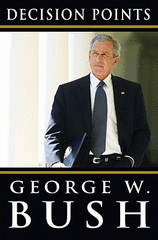
DECISION POINTS – George W. Bush (2010)

Decision Points by President George W. Bush is a book that every American ought to read.  The former president chronicles his early days in politics and honestly shares his weaknesses and decisions that he regrets.
Decision Points is possibly the most honest and candid book I have read to date.  Mr. Bush consistently takes the blame for decisions he made and refuses to cast blame on others. He congratulates others on their successes when he could have taken the credit himself.  Indeed, Mr. Bush embodies the sentiment of President Reagan who once said, “There’s no limit to what you accomplish if you don’t care who gets the credit.”

Mr. Bush discusses decision points that concern stem cells, war, Hurricane Katrina, and the financial crisis. This well written memoir bears witness to the importance of strong character, moral integrity, and a love for God, country, and freedom.  And while the former president is primarily concerned with the consequences of his decisions during his time in office, this is a vivid reminder of the importance of future decision points, crucial turning points that will impacts generations to come.

4 stars

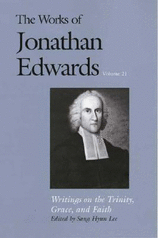
THE WORKS OF JONATHAN EDWARDS: On the Equality of the Persons of the Trinity – Volume 21

ON THE EQUALITY OF THE PERSONS OF THE TRINITY

In this short, untitled fragment that was originally written on a salvaged letter cover, Edwards demonstrates how “the personal glory of each of the persons of the Trinity is equal, though each one, as they have a distinct personality, have a distinct glory.”

Edwards argues that the divine essence of the Trinity is undivided and independent in two senses:

1. “With respect to its being, but not with respect to its relative being … that the divine essence should be what it is, is not in any respect in any dependence or by derivation.”

2. “The divine essence is independent and underived in another respect, i.e. it is not dependent on any arbitrament or voluntary communication.”

In typical Edwardsean fashion, he is delving deeply into the mystery of the Trinity.  He reiterates the importance of understanding the three person distinction and the equality among the members of the godhead.

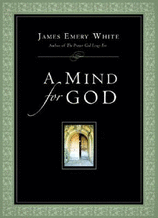
A MIND FOR GOD – James Emery White (2006)

“Thinking Christianly” is the purpose of James Emery White’s, A Mind For God.  He writes early on, “While short in length, it sketches out a very large challenge and investment: to develop our minds in light of a biblical worldview that is then used to think Christianly in the world.”

The author reaches his intended goal.  First, he explains the Christian mind and stresses the importance of recognizing and submitting to propositional revelation.  “The Christian mind is a mind that operates under the belief that there is something outside of ourselves that we must take into account.”

Second, the author develops the cultural mind.  In so doing, he explains the cultural battle that faces every Christian, namely, moral relativism, autonomous individualism, narcissistic hedonism, and reductive naturalism.  James Emery White argues essentially that Christ-followers must recognize these cultural competitors and respond in a biblical and winsome way.

Third, the author spends time developing the importance of developing good reading skills in order to nurture the Christian mind and provide a solid foundation for intellectual development.  Scripture, of course, is the centerpiece of the strategy here.

Fourth, there is a certain body of truth one ought to know if he or she is to nurture a properly informed Christian mind.  Included among the most important items are biblical, historical,  and theological literacy.  “Before a mind can contend with culture,” White argues, “it must first ground itself in a sound and vibrant Christian theology.”

The author stresses the need for spiritual discipline: “We need to recapture a sense that the development of our minds is a spiritual discipline.”  He props up specific rules for reading, learning, and reflection.

Finally, James Emery White brings everything together by making an appeal to the lordship of Christ, the issue that stands at the crux of Christian mind development and discipleship.  He writes, “This is the vanguard of Christian thinking – knowing how to live and then working to make the kingdom of God a reality for others to be able to live as well.”

I really enjoyed this book.  James Emery White has the perfect blend of Bible, cultural awareness, passion for the truth, and creativity. A Mind for God is a welcome addition to my own book, Developing a Christian Mind in a Post-Christian World which creates a workable framework for “thinking Christianly.”

4.5 stars

BONHOEFFER: PASTOR, MARTYR, PROPHET, SPY – Eric Mataxas (2010)

Eric Metaxas has outdone himself with his latest work, Bonhoeffer: Pastor, Martyr, Prophet, Spy.  The author sets the stage for Bonhoeffer’s life and ministry by detailing his life as a child and the events that led to full-time Christian ministry.

Metaxas provides rich detail that helps deconstruct this enigmatic character we know as Dietrich Bonhoeffer.  The formative years in Rome are explored, student life in Berlin, and his first pastorate in Barcelona.  Bonhoeffer is painted as one who loved children and had a passion for equipping young men for the ministry.

His life as a university student in Berlin is a fascinating journey, especially the information that pertains to his friendship with the German theologian, Karl Barth.  Also interesting is path chosen by Bonhoeffer as he studied with German liberals like Adolf von Harnack.  These years taught Bonhoeffer to think for himself and carefully formulate his theological presuppositions and produce doctoral and post-doctoral dissertations (Sanctorum Communio and Act and Being respectively).

Shortly after Act and Being was published with little acclaim, Bonhoeffer make his way to America in 1930.  He struggled with the lack of discipline that he saw demonstrated among the theological students.  He was shocked at horrific way that some Caucasians treated African-Americans.

In 1931, Bonhoeffer journeyed back to Germany after his time in America.  At this time, he struck up a friendship with Karl Barth.  He also returned to the lectern and pulpit with renewed fervor.  Metaxas observes Bonhoeffer’s desire to nurture the life of the Christian mind in his students: “He wished to disciple them in the true life of the Christian.  This ran the gamut, from understanding current events through a biblical lens to reading the Bible not just as a theology student but as a disciple of Jesus Christ.  This approach was unique among German university theologians of that era.”

One of Bonhoeffer’s students commented, “Among the public, there spread the expectation that the salvation of the German people would now come from Hitler.  But in the lectures we were told that salvation comes only from Jesus Christ.”  Bonhoeffer sought students who were biblical to the core.  Another student noted, “He taught us that the Bible goes directly into your life, [to] where your problems are.”

Bonhoeffer was a man of conviction.  In 1933 he preached at Trinity church in Berlin and boldly proclaimed, “The church has only one altar, the altar of the Almighty … Whoever seeks something other than this must keep away; he cannot join us in the house of God … The church has only one pulpit, and from that pulpit, faith in God will be preached, and no other faith, and no other will then the will of God, however well-intentioned.”

Dietrich Bonhoeffer not only took a stand for Christ; he stood on behalf of Jewish brothers and sisters.  His essay, “The Church and the Jewish Question” helped bolster his case for the Jews.  Metaxas rightly observes, “But Bonhoeffer knew that a church that did not stand with the Jews was not the church of Jesus Christ, and to evangelize people into a church that was not the church of Jesus Christ was foolishness and heresy.”

This German pastor was intensely practical and had little interest in academics as an end it itself.  Bonhoeffer writes, “Theological work and real pastoral fellowship can only grow in a life which is governed by gathering round the Word morning and evening and by fixed times of prayer.”  Additionally, Bonhoeffer would have been grieved by the so-called postmodern emphasis on “making the Bible relevant.”  He adds, “Do not try to make the Bible relevant.  Its relevance is axiomatic … Do not defend God’s Word, but testify to it … Trust the Word.”

Bonhoeffer placed a strong emphasis on preaching the written Word of God.  Metaxas comments, “For him a sermon was nothing less than the very word of God, a place where God would speak to his people … Like the incarnation, it was a place of revelation, where Christ came into this world from outside it.”

Metaxas chronicles the fascinating account of Bonhoeffer’s role as a spy and conspirator against the Nazi regime.  Bonhoeffer was a member of Military Intelligence but was in reality working to destroy Hitler’s evil devices.  The author speaks approvingly of this double agent pastor/spy: “Bonhoeffer was not telling little white lies.  In Luther’s famous phrase, he was ‘sinning boldly.’  He was involved in a high-stakes game 0f deception upon deception, and yet Bonhoeffer himself knew that in all of it, he was being utterly obedient to God.”

Metaxas meticulously details the events that led to two assassination attempts on Adolf Hitler which ultimately sent him to prison (even though the Gestapo did not initially have any idea of Bonhoeffer’s involvement in the conspiracy) and led him to the gallows.

Metaxas surveys the prison landscape that would serve as Bonhoeffer’s home for the last eighteen months of his life.  He explains how Bonhoeffer sought to keep the details of the conspiracy secret and hints at the Lutheran pastors’ ability to play a skillful game of subterfuge: “He was not a ‘worldly’ or ‘compromised’ pastor, but a pastor whose very devotion to God depended on his deceiving the evil powers ranged against him.  He was serving God by taking them all for a long ride.”

Before Bonhoeffer made his way to the gallows, he uttered these final words: “This is the end.  For me the beginning of life.”

Bonhoeffer: Pastor, Martyr, Prophet, Spy is a thoughtful and illuminating biographical account of a man who lived a faithful Christian life before God and the people of God.  The author brilliantly weaves data from personal research and a voluminous set of letters to and from Bonhoeffer.  The final product is an encouraging portrait of a courageous pastor who sought above all to obey God.  Highly recommended!

5 stars

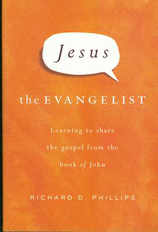
JESUS THE EVANGELIST – Richard Phillips

Jesus the Evangelist by Richard Phillips cuts to the core of the evangelistic task.   The purpose: to study key chapters in John’s gospel and learn evangelism from Jesus himself.

In part one, the author discusses basic principles of evangelism that is drawn from the example and witness of John the Baptist.  The author reminds, “A Christian witness is first and foremost about Christ … We need to declare that Jesus saves people from their sins.”

In part two, the author zero’s in on Jesus’ witness to Nicodemus and unpacks a theology of the Gospel.  He stresses Christ’s imperative in John 3, “You must be born again.”  A strong emphasis is rightly placed on monergistic regeneration.  Specifically, God alone regenerates the human heart.  There is no human cooperation.  And sovereign regeneration enables sinners to believe the gospel.

Part three includes a discussion of Jesus’ witness to the Samaritan woman and includes Jesus’ method or practice of evangelism.  The author spends time developing Jesus’ dynamic approach to evangelism and shows how he deals directly with sin.

Jesus the Evangelist is an important tool that should be utilized by anyone who has a passion for lost people.  This work is unique because it provides a solid theological framework for evangelism and a workable methodology. 

3.5 stars

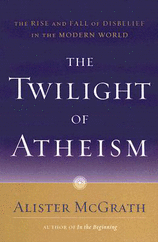
THE TWILIGHT OF ATHEISM – Alistair McGrath (2006)

The Twilight of Atheism: The Rise and Fall of Disbelief in the Modern World by Alistair McGrath is a book that deserves to be read.  The author maintains that the “rise and decline of atheism is framed by two pivotal events, separated by precisely two hundred years: the fall of the Bastille in 1789 and that of the Berlin Wall in 1989.”

McGrath skillfully guides readers through a detailed  tour of intellectual thought and demonstrates the corresponding rise and decline of atheism.

Part One: The High Noon of Atheism

Part one includes an excellent overview of the French Revolution.  Voltaire and Marquis de Sade are given special consideration and given special credit in the rise of atheism in France.

McGrath explores the intellectual foundations of atheism in Marx (God as an opiate), Freud (God as an illusion), and Feuerbach (God as an invention).

Atheism is seen through the eyes of science with a superb overview of atheism’s advance primarily through the pen of Charles Darwin.  McGrath demonstrates the rise of the so-called face value dichotomy which has contributed to the rise of secularism: “Science proves things, whereas religion depends on the authoritarian imposition of its dogmas, which fly in the face of evidence.”

Part Two: Twilight

The second half of the book picks up on the theme that Nancy Pearcey has so skillfully described in her book, Total Truth, namely the bifurcation of the sacred and the secular.  McGrath surveys the history of intellectual thought up through the Protestant Reformation and discusses the shortcomings of Protestantism.

Next, McGrath narrows his study to the birth of modernity and demonstrates that “atheism was [and is] perfectly suited to this rational and logical worldview.”

Postmodernity grew out of modernity, which according to McGrath seriously “undermines the plausibility of atheism.”  The reason: “Postmodernism is a cultural mood that celebrates diversity and seeks to undermine those who offer rigid, restrictive, and oppressive views of the world.”  And since atheism proves an incredibly intolerant worldview, the prospects of its growth do not bode well given the presuppositions of postmodernism.  McGrath suggests the reason for the incompatibility of atheism with postmodernism: “For postmodernity is intolerant of any totalizing worldview, precisely because of its propensity to oppress those who resist it” (which in the final analysis excludes atheism).

The book concludes by discussing the “fading appeal of atheism.”  McGrath discusses the shortcomings of this hopeless worldview and leaves the reader wondering what the future holds.  The author maintains, “Western atheism now finds itself in something of a twilight zone.”

The Twilight of Atheism is a welcome addition to an ever-increasing list of books on apologetics, worldviews, and evangelism.

4 stars

HOLLYWOOD WORLDVIEWS: Watching Films With Wisdom and Discernment – Brian Godawa (2009)

Whenever a book is dedicated to Francis Schaeffer, I usually stand at attention.  Brian Godawa’s book Hollywood Worldviews: Watching Films With Wisdom and Discernment is no exception.

Godawa presents the purpose of the book in to introduction: “I want to inform the reader of the nature of storytelling and analyze how worldviews are communicated through most Hollywood movies.  As readers sharpen their understanding of movies, they will be more capable of discerning the good from the bad and avoid the extremes of cultural desertion (anorexia) and cultural immersion (gluttony).

This work is divided into three parts and  are summarized below:

ACT ONE: STORYTELLING IN THE MOVIES

The first section includes a survey of movies that are laden with violence, profanity.  Also included are movies that stress stories, myth, and redemption.  The author is quick to point out that “every story is informed by a worldview.  And so every movie, being a dramatic story, is also informed by a worldview.  There is no such thing as a neutral story in which events and characters are presented objectively apart from interpretation.”

The author challenges readers to watch movies with a discerning eye and avoid generic responses such as “I liked it” or “I didn’t like it.”

ACT TWO: WORLDVIEWS IN THE MOVIES

In section two, the author presents a wide assortment of movies that promote existentialism, postmodernism, romanticism, monism, evolution, humanism, and Neo-paganism.  He honestly and thoughtfully interacts with and dissects dozens of movies and contrasts them with the Christian worldview.

ACT THREE: SPIRITUALITY IN THE MOVIES

Godawa explores the identity of Jesus in the movies and how Christianity is represented (usually poorly) in contemporary films.  He rightly alerts the reader to the fact/value dichotomy that emerges in many movies.

Hollywood Worldviews: Watching Films With Wisdom and Discernment is an excellent overview that clearly outlines the strengths and weaknesses in literally dozens of movies.  The author candidly interacts with worldview themes and carefully summarizes themes that are inconsistent with Scripture.  Godawa’s work is a breath of fresh air as he evaluates film and contemporary culture with a spirit of grace and a clear-headed approach.

4 stars

2010 in review

The stats helper monkeys at WordPress.com mulled over how this blog did in 2010, and here’s a high level summary of its overall blog health:

Healthy blog!

The Blog-Health-o-Meter™ reads Wow.

Crunchy numbers

Featured image

A Boeing 747-400 passenger jet can hold 416 passengers. This blog was viewed about 8,300 times in 2010. That’s about 20 full 747s.


In 2010, there were 123 new posts, not bad for the first year! There were 253 pictures uploaded, taking up a total of 84mb. That’s about 5 pictures per week.

The busiest day of the year was December 21st with 902 views. The most popular post that day was SLAVE – John MacArthur (2010).

Where did they come from?

The top referring sites in 2010 were challies.com, facebook.com, lagrandefbc.org, Google Reader, and faithbyhearing.wordpress.com.

Some visitors came searching, mostly for veritas et lux, kouzes and posner 2007, baldreformer, no creed but christ, and what is vocation.

Attractions in 2010

These are the posts and pages that got the most views in 2010.

1

SLAVE – John MacArthur (2010) December 2010
2 comments

2

THE LEADERSHIP CHALLENGE – James Kouzes and Barry Posner (2007 Revised) March 2010

3

Dr. David Steele January 2010
4 comments

4

THE SEVEN SAYINGS OF THE SAVIOR ON THE CROSS – A.W. Pink February 2010

5

MANAGING PEOPLE IS LIKE HERDING CATS – Warren Bennis (1999) August 2010

TOP BOOKS IN 2010

An incredible little book that explains the essence of the gospel without compromise.  A great evangelistic tool.

A valuable resource for pastors and seminary students. See my review


An assault on the fact/value dichotomy.  Don’t miss this one!

See my review

Classic Piper.

See my review

Excellent summary of neo-paganism and a crisp, clear evangelical response.

See my review.

A terrific biography by a terrific president.

See my review

MacArthur just keeps getting the gospel right!

See my review

Meaty essays in honor of Dr. John Piper.

See my review

A portrait of courage and conviction.

See my review

THE JOURNEY: A Spiritual Roadmap for Modern Pilgrims – Peter Kreeft (1996)

The Journey by Peter Kreeft is a sort of philosophical roadmap for truth seekers.  This allegorical tale which is something akin to Pilgrim’s Progress is a practical tool for travelers.  It is a practical guide to help them choose a life philosophy.  The author is quick to remind readers that every person has a philosophy.  Even a “n0n-philosophy” is a philosophy!  Ten questions are stated in advance by the author:

1. Shall I question?  Shall I go on this quest for truth at all?

2. If I question, is there hope of answers, or should I be a skeptic?  Is there objective truth?

3. If there is any objective truth, is there objective truth about the meaning of life?

4. If there is an objective truth about the meaning of life, is it that life is meaningless?

5. If life has real meaning, is it spiritual and not merely material?

6. If it is spiritual, is it moral?  Is there a real right and wrong?

7. If there is a real right and wrong, a real moral meaning, is it a religious meaning?  Is there a God?

8. If there is a God, is God immanent (pantheism) or transcendent (deism), everywhere or nowhere?

9. If God is both immanent and transcendent (theism, creationism) his prophets, his mouthpiece to the world?

10. If the Jews are God’s prophets, is Jesus the Messiah?

Socrates accompanies the pilgrim throughout this allegorical journey.  He reiterates the point made above, “Remember – you do not have a choice between some philosophy and no philosophy, only between good philosophy and bad philosophy.”

The traveler encounters a wide variety of philosophers, one of which is Protagoras the Sophist.  He maintains, “Truth is subjective, not objective … Whatever you believe is true, is true for you.  Man is the measure of all things.”  Thus Protagoras promotes the lie of relativism so prevalent in American culture.

The next traveler on the path is Diogenes who admits that there is some absolute truth.  He also admits that “it is self-contradictory to say otherwise.”  Socrates confronts the cynicism of Diogenes by showing the futility of the “proving is believing” model.

Gorgias emerges next on the path who represents a nihilistic worldview.  He summarizes his worldview: “First, nothing is really real.  Second, if it were, we could not know it.  Third, if we could we could not communicate it.”

Next, the traveler and Socrates come face to face with Democritus the materialist (Darwin, Marx, and Freud’s predecessor).  Socrates makes mince meat of Democritus’ arguments and “unquestioned faith.”  The author (who speaks through the Socratic character) clearly delineates the reason for the popularity of materialism as a worldview: “It offers exculpation from guilt … only a self can be guilty, because only a self can be morally responsible.  If we are nothing but clever apes, as Darwin says, or pawns of our economic system, as Marx says, or bundles of sex urges, as Freud says, then there is no free moral agent to blame, and no one to feel guilty.  Morality becomes a myth.”

The thoughtful friends continue their philosophical journey and eventually encounter the relativistic worldview of Thrasymachus.  His worldview that embraces the notion that “there is no natural law of good and evil” is immediately exposed.

Xenophanes is the next philosopher to appear on the trail who magically transforms into Nietzsche, the quintessential atheist.  The travelers are unimpressed with the antics of Nietzsche, so they scurry down the path.

Parmenides, who some consider to be the first philosophical pantheist appears next alongside Aristotle, the “first philosophical deist” (Kreeft compares him to John Locke and Immanuel Kant).

The travelers continue their philosophical quest and bump into Moses who quickly turns the discussion Godward!  He reveals the essence of man’s problem: “Sin.  Rebellion against God, and his will, and his law.  Sin blinds the mind.  Sin makes us forget God, and his will, and his law.  It makes us rationalize instead of reasoning.”

Moses directs his new friend to the creative power of God: “Our God gave the universe not just its shape or its motion but its very existence.  He created it out of nothing, not out of something.  Matter itself is his creation, not just form.”

The journey ultimately leads to the foot of three old crosses.  The middle cross pointed to the “King of the Jews.”  C.S. Lewis appears and reveals that his responsibility is to point people to the truth.  Lewis turns the attention of the traveler to the Messiah: “His claim on you is to be more than your teacher, like Socrates, and more than your prophet, like Moses.  His claim is to be your God.”  Lewis continues his dialogue with the traveler and unpacks the gospel message in a way that is theologically correct and philosophically pleasing.

Kreeft brings the journey to an end in an epilogue that finds its culmination in the life, death, burial, and resurrection of Jesus Christ.  He points readers to Christ, the true source of freedom and forgiveness!

Most people would immediately turn away upon seeing some of the philosophers presented in Kreeft’s book.  And people are generally intimidated by emerging worldviews.  However, Kreeft’s work enables readers to interact with ancient worldviews that have surfaced in our culture and effectively dismantles erroneous arguments and unbiblical presuppositions.  His narrative forces readers to choose between worldviews when faced with a fork in the road.  As usual, Kreeft’s work earns high marks for creativity and clarity.  The book is both educational and witty.  Postmodern pilgrims (and college students) need Kreeft’s book in their arsenal, especially in the difficult days ahead.

4 stars