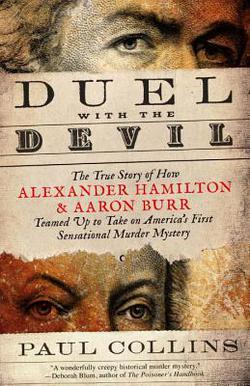
DUEL WITH THE DEVIL – Paul Collins (2013)

hamiltonJonathan Edwards is the greatest theologian to plant his feet on American soil.   It should come as no surprise, then, when one learns about the able individuals that sprouted forth from Edwards family tree – physicians, lawyers, university presidents, and even a vice-president.  Aaron Burr was Thomas Jefferson’s vice-president, of course.  Burr was also Jonathan Edwards grandson.  So when I learned about a new book that chronicled the well-known showdown between Aaron Burr and Alexander Hamilton, I eagerly devoured the book.

Duel With the Devil is the story of the unlikely pairing of Burr and Hamilton, two attorney’s who combined their efforts to represent and defend a man convicted of murder.  Courtroom drama, political maneuvering, and personality conflicts weave throughout this tale.  Paul Collins is the author who has a gift for transporting readers to a historical setting – in this case, 18th century America.

While many are familiar with the duel between Hamilton and Burr, most are unaware of their work together on this murder case, which  consumes most of the book.

Students of American history will be pleasantly surprised by Collins work.  Here is a combination of a writer with John Grisham-like ability to tell a story and Dan Brown-like attention for detail.  The book is filled with historical tidbits but reads like a very fine novel.

I received this book free from the publisher through the Bloggingforbooks.org. I was not required to write a positive review. 

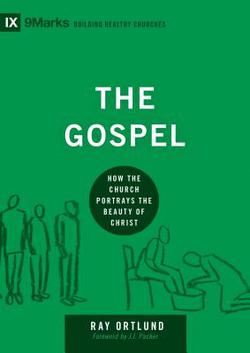
THE GOSPEL – Ray Ortlund (2014)

1433540835_bThe “gospel” has become somewhat of a buzzword in evangelical circles.  It’s a funny thing because the gospel is at the very center of the Bible and God’s redemptive purposes.  So it’s counterintuitive to claim the very idea that the gospel has become a buzzword.  Christ-followers knowingly or unknowingly validate a ministry, band, or organization by attaching the label, “gospel.”  In most cases, this approach is a good measuring rod of the validity of anything or anyone which claims to adhere to the historic Christian faith.  But in some cases, it is a mere word that carries no more meaning that a sticker on a product.  In this sense, the word becomes another piece of Jesus junk.  Thankfully, the book under consideration does not fall into the later category.

The Gospel by Ray Ortlund is the latest in a series of books in the 9Marks series, edited by Mark Dever.  I’ve read nearly all the books in the series.  They’re all good and are chock-full of sound biblical counsel.  Each of the books is designed to help establish and nurture healthy churches.  I commend each book to pastors, leaders, and Christ-followers who love the church and have a passion to see Christ’s glory penetrate the nations.  It’s almost unfair to compare the books because each one stands alone and is an important contribution.  Having said that, Ray Ortlund’s book stands head and shoulders above the others.

Ortlund establishes the beauty of the gospel in the introduction: “God, through the perfect life, atoning death, and bodily resurrection of Jesus Christ, rescues all his people from the wrath of God, with a promise of the full restoration of his created order forever – all to the praise of the glory of his grace.”  With this definition of the gospel in place, the author defines the purpose of the book, namely -“to show how Christ puts his beauty into our churches by his gospel.”

The first sentence in the book provides a framework for the rest of the journey through this wonderful little treatise: “Gospel doctrine creates a gospel culture.  The doctrine of grace creates a culture of grace.”  He adds, “Truth without grace is harsh and ugly.  Grace without truth is sentimental and cowardly.”  Unfortunately, many churches reflect the later.  But Ortlund is not deterred.  In a short chapter devoted to expositing John 3:16, he unpacks the wonder and majesty of the gospel of grace.  The gospel is compared to other so-called hopes that are offered up in the marketplace of ideas.  But the conclusion is simple: “Every other hope is based, explicitly or implicitly, on how deserving we are.  Only the Christian gospel is based – clearly, boldly, and insistently – on how loving God is to the undeserving.”  In short, “Gospel doctrine creates a gospel culture, and it matters.”

Ortund maintains the gospel is for the church: “The doctrine of grace creates a culture of grace where good things happen to bad people.”  As such, the author guides readers through a stunning exposition of Ephesians 5:25 – “Christ loved the church and gave himself up for her.”  Again, the culture is ultimately affected by the power of the gospel.  It is the gospel that makes us holy.  It is the gospel that makes us acceptable in the sight of a holy God.

The author draws the attention of readers to the comprehensive nature of the gospel.  The new heaven and earth are presented.  In other words, as Ortund writes, “This present heaven and earth, will be renewed.  God will restore this creation that he made, owns, and loves – this creation where we ourselves feel at home.”  At the end of the day, the gospel produces a culture which is brimming with hope – the hope that Christ will make all things new!

This is a book worth reading and re-reading.  It is a book that needs to be absorbed and assimilated into the fabric of every local church.  The Gospel should be placed in the hands of new believers and veteran believers.  It should be gifted to non-believers who express an interest in the gospel.

5 stars

PARDON FOR THE GREATEST SINNERS – Jonathan Edwards

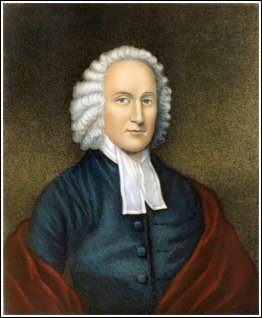
Jonathan_Edwards_engravingIt is unclear when the sermon under consideration was preached by Jonathan Edwards.  The best records seem to indicate that the Puritan divine preached this magnificent sermon before 1733, when Edwards was still in his 20’s.  The full title is Great Guilt No Obstacle to the Pardon of the Returning Sinner.  The subject was as relevant in the 18th century is it is now.  For large numbers of professing Christ-followers have abandoned their first love, in search of a “better way” which in the final analysis is the pathway to hell.

The sermon text is Psalm 25:11.

For your name’s sake, O Lord, pardon my guilt, for it is great.

From the outset, Edwards remarks about the heinousness of sin.  The Psalmist does not minimize his sin.  Rather, he maximizes the depth of his sin and acknowledges his deep great for pardon.

In typical Edwardsean fashion, America’s greatest intellectual reveals the doctrineIf we truly come to God for mercy, the greatness of our sin will be no impediment to pardon.

The established doctrine enables Edwards to  address the things which are needful in order for sinners to come to God for mercy.

1. That we should see our misery, and be sensible of our need for mercy.

“They must be sensible that they are the children of wrath; that the law is against them, and that they are exposed to the curse of it: that the wrath of God abideth on them; and that he is angry with them every day while they are under the guilt of sin.”

2. They must be sensible that they are not worthy that God should have mercy on them.

“They who come to God for mercy in a right manner are not disposed to find fault with his severity; but they come in a sense of their own utter unworthiness, as with ropes about their necks, and lying in the dust at the foot of mercy.”

3. They must come to God for mercy in and through Jesus Christ alone.

Edwards reveals four crucial supporting points to help bolster this proposition:

  • The mercy of God is as sufficient for the pardon of the greatest sins, as for the least; and that because his mercy is infinite.
  • That the satisfaction of Christ is as sufficient for the removal of the greatest guilt, as the least (1 John 1:7).
  • Christ will not refuse to save the greatest sinners, who in a right manner come to God for mercy: for this is his work.
  • Herein doth the glory of grace by the redemption of Christ much consist, viz. in its sufficiency for the pardoning of the greatest sinners.  The whole contrivance of the way of salvation is for this end, to glorify the free grace of God.
  • Pardon is as much offered and promised to the greatest sinners as any, if they will come aright to God for mercy.  The invitations of the gospel are always in universal terms.

Application

The heart of Edwards is to encourage sinners burdened with guilt to run to God for mercy: “If you go in the manner we have described, the arms of mercy are open to embrace you.”

I stand with Jonathan Edwards and beg my friends who are rebelling against God to run to the cross of Christ for mercy.  Run to Christ before it is too late.  Edwards speaks in vivid terms: “If you had as much guilt lying on each of your souls as all the wicked men in the world, and all the damned souls in hell; yet if you come to God for mercy, sensible of your own vileness, and seeking pardon only through the free mercy of God in Christ, you would not need to be afraid; the greatness of your sins would be no impediment to your pardon.  Therefore, if your souls be burdened, and you are distressed for fear of hell, you need not bear that burden and distress any longer.  If you are but willing, you may freely come and unload yourselves, and cast all your burdens on Christ, and rest in him.”

Edwards includes one final plea for sinners: “Spread all your wickedness before him, and do not plead your goodness; but plead your badness, and your necessity on that account: and say, as the psalmist in the text, not Pardon mine iniquity, for it is not as great as it was, but ‘Pardon mine iniquity, for it is great.'”

May sinners find rest in a Savior whose mercy runs deep and flows freely from the foot of the cross!

STRANGE BEAUTIFUL MUSIC – Joe Satriani and Jake Brown (2014)

Joe Satriani first came on my radar screen in the mid 80’s.  I’ll never forget the first 1939529646_btime I heard Surfin’ With the Alien.  Of course, I knew then that Satch was the real deal.  Since then, I’ve seen him several times in concert and have always been impressed with his showmanship, professionalism, and genuine humility.

Strange Beautiful Music is the first-hand account of Joe Satriani’s life and musical career. The book is packed with stories that chronicle his friendship with many musical greats, most notably – the great, Steve Vai.

The book confirms what I’ve always suspected about this hardworking superstar.  This is a musical memoir that is tasteful and brings Satriani cans into his personal arena for a firsthand look.

Strange Beautiful Music is a must for Joe Satriani fans, a man who has been wonderfully blessed by God and blessed with a gift that he will no doubt share with the world for years to come!

KNOW THE HERETICS – Justin Holcomb (2014)

Heretics have been around for a long time and have plagued the church for as long as 0310515076_bwe can remember.  Justin Holcomb provides a valuable service for the church in his excellent book, Know the Heretics.  The intent of the book is to provide a readable summary of the major heresies that have sprung up in church history.

Such a book is unable to deal with every heresy.  However, the author certainly does expose the major heresies which are described below:

  • Judaizers
  • Gnostics
  • Marcion
  • Docetists
  • Mani
  • Sabellius
  • Arius
  • Appollinarius
  • Pelagius
  • Eutyches
  • Nestorius
  • Socinus

A brief historical background is presented for each heretic which is followed by the specific heretical teaching, the orthodox response, and the contemporary relevance. Know the Heretics strikes the right balance.  The author provides enough data to inform readers but does not overwhelm them with the details.  The tone is gracious but does not mince words.  The church will only be strengthened and edified by this fine work as she commits herself to the timeless truths of Scripture.

I received this book free from the publisher through the BookSneeze®.com  book review bloggers program. I was not required to write a positive review. 


THE NEW THE NEW REAGAN REVOLUTION – Michael Reagan (2010)

Michael Reagan has captured the essence of President Reagan’s values, fiscal policy, 031264454X_band tough-minded leadership in his book, The New Reagan Revolution.  The sub-title should jolt any thinking American – “How Ronald Reagan’s Principles Can Restore America’s Greatness.”  Clearly, we have drifted far from President Reagan’s vision for America.  The city of the hill that he so loved has descended into the swamp of relativism and pragmatism that tolerates abortion on demand, celebrates homosexual marriage, and applauds big government and out-of-control spending.

The author walks readers on a path that traces Reagan from his days as a Democrat to his final days in the White House.  Readers learn that Reagan was a man of unwavering conviction.  He believed in a “banner of bold, unmistakable colors, with no pale pastel shades.”  The author adds, “Every leader who waves a banner of bold colors has plenty of critics.  If no one is criticizing you, you’re not being bold enough.  Ronald Reagan never worried about his critics.  He didn’t care what other people thought of him or said about him or wrote about him.”  Reagan’s son continues, “Pale pastel people try to straddle both sides of every issue in an attempt to get everyone to like them.  They try not to be too bold because they fear offending others or drawing criticism … Ronald Reagan knew he would never please everybody, so he staked out bold positions on the issues – then he proved he was right.”  This is the kind of leadership that brought the former Soviet Union to its knees.  This is the kind of bold leadership America needs now – bold, decisive, and unwavering in the face of adversity!

The author rightly portrays his father as the great communicator.  “Every leader,” writes the younger Reagan, “must communicate his vision in a way that persuades and inspires.”  And while Reagan truly inspired America in his two terms as president, he did not compromise his cherished values.  Nor did he play both sides for the middle in order to gain the loyalty of special interest groups.  The great communicator spoke with clarity and conviction.  He knew how to capture the heart of America.  He knew the power of the spoken word.

Additionally, the author portrays President Reagan as the great unifier.  The president once said, “We’ve got to quit talking to each other and about each other and go out and communicate to the world … We must go forth from here united, determined.”  Reagan worked to find common ground with his political opponents and even forged a friendship with his nemesis, Tip O’Neal.  America is in search of a leader who unifies like Ronald Reagan.

Finally, the author demonstrates the love that his father had for freedom.    Reagan was fond of saying, “Freedom is never more than a generation away from extinction.”  One wonders what he would say today.  One wonders what the former president would say about excessive regulation and a socialized health care system.  The author encourages readers to advance the New Reagan Revolution by “boldly standing up for the original Reagan Revolution.  Let everyone around you know the truth about Ronald Reagan, the Founding Fathers, the Declaration of Independence, and the U.S. Constitution.”

The New Reagan Revolution is a book that should be devoured by every American.  President Reagan is an inspiration for anyone who loves freedom, limited government, a strong military, and lower taxes.  The younger Ronald Reagan is on target when he says, “There will never be another Ronald Reagan.”  But we can certainly return to a day where the principles that President Reagan believed in are weaved into the fabric of American culture.

4.5 stars

WHEN CHARACTER WAS KING – Peggy Noonan (2001)

A number of years ago, I began devouring books about my favorite president.  When Character Was King by Peggy Noonan emerges as one of the most thoughtful and inspiring books about the former president.

Noonan paints a compelling portrait of President Reagan; a portrait that is an exceedingly human portrayal of a man who feared God, loved his country, and cherished freedom.  The author writes, “As president, Ronald Reagan believed without question that tyranny is temporary, and the hope of freedom is universal and permanent; that our nation has unique goodness, and must remain uniquely strong; that God takes the side of justice, because all our rights are His own gifts.”

Reagan opposed the godless ideology that held millions of Russians hostage from 1917 to 1991.  Lenin said in 1920, “We repudiate all morality that proceeds from supernatural ideas that are outside class conceptions. Morality is entirely subordinate to the interests of class war. Everything is moral that is necessary for the annihilation of the old exploiting social order and for uniting the proletariat.”  In contrast, Reagan knew that virtue and morality are directly related to one’s relationship with God.

A few quotes reveal the man we know as President Reagan:

“We had strayed a great distance from our Founding Fathers’ vision of America.  They regarded the central government’s responsibility as that of providing national security, protecting our democratic freedoms, and limiting the government’s intrusion in our lives – in sum, the protection of life, liberty and the pursuit of happiness.  They never envisioned vast agencies in Washington telling our farmers what to plant, our teachers what to teach, our industries what to build.”

“Don’t give up your ideals.  Don’t compromise.  Don’t turn to expediency.  And don’t for heaven’s sake, having seen the inner workings of the watch, don’t get cynical.”

“All of these things – learning to control the government, limiting the amount of money it can take from us, protecting our country through a strong defense – all of these things revolve around one word, and that word is ‘freedom.'”

President Reagan was and continues to be a breath of fresh air in an increasingly pessimistic political climate.  He was unafraid to stare evil in the face.  He courageously stood for the cause of freedom.  Indeed, he was jealous to see the flag of freedom fly in every land.  He opposed despotism, communism, and socialism.  He promoted free enterprise.  President Reagan refused to capitulate in the face of adversity.


THE REBELLION OF RONALD REAGAN – James Mann (2009)

1400140625_bThe day was June 12, 1987.  President Ronald Reagan stood in front of the Brandenburg Gate in West Berlin and uttered these crucial and historic words: “General Secretary Gorbachev, if you seek peace, if you seek prosperity for the Soviet Union and Eastern Europe, if you seek liberalization: Come here to this gate!  Mr. Gorbachev, open this gate!  Mr. Gorbachev, Mr. Gorbachev, tear down this wall!”

James Mann’s, The Rebellion of Ronald Reagan is a fascinating and readable account of the days leading up to the end of the Cold War.  Mann clearly describes the inner workings of the Reagan administration and the resistance from liberals and conservatives alike to the president’s approach and methodology.

The Rebellion of Ronald Reagan relentlessly presents the former president’s love for freedom and his passion to eliminate totalitarianism.   I was reminded of Reagan’s love for freedom  in 2005 as I stood on a bridge that spans the Moscow river.  As I gazed at the Kremlin and reflected on the new found and relative freedom the citizens of Russia enjoy, I glanced at the”goon-inspired” graffiti that was etched onto the bridge. The words, “Heil Hitler” were mindlessly inscribed on the edge of the bridge.  The graffiti reminded me that freedom will be short-lived if liberated people grow apathetic and fail to guard their freedom.  It reminded me that fascism is still visible in the rear view mirror, not to mention the horizon.   And it reminded me that Marxism still has momentum and must be stopped at every juncture.  Liberated people everywhere would do well to seriously consider the warning of Thomas Jefferson: “When the people fear their government, there is tyranny; when the government fears the people, there is liberty.”

President Reagan was acutely aware of these concerns which helped fuel the fire of his policies and interactions with Gorbechev. The Rebellion of Ronald Reagan is a helpful reminder of events in the distant past.  While the Cold War is over, the ideology that inspired Lenin, Stalin, and Hitler is still very much alive. Ronald Reagan reminds us of the importance opposing the enemies of freedom; he reminds us to stand on the watchtower and jealously guard our freedom.  He reminds us that freedom is not free; it is a precious commodity worth dying for.  And he reminds us that freedom is never guaranteed in the future.

Reagan was aware of the protesters that gathered to voice their complaints over his appearance at the Brandenburg Gate.  His speech closes: “And I would like, before I close to say one word.  I have read, and I have been questioned since I’ve been here about certain demonstrations against my coming.  And I would like to say just one thing, and to those who demonstrate so.  I wonder if they have ever asked themselves that if they should have the kind of government they apparently seek, no one would ever be able to do what they’re doing again.  Thank you and God bless you all.”

President Reagan is no longer with us but the Reagan revolution is still alive and well; much to the chagrin of the liberal elite and secular progressives.  Big government, nationalized health care, excessive taxation, a reduction in personal liberty, and a weakened national defense was never tolerated by Reagan.  And the current progressive agenda will not be tolerated by the American people.

3.5 stars

REAGAN ON LEADERSHIP – James M. Strock (1998)

098407743X_lHe is man who inspired the United States of America after four years of economic disaster in the Carter administration.  He is the man who called out a Communist leader as he stood before the  Brandenburg Gate in Germany.  He is the man who is largely responsible for the demise of the former Soviet Union.  He is the man who restored faith in the American ideal of life, liberty, and the pursuit of happiness.  His name – President Ronald Wilson Reagan.

President Reagan was a first-rate leader.  His approach to leadership emerges clearly in James Strock’s excellent project entitled, Reagan on Leadership: Executive Lessons From the Great Communicator.

Part one discusses President Reagan’s approach to Leadership.  The author notes the importance of crafting a compelling vision.  Anyone who is familiar with Ronald Reagan will admit that he was the master of vision casting.  Reagan’s leadership was tough and decisive.  He proposed policies with boldness and humility that was laced with a depth of character the many Americans relegate to the good ol’ days.

Part two discusses the Management philosophy of President Reagan.  A plaque that set on his desk in the Oval Office communicates the heart and soul of his approach to management: “There is no limit to what a man can do or where he can go if he doesn’t mind who gets the credit.”  He repudiated a micro-management approach and was happy to delegate authority to his staff.    He said, “The way I work is to identify the problem, find the right individuals to do the job, and then let them go to it.”  So his management philosophy had an inherent trust in people.  His desire was to unleash the gifts and talents in others for a the benefit of the American people.

Part three overviews Communication.  Of course, Reagan is best known as the great communicator.  In a poignant moment, the former President admitted, “I wasn’t a great communicator, but I communicated great things.”  And so the leader of the free world inspired Americans with lower taxes, a strong military, and a smaller government – three pillars that have all but crumbled under the current administration.

Part four focusses on Self-Management.  The author zero’s in on the character qualities of courage, authenticity, confidence, optimism, empathy, grace, charm, discipline, constancy, perseverance, and humility to name a few.  These are the marks that made the made.  The combined total of these characteristics shaped the man that we know as President Ronald Reagan.

Reagan on Leadership is a reminder that leadership matters.  It is a reminder that great men are great leaders.  It is a reminder that character matters; that leaders are made, not born.  This is a book that is greatly needed in our day and will help inspire the next generation of leaders committed to the rise of conservative values and policy.

THE FAITH OF RONALD REAGAN – Mary Beth Brown (2011)

February 6, 2011 marks the 100th anniversary of President Ronald Reagan’s birth.  Mary Beth Brown honors the life and legacy of the fortieth president in her book, The Faith of Ronald Reagan.

The Faith of Ronald Reagan uncovers what most books on the former President miss – a deep trust and reliance on the sovereign God of the universe.

The author explores the faith of Reagan’s mother and the spiritual influence she had on her son.  As such, she tracks the spiritual pilgrimage of former president and notes special moments that contributed to Reagan’s walk with God.

Mary Beth Brown does an excellent job highlighting President Reagan’s Christian faith and especially marks his deep trust in Christ and his reliance on the Providence of God.  She notes, “Reagan was the great communicator as we all know, but the key to his political success was his unparalleled ability to speak the language of faith and values.  This ability was a result of his strong faith and close relationship with God.”

Additionally, the author stresses Reagan’s love of personal dignity and  freedom – freedom that grows weaker as segments of America embrace liberalism.  Brown adds, “Reagan firmly believed that if we couldn’t convince the nation of the immortality of abortion, that we were in for a dire future.”

President Reagan modeled humble leadership.  The sign on his desk in the Oval Office read, “There is no limit to what a man can do or where he can go if he doesn’t mind who gets the credit.”

I will never forgot the day I heard of President Reagan’s death.  My wife asked, “Are you crying?”  I tried to hold it back, but the tears were welling up in my eyes.  America lost a great patriot on June 5, 2004.

Ronald Wilson Reagan will consistently be remembered by American’s as the greatest presidents of the twentieth century and one of the most influential presidents in American history.  Indeed, he stands alongside the likes of George Washington, John Adams, and Abraham Lincoln.  He taught us that freedom matters.  He taught us that freedom is not free.  He modeled good leadership.  And President Reagan demonstrated the importance of living out the Christian worldview.  We are the beneficiaries of his legacy.

4 stars

I received this book free from the publisher through the BookSneeze.com <http://BookSneeze.com> book review bloggers program.