FOR THE FAME OF GOD’S NAME – Sam Storms and Justin Taylor, Ed. (2010)

Three years ago, Sam Storms and Justin Taylor came up with a great idea.  They would collaborate on a book that honored the life and ministry of John Piper.  Anyone familiar with Piper’s pastoral ministry and prolific writing will recognize the mammoth undertaking that stood before Storms and Taylor.  But they went to work, securing an army of pastors and theologians who agreed to write on their assigned topic.

This is an almost impossible book to review.  Each chapter stands alone and appropriately honors the life and legacy of John Piper.  The book is composed of seven parts:

Part One: John Piper

Part Two: Christian Hedonism

Part Three: The Sovereignty of God

Part Four: The Gospel, The Cross, And The Resurrection of Christ

Part Five: The Supremacy of God In All Things

Part Six: Preaching and Pastoral Ministry

Part Seven: Ministries

Readers familiar with Piper will immediately recognize these emerging themes and consider each theme an accurate reflection of his life, theological passion, and ministry.

Looking back through the book, I think Jon Bloom’s comments concerning John Piper is probably an accurate reflection of every contributor: “John Piper’s influence on my life is incalculable.  Because of John I am more deeply in love with Jesus and his church.  My marriage, my children, my prayers, my love of Scripture, my vocation, my possessions, where I live, how I lead, what I read – all have been profoundly influenced by him.”

For the Fame of God’s Name is an inside look at what makes John Piper tick.  But more important, this work magnifies the sovereign plans and purposes of a great and majestic God – the God who is “most glorified in us when we are most satisfied in him.”  This work is a feast for the intellect and a boon for the soul.  Pastors and parishioners alike will benefit from this treasure trove.

5 stars

Slave – John MacArthur (2010)

John MacArthur has been churning out quality Christian books and resources for over thirty-five years.  He has been defining and defending the biblical gospel in books like The Gospel According to Jesus, Faith Works, Ashamed of the Gospel, Hard to Believe, and The Truth War. Each of these books, beginning especially with The Gospel According to Jesus has had a profound effect on my life and pastoral ministry.

Slave, MacArthur’s newest book continues to articulate the biblical gospel, the very same gospel that was preached by the apostles, Reformers, and Puritans.   The uniqueness of this book is that the author seeks to “pull the hidden jewel” as he says, “all the way into the sunlight.”

MacArthur’s concern is that what is means to be a Christian has been and is being redefined by many evangelicals.  But the New Testament clearly delineates the meaning of what is means to be a Christian, namely, a “wholehearted follower of Christ.”  MacArthur picks up the same theme he began in The Gospel According to Jesus when he argues that Christian discipleship “demands a deep affection for Him, allegiance to Him, and submission to His Word.”

The Greek term doulos is at the heart of MacArthur’s concern.  While English translations have been notorious for mistranslating this term as “servant,” the proper translation is “slave.”  He notes this glaring error and insists that while many Greek words can be translated “servant,” doulos is certainly not one of them!  The author highlights the key distinction between a servant and a slave, namely, “servants are hired; slaves are owned.”

Therefore, Christian disciples are defined in a biblical sense as slaves of God.  MacArthur adds, “He [Christ] is the Master and Owner.  We are His possession.  He is the King, and the Lord, and the Son of God.  We are His subjects and His subordinates … True Christianity is not about adding Jesus to my life.  Instead, it is about devoting myself completely to Him – submitting wholly to His will and seeking to please Him above all else.”

MacArthur argues convincingly that Christ is Lord and Master over his church (Eph. 5:23; Col. 1:18).  Indeed, Christ is sovereign over every person and everything in the universe.  John Hus is cited as a model of one who fully gave his life “to the sovereign lordship of Christ and the supremacy of His Word …”

The author demonstrates the folly of a watered-down version of Christianity: “To diminish the dominating role of Scripture in the life of the church is to treat the Lord of the church as if His revelation were optional … Nonbiblical ministry, non-expository preaching, and non-doctrinal teaching usurp Christ’s headship, silencing His voice to His sheep.”

MacArthur presents the biblical portrait of man apart from Christ, namely, “bound, blind, and dead.”  The backdrop of depravity sets the stage for grace to rule and reign in the hearts and minds of sinners.  For “it is from slavery to sin that God saves His elect, rescuing them from the domain of darkness and transferring them as His own slaves into the kingdom of His Son” (Col 1:13).  The author continues, “Freedom in Christ, then, is not freedom to sin but freedom from sin – freedom to live as God intends, in truth and holiness.”

MacArthur presents an excellent summary of particular redemption, a doctrine that has been neglected for years in the church.  He argues, “Christ’s death on the cross actually pays the penalty for the elect sinner, redeeming him from sin and rescuing him from God’s wrath … the saving benefits of Christ’s redemptive work are applied only to those whom God has chosen for Himself.”

The author sets forth the biblical teaching concerning adoption.  The historical precedent for adoption is shown in the Old Testament.  And the New Testament reality of adoption is explained in detail.  All of God’s elect are thus “simultaneously sons and slaves.”  MacArthur adds, “Like justification, adoption rests on the loving purpose and grace of God.”

Finally, the author presents four compelling paradoxes that relate to the overall theme of the book:

1. Slavery brings freedom.

2. Slavery ends prejudice.

3. Slavery magnifies grace.

4. Slavery pictures salvation.

John MacArthur just keeps getting the gospel right.  Ever since he wrote The Gospel According to Jesus, he has been warning the church to define the gospel biblically and keep Christ at the center of the gospel.  He continues to remind the church to steer clear from the no-lordship position that is promoted by the Free Grace Movement, which is, in the final analysis, a different gospel.

MacArthur hits the Christological target with this book.  With the skill of a theologian-marksman, he exalts and magnifies Christ.  In the final analysis, Slave is a primer on Reformed theology and is written with humility and great erudition.  It should receive a wide reading for years to come and make a significant difference in the body of Christ.

I received this book free from the publisher through the BookSneeze.com <http://BookSneeze.com> book review bloggers program.


CAN SOMETHING COME FROM NOTHING?: Teaching Intelligent Design to Children

Charles Darwin published The Origin of Species in 1859 and set forth his theory that all living organisms, including humans descended from a single primordial form.

Evolutionists bombard students with the erroneous notion that we are a result of a cosmic accident; that human life arose by chance.  Indeed, evolutionary theory teaches that man is an evolving animal.  Human destiny is “an episode between two oblivions,” says Ernest Nagel.

The logical end of this river of sludge is hopelessness.  Any consistent evolutionist must admit the utter futility of the human condition.  Jean Paul Sartre faced this dire set of circumstances with intellectual honesty.  The French Atheist admitted, “Every existing thing is born without reason, prolongs itself out of weakness and dies by chance.”

My family is in the process of studying the Westminster Shorter Catechism which addresses this issue directly.  Q: What is the work of creation? A: The work of creation is, God’s making of all things of nothing, by the word of his power, in the space of six days, and all very good.

I began with a dinner time bombshell: “I want to teach you about the uniformity of natural causes in a closed system” (Francis Schaeffer’s catch phrase for the theory of evolution).  “Do you know what this means?”  Two blank faces.  I continued by drawing two pictures on a paper napkin that represented two prominent worldviews in our culture, namely, a closed system and an open system.

We began with a closed system (the uniformity of natural causes in a closed system).  In a closed system, man exists and God does not exist.  Since God does not exist in a closed system, there is no distinction between the creature and the Creator.  Then I asked my kids, “What are the consequences of living in a closed system?”  We learned together that in a closed system, miracles are impossible.  Knowledge and morality are impossible in a closed system.  And meaning becomes meaningless in a closed system.

I set my watch on the table.  “What are some things you know about my watch,” I said.  Both children chimed in.  “Your watch is silver.  It has an hour hand and a minute hand.  It shows the date.  It includes the words, ‘Swiss Military.'”  I asked my eight year old, “What would you say if I told you that this watch appeared out of nowhere … Poof!”  He responded, “Dad, that would be crazy.  That would be impossible.”  My eager learners understood an important lesson.  They grasped the law of causation, namely, every effect has a cause, a reality that is impossible in a closed system.

We continued to examine the implications of living in an open system.  In an open system that is set in a biblical framework, God exists.  God created the universe ex nihilo (out of nothing).  His ability to create is as as Al Mohler notes, “not dependent upon any preexistent matter or conditioned by any external force” (For the Fame of His God’s Name).  God not only exists, but he has revealed himself.  He has spoken through his Word and through his Son (Heb. 1:1-3).  Therefore, there is a distinction between the Creator and the creature.  He is God.  We are not.  Therefore, we are accountable to God.  Because he is God, we have an obligation to obey his commandments.

Children and adults alike need to be reminded of Augustine’s motto: Ex nihilo, nihil fit, out of nothing, nothing comes.  In other words, something cannot come from nothing.  Children and adults need to be reminded that the uniformity of natural causes in a closed system is one of the biggest lies that has been weaved into the fabric of public education.  We all need to be reminded that a personal God created all things and holds all things together by the word of his power.

“For by him [Christ] all things were created, in heaven and on earth, visible and invisible, whether thrones or dominions or rulers or authorities – all things were created through him and for him.  And he is before all things, and in him all things hold together” (Colossians 1:16-17, ESV).

WOODEN ON LEADERSHIP – John Wooden and Steve Jamison (2005)

John Wooden is in the minds of many the greatest basketball coach of all time.  He won 10 national championships and tallied 88 consecutive wins at UCLA.  Wooden on Leadership explores the inner workings of Coach Wooden’s approach to coaching and his approach to life in general.

PART ONE: THE FOUNDATION OF MY LEADERSHIP

Wooden summarizes his view on leadership: “Helping others to achieve their own greatness by helping the organization succeed.”  While Wooden was wired to compete, national championships were not first and foremost on his mind.  He told his players, “When it’s over, I want your heads up.  And there’s only one way your heads can be up – that’s to give it your best out there, everything you have.”

Part one unpacks Wooden’s famous “pyramid of success.”  Originally conceived before Wooden became of head coach of the UCLA Bruins, the pyramid describes the heart and soul of Wooden’s leadership style.  The foundation includes  the cornerstone qualities of industriousness (hard work) and enthusiasm.  Also included in the foundation of the pyramid are friendship (respect and camaraderie), loyalty, and cooperation.

The blocks in the second tier of Wooden’s pyramid of success includes self-control, alertness, initiative, and intentness.

Next, Wooden describes the heart of the pyramid of success which includes condition (mental, moral, and physical), skill (lifelong learning and executing one’s job properly), team spirit (sacrificing for the sake of others), and poise.  Faith and patience are the “mortar” in the pyramid which leads ultimately to success.

PART TWO: LESSONS IN LEADERSHIP

Part two, which makes up the bulk of the book includes miscellaneous lessons that Coach Wooden has learned as a result of his coaching career.  Wooden stresses the importance of values and good character.  He warns against unchecked emotion.  He encourages good teaching skills: “… Effective leaders are, first and foremost, good teachers.”  Teamwork is a must.  The little things matter.  Time must be mastered.  Make adversity an ally.  Make decisions rooted in integrity.

PART THREE: LESSONS FROM MY NOTEBOOK

The final section includes excerpts from Coach Wooden’s notebook – “notes, observations, reminders, suggestions, and lists of relevant goals and how to achieve them.”  Wooden also includes detailed descriptions of what he expected from his players.

Coach Wooden writes, “Your ability to bring forth – maximize – the potential and abilities of those under your leadership marks you as a great competitor and leader.”  This seems to capture the essence of Wooden’s leadership philosophy. 

Wooden on Leadership is an inside look at one of the greatest coaches to step on the hardwood.  The lessons that Wooden taught his players on the basketball court may be directly applied to the real world.  Perhaps this is what made Wooden such an effective coach – he was tuned into the real world and transferred his practical knowledge and leadership to young men who would in turn become leaders in their communities.

4 stars

THE WORKS OF JONATHAN EDWARDS: Directions for Judging of Persons’ Experiences – Volume 21

DIRECTIONS FOR JUDGING OF PERSONS’ EXPERIENCES

I cannot think of anyone better than Jonathan Edwards to evaluate the testimonies that were offered during the Great Awakening in 1734-35.  Nothing has changed in the church when it comes to experiences – some are legitimate and some are sham.  Sang Hyun Lee, editor of Volume 21 holds that this short essay contains “raw material that Edwards could use in constructing his treatises on conversion, affections, and the signs of grace.”

Edwards is concerned that a particular experience “be solid, not operating very much by pangs and sudden passions, freaks and frights, and capriciousness of mind.”  His concern his miles away from the current lack of discernment that exists in the church.  Imagine a  contemporary pastor or theologian setting forth these concerns in the postmodern church.  The criticism would be and is devastating!  I hear the constant echo in my ear, “Who are you to judge a someone’s experience.”

Edwards is less concerned with his critics.  He is more concerned with genuine religious experience.  So he cites several benchmarks for evaluating whether a given experience is genuine or not:

  • That they long after HOLINESS, and that all their experiences increased their longing.
  • Let ’em be inquired of concerning their disposition and willingness to bear the cross, sell all for Christ, choosing their portion in heaven, etc.
  • Makes ’em long after perfect freedom from sin, and after those wherein holiness consists; and by fixed and strong resolutions …
  • Whether, when they tell of their experiences, it is not with such an air that you as it were feel that they expect to be admired and applauded …
  • Inquire whether their joy be truly and properly joy in God and in Christ; joy in divine good; or whether it ben’t wholly joy in themselves, joy in their own excellencies or privileges, in their experiences; what God has done for them, or what he has promised he will do for them; and whether they’ve been affected with their own discoveries and affections.

Edwards sets forth a more comprehensive evaluation of experiences in his powerful work, Religious Affections. This short piece is yet another reminder and a corrective in our culture that is bent on narcissism and subjectivism.


ON THE MOVE – Bono

I have followed the Irish rock band U2 since 1984.  Bono, the lead singer and front man, has never been shy about voicing his concerns about cultural problems.  On the Move is the speech that Bono delivered at the National Prayer Breakfast in Washington D.C. in 2006.

Bono begins by sharing a bit of his family background and the struggles he experienced in a home where his mother was a Roman Catholic and his Father, a Protestant.  He quickly learned that “religion often gets in the way of God.”

Bono admits a certain degree of cynicism that began to change in 1997 when a few British Christians began to encourage canceling debts to the poorest of nations.  He began to see in a vivid way that we are in an age of grace; grace that was demonstrated in the life and death of Jesus.

He cites Colin Powell who called the AIDS virus “the greatest W.M.D. of them all.”  Again Bono admits his cynicism toward the church who often appeared judgmental toward AIDS victims – that is, until some decided to act.

Bono rightly argues that God is concerned with the plight of the poor.  He cites Isaiah 58:9-11 that speaks to the needs of the afflicted.  Verse 11 reads, “And the LORD will guide you continually and satisfy your desire in scorched places and make your bones strong; and you shall be like a watered garden, like a spring of water, whose waters do not fail” (ESV).

Bono commends America for providing relief to the poor.  He speaks approvingly of the policies of President Bush: “America has doubled aid to Africa.  America has tripled funding for global health …”

But his crucial point is a simple one – he argues that the problem is not one of charity, but justice.  Bono’s words are sobering: “… There’s no way we can look at what’s happening in Africa and, if we’re honest, conclude that deep down, we really accept that Africans are equal to us.”

In essence, Bono is pleading with America to allocate an additional 1%  of the federal budget to the poorest of the poor in the world.  He calls his proposal the “Beatitudes for a Globalized World.”  Pretty creative for a rock star!

On the Move is a serious challenge to the wealthiest nation in the world.  Bono’s argument is carefully arranged; his plea is sound and rooted in Scripture because all people are made in the image of God and have equal standing before God.

Most important is the practical out working of Bono’s faith in Christ.  Richard Phillips explores his faith in his recent book, Jesus the Evangelist.  He cites Bono: “It doesn’t excuse my mistakes, but I’m holding out for Grace.  I’m holding out that Jesus took my sins onto the Cross … It’s not our good works that get us through the gates of Heaven.”

THE WORKS OF JONATHAN EDWARDS: Discourse on the Trinity – Volume 21

DISCOURSE ON THE TRINITY

Jonathan Edwards usually does not waste time in getting to his point.  This work is no exception.  He begins his discourse on the Trinity: “When we speak of God’s happiness, the account that we are wont to give of it is that God is infinitely happy in the enjoyment of himself, in perfectly beholding and infinitely loving, and rejoicing in, his own essence and perfections.”

Edwards continues in this vein: “God undoubtedly infinitely loves and delights in himself and is infinitely happy in the understanding and view of his own glorious essence … The infinite happiness of the Father consists in the enjoyment of his Son.”  Edwards maintains, “The sum of all God’s love is his love to himself.”

Edwards proceeds to unpack three key truths that pertain to the Son of God: (1) Christ is called the wisdom of God.  (2) Christ is called the logos of God.  (3) Christ is called the Amen, which is a Hebrew word that signifies truth.

Edwards argues that the essence of the Trinity is love (1 John 4:8).  “Now the sum of God’s temper or disposition is love, for he is infinite love … This is the divine disposition or nature that we are made partakers of; for our partaking or communion with God consists in the communion or partaking of the Holy  Ghost.”  The Spirit quickens, enlivens, and beautifies all things, and in the final analysis seeks to sanctify, comfort, and delight the people of God.

Standing with the historic position of the Western church and holds that the Son is begotten by the Father, and the Holy Ghost proceeds from the Father and Son.  The members of this society or family are co-equal and co-eternal.

In typical Edwardsean fashion, our author reminds us of the beauty, majesty, and authority of the Triune God – “For from him and through him and to him are all things.  To him be the glory forever.  Amen” (Rom. 11:36).

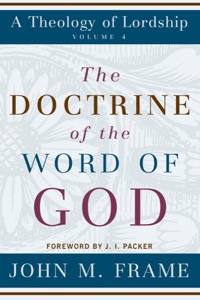
THE DOCTRINE OF THE WORD OF GOD – John Frame (2010)

In 1987, John Frame embarked on his series, A Theology of Lordship. He began with his first work, The Doctrine of the Knowledge of God.  Fifteen years later, he released The Doctrine of God.  In 2008, he completed The Doctrine of the Christian Life.  Each book is noteworthy in its own right.  However, I must add that outside of Scripture, Frame’s Doctrine of God is by far the most helpful and impressive book I have ever read.

Today I begin the final installment of the Theology of Lordship Series – The Doctrine of the Word of God. And the author inserts a bombshell in the preface: “And the more I think about it, the more I think this book is my best work ever.”  Quite a statement from an author who has already penned the most significant book in my life to date!

Here’s the deal.  When I dig into a Frame book, it is something akin to being invited to the White House.  The tour guide invites guests to explore all the rooms in the house.  “Take your time and enjoy yourself.  Make your self and home.  Stay as long as you like.”  Such an invitation would be both exhilarating and intimidating.  Welcome to the world of John Frame!

Frame divides his work into four parts which include, 1) Orientation, 2) God’s Word in Modern Theology, 3) The Nature of God’s Word, and 4) How the Word Comes to Us.  He includes (as in the other three volumes a very helpful analytical outline) which has helped me over the years in writing my own curriculum for theological education.  Additionally, Frame maintains these outlines help readers see the flow of argumentation throughout the book.

PART ONE: ORIENTATION

This section merely introduces readers to the theme of the book: “The main contention of this volume,” writes Frame, “is that God’s speech to man is real speech.  It is very much like one person speaking to another.  God speaks so that we can understand him and respond appropriately.”  Frame, then,  articulates his thesis: “God’s word, in all its qualities and aspects, is a personal communication from him to us.”

Frame argues that our response to God’s revelation should be one of obedience that comes from the heart: “When God speaks, our role is to believe, obey, delight, repent, mourn – whatever he wants us to do.  Our response should be without reservation, from the heart.”

The author distinguishes the God of the Bible from other world religions.  He summarizes work previously set forth in The Doctrine of God (DG): As such, he is set forth as a God who is an absolute personality.  He is absolute in that he is unchangeable, eternal, and infinite.  Yet he is also personal (or as Frame puts it “tripersonal”).  His point is that some religions and worldviews acknowledge the existence of a personal god.  And others recognize gods who are absolute.  But only historic Christianity acknowledges and worships a God who is personal and absolute.

God is the Creator.  As such, the creation is set apart from the Creator; hence the Creator-creature distinction.  The creature is wholly dependent on the Creator (Acts 17:28).

God is the Covenant Lord.  Frame is quick to remind readers that Lord “represents the Hebrew Yahweh, the name by which he wants his people to remember him.”  God is a covenental; he is the God of control, authority, and presence (what Frame calls the three lordship attributes; a theological reality that is teased out in DG).

Frame relates the lordship attributes to three perspectives respectively.  The situational perspective is the area where we teach and preach the authoritative Word.  The normative perspective focuses on how Scripture defines the word.  And the existential perspective is where God’s Word is transferred from the words we speak to our hearts.

PART TWO: GOD’S WORD IN MODERN THEOLOGY

Part two discusses modern views of revelation: “What distinguishes modern views of revelation from orthodox views is their affirmation of human autonomy in the realm of knowledge.  Intellectual autonomy is the view that human beings have the right to seek knowledge of God’s world without being subject to God’s revelation.”  Autonomy is always irrational; always sinful.

Frame argues that when man seeks to become his own lord, he “denies God’s ultimate control, authority, and presence.”  He articulates the classic Van Til idea of irrationality/rationality: “Either he denies that there is such a Lord or he ascribes lordship to something in creation.  If he denies that there is a Lord, he embraces irrationalism, the view that there is no ultimate meaning in the universe.  If he ascribes lordship to something finite (i.e., idolatry), he embraces rationalism, the view that a godlike knowledge can be obtained from the creation alone.”

Frame’s conclusion is that “nothing can be validated by autonomous reason … for such reasoning leads to a rationalist-irrationalist dialectic, which destroys all knowledge.  For that pottage, much of the church has forsaken its birthright, God’s personal word.”

Anyone familiar with John Frame will recognize that he does not oppose reason itself.  Indeed, “reason itself is a good gift of God.”  This good gift, however, is “fallible … and affected by sin.”  Rather, he rightly reacts against two bedrock principles in liberal theology: (1) Autonomous human reason, and (2) The notion that autonomous reason provides the ultimate criteria of truth and error, right and wrong, “by which everything (including Scripture) is to be judged.”

The author argues that it is sinful to substitute human rationality, history, or a subjective event for the “ultimate authority of God’s personal words” a feat that has been virtually perfected by theological liberals.  Frame has not only identified a key marker of liberalism; he has his finger on some of the error that is creeping into biblically-minded churches and followers of Christ.  Liberals and conservatives alike should recognize that rationalism, historicism, and subjectivism are unable of dealing properly with God’s personal words, i.e. God’s revelation.

Friedrich Schleiermacher, the so-called “father of theology” is the name most associated with the subjective event which is substituted for the authority of God’s Word.  He view of revelation should be familiar to evangelicals because many fall into the ditch of liberalism and do not even realize their shoes are dirty.  Schleirmacher believes that “revelation is primarily subjective, not objective.  It is not objective truths, but our subjective responses to objective truths.”

PART THREE: THE NATURE OF GOD’S WORD

Frame defines the Word of God as (1) “God himself, understood as communicator,” and (2) “the sum total of his free communications with his creatures.”

He reiterates a central theme of the Lordship Series, namely, God speaks to us as Lord.  “We should therefore expect that is speech, like all his actions, will express his lordship attributes: his control, authority, and presence.” As such, Frame examines each lordship attribute respectively.

First, he explores the controlling power of the Word of God.  God’s Word exerts power over inanimate objects as well as creatures.  God’s Word is an instrument of judgment as well as grace/blessing.  In the final analysis, “God accomplishes all his works by his powerful word: creation, providence, judgment, grace.”  The efficacy of God’s Word is God’s sovereign prerogative.

Second, Frame examines the Word of God as his meaningful authority.  When God speaks, his words are meaningful, thus authoritative.  Consequently, God’s authoritative words create obligation on the part of the creature:  “When he questions us, we should answer.  When he expresses his grace, we are obligated to trust it.  When he tells us his desires, we should conform our lives to them.  When he shares with us his knowledge and intentions, we ought to believe that they are true.”

Jesus carries the fully weight of authority as he comes to bear witness to the truth and accomplish the redemptive act that was ordained in eternity past.  Frame concludes, “To hear the words of Jesus, then, is the same as hearing the words of the Father.  We are to hear the words of Jesus as Abraham heard the words of Yahweh, as words of supreme authority.  We are not in any position to find fault with the words of Jesus.  They rather create obligations on our part to hear, believe, obey, mediate, rejoice, mourn – whatever the words may demand of us.”

Lastly, Frame explores God’s Word as personal presence – the third lordship attribute.  The author presents nine practical ways that God manifests his presence in a special way to his people.

1. God’s nearness to his people is the nearness of his words.

2. Where the Word is, there is God’s Spirit.

3. God performs all his actions through speech.

4. God is distinguished from all other gods because he is the God who speaks.

5. The persons of the Trinity are distinguished  from one another in Scripture according to their role in the divine speech.

6. The speech of God has divine attributes.

7. The Word does things that only God can do.

8. The Word of God is an object of worship.

9. The Word is God.

The three lordship attributes of control, authority, and presence are inseparable.  In other words, when God exerts control, there is a corresponding authority and presence that complement one another.  Frame puts it this way: “So if God performs all his actions by powerful and authoritative speech, then his speech is never separated from his personal presence.”

PART FOUR: HOW THE WORD COMES TO US

Part four makes up the bulk of the work and is concerned primarily with how the Word of God gets into our hearts and minds.  Dr. Frame explains how God reveals himself via events and words (the divine voice, the apostles, and prophets).

Frame discusses Jesus’ and the apostles’ view of the Old Testament respectively.  He includes a helpful section on the canon of Scripture.  His treatment of inspiration is extremely valuable and encouraging.

The author tackles what he calls the content of Scripture and parallels it with the Hittite suzerainty treaty which unfolds as follows:

1. Name of the great king

2. Historical prologue

3. Stipulations (laws) and includes exclusive loyalty which is equivalent to love and specific requirements.

4. Sanctions (blessings and curses)

5. Administration.

Frame maintains the “covenantal model of canonicity is enormously helpful in dealing with questions concerning biblical authority, infallibility, and inerrancy.  On this model, God is the ultimate author of Scripture, and we vassals have no right to find fault with that document; rather, we are to be subject to it in all our thought and life.”    And he argues that the five sections also point to five types of revelation that emerges in Scripture respectively:

1. Revelation of the name of God

2. Revelation of God’s mighty acts in history

3. Revelation of God’s law including love and specific requirements

4. Revelation of God’s continuing presence to bless and curse

5. Revelation of God’s institutional provisions: Scripture, church, sacraments, discipline, etc.

Frame argues that the covenants  bolster  the unity of Scripture by their “pervasiveness, complementarity, and their perspectival relationship.”

The inerrancy of Scripture is explored in a thoughtful and comprehensive way.  Frame’s argument is convincing and compelling: “Scripture is both inerrant and infallible.  It is inerrant because it is infallible.  There are no errors because there can be no errors in the divine speech … Error arises from two sources: deceit and ignorance.  Deceit is intentional error, lying.  Ignorance may lead to unintentional error.  But God does not lie, and he is ignorant of nothing.  If Scripture is his Word, therefore, it contains no errors.  It is inerrant.”

Frame unpacks the clarity, necessity, comprehensiveness, sufficiency, and the transmission of Scripture.  Concerning the transmission of Scripture in particular, the author articulates the process as follows: the divine voice communicates via prophets and apostles which leads to the written word.  Frame argues “there is no decrease in power, authority, or divine presence, as we move from the divine voice, to the prophets and apostles, and to the written word.”  Additionally, the written Word proceeds through a number of processes before it reaches the human heart and mind.  These include copies, textual criticism, translations, teaching, preaching, sacraments, theology, confessions and creeds, interpretation, and assurance.

Frame summarizes the essence of his thesis: “He [God] is our covenant Lord.  So his word to us reflects his lordship attributes of control, authority, and presence.  His word has a power that controls all things.  It has supreme authority, so that it creates obligations in its hearers: obligations to believe, obey, and otherwise participate in what he presents to us.  And the word is also the location of God’s very presence to us.”

SUMMARY STATEMENT

Finishing volume four of the Theology of Lordship Series marks the end of an incredible journey.  But in many ways, the journey is just beginning.  For followers of Christ recognize the mandate to love the Lord with all their heart, soul, mind, and strength.  Indeed, our God is the God of control, authority, and presence.

I consider Dr. Frame’s Theology of Lordship Series a labor of love that the church will appreciate and benefit from for years to come.  Every young pastor should set a goal to purchase and thoroughly digest each volume in the Lordship series.  I count these four book among the most valuable resources in my theological library.

Many thanks to John Frame for courageous writing and his diligent approach to God’s Word.

5 stars

AS IRON SHARPENS IRON – Howard and William Hendricks

As Iron Sharpens Iron attempts to explain and sell the concept of mentoring.  The stated goal of the authors is to see thousands of readers develop mentoring relationships as a result of reading the material.  The authors hope to steer as many men as possible into vital relationships that produce and reproduce godly men.

The authors admit the difficulty of defining a “mentor” and note some distinguishing qualities between mentorship and discipleship.  The concept of discipleship is presented as a specific plan to nurture spiritual growth in the life of another man.  The idea of mentoring is presented as more of a broad scheme.  A mentor is fundamentally committed to helping another grow and realize specific life goals.  Therefore, the authors seek to build the case for utilizing mentoring as one of the primary means of bringing men to maturity.  Mentoring is meant to leave a lasting legacy on the life of another man.

The book is divided into two general parts.  Part one is devoted to men who seek a mentor.  The authors intend to help such a man find a mentor, provide qualities to look for in a mentor, give some basic strategies for growth, and offer tips in building a mentoring relationship.

Part two is devoted to men who intend to serve as a mentor to a younger man.  The authors lay the foundation by discussing the need for mentor-type relationships in our culture.  Further, the authors discuss the roles and responsibilities of a mentor.  Finally, the authors provide a host of “how-to’s” as well as a list of problems to avoid in a mentoring relationship.

As Iron Sharpens Iron is a worthwhile book that focuses on the practical rather than the theoretical.  A further strength worth mentioning is the holistic approach to a mentoring relationship.  The authors are careful to endorse a complete concept of mentoring that stresses the construction of the complete man including the spiritual, emotional, social, physical, and financial.  The book is well-balanced and thought-provoking.  As Iron Sharpens Iron is very encouraging and motivating.  One wonders how any reader could walk away from this material without calling up a potential protégé to start a mentoring relationship.

The only weakness I detected was a great deal of monotony.  Much of the material presented in part one is rehashed in part two.

This work shall prove to be a great help in my current ministry.  The concepts may be immediately implemented in a mentoring program in the local church.  Further, this book may be used as a stimulus to get other men interested in the mentoring process.  The possibilities are endless for any church that seeks to build life on life relationships for the purpose of godliness.

3.5 stars

A HISTORY OF MODERN RUSSIA – Robert Service (1997)

A History of Modern Russia by Robert Service is a fascinating account of the events that begin with Nicholas II and lead all the way to Vladimir Putin.

Sometimes a few sentences  is worth the price of the book.  The author contemplates the death of Stalin and describes the process of embalming and the funeral that took place.  Service adds, “A silence was meant to descend over Moscow.  But such was the crowd in the nearby streets that a commotion broke out.  The pressure of bodies led to dozens of fatalities.  From under the glass the chemically-treated corpse could still terminate innocent lives.”

A few lessons stand out:

1. Unchecked power corrupts people and nations

2. The power of an ideology or worldview does not terminate with the death of a  given leader

3. Never underestimate the power of an atheistic worldview

4. Never take freedom for granted

A History of Modern Russia is a terrific overview.  It honestly assesses the strengths and weaknesses of this fascinating country. 

3.5 stars