LIBERTY AND TYRANNY: A Conservative Manifesto – Mark Levin (2009)

1416562850_bMark Levin’s book, Liberty and Tyranny made quite a splash when it was originally published in 2009.  Even though the book is a bit dated now, I think it’s relevance is even greater now that President Obama’s failed policies have taken root.  The rotten fruit of liberalism litters the American landscape – conservatives are faced with the challenge of cleaning up the mess.

Levin lays his cards on the table at the beginning: “Conservatism is a way of understanding life, society, and governance.”  Indeed, conservatism is a worldview; a way of seeing the world and playing a part within it.

All of the arguments in Liberty and Tyranny find their genesis in the minds of the founding fathers: “The founders understood that the greatest threat to liberty is an all-powerful central government, where the few dictate to the many.”  Or as President Reagan once said, “The most frightening thing to hear when answering the door is, ‘Where from the government and we’re here to help.'”

Liberty and Tyranny is really an expose on the Statist ideology.  Of course, the Statist is consumed with power as we have seen displayed in the Obama administration.  Levin makes it clear that the “Conservative does not despise government.  He despises tyranny … The Conservative is alarmed by the ascent of a soft tyranny and its cheery acceptance by the neo-Statist.  He knows that liberty once lost is rarely recovered.  He knows of the decline and eventual failure of past republics.  And he knows that the best prescription for addressing society’s real and perceived ailments is not to further empower an already enormous federal government beyond its constitutional limits, but to return to the founding principles.”

So with the backing and historical muscle of the Founding Fathers, the author presents a cogent case for Conservatism  by confronting Statism with bold arguments and common sense American values.  He tackles matters of the free market, welfare state, environmentalism, and immigration among others.

I highly recommend Liberty and Tyranny by Mark Levin.  It will serve as an encouragement to most Americans but will be a source of irritation for social progressives.

4 stars

JESUS CONTINUED – J.D. Greear (2014)

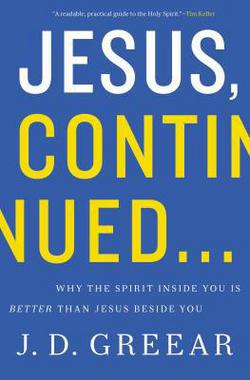
0310337763_bJesus Continued by J.D. Greear is a book about the Holy Spirit.  The subtitle is a better description about the big idea in Greear’s book – “Why the Spirit Inside You is Better Than Jesus Beside You.”  If nothing else, the subtitle is bound to prompt discussion about the role of the Holy Spirit.  Ultimately, if the discussion follows the basic flow of the book, the discussion will, in the final analysis prove fruitful and worthwhile.

Part One: The Missing Spirit

In part one, the author makes an absolutely crucial point that runs through the rest of his work, namely – we cannot fulfill the Word apart from the Spirit.  That is to say, the Spirit of God uses the Word of God to transform the people of God.  Eliminate the Spirit from this maxim and the result is dry academia which influence no one.  Eliminate the Word from this maxim and the result is fanatical extremism which may influence some people but is utterly useless.  Greear makes it clear that Christians must be “led by the Spirit and taught by the Word.”

The author discusses the role of the Spirit in the Christian life.  He adds, “Devotion to the mission of Jesus and the fullness with the Spirit of God, you see, always go hand in hand … The primary objective of God’s Spirit is to complete the mission.  To know him is to be devoted to that mission.  Without him, we cannot hope to succeed.  With him, we cannot fail.”

Greear clearly describes the role of the Spirit in the life of the believer and reveals the benefit of the indwelling Spirit which is better than “the Jesus beside you.”

Part Two: Experiencing the Spirit

In part two, the author helps readers understand how to experience the Holy Spirit.  He notes that Christians experience the Holy Spirit in at least six specific ways:

  • In the Gospel
  • In the Word of God
  • In our giftings
  • In the church
  • In our spirit
  • In our circumstances

Greear gives practical illustrations how the Holy Spirit is experienced and offers biblical support throughout.

Part Three: Seeking the Holy Spirit

Part three combines the best of parts one and two and challenges readers to surrender afresh to the Holy Spirit and to expect personal and corporate revival.  He encourages readers to pursue the “ordinary means of grace” by 1) repenting of sin, 2) preaching the gospel faithfully, 3) saturating themselves in the gospel, and 4) persisting in prayer.

Readers are urged to seek the Holy Spirit in prayer and living by faith in the promises of God.  In the final analysis, Greear writes so that Christians will see the Holy Spirit is beckoning them to follow him.

Several features not only make J.D. Greear’s book noteworthy; these features make this book one of the best Christian books of 2014.

  1. Jesus Continued is saturated in the Reformed tradition.  While the author writes with Reformed convictions, his focus is on the Holy Spirit which should encourage charismatics and challenge Reformed thinkers.
  2. Jesus Continued is a fresh look at the person and work of the Holy Spirit by a pastor who has a heart for theology and a love for the people of God.
  3. Jesus Continued presents a pneumatology which is Scripture-soaked.
  4. Jesus Continued is a personal work and practical work.  While this is the work of a top-notch scholar, the writing is simple enough for a high school student to understand but will also challenge seasoned pastors.

I highly recommend Jesus Continued.  I trust that it will receive a wide readership and that God will use it in mighty ways.  May Christ-followers surrender afresh to the ministry of the Holy Spirit!

I received this book free from the publisher through the BookLook bloggers program. I was not required to write a positive review. 

5 stars

ROSE GUIDE TO END-TIMES PROPHECY – Timothy Paul Jones (2011)

159636419X_bRose-Guide to End-Times Prophecy by Timothy Paul Jones is a terrific overview of eschatology designed for beginning Bible students.  The author provides a fairly comprehensive look at the four major eschatological views – Amillennialism, Postmillennialism, Dispensational Premillennialism, and Historical Premillennialism.  Each position is spelled out in a fair manner – an unusual approach.


TAKING GOD AT HIS WORD – Kevin DeYoung (2014)

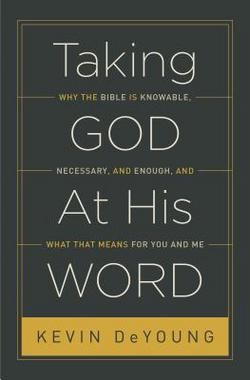
Taking God at His Word by Kevin DeYoung is yet another reminder that Mr. DeYoungword is for real.  He consistently churns out books which are readable and practical.  But more importantly, DeYoung writes books which are biblical.  His newest book is no exception.

The subtitle of DeYoung’s work accurately describes the essence of the book: “Why the Bible is Knowable, Necessary, and Enough, and What That Means For You and Me.”

DeYoung challenges readers to consider the sufficiency, clarity, authority, and necessity of Scripture.  This fine work will thrill conservative Christians and enrage liberals and postmodern compromisers.

At the end of the day, our approach to Scripture is what really matters.  DeYoung summarizes: “Submission to the Scriptures is submission to God.  Rebellion against the Scriptures is rebellion against God.”  May Christ-followers maintain a strong and robust doctrine of Scripture in the difficult days to come.  Taking God at His Word is strong encouragement for faithful Christians who love the Bible.

4 stars

Hand in HAND – Randy Alcorn (2014)

AAThe debate over the sovereignty of God and the free will of man originally heated up between Augustine of Hippo and Pelagius in the 4th century.  This debate has raged throughout church history and does not show any signs of letting up.  Arminians accuse Calvinists of serving a “tyrant God” who plays the role of a puppet master, making free will an illusion.  Calvinists accuse Arminians of serving a “timid God” who is weak at the knees.

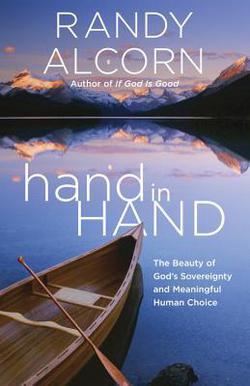
Hand in HAND by Randy Alcorn addresses the thorny issue of God’s sovereignty and the free will of man.  Alcorn does not promise to end all arguments.  But he does enter the ring as a sort of “theological referee.”  The author is a former Arminian theologian who has since turned into a Calvinist.  While Alcorn prefers to say that he is a 4 point Calvinist, since he is uncomfortable with particular redemption, he is committed to Calvinistic presuppositions.  This theological shift allows the author to sympathize with Arminians and provide some good teaching points for Calvinists who tend to be overzealous.

Alcorn begins by reassuring readers that the subject should be discussed and notes six important reasons for  pursuing the matter:

1. To develop a deeper appreciation for God and his Word, which reveals him to us.

2. To help us mirror Christ’s humility.

3. To embrace all of God’s inspired Word, not just parts of it.

4. To foster unity in the body of Christ.

5. To avoid fatalism and crushing guilt.

6. To prevent us from becoming trivial people in a shallow age.

The author surveys the biblical data which point to the biblical reality of God’s sovereign control over all things as well as human responsibility.  He notes how these two realities intersect, creating a paradox not a contradiction.

One chapter is devoted to addressing the matter of Open Theism, a theological cousin of Arminianism which denies God’s definite foreknowledge of all things and affirms the libertarian free will of the creature.  Alcorn makes it clear that both points are patently rejected in Scripture.

Several features make Hand in HAND a worthy book; a book that will likely win the Gold Medallion Award:

First, Alcorn writes with the proper tone and spirit.  Much of the debate the occurs over these matters produce more heat than light.  Dave Hunt’s Book, What Love is This is a good example of this mean-spirited approach which caricatures a given theological view.  Alcorn approaches the subject with humility and gentleness and invites readers of differing opinions to pay careful attention to the arguments.

Second, misunderstood terms are clearly defined.  The author does a good job of providing working definitions that are biblical and understandable.  The clear terminology should help in future debates between Calvinists and Arminians.

Third, the lines of orthodoxy are clearly drawn.  Both Calvinists are Arminians are included in the so-called box of orthodoxy.  This point is of great value, especially when both schools of thought accuse each other of heresy.  Alcorn invites both sides to engage in meaningful debate without name calling.  Additionally, Alcorn rightly notes that Open Theism is outside of orthodoxy.  Any theologian who refuses to grant God the ability to possess definite foreknowledge of all things has moved outside the perimeter of orthodoxy.

Fourth, a determinism continuum is presented.  Sadly, many readers and students of theology are unaware of the theological landscape which includes many views concerning determinism and free will.  The author clearly describes and defines these views: Hyper-Calvinism (outside orthodoxy), Compatibalism, Molinism, Libertarianism, and Open Theism (outside orthodoxy).

Fifth, Biblical Calvinism is presented correctly.  Apart from the merits of particular redemption which could be debated at another time, the author does a terrific job of presenting Calvinism as a biblical system which is passionately God-centered; a system which promotes evangelism and engagement with culture.  Additionally, the author demonstrates repeatedly that Calvinism embraces the notion of free will, (what Alcorn prefers to call “meaningful choice”) by pointing readers to the definition popularized by Jonathan Edwards – “choosing according to one’s strongest inclination.”

Sixth, all readers are admonished to trust a sovereign God.  In what proves to be the best chapter in the book (chapter 10), the author encourages readers of all theological backgrounds to trust in a God who is sovereign.

Hand in HAND will not be received well by Open Theists and Hyper-Calvinists.  Some Arminians and Calvinists may be bothered as well by some of the content.  But as a pastor who has travelled a very similar theological path from Arminianism to Calvinism – and even attended the same Bible College, I trust that thousands of people will devour Hand in HAND in the days ahead.  There is no doubt that Alcorn’s work will spark questions and stimulate debate.  But my prayer is that the debate will produce more light than heat.  And in the final analysis, people will be drawn closer to the Savior and bank on his all-sufficient grace.  Indeed, he is sovereign over all!

5 stars
REMEMBERING WILLIAM TYNDALE ON REFORMATION SUNDAY


William Tyndale was born in 1494.  He attended Oxford, Magdalen Hall and Cambridge University.  A student and adherent of the Protestant Reformation, Tyndale engaged in numerous debates with Roman Catholics.    One leader in the Roman Catholic church mocked Tyndale: “We are better to be without God’s laws than the Pope.”  Tyndale, never one to mince words replied, “I defy the Pope and all his laws.  If God spare my life ere many years, I will cause the boy who drives the plow to know more of the Scriptures than you.”

Tyndale was a confident, bold, and fearless theologian and scholar who translated the Bible into an early form of Modern English, likely with Luther’s help in Wittenberg.  But Tyndale was arrested and imprisoned for 500 days in a kangaroo court, and ultimately convicted.  He was sent to be strangled and burn at the stake in the prison yard on October 6, 1536 – the same year that Calvin published the first edition of The Institutes of the Christian Religion.  His last words were, “Lord, open the king of England’s eyes.”

Today, we celebrate Reformation Sunday.  May God raise up a new generation of leaders like William Tyndale – courageous and bold; men with a theological backbone and rock solid integrity.  May God raise up  a new generation of men who say what they mean and mean what they say; men who are unashamed of the gospel; men who are utterly unwilling to compromise the truth; men who are willing to be burned at the stake for the sake of truth.

Semper Reformanda!


STORM – Jim Cymbala (2014)

Jim Cymbala has a warning for the church.  The warning is an urgent plea.  The stormwarning is for every Christian.  Cymbala is afraid that the influence of the church is on the decline in America.  Biblical competency is at an all-time low.  Pastors are leaving the ministry.  Young people are jettisoning the Christian faith.  Trinkets are peddled but theology is minimized.  Pragmatism is celebrated but prayer is downplayed.  These are themes that the author develops in his latest work, Storm: Hearing Jesus For the Times We Live In.

Cymbala offers a prescription for these perilous times.  His solution is a return to prayer and a reliance on the ministry of the Holy Spirit.  The author writes with certain degree of boldness which may offend some.  Certainly, church growth proponents will be repelled by Storm.  But the essential message stands – “Everyone knows that a church must have a strong pulpit and strong preaching … But all this is utterly impossible without the enablement of the Holy Spirit.”

Storm is filled with stories of God’s grace and practical help for struggling pastors who serve in struggling churches.

I received this book free from the publisher in exchange for an honest review.  I was not required to write a positive review. 

THE TRINITARIAN DEVOTION OF JOHN OWEN – Sinclair Ferguson (2014)

aowenThe Trinitarian Devotion of John Owen by Dr. Sinclair Ferguson is the latest installment in the Long Line of Godly Men Profile Series, edited by Dr. Steven Lawson.  Ferguson presents a readable introduction to the most well-known Puritan, John Owen.

The book includes five chapters which overview Owen’s life and theological commitments.  Chapter one focuses on his life as a pastor and theologian.  Owen’s upbringing is discussed and his pastoral experience is surveyed.  Additionally, the author touches on Owen’s tenure as vice-chancellor at Oxford University.

The remaining chapters overview Owen’s theological framework which focuses more narrowly on his robust doctrine of the Trinity.  Sinclair Ferguson carefully summarizes Owen’s pursuit of the God in all his glory as expressed in the three persons – Father, Son, and Spirit.  Ferguson adds, “To become a Christian believer is to be brought into a reality far grander than anything we could ever have imagined.  It means communion with the triune God.”  The author demonstrates how Owen regarded the Trinity as a chief cornerstone of the Christian faith.  Numerous primary sources are cited and explained.  In addition, Dr. Ferguson provides helpful analysis along the way.  He beautifully captures the essence of John Owen’s devotion to the Trinity.

The Trinitarian Devotion of John Owen is a perfect introduction for the beginning student of the Puritan divine.  But this work is also suitable for veteran students of Owen as well.  Ferguson bring his typical scholarly approach to the table but writes with the heart of a pastor/shepherd.  This work should help revive further interest in Puritanical studies and is a welcome guest at the table of these godly men.  My hope is that Ferguson’s work will catapult readers to Owen primary sources – a practice which is certain to encourage, edify, and equip a new generation of Christians.

I received this book free from the publisher in exchange for an honest review.  I was not required to write a positive review. 


THE MANNER IN WHICH THE SALVATION OF THE SOUL IS TO BE SOUGHT – Jonathan Edwards (1740)

imagesJonathan Edwards presents his doctrine at the front end of the sermon: We should be willing to engage in and go through undertakings, in order to our own salvation.

Noah, in this case is the exemplar.  As Noah obeyed when God commanded him to build the ark, so we too, should go through “great undertakings, in order to our own salvation.”

Three specific propositions undergird the doctrine.

Proposition # 1: There is a work of business which must be undertaken by men, if they would be saved.

“If we would be saved, we must seek salvation,” Edwards argues.  He explains, “It is on account of the works which Christ hath done for us.  Works are the fixed price of eternal life; it is fixed by an eternal, unalterable rule of righteousness.  But since the fall there is no hope of our doing these works, without salvation offered freely without money and without price.”

Proposition # 2: This business is a great undertaking.  Six statements describe this great undertaking:

  1. It is a business of great labor and care.
  2. It is a constant business.
  3. It is an undertaking of great expense.
  4. Sometimes the fear, trouble, and exercise of mind, which are undergone respecting this business, and the salvation of the soul, are great and long continued, before any comfort is obtained.
  5. It is a business which, by reason of the many difficulties, snares, and dangers that attend it, requires much instruction, consideration, and counsel.
  6. This business never ends till life ends.

Proposition # 3: Men should be willing to enter upon and go through this undertaking, though it be great, seeing it is for their own salvation.  Edwards notes four reasons for seeking salvation:

  1. A deluge of wrath will surely come.
  2. All such as do not seasonably undertake and go through the great work mentioned will surely be swallowed up in this deluge.
  3. The destruction, when it shall come, will be infinitely terrible.
  4. Though the work which is necessary in order to man’s salvation be a great work, yet it is not impossible.

Application

Edwards concludes with five pointed statements which serve as points of application for his hearers:

  1. How often you have been warned of the approach flood of God’s wrath.
  2. Consider the Spirit of God will not always strive with you; nor will his long-suffering always wait upon you.
  3. Consider how mighty the billows of divine wrath will be when they shall come.  Edwards adds, “The misery of the damned in hell can be better represented by nothing, than by a deluge of misery, a mighty deluge of misery, a mighty deluge of wrath, which will be ten thousand times worse than a deluge of waters; for it will be a deluge of liquid fire, as in the Scriptures it is called a lake of fire and brimstone.”
  4. This flood of wrath will probably come upon you suddenly, when you shall think little of it, and it shall seem far from you.
  5. If you will not hearken to the many warnings which are given you of approaching destruction, you will be guilty of more than brutish madness.

Edwards utilizes the historical narrative surrounding the events of Noah’s life to alert his congregation to the reality of God’s wrath and the importance of seeking salvation.  Included are his strong words; words of vivacity and intensity which seek to awaken sinners to the reality of sin, salvation, and final judgment.  Listen to the final warnings he utters in his sermon, warnings which are rarely heard from American pulpits in this generation.

“You have been once more warned today, while the door of the ark yet stands open.  You have, as it were, once again heard the knocks of the hammer and axe in the building of the ark, to put you in mind that a flood is approaching.  Take heed therefore that you do not still stop your ears, treat these warnings with a regardless heart, and still neglect the great work which you have to do, lest the flood of wrath suddenly come upon you, sweep you away, and there be no remedy.”

EDWARDS ON THE CHRISTIAN LIFE – Dane Ortlund (2014)

143353505X_b

Edwards on the Christian Life by Dane C. Ortlund attempts to summarize the theology of Jonathan Edwards and pays special attention to his remarks on the Christian life.  For Edwards, living the Christian life is about “enjoying and reflecting the beauty of God.”

The author successfully achieves his goal by directing readers to twelve questions which capture the essence of Edward’s God-entranced worldview.  Consequently, the following themes emerge:Beauty, new birth, love, joy, gentleness, the Bible, prayer, pilgrimage, obedience, Satan, the soul, and heaven.

Each theme is surveyed from the perspective of Jonathan Edwards.  Historical highlights are included in order to provide a much-needed perspective and many primary sources are cited.  For the scores of people who believe that God’s wrath is Edwards’s controlling attribute, Ortlund provides a necessary corrective: “Not sovereignty, not wrath, not grace, not omniscience, not eternity, but beauty is what more than anything else defines God’s very divinity.  Edwards clearly believed in these other truths about God and saw all of them as upholding and displaying and connected to God’s beauty.  Yet none of them expresses who God is in the way that beauty does.”

Ortlund beautifully captures the theology of Edwards in this rather short volume.  The work is accessible to a wide range of people but never at the expense of solid content.  Of the multitude of secondary source books which explore the theology of Jonathan Edwards, Ortlund’s work is among the best.

Despite, the high praise offered above, I must take exception with one of Ortlund’s statements which takes aim at  Steven J. Lawson’s book, The Unwavering Resolve of Jonathan Edwards.  Ortlund charges  Lawson of “succumbing to hagiography regarding Edwards.”  Clearly, Ortlund has missed the intent of the Long Line of Godly Men Series where pivotal figures in church history are introduced and commended as pillars of the Christian faith.  Anyone familiar with Steven Lawson understands his chagrin with the postmillennialism and paedobaptism that emerge in the Northampton preacher.  But the series is merely designed as an introduction to these pivotal figures, not a detailed exposition.  Taken seriously, Ortlund’s accusation should cast a dark shadow over every biographical account of figures in church history.

Perhaps the most interesting aspect of Ortlund’s book is his criticism which he directs toward Jonathan Edwards himself.  The criticism here is rightly placed and balanced.  His critique is timely and alerts students of Edwards to weaknesses in his theological infrastructure.

Edwards on the Christian Life is a well written book which should provide ample discussion for anyone interested in America’s greatest intellectual.  The brief criticism noted above does not marginalize any of the rest of the book.

Highly recommended

5 stars