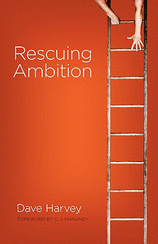
RESCUING AMBITION – Dave Harvey (2010)

Rescuing Ambition by Dave Harvey is a book about discipleship.  It is a book about sanctification.  Specifically it is about the sanctification of ambition – the transformation of ambition.

Harvey adds, “The Bible teaches that people are created by God to desire – and to go after those desires with single-minded determination.  It’s this capacity to desire and strive that can generate remarkable good or stupefying evil.  Whether it’s to conquer nations or control the remote, we’re hardwired to be ambition for what we want.”  The general tenor of the book explores these themes are subjects this ambition to the scrutiny of Scripture.

In one of the more poignant moments in the book, Harvey writes, “Don’t focus on what you’re to do; focus on what God has done for you.  He is faithful, and he’ll show his faithfulness to you.”  Sounds like ambition has been rescued!  This kind of ambition has been stripped of carnality and selfishness (i.e. selfish ambition) and is consumed with honoring and glorifying the Lord Jesus Christ!

Dave Harvey writes with the typical God-centered, gospel-rejoicing, Holy Spirit infused zest that we have grown to love over the years from the Sovereign Grace family.  Rescuing Ambition is a welcome addition to the growing number of resources that will only serve to strengthen and edify the church.

“Godly ambition is gospel ambition.  We dream because God rescued our corrupted, selfish ambitions and gave us the capacity to desire, dream, and work for his glory.” – Dave Harvey

4.5 stars — Highly recommended

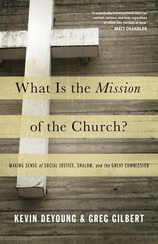
WHAT IS THE MISSION OF THE CHURCH? – Kevin DeYoung/Greg Gilbert (2011)

What is the Mission of the Church?  Ever since the establishment of the church in Acts, the question of mission has been on the mind of Christ-followers.  The question of mission is especially pertinent in our day.  Kevin DeYoung and Greg Gilbert address the question within a biblical framework.

DeYoung and Gilbert carefully peel away the necessary layers of data in order to answer the question posed in the book.  The heart of their answer lies in the Great Commission and Great Commandment.  They admit upfront the necessity of helping the poor and engaging in acts that constitute “social justice.”  Their bottom line: “If we improve our schools, get people off welfare clean up the park, and plant trees in the neighborhood, but aren’t seeking to make disciples, we may ‘bless’ our communities, but we’re not accomplishing the church’s mission … Ultimately, if the church does not preach Christ and him crucified, if the church does not plant, nurture, and establish more churches, if the church does not teach the nations to obey Christ, no one else and nothing else will.”

DeYoung and Gilbert have  successfully hit the target.  Their commitment to keep the main thing the “main thing,” namely developing disciples to the glory of God is what that the church needs to hear and put into practice.

4.5 stars

TRUE COURAGE – Steve Farrar (2011)

Ever since Steve Farrar wrote Point Man, he has been churning out books aimed the hearts and minds of men.  Farrar has consistently called men to holiness.  He has called them to lead their families.  He has called them to lead in their churches.  His latest book calls Christian men to demonstrate True Courage.

The author points readers to Daniel (specifically Daniel 1-6) and argues that this man is an example of true courage.  Indeed, “True courage is the result of knowing God.”  The man who displays true courage fears God more than man, trusts God with his future, and realizes that God governs all events.  The simple point: Since God ordains everything that comes to pass, Christian men must bank on this reality and muster true courage in these last days.

Steve Farrar maintains his commitment to the authority of Scripture in this helpful volume.  He cites the great heroes of the Christian faith and stands on the shoulders of the Puritans and Reformers.  His work is encouraging and will serve men well – especially men who seek to be men of true courage.

4 stars

STEVE JOBS – Walter Isaacson (2011)

I have waited patiently for a decent biography on Apple front man, Steve Jobs.  When I learned that Walter Isaacson, one of my favorite biographers took the challenge, I jumped at the chance to read this book.

Two words – “Steve” and “Jobs.”  Ordinary words.  But smash the two words together and two things happen: ordinary vanishes and controversy begins.  It is common knowledge that Jobs rubbed many people the wrong way during his days at Apple.  Isaacson documents numerous stories that confirm this. And while some reviewers resist Isaacson’s willingness to share the good, the bad, and the ugly, this biographer truly seeks to present a balanced portrait of Steve Jobs.  Isaacson writes with a measured, yet realistic respect.  His work is thorough and the research is extensive.

Whatever one thinks about Steve Jobs, it is important to recognize that Apple recently emerged as the most valuable company in America, topping out at $337 billion.  There is no question that Jobs’ ingenuity, creativity, “out-of-the box thinking,” business sense, and vision helped shaped this phenomenal company.  Apple would not be Apple without Steve Jobs.  Rick Warren rightly tweeted on the day of his death, “Steve Jobs, the Thomas Edison of my generation.”

Jobs’ Edison-like influence on contemporary culture is widely known.  This review is hammered out on a MacBook Pro.  Multiple people surround me using Mac devices including iPhones, iPads, and iPods.  It is an indisputable fact that Steve Jobs changed the way people look at and use technology.

I intend to review books from a Christian perspective at Veritas et LuxSteve Jobs by Walter Isaacson is a vivid reminder of God’s common grace – the grace that gives people an ability to produce great art, inspiring music and useful technology.  It is a reminder that all good gifts come from God and God alone.  The takeaway is simple: Will we reflect God’s glory with the common grace he has extended or will we turn the spotlight on ourselves?  “For from him and to him and through him are all things.  To him be the glory forever and ever” (Rom. 11:36, ESV).

3.5 stars

A SIMPLE WAY TO PRAY – Archie Parrish (2011)

The Kindle edition of A Simple Way to Pray by Archie Parrish is a welcome complement to the growing amount of Reformed literature.

Luther spells out his approach to prayer as he approaches the Ten Commandments, Lord’s Prayer, and Apostles’ Creed: “Take care not to undertake … so much that one becomes weary in spirit … It is enough to consider one section or half a section which kindles (no word play here … Guttenberg had only recently invented moveable type!) a fire in the heart … If in the midst of such thoughts the Holy Spirit begins to preach in your heart with rich, enlightening thoughts, honor Him by letting go of this written scheme; be still and listen to Him who can do better than you can do.  Remember what He says and note it well and you will behold wondrous things in the law of God.”

A Simple Way to Pray is a much-needed work in our day of prayerlessness. I am reminded that every major move of God in church history has been fueled by prayer.  Oh that the church would spend time on her knees.  We look forward to a new reformation and revival.  We long for a church that cherishes God’s Word, refuses to compromise God’s Word and is blood-earnest about fulfilling the Great Commission to the glory of God!

Semper Reformanda!

THE BARBER WHO WANTED TO PRAY – R.C. Sproul (2011)

R.C. Sproul has a way of “bringing the cookies” to a level that anyone can reach.  Once again, he has accomplished this feat in his newest children’s book, The Barber Who Wanted to Pray.

Sproul retells the historical account of Martin Luther’s trip to the barber shop.  This was no ordinary visit. Luther was a wanted man.  Nailing the 95 theses on the castle door at Wittenberg became more than public dispute.  These nails sealed Luther’s fate – at least in the eyes of the Roman Catholic Church.

The barber who held a sharpened razor to Luther’s neck knew that in one movement, Luther would be a dead man.  The barber could retire in the lap of luxury.  But instead of cashing in his chips, the barber asked Luther a penetrating question: “Dr. Luther, can you teach me to pray?”  The German Reformer was astonished and impressed with this request.  He asked for some time to frame a response.  Within days, he was back with an answer – an answer that the people of God can all benefit from.

Luther’s response to his barber was a simple approach to prayer – all based on the Ten Commandments, the Lord’s Prayer, and the Apostles’ Creed.  He would eventually compile his answer into a valuable little book, entitled The Way to Pray. The essence of his method is to pray line by line, reflecting on the truth contained in the Ten Commandments, Lord’s Prayer, and Apostles’ Creed.

On this Reformation Sunday, let us remember the accomplishments of Luther and the Protestant Reformers.  But more importantly, let us marvel at the beauty of the gospel and the precious truth of justification by faith alone!

“Therefore, since we have been justified by faith, we have peace with God through our Lord Jesus Christ” (Rom. 5:1, ESV).

Semper Reformanda!

THE WORLD-TILTING GOSPEL – Dan Phillips (2011)

Some of the most helpful Christian books I have read over the years focus on the subject of biblical worldview.  Among the best include books like Total Truth and Saving Leonardo by Nancy Pearcey, Life’s Ultimate Questions and Worldviews in Conflict by Ron Nash, Building a Christian Worldview by Hoffecker Smith, The Universe Next Door by James Sire, and of course anything by Francis Shaeffer.  Add one more fine book to the list – The World-Tilting Gospel by Dan Phillips.

PART ONE: WHO ARE WE?

Phillips begins where every good worldview begins, namely – God’s good creation.  He rightly argues that “our view of ourselves as we stand before God is inextricably interwoven with our view of God.”  Calvin made the identical argument in the opening chapter of The Institutes of the Christian Religion: “But though the knowledge of God and the knowledge of ourselves are bound together by a mutual tie, due arrangement  requires that we treat of the former in the first place, and then descend to the latter.”

The author moves from creation to the Fall and unpacks the biblical doctrine of total depravity.  The essence of Adam and Eve’s disobedience is one of autonomy: “They will know on their own terms, set their own values independent of God, as liberated from God.  They will be self-ruled, they will be a law unto themselves.”  One immediately recognizes the influence of Cornelius Van Til,  an influence that should penetrate every evangelical mind.

Sin is imputed on Adam’s descendants (Rom. 5:12) which renders each person dead in sin (Eph. 2:1-3).  Phillips does a terrific job explaining radical depravity at this point.  He alerts readers to the modern-day love-affair with free will among many evangelicals.  Thus, unregenerate people are unable to come to Christ apart from the drawing ministry of the Holy Spirit (John 6:44).

PART TWO: WHAT HAS GOD DONE FOR US?

In part two, the author introduces readers to the Reformed doctrine of predestination – a crucial doctrine that is taught from Genesis to Revelation.  He builds his argument on the character of God, beginning with the holiness of God: “God’s holiness overarches and gloriously radiates through all of His attributes.” Phillips proceeds to explain God’s love and wisdom which set the stage for the biblical reality of election.

Phillips does a wonderful job explaining redemptive history in a way that is clear, compelling, and biblical.  At the heart of his discussion is the penal substitutionary atonement by blood – a doctrine that is currently under attack by some emergent leaders.  Christ is magnified and exalted in this section.  He is supreme and worthy to be praised for the work He accomplishes for His people on the cross!

PART THREE: HOW DO WE GET IN?

Part three unpacks the doctrines of justification and regeneration.  Phillips articulates these vital doctrines in clear and unmistakable terms.  The author leans on the earth shattering exegesis of Martin Luther as he explores the doctrine of justification by faith alone: “It is a status [God] bestows on sinners.  It is a declaration that they are in good standing as far as His righteous law is concerned.”

The doctrine of regeneration is act of God’s sovereign pleasure.  The Holy Spirit alone regenerates the depraved human heart.  Monergistic regeneration is clearly taught in this work.  Phillips clearly describes the necessity of holding to the Reformed reality that regeneration precedes faith – and he does it in a winsome way.  May God spread this kind of clarity and winsomeness among the young, restless, and Reformed!

PART FOUR: HOW DO WE GET GOING?

In the final section, the author guides readers through a series of theological land mines that have  the potential to stunt Christian growth.  The so-called Free Grace movement is confronted directly and mystical approaches to the Christian life are demolished.  The popular notion of “let go and let God” is annihilated.  And the category of so-called “carnal Christian” is crushed.  Phillips is rightly concerned that these erroneous views impede spiritual growth and short-circuit the sanctification process.

Finally, Phillips concludes with a thoughtful chapter that helps summarize the main points of the book and motivate readers to embrace a worldview that is in the final reality a “world-tilting” worldview.

This author has surpassed all my expectations.  Don’t let the cheesy cover fool you!  This is a serious book with a plethora of practical implications.  Phillips writes in a popular style; a kind of style that will attract a younger audience.  But the serious nature of the book should draw a wide range of readers.  He interacts with a diverse group of Christian thinkers – a helpful way to introduce folks to the Puritans and the Reformers.

Highly recommended!

FYODER DOSTOEVSKY – Peter Leithart (2011)

Fyodor Dostoevsky has been somewhat of an enigma to me for many years.  Thankfully, Peter Leithart’s latest book that bears the name of this famous Russian author sheds light on his life and worldview.

Dostoevsky was the son of a strict Russian physician.  He graduated from the military academy and was, in the final analysis, exiled to Siberia – accused of “subversive activities” against the state.

Once released, Dostoevsky continued his brilliant writing career – but not without personal struggle and hardship.  Many of his novels bear this out – namely, his battle with gambling and interpersonal conflict.  He also struggled physically.  Epilepsy dogged him for many years.

Despite his battle with sin, Dostoevsky clung to the cross of Christ.  He was a real man with real pain.  Perhaps this is what attracts so many people to his writings.  Dostoevsky was an authentic man who was not afraid to share his struggles.

Peter Leithart should be applauded for his latest work on Dostoevsky.  It is evident that he has read and devoured Dostoevsky’s novels.  And his creative, first-person look at the writer is an inside look at this fascinating Russian man.

I received this book free from the publisher through the BookSneeze.com <http://BookSneeze.com> book review bloggers program.

3.5 stars

The Christian Mind – Harry Blamires (1963)

My uncle Dwight gave me this book almost twenty years ago.  I’ll never forget what he said when he handed it to me: “Only real men can read this book.”  Whether it was meant to motivate or amuse, I read it with a vengeance.  This is my third time through.

Blamires thesis is clear throughout the book: “There is no longer a  Christian mind.”  An interesting proposal, given the original publishing date of 1963.  But the facts outweigh any contrary argument.  The author notes, “And we have emptied our brains of Christian vocabulary, Christian concepts, in advance, just to make sure that we should get fully into touch.  Thus we have stepped mentally into secularism.”  We live in a post-Christian era.  This much is certain.  The frightening reality is that some Christians understood this in the 1960’s.  Many Christians today simply have no comprehension of the Christian mind.

In part two, the author suggests  what the Christian mind should look like.  He delineates six marks of the Christian mind which include:

1. A supernatural orientation.

2. An awareness of evil.

3. A conception of truth

4. Accepts the notion of authority

5. Has a concern for the person

6. Has a passion to live life to the glory of God.

The Christian Mind should be celebrated for its analysis of culture and its allegiance to the Word of God.  Like Francis Schaeffer, Blamires is in touch with the barriers to Christian thinking.  While his concerns originated in 1963, they continue to reverberate almost fifty years later.

The point my Uncle was trying to make is this: Real men think Christianly.  Real men live according to truth.

“The Christian mind is the prerequisite of Christian thinking.  And Christian thinking is the prerequisite of Christian action.”

Harry Blamires

KING SOLOMON – Philip Graham Ryken (2011)

King Solomon: The Temptations of Money, Sex, and Power by Philip Graham Ryken is a candid look at the famous king who struggled with the flesh.

It is clear from the outset that the author has done his homework.  He paints historical detail onto the canvas of his exposition.  And he clearly presents the movements of Solomon’s life through the book of 1 Kings – the good, the bad, and the ugly.

The most important feature of this book is how the author weaves the gospel into the story of Solomon’s life.  The author’s conclusion is a fitting end to this gospel-saturated exposition: “Praise God for Jesus Christ, the risen King, the true and righteous Solomon of our salvation!  By the power of his resurrection, we will be able to serve God to the end of our days.  And afterwards we will rise with Solomon and all the children of God, to offer our Savior an eternity of praise.”

4 stars