77’s – Ping Pong Over the Abyss (1983)

The 77’s first album was originally released in 1983.  So why review an album that is almost thirty years old?  For starters, Michael Roe decided to make the album available on iTunes a few weeks ago.  So anyone that has an old crusty cassette and nothing to play it on should be very excited.  Also, the iTunes release gives many listeners a chance to hear these unbelievable notes for the first time.


Ping Pong Over the Abyss engages with worldview themes in a way that is uncommon in Christian circles.  If King Solomon wrote lyrics to a rock album, this is what it would be like.  The album tackles several worldviews in a very straightforward way.  A Different Kind of Light questions the notion of finding “truth within.”

They talk about a light inside you
I hope I never get that blind
I don’t want to take my chances
On joining the collective unconscious
I’m waiting for the clouds to break
I’m looking for the road to take
Don’t want the usual merchandise
Recycled in a new disguise

I’m following a different Light
A different kind of light

It’s So Sad lays bare the worldly philosophy of hedonism and refuses to embrace the lies of Hinduism:

Trying to buy heaven
Right here on earth
The cost will always end up
More than it’s worth
You ponder living
You wonder why
No matter what you do
You’re still going to die

Falling Down a Hole wrestles with a host of worldviews including Buddhism, Islam, Spiritualism, Fatalism, Humanism, Evolution, and Witchcraft:

Humanism
Is a tired old line
The logos is sleeping
Just give it some time
Evolution is preaching
“From monkey to divine”

Renaissance Man is a frontal assault on atheistic evolution and is a powerful musical apologetic:

It’s from “star stuff” that he’s made
It’s the cosmos that gave him life
How does that help him feed the poor
How does that help him love his wife

A renaissance man
Tearing himself from The Rock
A renaissance man
Tearing himself from The Rock

He’s cast away all thoughts of heaven
His science is full of preconceptions
His answers make me ask more questions
How many can wait on evolution

He needs to live
On the sides of the north
In the city of Reformation
That’s where he’ll find his life

This album is definitely not a typical Christian rock album.  The themes are sobering and tap into the meaningless of man apart from Christ.  A severe blow is delivered to nihilism, humanism, and hedonism.  Something tells me these guys were reading Francis Schaeffer in the late 70’s!

If you like your music raw and realistic and don’t mind a trip back to the 80’s,  Ping Pong Over the Abyss is for you.

GUARDING THE DEPOSIT: A WORLDVIEW WARNING

Charles Hodge rightly said, “History in all its details, even the most minute, is but the evolution of the eternal purposes of God.”  Hodge understood the biblical reality that God “works all things according to the counsel of his will” (Eph. 1:11).  Yet, we live in an eroding culture; one that is hostile to this fundamental truth.  We live in a culture where God is discounted, his truths are marginalized, and human autonomy appears to triumph.

One worldview that is diametrically opposed to the Christian worldview is deism.  This worldview held a dominant position in France and England from the late seventeenth century to the first half of the 18th century.  But make no mistake.  Deism is still alive.  It has yet to go the way of the dinosaur.

Noah Webster defines deism: “The belief that God exists and created the world but thereafter assume no control over it or the lives of people.”  The Enlightenment (1660-1798) provided the philosophical soil for deism to flourish.  Adherents of the Enlightenment rejected the belief that faith depends on received or religious doctrines.  They did not emphasize a personal relationship with God.  Rather they believed in an impersonal Creator and embraced the idea that nature tells us everything we need to know about him.

Notice a few components of deism.  First, the deist maintains that God is not involved with creation. The God of deism is seen as one who creates but is only  a “clockmaker” who steps aside after his creative work.  Walter Isaacson describes the modified deism of Benjamin Franklin: “He no longer believed in the received dogmas of his Puritan upbringing, which taught that man could achieve salvation only through God’s grace rather than through good works.”

Second, deism elevates the role of reason. Whenever reason is elevated, there is a danger of neglecting revelation, which is precisely what occurs in a deistic worldview.  A writer representing this view says, “In deism, there is no need for a preacher, priest, or rabbi.  All one needs in deism is their own common sense and the creation to contemplate.”  In this scheme, propositional truth is either downplayed or discarded because reason is seen as the superior way to know God; albeit a God who is not personal.  Consequently, “Nature is a closed system,” writes W. Andrew Hoffecker, “and humans cannot know anything beyond the natural realm.”

Third, it follows that deism rejects special revelation. Herein lies the reason for Thomas Jefferson’s irresponsible act of taking a razor blade to all the New Testament references to Jesus’ miracles, his Virgin birth, and any reference to deity.

But for now, ask yourself where deism emerges in our culture.   Ask if you have subtlety succumbed to this pernicious worldview.  For when we discount the miraculous, we become practical deists.  When reason replaces revelation, we become practical deists.  When general revelation replaces special revelation, we become practical deists.

Hodge was right on target.  “History in all its details, even the most minute, is but the evolution of the eternal purposes of God.”  May we pay careful attention to Paul’s admonition to Timothy: “… Guard the deposit entrusted to you.  Avoid irreverent babble and contradictions of what is falsely called knowledge, for by professing it some have swerved from the faith” (1 Tim. 6:20-21).  May our thinking and affections be aligned to God’s Word and may we passionately plead with culture to turn their attention to the all-wise work of God!

A deistic worldview essentially presents a neutralized deity.  He is stripped bare of his attributes.  Jesus is rendered useless and powerless.  The cross becomes unnecessary.  Prayer becomes random and meaningless.  The net result of deism is a caricature of the Christian faith that fails to honor God and refuses to give him the glory he rightly deserves.  See if you can detect the deism that emerges in Albert Einstein’s worldview:

  • “My religion consists of a humble admiration of the illimitable superior spirit who reveals himself in the   slight details we are able to perceive with our frail and feeble minds.  That deeply emotional conviction of the presence of a superior reasoning power, which is revealed in the incomprehensible universe, forms my idea of God.”

Deism poses significant problems for people:

In a Deistic Worldview, People are Unable to Make Significant Decisions

James Sire writes, “Human beings are what they are; they have little hope of becoming anything different or anything more.”  Since deism maintains that God has not revealed himself, it follows that an ethical framework is untenable.  Meaningful decisions are rendered void.

In a Deistic Worldview, Humans are Merely a Part of Nature

W. Andrew Hoffecker adds, “Unlike Christian thought, which teaches that man is specially made in the image of his creator and is thereby capable of a unique, personal relationship with God, deists conclude that man is simply locked into the closed system of nature.  People cannot have a direct relationship with God … Man and God are thus essentially disengaged.”

In a Deistic Worldview, Humans Have No Hope, No Help, and No Purpose

Deism is, in the final analysis a hopeless worldview where salvation is not only impossible; it is entirely unnecessary.

The verdict concerning deism is in.  God is personal (Isa. 40:10-11; 41:8-10).  God is immanent (Isa. 57:15).  God has spoken (Heb. 1:1-2).  And God is intimately involved with the affairs of people and nations.  Spurgeon helps us understand God’s meticulous Providence:  “I believe that every particle of dust that dances in the sunbeam does not move an atom more or less than God wishes – that every particle of spray that dashes against the steamboat has its orbit, as well as the sun in the heavens – that the chaff from the hand of the winnower is steered as the stars in their courses.  The creeping of an aphid over the rosebud is as much fixed as the march of the devastating pestilence – the fall of … leaves from a popular is as fully ordained as the tumbling of an avalanche.”

May we constantly turn our affections to God who has revealed himself in nature (Ps. 19:1-6), in his Son (Heb.1:1-2), and in Scripture (Ps. 19:7-11; John 17:17; 2 Tim. 3:16).  And let us remember the admonition that Paul gave Timothy as we contend for the truth in a culture that is hostile to the gospel: “O Timothy, guard the deposit entrusted to you.  Avoid the irreverent babble and contradictions of what is falsely called knowledge, for by professing it some have swerved from the faith” (2 Tim. 6:20-21).

Soli Deo Gloria!

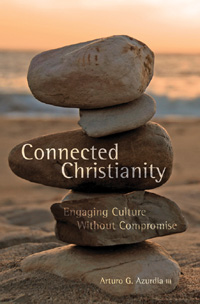
CONNECTED CHRISTIANITY: Engaging Culture Without Compromise – Art G. Arzurdia

Connected Christianity is a refreshing look at the responsibility before Christ-followers in godless culture.  Art Arzurdia writes with the patience of a tender-hearted pastor and the depth and breadth of a well-grounded Reformed theologian.

He addresses the mission of every Christian, namely to stand as a bright light and offer the purifying saltiness of a biblically informed disciple.  Arzurdia is clear concerning the mandate: “To remain in this world for the express purpose of declaring to it the saving benefits secured by the conquest of Jesus Christ … His clarion call for them [disciples] was to a worldly Christianity.”

Some readers might jump to an unwarranted critical conclusion of Arzurdia’s choice of words.  However, the criticism would be premature and wrong-headed.  Arzurdia argues that Christians must be both theologically grounded and missional in their approach to contemporary culture.  And he carefully balances his assertion with biblical insight: “And so, while we cannot be missional without being theological, we must never be theological without being missional … we cannot hope to be authentically Christian without being meaningfully worldly.”

The author roots his admonition in Jesus’ high priestly prayer.  Consider some of the high points of our Lord’s prayer:

  • “I do not ask that you take them out of the world, but that you keep them from the evil one” (John 17:15, ESV).
  • “Sanctify them in the truth; your word is truth” (John 17:17).
  • “As you sent me into the world, so I have sent them into the world” (John 17:18).

Arzurdia acknowledges that the world is the playing field where believers carry out their divine mission.  He warns against two barriers to effectiveness: “cultural gluttony” or “cultural anorexia.”  Cultural gluttony is friendship with the world; a carnal fascination with the ideology of the world’s system.  It is the “consequence of being missional without being theological.”  Cultural anorexia is the classic Christian tendency to withdraw from the world and the propensity to retreat into a “Christian sub-culture.”  Cultural anorexia is “the consequence of being theological without being missional.”

Arzurdia continues to unfold his argument by stressing the need for holiness of life.  He poses the question, “How can we engage the world meaningfully without compromising the integrity of our Christianity?”  The answer is found on Jesus’ lips in John 17:17.  “Sanctify them in the truth, your word is truth” (John 17:17).  So the truth is the means that God uses to accomplish the objective he sets forth:  “The Scriptures are the criteria, the standard, the reference point by which everything else is to be measured.  And here, in this context, they are defined particularly as the instrument of sanctification …”

The remainder of the book directs the attention of the reader to Christ.  Arzurdia includes an excellent treatment of Christ’s redemption that is particular in nature.  Jesus is presented as our Great High Priest who is supreme above all, uniquely qualified, and perfectly compassionate; One who will enable his people to fulfill the his mandate.

Connected Christianity is a good book.  It will undoubtedly get people talking.  Azurdia’s assertions are biblically grounded and challenging.  He has effectively navigated the chasm between license and legalism and carefully guides the reader on the correct path that engages the culture without compromise.

4 stars

WHEN I AM AFRAID – Edward T. Welch (2010)

When I Am Afraid by Edward T. Welch is a short book.  It is also a very powerful book.  The author sets forth his intended goals at the beginning of the book.

  • You want to hone your spiritual instincts so that you turn to  Christ when anxious thoughts arise.
  • You want to know what Jesus says because when you turn to him in this way his words go deep.
  • You want to be less fearful and anxious and more content and hopeful.
  • You want to be more confident that God’s communication to you in the Bible speaks meaningfully to all the struggles of life.

Welch tackles fear and anxiety at the outset.  He admits, “to be human is to be afraid.”  Therefore, the responsibility of the reader is to recognize and isolate fear and anxiety.  He affirms, “So sometimes you will see that your fears mean you are trusting yourself rather than the Lord.  But you will always find that fear and worry are opportunities to hear God, to either turn toward him or to keep facing him and grow in trusting him.”

In chapter two, the author continues to focus on the need to trust God.  He sets forth some practical principles that point to God’s promise to deliver his people:

  • We trust in God not because he delivers us from every fearful situation, but because he alone is King.
  • He will always be with us in fearful situations.
  • He will deliver his people, but at times his deliverance will be more sophisticated than we can understand.
  • God will give you grace when you need it.

Chapter three discusses the relationship between fear and money.  Welch writes, “When you turn away from securing your own kingdom, which teeters on bankruptcy anyway, you get the true kingdom.”

Chapter four summarizes the fear many people have concerning death.  Chapter five contains practical counsel for dealing with the fear of man: “Fear of man will prove to be a snare, but whoever trusts in the LORD is kept safe” (Prov. 29:25).

Welch goes to the core of the matter in chapter six with a good discussion regarding the promises of God: “God is not passive in his nearness.  When God says he is present, it means he is doing something on your behalf.  He is giving you manna.  He is keeping promises and giving grace when you need it.  God is never passive, and certainly he is never powerless.”

Chapter seven makes an appeal to Psalm 46 and leads the reader to the redemptive work of Christ: “With the Cross of Jesus proclaiming that your sins have been paid for, and with his resurrection assuring you that he is now the reigning King, you can trust him for the future and focus on today.”

When I Am Afraid is worth reading.  Edward Welch steers readers away from the precipice of selfishness and directs them toward the work of Christ.  He clearly articulates the biblical reality that “love expels fear.”  Built into the book are a series of thought-provoking questions and space for biblical meditation and response.  When I Am Afraid would be best utilized in a small group Bible study or a one on one discipleship.


THE GOD WHO IS THERE: Finding Your Place in God’s Story – D.A. Carson (2010)

This year I have been teaching my kids the game of baseball. When one stops to consider, there are a lot of rules in this game: three outs, nine innings, four balls, fly outs, tag outs, force outs, relief pitchers, pitch hitters, singles, doubles, triples, home runs, infield fly rule, ad infinitum.

For years I have also been teaching my kids about a much more important subject, namely, the Bible.  The Bible is a little bit like baseball.  Again consider, there is an awful lot of information in the Book!  Commandments and covenants, warnings and worship, promises and parables, sacrifices and substitution, prophets and predestination, tabernacles and temples.  You get the idea.  A little bit intimidating for a rookie Bible reader.

D.A. Carson invites readers to “Spring Training” in his newest book, The God Who Is There: Finding Your Place in God’s Story.  He assumes that many readers will “step up to the plate” with little or no knowledge of the Bible.  So unlike most of Carson’s other books, this little gem is designed specifically for new believers and folks who have never been to the “ball park”; folks who are new to the content of the Bible.

Carson begins where the Bible begins – “In the beginning God created the heavens and the earth.”  His first pitch may be difficult for postmodern people to handle.   God made everything.  He is the Creator.  He is the first cause.  In many ways, the first chapter is one of the most (or perhaps the most important) chapter in the book.  Carson carefully and gently refutes evolutionary theory.  And he shares some simple and undeniable truths about God:

  • God simply is
  • God made everything that is non-God
  • There is only one of him
  • God is a talking God
  • Everything God makes is good – very good
  • God comes to an end of his creative works, and he rests
  • The creation proclaims his greatness and his glory

Carson continues by contrasting the Creator with the creature:

  • We are made in the image of God
  • We were made male and female
  • The man and his wife were innocent

The author clearly delineates the Creator-creator distinction and continues to articulate a biblical anthropology in chapter two.  Man has fallen and has rebelled against a good God.  He makes it clear that sin is more than merely “breaking rules.”  Carson writes, “What is at stake here is something deeper, bigger, sadder, uglier, more heinous.  It is a revolution.  It makes me god and thus de-gods God.”

Sinful man has been separated from God.  Therefore his greatest need is reconciliation and forgiveness.  We need someone to save us from our sins.  The rest of  the book unfolds how God saves sinful people.  Carson skillfully weaves his way through Scripture to demonstrate how God keeps his promise in Genesis 3 and Genesis 12.  The chapter titles give a general idea of the book’s flow:

  1. The God Who Made Everything
  2. The God Who Does Not Wipe Out Rebels
  3. The God Who Writes His Own Agreements
  4. The God Who Legislates
  5. The God Who Reigns
  6. The God Who is Unfathomably Wise
  7. The God Who Becomes a Human Being
  8. The God Who Grants the New Birth
  9. The God Who Loves
  10. The God Who Dies – and Lives Again
  11. The God Who Declares the Guilty Just
  12. The God Who Gathers and Transforms His People
  13. The God Who Is Very Angry
  14. The God Who Triumphs

This book has many strengths worth discussing.  But the chief strength is the author’s ability to present the biblical meta-narrative and make sense of the puzzle pieces that emerge in Scripture.  Carson make a compelling case for the Christian worldview and accurately describes the flow of redemptive history.

The God Who is There: Finding Your Place in God’s Story is a book that can be utilized at multiple levels.  Most importantly, the book should be utilized in personal evangelism and small groups.  Video content may be downloaded at http://www.thegospelcoalition.org.

Readers who have never “been to the park” should check out D.A. Carson’s book.  It truly is an invitation to the “big game.”

4.5 stars

Saving Leonardo: A Call to Resist the Secular Assault On Mind, Morals, and Meaning – Nancy Pearcey (2010)

Nancy Pearcey has done it again.  Her book Total Truth captured the attention of thousands and helped equip a new generation of thinking Christians.  While some consider the term “thinking Christian” somewhat of an oxymoron (think, “military intelligence,” or “jumbo shrimp”), nothing could be further from the truth.  Indeed, clear thinking  and warm-hearted devotion are crucial characteristics for anyone who professes faith in Christ.  Anyone who rejects the notion of a “thinking Christian” should pause and consider the thought process generated in order to make the claim!

Pearcey’s newest masterpiece, Saving Leonardo is as the subtitle suggests a call to resist the secular assault on mind, morals, and meaning.  The primary assertion: “The only hope lies in a worldview that is rationally defensible, life affirming, and rooted in creation itself.”

THE THREAT OF GLOBAL SECULARISM

In part one, the author clearly articulates the necessity of a Christ-informed worldview.  She challenges readers: “Do you have the tools to detect the ideas competing for your allegiance in movies, school textbooks, news broadcasts, and even Saturday morning cartoons?”

Pearcey reveals the goal of the book at the outset: “The goal of this book is to equip you to detect, decipher, and defeat the monolithic secularism that is spreading rapidly and imposing its values on your family and hometown.”  As such, she calls Christians to abandon the “fortress mentality” that has been prominent for years; a mentality that gravitates to isolation from the world.  Rather, Christ followers ought to become familiar with their audience and engage with them on a worldview level.    “The first step,” writes Pearcey, “is to identify and counter the key strategies uses to advance the global secular worldview.”

Next, Christians must understand how secularism views the nature of truth.  Pearcey demonstrates how empiricism has spawned what we know today as the fact/value split.  This divided concept of truth is the most important feature of a secular approach to epistemology and is “the key to unlocking the history of the Western mind.”  The author is quick to explain the biblical concept of truth; a notion that was the theme of Total Truth: “Because all things were created by a single divine mind, all truth forms a single, coherent, mutually consistent system.  Truth is unified and universal.”

The fact/value dichotomy finds values in the so-called upper story (a scheme developed by Francis Schaeffer).  These values are private, subjective, and relative.  Values include religious claims and personal preferences.  Fact are found in the lower story.  These facts are public, objective and universal.  The author gives numerous examples of how the fact/value dichotomy is diametrically opposed to the biblical view of truth.  For instance:

  • “Science deals mainly with facts; religion deals mainly with values.” – Martin Luther King Jr.
  • “Science yields facts but not ‘value judgments’; religion expresses values but cannot ‘speak facts.'” – Albert Einstein

Clearly, values posed in the fact/value dichotomy are never considered to be true.  Rather they are expressions of an opinionated individual; i.e. a so-called “bigoted Christian.”

TWO PATHS TO SECULARISM

Part two uncovers two paths to secularism, namely, the Enlightenment and Romantic movements respectively.  The Enlightenment (or Analytic Tradition) is fixated on reason and relies on the scientific method.  Immanuel Kant plays a central role here with his nature/freedom dichotomy.  Various worldviews have been spawned as a result of Enlightenment thought including empiricism, rationalism, Darwinism, logical positivism, linguistic analysis, utilitarianism, and materialism.

The Romantic stream (or Continental Tradition) relies on story and is fascinated by myth and imagination.  Again, various worldviews have resulted including idealism, Marxism, deconstruction, phenomenology, existentialism, pantheism, and postmodernism.  Both streams are reductionistic and the author is careful to bring this point home repeatedly.

Pearcey dissects both streams carefully and skillfully.  Her depth and insight is very helpful and encouraging.  The final two chapters are the most helpful and practical.  The author prompts readers to give up the typical Christian fortress mentality:  “Christians must go beyond criticizing the degradation of American culture, roll  up their sleeves, and get to work on positive solutions.  The only way to drive out bad culture is with good culture.”

The author reminds Christian parents that they cannot protect their children from unbiblical worldviews.  But they can “help them develop resistance skills, by giving them the tools to recognize false ideas and counter them with a solid grasp of biblical concepts … Christians are responsible for evaluating everything against the plumb line of Scriptural truth.”

Nancy Pearcey is picking up where Francis Scheaffer left off.  And she gives Schaeffer the last word on the subject: “One of the greatest injustice we do our young people is to ask them to be conservative.  Christianity is not conservative, but revolutionary … We must teach the young to be revolutionaries, revolutionaries against the status quo.”

S

INSTRUMENTS IN THE REDEEMER’S HANDS – Paul David Tripp (2002)

Instruments in the Redeemer’s Hands by Paul David Tripp is a superb introduction to biblical counseling.  However, Tripp’s book should not be confined to a mere counseling resource.  Rather, his work is about the simplicity of personal ministry.  It is call to live a life that is rooted in the reality of God’s Word.  Additionally, the book is “rooted in the belief that God has called and positioned all of his children to live as ambassadors.”

The core truths of an ambassador summarize the primary tenets of the book:

1. We need God and his truth to live as we were meant to live.

2. Each of us has been called by God to be his instruments of change in the lives of others.

3. Our behavior is rooted in the thoughts and motives of our hearts.

4. Christ has called us to be his ambassadors, following his message, methods, and character.

5. Being an instrument of change involves incarnating the love of Christ by sharing in people’s struggles.

6. Being an instrument of change means seeking to know people by guarding against false assumptions, asking good questions, and interpreting information in a distinctly biblical way.

7. Being an instrument of change means speaking the truth in love.

8. Being an instrument of change means helping people do what God call them to do by clarifying responsibility, offering loving accountability, and reminding them of their identity in Christ.

Instruments in the Redeemer’s Hands is an important resource.  First and most importantly, Tripp’s work is biblical.  This book is drowning in a sea of biblical truth!  The book is practical and offers many practical tools to enable ministers to help and encourage hurting people.  And the book is intensely personal.  Indeed, the emphasis on personal ministry (ministry that can be done by any Christ-follower) is one of the greatest strengths of the book: “In personal ministry we call people to exercise faith in new and deeper ways – to forsake things they have done for years and do things they have never done before.  We call them to new motives, purposes, and goals … We call them to give up things that have been precious, and to do all these things not just once, but with long-term commitment and perseverance.”

4.5 stars

ON GLOBAL WIZARDRY – Peter Jones, Ed. (2010)

Peter Jones understands postmodern culture and has a particular interest in warning the church about the pernicious influence of neo-paganism.  His newest book, On Global Wizardry, continues to alert Christ-followers and equips them to respond in a biblically appropriate way.

Jones edits this work and relies on a host of experts to assist him in confronting and responding to neo-paganism.  Jones sets forth the thesis: “If, as contemporary thought contends, all religions are the same, then the spirituality of all those religions is also essentially the same, whether in its Easter or ‘primitive’ versions or in its Western ‘interfaith version.”  Therefore, the reader must ask himself, “Will we worship Nature or the God who created nature?”

The topics include a description and response to a host of worldviews including Witchcraft, Chinese spirituality, Syncretism, Gnosticism, Kabbalah, Astrology, Shamanism, and more.

Andrew Young is a fine example of a Christian responding appropriately to neo-paganism:  He writes, “Mystical techniques and the inward journey have no place in true biblical spirituality.  If there is reality experienced in such things, it is a reality other than that promised in the gospel … Christian spirituality, consequently does not journey inward in search of an immediate experience of oneness with God.  Instead, through the indwelling Holy Spirit it looks toward Christ and through him to the Father.  Contemplative mysticism is not the path of biblical spirituality; faith-based relationship with the Triune God is.”

The final chapter by Jones is very helpful.  Dr. Jones  invites readers to discern truth from error by setting up an antithesis.  He illustrates by pointing to the apostle Paul who declares an antithesis in 2 Corinthians:

  • “What partnership has righteousness with lawlessness?”
  • “What fellowship has light with darkness?”
  • “What accord has Christ with Belial?”
  • “What portion does a believer share with an unbeliever?”
  • “What agreement has the temple of God with idols?”

Jones adds, “Human thinking is idolatrous or autonomous because it raises itself to the level of ultimate truth, a place only the mind of God can occupy.  As creatures, we see a miniscule piece of the cosmos.  Of God, we see nothing, except what God chooses to reveal.”

Every parent should read this book.  It steers clear from legalism.  It educates and informs.  It encourages cultural engagement.  And it challenges neo-paganism from many angles.  On Global Wizardry is a call for Christ-followers to reclaim lost ground.  It is time for the people of God to affirm and defend the Creator-creature distinction and penetrate a lost world with the saving message of the gospel.

4.5 stars

MANAGING PEOPLE IS LIKE HERDING CATS – Warren Bennis (1999)

Managing People is Like Herding Cats is a book that explores the principles of effective leadership at all levels.  Renowned leadership scholar and USC professor Warren Bennis writes, “Be humble.  Stop trying to ‘herd cats’ and start building trust and mutual respect.  Your ‘cats’ will respond.  They will sense your purpose, keep your business purring, and even kill your rats.”

The book contains three sections.  The first section explains the leadership crisis in America.  The author maintains that true leaders are a rare find today.  Leaders who stand on principle and cast vision are few and far between.  Central to this section is issue of trust.  The primary proposition is that leadership cannot exist in an environment of “non-trust.”  The author insists that leaders are highly focused, able to inspire trust and bring hope to a given organization.  They listen deeply to constituents which builds trust.  “Effective leaders put words to the formless longings and deeply felt needs of others.”  The essence of the first section is that America presently faces a leadership crisis.  Someone must stand in this leadership gap or the decline will continue.

Section two details the qualities of the kind of leader that is needed in this generation.  Bennis makes a sharp distinction between a leader and a manager.  The manager does things right; the leader does the right things.  The manager administers; the leader innovates.  The manager maintains; the leader develops.  The manager relies on control; the leader inspires trust.  The manager accepts the status quo; the leader challenges it.  Bennis maintains that our country needs a new generation of leaders, not managers if we have any hope of surviving.  He discusses four things people look for in a leader including 1) purpose, direction or meaning, 2) trust, 3) a sense of we-can-do-it optimism; and 4) results.  Further, he lists the four competencies of leaders including management of attention (they get everyone on the same page and working together) , management of meaning (they communicate the vision), management of trust and management of self (they are aware of their strengths and nurture them).  Finally, in a broad stroke of the pen, Bennis adds ten vital traits of dynamic leaders.  They include 1) self-knowledge, 2) openness to feedback, 3) eager to learn and improve, 4) curious, risk takers, 5) concentration at work, 6) learn from adversity, 7) balance tradition and change, 8) open style, 9) work well with systems, and 10) serve as models and mentors.

Section three is about change and leadership.  The author discusses how to avoid disaster during change.  Central to the discussion is transforming culture which is a key challenge that every leader faces.  Bennis adds, “Management is getting people to do what needs to be done.  Leadership is getting people to want to do what needs to be done.  Managers push.  Leaders pull.  Managers command.  Leaders communicate.”

Bennis has written a thought-provoking and challenging book.  While he writes from the perspective of a secular business professor, many of the principles can be directly applied to the church.  The distinction between a manager and a leader is very helpful.  His advice should be utilized in today’s over managed and under-led church.  Indeed, a leadership crisis not only exists on a national scale but in the local church as well.

4 stars

GOSPEL TRUTH, PAGAN LIES – Peter Jones (1999)

A few days ago as my family entered a bookstore, my eight year old son shocked and thrilled me when he asked, “Hey Dad, where can I find the Peter Jones books?”  My son is asking the question that scores of Christians should be asking.  Enter Gospel Truth, Pagan Lies by Peter Jones.

It is not trendy.  It never made the New York Times best sellers list.  It is probably not on the shelf of your local Christian book store.  (It wasn’t available at the store I was in). In fact, most people have probably never heard about Gospel Truth, Pagan Lies.  But this is a very important book that needs to be read.

Dr. Jones clearly unfolds the differences between biblical Christianity and paganism and calls Christ-followers to spiritual discernment: “We need to wake up.  Anti-Christian but very spiritual paganism is flooding our land.”  Jones notes, “There are only two kinds of spirituality – Christian or pagan.  The two systems have nothing in common, and are as different as the truth and the lie.  But paganism loves to disguise itself in Christian clothes.”

Jones unpacks the five tenets of monism and contrasts these erroneous components with a Christ-centered and biblically informed worldview.  I am intentionally omitting the specific points in this review in order to lure readers to Jones’ excellent work.

Gospel Truths, Pagan Lies should be required Christian reading.  Parents need to read it for the sake of their children.  Young people need to read it in order to recognize the errors of monism and how these lies have infiltrated their culture.  Jones reminds us, “Paganism is like a downward spiral.  In the vortex at the bottom is Satan and the worship of evil … Biblical theism is like an upward spiral that brings us into the light of God’s presence.”

5 stars